Porsche’s vision beyond electrification?

  • Brand: Porsche
  • Topic: Electric Vehicle Market, Strategy & Marketing, Supercars Future

Porsche recently shared an official announcement detailing its strategy for the foreseeable future. At first sight, it could look like the company is going back on its electrification plans after a few years of relatively underwhelming performances and heavy depreciation that affected the Taycan so much, it has almost become a symbol for the risks of buying luxury electric vehicles. However, on a second look, it appears there is more to it. But let’s back up a bit and look at the brand’s recent history.

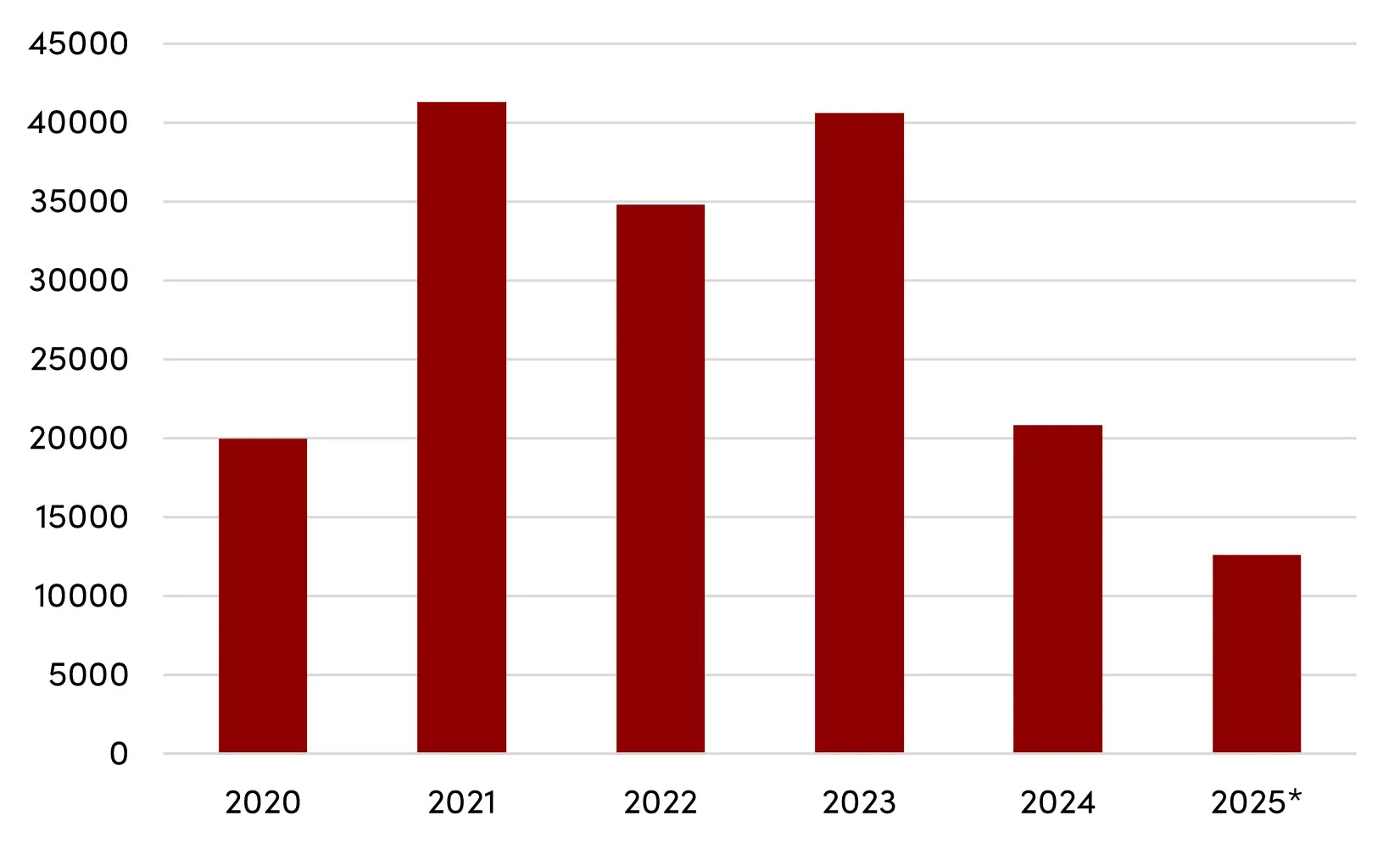
Since launch, after a first period of strong interest by early adopters during which the Taycan sales grew quickly, the performance of full-electric vehicles has not satisfied expectations. After peaking in 2021, sales have stagnated at best through to 2023, and due to low demand and depreciation, they halved in 2024, going back to 2020 levels. In the first 9 months of 2025, Taycan sales fell by another 10% compared to an already poor 2024, but the new full-electric Macan seems to have obtained good results overall with over 36,000 units sold. These not only outpaced the 28,533 ICE ones but resulted in a total of 64,783, increasing by 18% the Macan sold up to Q3 2024.

Porsche's Yearly EV Sales (2021- Q2 2025*)
ev sales porsche

So, going back to Porsche’s recent announcement, while a substantial scale-back on electrification is definitely a key step in this renewed business and product strategy, the objective is not just steering away from it. But first, let’s see the announcement in detail.

Porsche’s key measures

The first line in the press release states the upcoming product line will be supported by ‘brand-defining’ models featuring combustion engines. These will likely include the 911 ahead of any other, and all its derivates.

Additionally, the new SUV line, which will be positioned above the Cayenne as was initially planned as full-electric, will be offered at least in its early phase only with an internal combustion engine (ICE) or as a plug-in hybrid (PHEV).  

The ICE models already present in the lineup will receive a longer life cycle, and in between these and the eventual electrified substitute, more models have been added. Similarly, the new EV-dedicated platform planned to be released in the 2030s will be delayed.
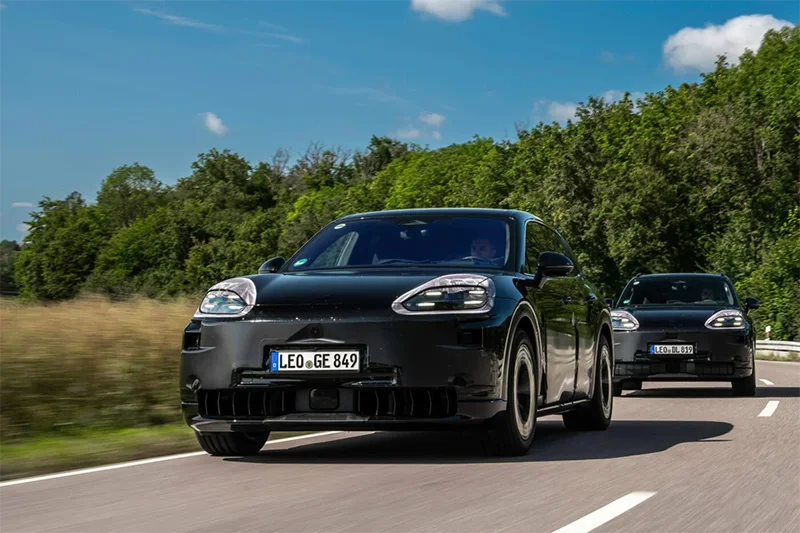
porsche cayenne copy*New Cayenne testing

Finally, the current full-electric models (Taycan, Taycan Cross Turismo, and Macan) will continue to receive updates and remain a consistent component of the product lineup. Additionally, a new all-electric Cayenne and 718, derived from the Mission-R teased a few years ago, will be added to the lineup as well.

According to the statement, while these measures are organised to secure long-term financial success, Porsche expects them to lead to additional depreciation and potential provisions. The financial expectations for the year are of similar revenues, but lower returns than previously forecasted. Lower automotive EBITDA is expected as well.

What does it mean for Porsche’s strategy?

The potential of electric vehicles is not overlooked, but requires a more cooperative effort by the group. After the many difficulties faced by Volkswagen software developer CARIAD, the Group has turned to American Rivian to create a Joint Venture that will grant them expertise to develop SDV platforms, both hardware and software, for the upcoming generation and new software.  

In the words of Porsche’s CEO Oliver Blume, with this strategic shift, the OEM wants “to meet new market realities and changing customer demands”, “These decisions build on the previously announced initiatives and help us to achieve a very balanced portfolio. This increases our flexibility and strengthens our position in a currently highly volatile environment. […] we want to meet the entire range of customer requirements.”

oliver blume*Porsche CEO Oliver Blume

The new strategic arrangement allows Porsche to be ready and more responsive to such an uncertain and fast-changing market. Sports cars, GT, and SUV lines will all offer choices between ICE, PHEV, and BEV powertrains to be able to cater to any potential new request. Through innovation and flexibility, companies can reduce risk by diversifying the product portfolio to maintain business stability. On top of that, effective marketing is the key to communicating to clients this diversity, the relative added value, and competitive advantages, building a stronger brand image. In these market conditions, this strategy builds resilience and ensures relevance by also playing on the brand strengths in the face of inevitable change and an increasingly stronger competition.

In time, this could also translate into a deeper diversification by adopting a geography-based approach that is usually not applied (or in a very limited way) by luxury brands such as Porsche. A 2019 research by the Journal of Risk and Financial Management investigates how this type of diversification can positively impact a company’s financial performance both in terms of return on assets and return on equity. From the research, the varying results obtained with different diversification models are explained through inefficient utilization of resources, especially in terms of innovation for a specific market. Additional risk with this approach is identified for both product diversification and geographic diversification based on the Agency Theory, with managers opting for diversification strategies that fit their personal benefits. These instances naturally negatively affect the financial performance, even though not in the totality of cases.

While it would be extremely capital-intensive for a luxury automaker to develop entirely new products for a single market (even though there could be noteworthy considerations to make for large markets such as China), a higher-level strategy seems feasible. One relatively common solution for the Asian markets in the past has been to introduce exclusively for those regions extended-wheelbase models. As the Chinese EV market continues to grow more rapidly than any other, Porsche caters to a more “traditional” audience used to the added value of its ICEs performance stabilising its business globally. At the same time, it can continue to develop its next-gen electrified generation more effectively and with less pressure to address the Chinese market and other more EV-focused ones that might develop in the coming years.
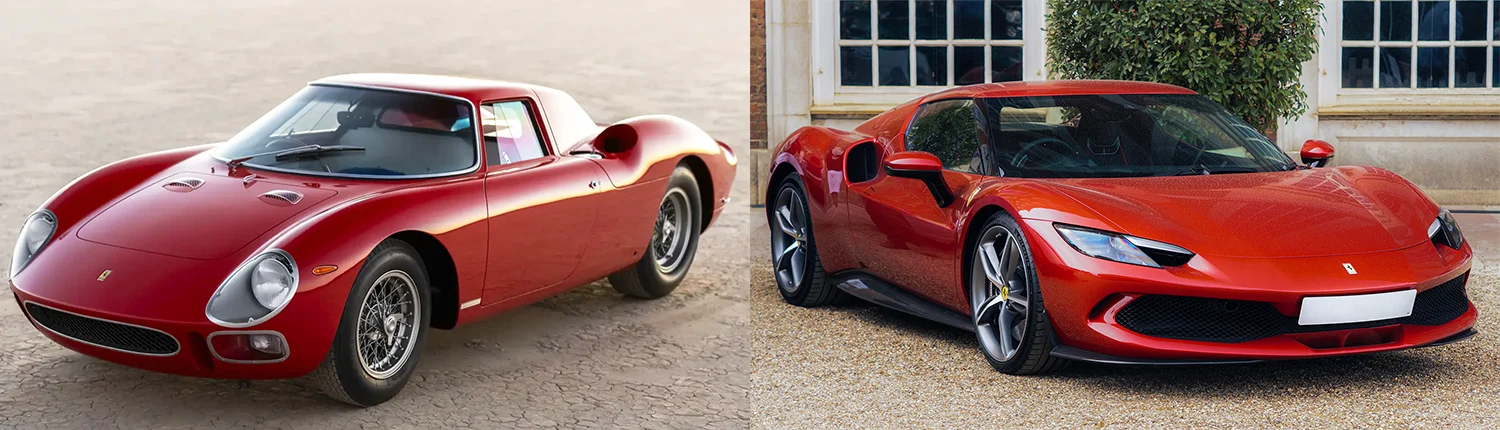
Ferrari reinforces the celebration of its heritage with modern vehicles

  • Brand: Ferrari
  • Topic: Strategy & Marketing

A while back I reviewed a trend consolidating in the luxury automotive industry that saw established automakers drawing from their heritage to create distinctive designs and perpetuate the values that distinguish a brand from the rest of the industry.

The relevance of this strategy, naturally, stands in the fact that only very few automakers have the reputation and history to put it in place. In the previous review, in the article Ferrari introduces Icona Series Daytona SP3: Heritage Cars in Modern Automotive, it was highlighted how most of this activity was carried out only through rare and very limited runs. These models, sold at significantly higher prices than “regular” production ones, were also the perfect candidates for collectors to massively appreciate in the after-sales market (this unfortunately has not happened for all of them).

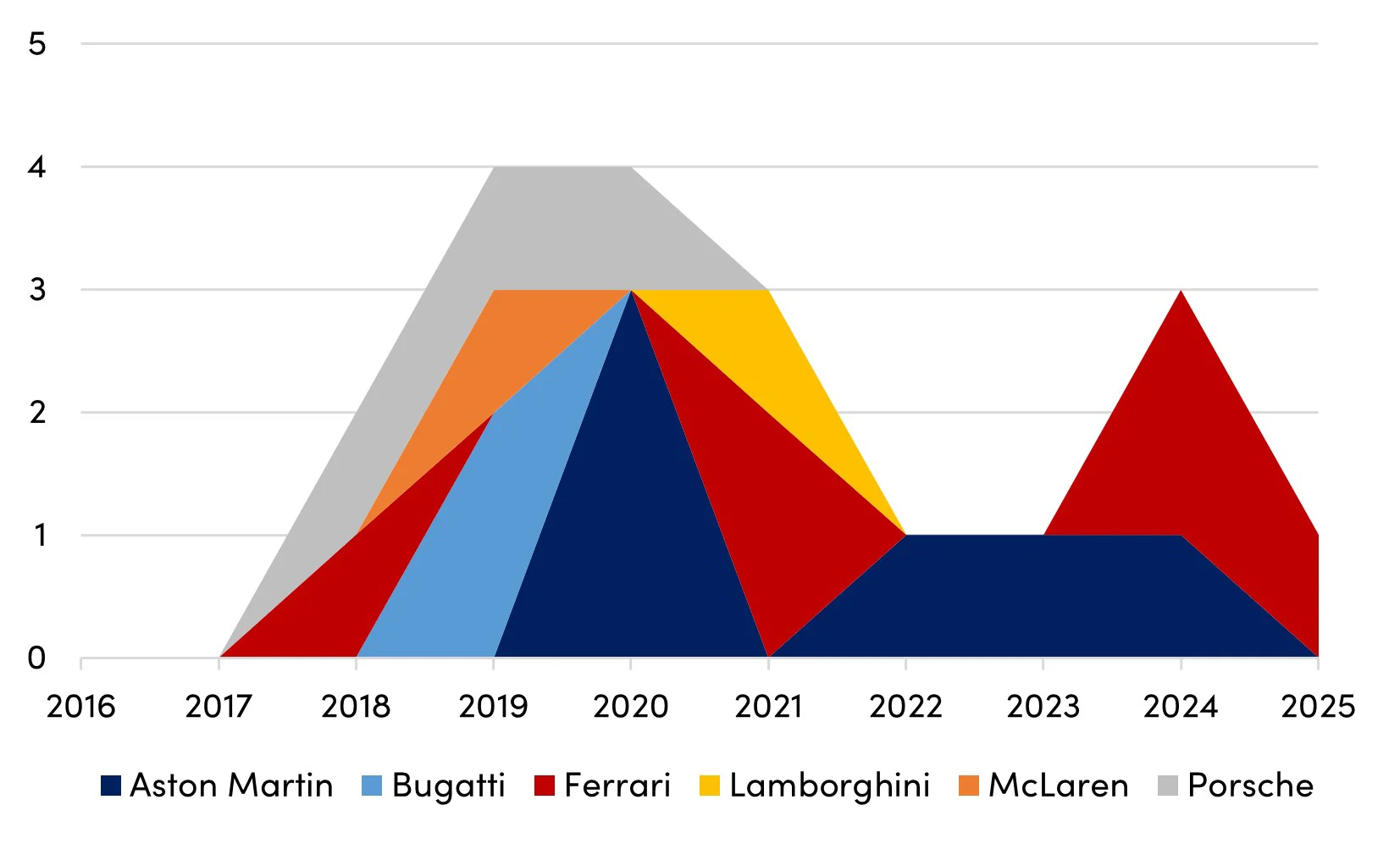
NUMBER OF MODERN HERITAGE CARS RELEASED BY MANUFACTURER (2016-2025)

graph

From the latest graph update it is evident how most of the trend has been limited to low-volume limited editions released between 2018 and 2021. Currently, Aston Martin, and even more Ferrari are strengthening it with their new products while other brands like Lamborghini and Porsche that make innovation and forward-looking vision key messages of their branding do not focus as much on it in their “regular” product line.

What about Ferrari?

Ferrari too started a while back with its Icona series. A unique initiative that created a separate product lineup made exclusively of rare (and very expensive) road-legal models directly inspired by the brand’s most iconic classic cars. Even more noteworthy, in this case, is the ones that inspired the two Icona series entries so far, Monza SP1/SP2 and Daytona SP3, are all racing and not road-legal vehicles.

However, different from its competitors, Ferrari pushed this initiative one step further. All the established automakers in the space strive to maintain their heritage intact to some extent. For example, Lamborghini with the wedge-shaped lines for its cars’ profiles, or Aston Martin with the flowing elegant lines and its iconic grille in the front.

However, in this case it is not just about maintaining single design elements through the product line, but about taking inspiration from single models’ design to give a unique character to a single one. And this is something that Ferrari started doing more and more in its latest generation that has already covered the entire key lineup of the brand with the sole exception of the SUV Purosangue which is a completely new vehicle category.

In the production models, this started with the 296 GTB, that took clear inspiration from the famous 250 LM in its overall profile, but even more in the side vents and rear shape (with some details also from the 1984 Testarossa) as well as the b-pillar cut.

296 250*250 LM and 296 GTB

Then, last year came the 12Cilindri. The car replacing the front-engine 812, celebrates the iconic design of the 60-70s 365 Daytona with modernised but very recognisable lines, especially in the front.

Right after that at the end of the year the LaFerrari successor F80 was released and that too brought some clear design inspiration from some icons of the past. In line with the “latest design language” by the brand it shares elements with the 12Cilindri but in particular, it recalls the most iconic of all, the F40. The last car approved by Enzo Ferrari himself.

Latest of the bunch is the 849 Testarossa, that right from the name recalls one of the most iconic Ferrari heritage pieces. The name was first attributed to a car back in 1956 when the heads of a reworked 4-cylinder engine were painted red, giving rise to what became the 500 TR (for Testa Rossa, literally Red Head). To the second version called 500 TRC soon followed by the 250 Testa Rossa, that featured a version of the V12 on the 250 Gran Turismo with the valve covers painted again in red. It was in 1984 that the name jumped from race cars to road-legal ones with one of the most recognizable Ferrari models ever that took the definition as the name itself turning it into a single word Testarossa (instead of the two separate ones).

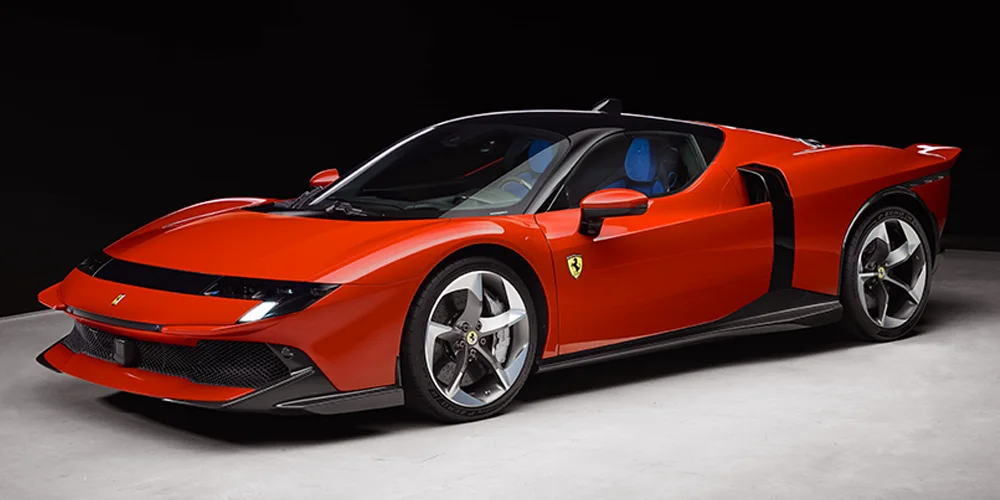
The latest release from the house of Maranello, replacing the SF90 Stradale, draws from Ferrari’s heritage in its design as well, not just in the name. The overall design is more essential and angular, with a black band in the front that ties in with that of the 12Cilindri and F80 and a shape that takes inspiration from the 1980s designs such as 288 GTO or Testarossa. According to Ferrari, the back instead, with the two winglets and less busy surfaces compared with the predecessor SF90, take inspiration from the 1970s prototypes. This is quite evident when looking at racing prototypes such as the 512 S from which it takes also the two front bonnet extensions (already seen in the Daytona SP3 that was explicitly inspired by those same race cars).

849 testarossa*Ferrari 849 Testarossa

The three production models currently on sale, along with the F80, cover the entire Ferrari lineup with cars that effectively take direct inspiration from models of the past.

What are the key advantages in today’s market?

There are several frameworks developed in marketing and business strategy that look into the potential of this kind of activity and product development.

According to Brown, Kozinets, and Sherry the so-called retro branding and retro brands, cater to the modern "inordinate fondness for revivals, reenactments, remakes, reruns, and re-creations". And while this was present in the early 2000s as per their research, in luxury automotive has certainly gained momentum over the past 6-7 years.

Their analysis identifies the 4As of retro branding. Allegory (brand story), Arcadia (idealized brand community), Aura (brand essence), and Antinomy (brand paradox).

Allegory indicates symbolic stories and narratives used to bring resolution to consumers’ ‘moral conflicts’. Arcadia refers to the utopia of a special and better past world and community. Aura evokes a powerful sense of authenticity communicated by the brand through uniqueness of brand values and ‘DNA’. Antinomy is identified as the paradox of technological development seen both as an unstoppable and necessary force, as well as the key factor pushing consumers to look for past simpler, slower, less stressful (and overall better) times.

Ferrari’s Allegory is built in its stories and narratives, right from the beginning with Enzo’s passion for racing, to its numerous successes and how the unique European industry in those days (in this specific case in Italy) developed with a unique attention to hand-crafting, luxury and quality, while the world was moving more and more toward mass production and the democratization of the automobile. The stories come from countless witnesses and even, in more modern days, from cinema and television, where the Ferrari brand always represented something aspirational and the ultimate dream and/or achievement.

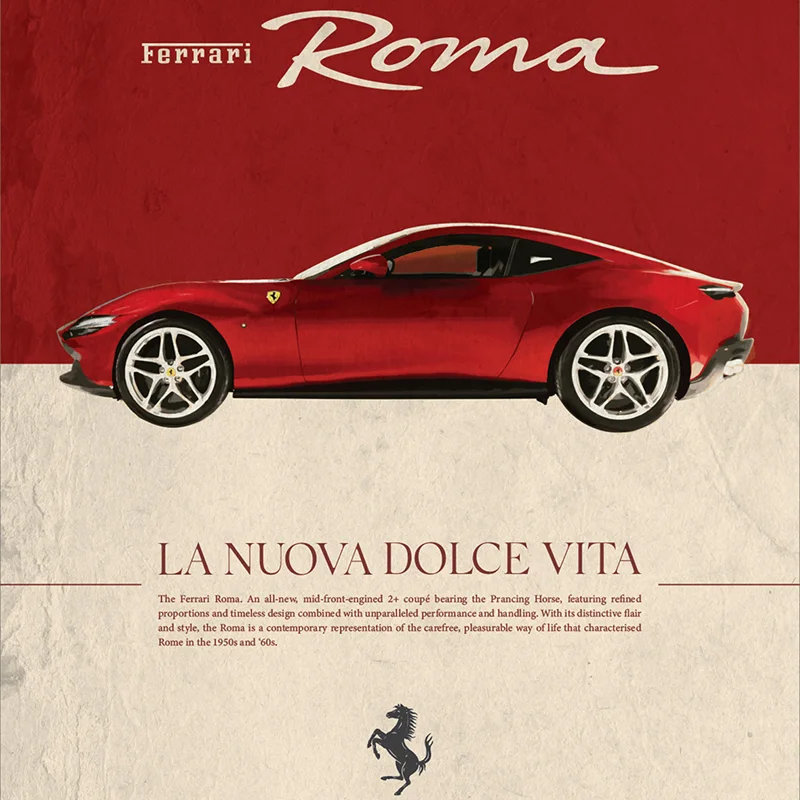
The concept of Arcadia connecting to the past, fits into Ferrari’s strategy in a modern world and automotive industry where electric vehicles and new technologies are increasingly levelling the playing field and lowering the entry barriers for new competitors. The current references to Ferrari’s past, both in naming and styling of new models, bring in today’s brand identity the continued successes and domination of a racing world that is the true essence of the brand, but built on a technology that is changing faster and faster. Even if it was replicated in numbers today, in fact, it would certainly have very different characteristics that could be replicated by modern competitors, differently from the past ones. Furthermore, this past world and its iconography are recalled once more with Ferrari’s Italian identity through naming. The recent entry-level lineup featured in order, Portofino, Roma, and now Amalfi. Places that, like the rest of the country, thanks to tourism have become more than ever the destination of people looking for classical beauty and the famous concept of ‘La Dolce Vita’, used by Ferrari itself in the initial marketing campaign of the Roma but quoted as 'La Nuova Dolce Vita' (The New sweet life).

la nuova dolce vita

As for Aura, with the objective of bringing the brand essence with these new products, while technology evolves, and Ferrari embraced it extensively, both in terms of powertrains and vehicle dynamics as well as interior software and hardware, designs, as mentioned are drawing increasingly from the brand’s past and bringing a retro essence. This kind of strategy can be risky, and has backfired recently for other brands. Consumers might ‘see through’ the initiative and consider it not genuinely adding value, but using ‘cheap nostalgia’ to short-term gains if it stopped at names or design features. This, however, has not been the case for Ferrari that, so far, has always brought significant improvements to each new model it has introduced.

Finally, Antinomy is conceptualised around the idea of the paradox in marketing driven by technological advancement and progress which are unstoppable but also cause people to desire to return to simpler, slower, less stressful times. In Ferrari’s case this paradox is evident in the push toward electrification and product digitisation against the heritage in design and “emotional” connection between driver and vehicle that made the brand what is today. Both are adopted today, in a product line that is embracing hybridisation and digital technology while, as stated before, design is increasingly staying connected to the brand’s roots.

The combination has worked effectively for limited runs in the Icona Series. On the other hand, one of the worst cases of depreciation in Ferrari’s recent history is the SF90 released in 2019, which attempted to innovate in both directions. Several pre-owned models are selling between 40 and 50% less than their original price after option. While this situation is certainly not exclusively due to car design or technical characteristics, Ferrari has corrected its course with the successor. High production numbers, along with a difficult automotive market condition certainly affected the SF90 resale value, but the 849 Testarossa aims at representing more closely the brand, adding more value to its presence in a crowded market even if potentially falling into the paradox of retro branding.

New Online Course Available Now

  • Brand: Aston Martin, Bentley, Bugatti, Ferrari, Lamborghini, Maserati, McLaren, Pagani, Porsche, Rolls-Royce, Mercedes, BMW
  • Topic: Electric Vehicle Market, Finance, Strategy & Marketing, Supercars Future

Following up on the first half of the Luxury Automotive Strategy and Marketing online course published a while back, the second half is now available on Udemy at the link HERE.
As for the previous one, this course too is thought for enthusiasts and university students who want to learn more about the workings of the industry. While it is not necessary to have completed the first half to be able to understand and learn this second one, the two are closely linked and form a complete picture.

So, after learning about the key players in the industry and how their branding and strategies compare to each other, this new section looks at market dynamics highlighting the main trends, some academic analysis of them, and an overall view of the global luxury market numbers. Last but not least, a couple of interesting case studies conclude the course comparing diversification strategies and innovation in luxury automotive.

I hope you'll enjoy it. Don't forget to leave feedback and get in touch to know more.

Cover homepage alt copy 3

Is luxury automotive marketing changing?

  • Brand: Aston Martin, Bentley, Ferrari, Lamborghini, McLaren, Pininfarina, Porsche, Rimac
  • Topic: Strategy & Marketing

Times of uncertainty and overall luxury market slowdown as highlighted in previous articles have brought difficulties to several brands in the segment. However, regardless of current and recent success or struggles, trends in brand, diversification, and marketing strategies have changed significantly.

Driven by various factors for different brands, whether one calls it a more cautious approach or a focused one, after quite a few years of expansion and diversification, most OEMs in the segment seem to be pulling back on both product and marketing strategies.

Diversification

While quite a few brands in the segment had diversified quite aggressively in the past, some of these strategies have gradually changed. One of the best examples of this is Aston Martin. As discussed in a previous article (Not just Luxury Cars: Aston Martin Diversification Strategy), through the 2010s the British automaker started several partnerships and diverse activities that materialized in several limited products and concepts including the likes of bicycles, speedboats, real estate, and even submarines and aircrafts. The latest of these projects is probably the motorcycle AMB 001 developed along with British motorcycle manufacturer Brough Superior and introduced in 2020 for a limited run of 100 units sold for around £100,000.

aston martin amb001*Aston Martin AMB 001

But Aston Martin is not the only one. Some of these activities continue and will most likely continue in the future. The collaboration with video game developers is by now one of the most established strategies in the industry in which every automaker takes part and that has even expanded in the last few years beyond just racing games.

Others however could have been a phase or one-offs to look for new opportunities or business models but seem to have been completely abandoned.

Real estate projects have been relatively popular for a while among luxury automakers, with the likes of Bugatti, Porsche, Pininfarina, and Bentley (as well as the just-mentioned Aston Martin) and more all entering partnerships with high-end developers for residential buildings in selected areas such as Dubai or Miami. These have recently slowed down or almost disappeared.

Similarly, various OEMs have also reduced the release of branded merchandise like Ferrari removing a significant share of everyday objects and accessories, or Bentley not following up on its collaboration with Fanatec for driving simulators steering wheels.

Product trends

On the product side, a key trend that seemed destined to get stronger in the coming years, but that, at least for now, has almost completely stopped is the production of one-offs.

An initiative that in the era of high customisation represented the absolute top of luxury automotive tailoring. Something that Ferrari has been doing for the past 20 years now, and that over the last 8 or 9 has been consistently growing with more OEMs developing similar initiatives year after year. This went on up until 2023, to almost completely stop in 2024.

Yearly One-Off and Few-Off production by Brand (2006-2023)

graph one off

A similar result would be displayed if few-offs were included. 2024 saw only a few releases and only some were very limited (below 100 units) and presented significant updates compared to the “regular models” like the Lamborghini Huracán STJ released in only 10 units to celebrate the end of the model’s lifecycle.

It is still unclear whether this is just a casual slowdown, while the automakers continue developing their own personalisation programs, but the slowdown is certainly noteworthy.

On the product side, 2025  so far has also seen a substantial slowdown in the release of production models, with only 2 major releases by an established automaker consisting of Aston Martin’s convertible versions of its new Vantage and Vanquish models. This is certainly not only due to strategic changes, as over the last 5-6 years, most established brands released entirely new product lines that in this market tend to last between 5-10 years, sometimes without any significant mid-life refresh. That said, uncertainty with electrification in the luxury segment and other factors have certainly played a role too, and overall the release rate over the first 4 months of 2025 represents an average 71% slowdown compared to the previous 6 years.

Reversing Course on Electrification

As just mentioned this is probably one of the biggest factors of instability in the current market. As the electric vehicle market started developing legacy OEMs and luxury brands started working on the development of luxury EVs. But things did not go according to plan.

Porsche was among the first and its Taycan has been one of the fastest depreciating vehicles on the market reaching a -51% in just 4 years, with over 30% over just one.

Similarly, other OEMs that launched electric supercars or hypercars have struggled to sell out even extremely limited runs. It has been the case for the likes of Pininfarina and Rimac too which has been at the forefront of this transition right from the start. However, since the beginning, even Rimac’s CEO Mate Rimac has been quoted saying that customers in this segment simply do not want full-electric vehicles, which will likely force the brand to introduce hybrid powertrains facilitated by its joint venture with Bugatti. Aston Martin too has currently delayed its first EV.

As traditional strategies have not worked as expected, OEMs had to rethink or expand their plans. Ferrari, set to release the first fully-electric vehicle in 2025, is likely to introduce a unique vision for it as discussed in a previous article (New Luxury Automotive: Going Beyond Performance?).

macan*Porsche Macan EV

Porsche while still struggling in selling its GT Taycan, despite the mid-cycle refresh which brought several improvements, seems to have found a solution to successfully build its EV portfolio. In 2025, 25.9% of the vehicles sold were EVs, led by the recently introduced Macan EV SUV. Over the first 3 months of the year, the SUV sales grew by 14% to 23,555 units sold. Of these over 60% (14,185) were full-electric ones, confirming a certain appetite for comfortable and sporty family luxury vehicles rather than exclusively performance ones.

This trend is surely going to reflect on the marketing and product strategies of luxury OEMs preserving their strong identity instead of exclusively focusing on what the future holds for the industry, which in turn could also give them competitive advantages against upcoming competitors.

Refocusing on motorsport

Beyond Formula 1 which has been skyrocketing in popularity over the last few years, endurance is certainly getting more attention and become a key marketing tool for most legacy luxury performance brands.

mclaren lmdh

Following Porsche and Ferrari, most other brands followed in rapid succession. Lamborghini announced its LMDh participation with the SC63, Aston Martin confirmed its entrance in the LMH category in 2025 with a racing version of its Valkyrie. Last but not least McLaren too announced they will be participating in the FIA endurance championship from 2027.

Conclusions

Luxury automakers’ marketing and programs' expansion slowed down over the past 1-2 years following difficulties in the industry for several brands driven by a general slowdown in automotive and in the larger luxury sector, along with changing trends in consumer preferences.

Where for a while it seemed like most companies were more and more frequently trying new strategies, these have ultimately been decreasing with automakers refocusing on core values, legacy products, and (when relevant) motorsport.

One exception however is coming from Ferrari. After the pull-back in diversification and the claim of wanting to become “a luxury brand”, a few days ago Chairman John Elkann announced a new project for a Ferrari sailboat coming soon. While the sailing segment is not exempt from crossovers with the luxury automotive one, this seems like it could be a larger project with a bigger commitment that will be discussed in future articles.

Can Aston Martin become profitable in 2025?

  • Brand: Aston Martin
  • Topic: Finance, Strategy & Marketing

Aston Martin is another luxury automaker that has gone through significant changes in a short time. After the IPO, and the difficult pandemic period sales and financial performance suffered a slowdown that resulted in layoffs and the start of its restructuring.

Ownership Structure and Partnerships

The initial step of this process has been the acquisition of a 16.7% stake in the company by the consortium Yew Tree Overseas Limited led by Lawrence Stroll. In subsequent investments, the consortium has brought the share of ownership up to over 26%. A little later, but across more or less the same period another important player entered the picture. Chinese Automaker Group Geely started with a 7.6% stake acquisition in late 2022. The company is naturally well known in Europe by now thanks to its extensive interests with the ownership of legacy brands such as Volvo and Lotus and the creation of new ones like Polestar, already existing but revamped as an EV manufacturer and completely separated by the former parent company Volvo, Lynk & Co, experimenting with new vehicle ownership alternative models, and Zeekr, another EV-only startup that began operations in 2021 and is set to start its first deliveries in Europe in the second half of 2025.

After the initial investment, Geely extended its ownership of the brand to 17% in 2023 becoming the third largest shareholder.

Another important milestone in 2023 for the British automaker is the partnership formed with American EV-maker Lucid. The contract for over $450 million included the supply of electric powertrain components, such as its proprietary high-performance twin motor, and batteries for upcoming electrified vehicles. Following this agreement, however, once again things have not been easy for Aston Martin which, while issuing two separate profit warnings in 2024 due to delays and sales slowdown in China, has also delayed plans for the introduction of its first EV, initially to 2027 and later to 2030.

A sign of relative instability, and probably one that is not encouraging for potential investors, has been the continued change of leadership in a short time. After almost 6 years at the helm of the company, Andy Palmer, right after the arrival of Mr Stroll, was replaced by former AMG CEO Tobias Moers. The new leadership came less than two years later with former Ferrari CEO Amedeo Felisa, who himself remained for just two more years before being substituted by former Bentley CEO Adrian Hallmark.

While some time to properly recover from the pandemic impact was expected, with renewing infrastructure and product portfolio, 2024 was initially quoted as the year the company would have finally become profitable after several years. This has not happened, due to several factors. But what went wrong? And can Aston Martin turn this trend around?

A new direction for the brand

As it has been discussed a few times already in this blog, under the new leadership Aston Martin has refocused its image, communication, and brand strategy on pure performance rather than a more classic ‘British elegance’ and grand touring vehicles.

This vision is ultimately realised in the new vehicle lineup that has been completely renovated over the past five years.

Aston Martin product

With the 2023 launch of the new DB12 dubbed as “the world’s first super tourer” instead of “just” being a grand tourer, the 12% increase in horsepower and the revised vehicle dynamics Aston Martin brought this vision to life. All the following releases, which over a 2-year period replaced the old lineup, followed suit. The new Vantage’s power has been increased by over 30% over its predecessor, and finally, the new Vanquish which brought back the old formula with the front-engine V12 rather than the mid-engine concept teased in 2019, also delivers important figures with maximum power at 823 hp.

Last but not least, 2025 should finally see the first deliveries of the second mid-engine ever made by the automaker. Born from the collaboration of a few years ago with Red Bull racing, styled by Adrian Newey and Valkyrie’s little sister, the Valhalla.

A second important change that has come with the new lineup is the interior tech update. A common complaint made by modern Aston Martin clients was the outdated tech brought in from 2018 Mercedes models with a previous agreement. Now, all the new vehicles (including the DBX707 which gets the interior update from 2025 on) feature new interiors with greatly improved quality and tech that is up to modern standards but interestingly do not forget the importance of luxury tactile experience. For this reason, Aston Martin did not implement entirely digital control like many competitors have been doing but instead decided to “future-proof” its cars with high-quality physical dials and buttons.

aston interior*Aston Martin DB12 interior

The new image for the brand aims to reflect the renewed endeavours in motorsport, with an F1 Team that enters its 5th season under the new name (previously Racing Point), and the Valkyre making its debut this year in the LMH Endurance division. On the motorsport side, the investments go even further, with a completely new HQ for the racing division and a new wind tunnel for aerodynamics testing which has just become operational.

Aston Martin and the Luxury Automotive Industry in 2024-25

While the new approach taken by the management and the steps made so far have been generally praised by enthusiasts communities and media, the results are, unfortunately, far from positive.

Aston Martin Sales (left) and Revenues & Operating Loss (right) (2020-2024)

charts

In 2024, sales have decreased by 9% compared to the previous year and financial losses have remained mostly similar to 2023. Aston Martin reports difficulties with the supply chain in China as a major factor in this slowdown, and the main reason why it had revised its sales target for the year earlier in 2024 lowering it compared to previous estimates. However, it also highlights an 8% increase in volumes in the last quarter of 2024.

So, are there any positives to draw from these uncertain results?

On closer inspection, one positive, reflecting the continuously increased average selling price that reached £245,000 (€291,000) in 2024, is that despite the 3% drop in revenues, while sales volume went to lower levels than 2021 revenues compared to that same year are 45% higher. This at least signals a healthier sales strategy for a luxury brand.

Also, for the first time in quite a few years, the brand seems finally fully positioned on all fronts to deliver good results with marketing, product line, and infrastructure all aligned with the competition and delivering a unique brand character.

Last but not least, it must be remembered that the global market uncertainty has surely negatively affected Aston Martin’s results as several other brands.

In 2024, for the first time in several years, the global luxury market had a contraction, albeit a small one (1-3%). Automotive remains by far the largest industry in the segment with an overall value of €579 billion despite a 5% volume decline. The impact of negative sales is partially offset by the ongoing trend of increased focus on personalisation and exclusivity which Aston Martin has partially captured with improvements in its customer service and range of options of its Q Division (but that is still led by Ferrari with a total 2024 sales of 13,752 units, just +0.7% over 2023 still resulting in a +11.8% in revenues over the same period).

Where to go from here?

The current markets are harder than ever to ‘read’ or try to assess, with multiple geopolitical factors affecting international relations and various dynamics developing in unpredictable ways. So, assuming potential stability of the current situation, Aston Martin seems in the best position in many years (maybe ever) to deliver some good results in 2025. The competition, however, embodied especially by Ferrari, and partially by Lamborghini, is stronger than ever as well. While other British brands like Bentley and McLaren are also not going through an easy time.

aston martin atelier

Key to the long-term success of this project will be to limit depreciation that has already hit hard older DBX models (with older models losing around 50% of the value already over 5 years probably also due to the following release of the more powerful version), and is affecting the resale value of more recent DBX707 and even DB12 models. Naturally, this is not an issue hitting Aston Martin alone. But managing to do that would make new models more desirable. Similarly, the success of the Valhalla which has so far received a very positive reception will also ensure a good overall boost to financial results, as other special runs have done over the past two years, partially offsetting the other difficulties the automaker has gone through.

Last but not least, a continued improvement of customer service, personalization offering, and dealership network should remain a priority as it is one of the main factors affecting luxury buyers’ purchase decisions. As the restructuring has taken place and reshaped the company, 2025 could be the year financial results catch up.

Maserati: What went wrong?

  • Brand: Maserati
  • Topic: Strategy & Marketing

2024 has been a difficult year for Stellantis’ top-tier luxury brand despite undergoing a deep image renewal with a new product line to match.

A while back I wrote about Maserati’s renovated marketing communication on the eve of the release of the MC20 and the start of its electrification journey. The MC20 was an extremely important vehicle for the brand as it not only recalled one of its most iconic modern models the MC12, but it also marked its return to the research of that somewhat lost exclusivity.

As for electrification, the first step into this new world was the introduction of a mild-hybrid version of the Ghibli that by that time was already 8 years old, even with minor upgrades throughout the years.

Maserati in Numbers

The previous look at Maserati showed how sales kept decreasing sharply after the 2017 peak driven by the introduction of the successful SUV Levante. The period for the brand was unfortunately marked by mismanagement with a strategy too focused on volumes rather than exclusivity, quality issues, and an ageing lineup with technology that could not keep up with the direct competition of German brands.

A decisive change of direction was necessary then, and it came in 2020. To the initial steps just mentioned and detailed in the article here ‘Maserati strategy: back to the origins to look at the future’ followed the release of convincing and competitive all-new models. The Grecale SUV, the GranTurismo and GranCabrio GT (Coupé and Convertible), with each model coming in two trim levels, Modena and the sporty Trofeo, but all three have also been followed by the first full-electric versions called Folgore. Finally, the convertible MC20 Cielo was also added to the new lineup.

These models brought, as expected, elegant Italian styling with attention to detail, and most of all, updated technology with the new Maserati Intelligent Assistant (MIA) based on Android Automotive as is Stellantis’ Uconnect.

Expectations were high for the new update lineup that should have brought Maserati back in competition against the German brands leading the premium and luxury segments. However, after a recovery (+42%) from the slump of 2019, worsened in 2020 by the pandemic, sales have remained mostly stable with a promising +14% in 2023, but things got worse in the past year.

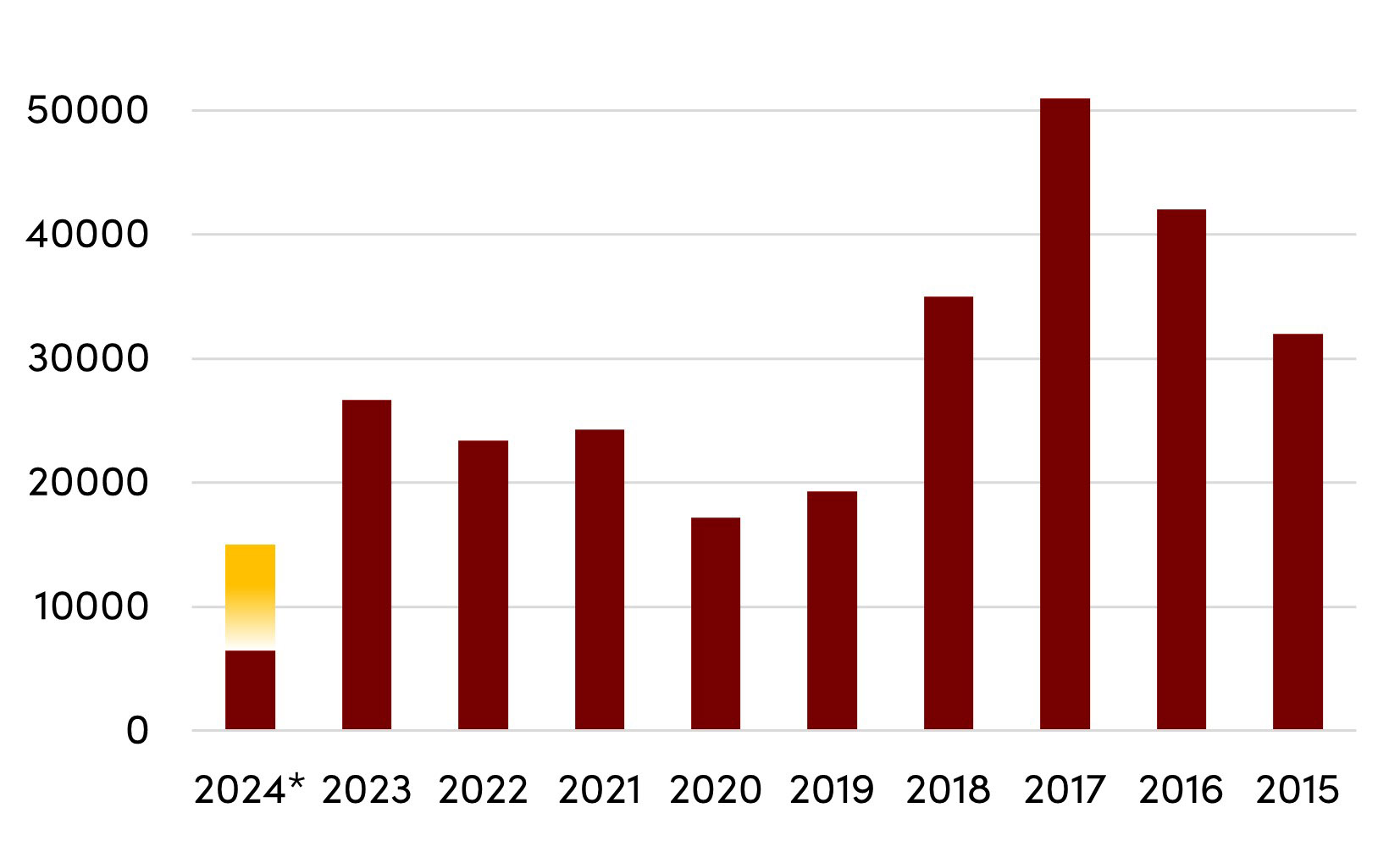
Maserati Yearly Sales (2015-2024)

sales graph*2024 data is a projections for H2 based on H1 sales report

Deliveries in the first half of 2024 reached just 6,500 units equalling a -57% compared to the same period in 2023, and the trend is expected to have continued through the year bringing the overall sales to a total of around 15,000 units for the full year.

Maserati Communications and Media

The report from Stellantis quotes as key reasons for this slowdown the discontinuation of three V8-based models whose production was stopped in rapid succession between 2023 and 2024. The Levante, Ghibli, and Quattroporte. The first two were followed by end-of-production limited editions called Ultima, programmed for 103 units each and featuring reviewed components and performance, with a significantly higher price to match (around £160,000 for both in the UK or $190,000 in the US).

What is even more worrying though, is that the second reason quoted in the report is the low sales of the new SUV Grecale. Considering a global automotive market where the different sources quote the percentage of SUVs sold in developed areas between 49 and 54% of the total, and a world in which Porsche’s best-seller over the past 20+ years has always been an SUV by far, the new mid-size Grecale should have been Maserati’s heavy seller and make up for the loss of the other models if not more.

grecale trofeo

Following the news of this drastic slowdown in the first 6 months of the year, the now-former CEO Carlos Tavares in an interview stated:

“With Maserati, we have the right cars and we have the right technologies. We can offer thermal or 100% electric luxury sports cars. If sales are sluggish right now, it is a matter of marketing. We have also improved a lot on the quality front, but now we need to work on marketing. We lack prospects and leads, we need to reach potential customers and deliver the right message for the right positioning.”

This explanation however left many industry observers confused, to say the least.

What went wrong?

First of all, the difficulties for Maserati have been exacerbated by continuous production stops and reductions in the different production plants that began in early 2024 and peaked at a -75% production rate in Turin-based Mirafiori factory later the same year. The low demand that is impacting the brand production plans, especially for the full-electric models (and not just the ones under the Maserati brand for Stellantis) is the same that a while before forced the closure of the Grugliasco factory.

Along with the Mirafiori situation, the other two plants in Modena and Cassino, producing MC20 and Grecale respectively would have seen a production decrease of 79 and 58% (Italpassion.fr). The overall reduction would be around 64% with production that has dropped below 10,000 units from the almost 30,000 of the previous year.

At launch, most of the media and experts expressed positive opinions of the new Maserati models, MC20, Grecale, GranTurismo, and GranCabrio.

The quality improvements in construction and materials as mentioned by former CEO Tavares have definitely been noticed and appreciated, as are the new updated technology, and above all the performance and dynamics able to rival with Maserati’s most fierce competitors if not surpass them.

So where does the real problem lie? Well, two factors that likely held back sales are pricing first, and secondly, but probably even more important in this segment, depreciation coming as a consequence.

The problem with high prices has been quoted by most media outlets or expert testers when comparing new Maserati models with their direct competitors.

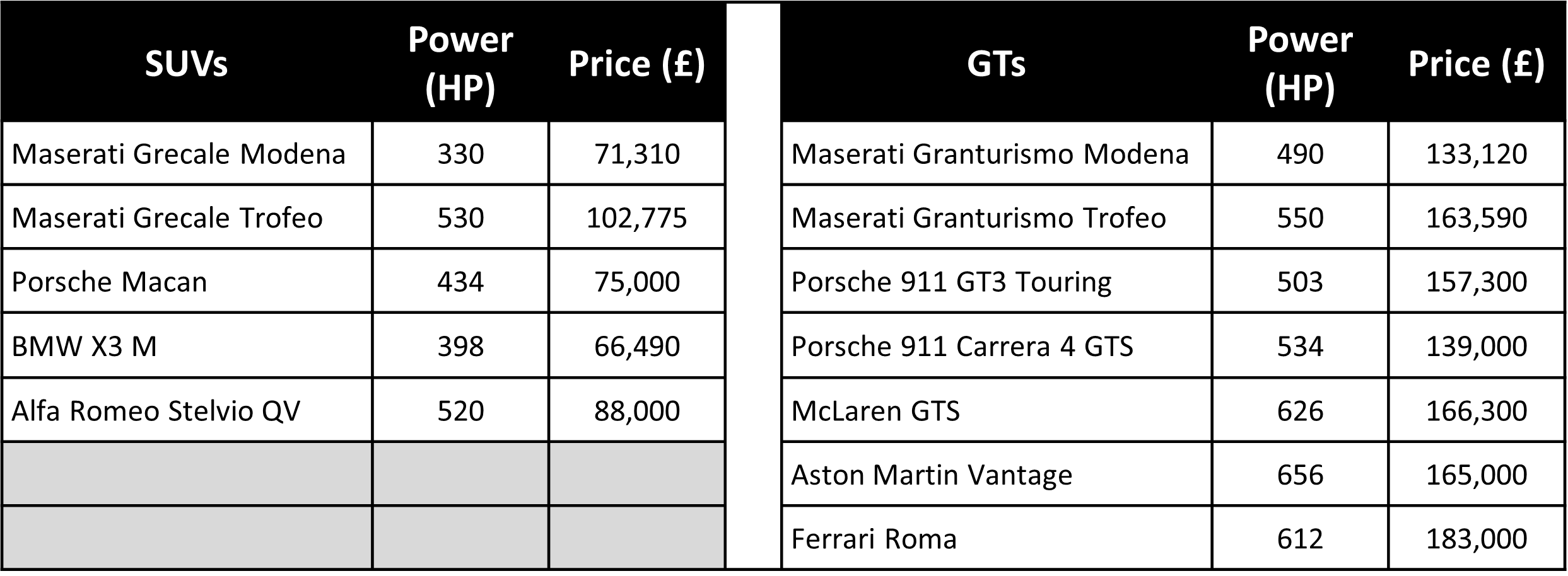
Below are some examples of the Grecale and Granturismo Modena and Trofeo trim levels against competitors in the market right now with prices (for the UK) and power figures. While not exhaustive as a comparison, as there are many more factors involved in a luxury vehicle’s valuation, the table along with the following considerations can be helpful to draw a picture of Maserati’s current positioning.

Maserati Grecale SUV and Granturismo (Modena and Trofe trims) competition by Price (£) and Power (HP)

table

On the SUV side, the top-trim Trofeo leads in terms of power but at a significantly higher cost than its competitors. It must be also considered that in line with the rest of the automotive luxury industry, Maserati too offers a long list of options and additional packages that can easily drive the price of these cars up by £30,000-50,000 bringing the Grecale Trofeo potentially to over £150,000.

Similarly, on the GT side, the Granturismo Trofeo ties in price the absolute top of the luxury performance market with Porsche’s offering being even lower, McLaren and Aston Martin on the same level but offering significantly more power, and even entry-level Ferrari is not that far ahead.

What must be taken into account here is the also the brand value. As proven multiple times, and even reported in various previous articles, the brand is the most important characteristic considered by buyers when approaching a luxury automaker. And as of now, considered the history, and status all these luxury competitors bring significantly higher brand equity, which in turn translates into lower depreciation and leads straight onto the next and most important point.

As reviewed with various examples in Luxury Automotive Resale Value and Depreciation: How and Why, depreciation is one of the most important factors in the luxury automotive segment and one that when achieved can constitute a significant driver for increased sales. While none of the listed brands is immune to it, especially in these times of uncertainty, unfortunately for Maserati, an evident example of severe depreciation that might drive customers away is its top-of-the-line MC20.

mc20

Starting at around £220,000, which once options are added can easily go close to £300,000, the mid-engine supercar from Maserati goes straight into competition with the best of the previously mentioned McLaren, Aston Martin, Ferrari or even Lamborghini brands. However, a quick look at the pre-owned market shows that models with extremely low mileage from 2-3 years ago sell between £140,000 and £149,000, which assuming a (conservative) £250,000 price at sale after options, would mean a 40-44% depreciation in such a short amount of time.

Similar depreciation rates are observable for the Grecale SUV as well, and slightly better for the Granturismo (between 25% and 35%) even though it must be remembered that the latter is newer so currently pre-owned samples on sale are all from 2024.

The solution to this situation is anything but easy. On the one hand, readjusting the models' positioning could devalue the brand or the perceived luxury that Maserati is trying to restore and has partially regained with this new generation. On the other hand, adopting a similar strategy to that used in the 2010s, with discount deals on leases and other solutions of the same sort has already proven unsuccessful and in the worst cases even damaging to the brand reputation. One potential, yet risky solution, taking into account the already severe production delays, and factories' closures, could be to gradually adopt the ‘luxury business model’ and artificially limit sales like Ferrari has always successfully done and others are trying to which could, in time, positively affect the depreciation factor.

New Luxury Automotive: Going Beyond Performance?

  • Brand: Aston Martin, Ferrari, Pagani, Rimac
  • Topic: Electric Vehicle Market, Strategy & Marketing

The current luxury automotive landscape is shaped by a specific trend that has influenced various players and could increasingly define new products in the near future. In a way, it might even seem like the industry is going backwards. But the truth is that recently something has fundamentally changed in how the value proposition of luxury cars is conceived. And electric cars might be a big part of this.

In the early days of the automotive industry, cars were rare objects for the rich and the daring who wanted to experiment first-hand with this new technology. Cars were not thought for the mass market and were entirely built by hand and highly personalised, at least until the advent of the Ford Model T in the early days of the past century. In Europe in particular the trend of hand-crafted cars and coachbuilders who would specify a body according to the client’s specifications continued for a while. Along with the aesthetics, one of the defining characteristics of cars at the time was performance, and racing was a powerful marketing tool for it.

This is true today as well, but there is more going on. I have already touched previously on how customization is gaining more importance today, and how it has become a significant share of companies earnings (to know more check Tailor-made: What luxury car customers can't go without and One-off Supercars: What’s the next step for luxury automotive? ). In its Q2 2024 report, Ferrari quotes a +16.2% in revenues, and as it happened several times already, among the contributing factors is consistently mentioned increased popularity of personalisation programs, which also allows for the significant margins made on every single vehicle sold. But in the modern industry of supercars and hypercars it is becoming more and more common to see taglines about “the fun of driving” or “driving involvement" rather than the continued comparison of 0-100 km/h (or 0-62 mph) times and top speeds that has been the benchmark of most new performance cars’ headlines for many years.

The trend has been developing for a few years now. Ferrari is a prime and most successful example of this and it is visible in the comparison between revenues and sales figures over the last few years. Right after the pandemic and the quick 2021 recovery, revenue growth remained consistent at almost 20% while sales growth has been gradually limited toward the 15,000 units mark dropping significantly to around 3% in 2023 highlighting the increasing margins made on each model thanks to increasing personalisation demand. 

Ferrari's Sales and Revenues Growth Percentage by Year (2020-2023)

ferrari growth

Enjoyment over performance

With the advent of electric performance cars, obliterating normal combustion engine cars in acceleration performance, some initially thought this new technology benchmark would be the driver for the future of the industry. But, at least for now, things are going in a different way.

Despite environmental regulations limiting emissions and engines’ size, which have been the main factors in the growing adoption of turbochargers and superchargers for automakers to keep boosting performance, we are seeing more “going back” to naturally aspirated large high-revving engines. This is naturally, in part, allowed by the fact that environmental restrictions are different for low-volume manufacturers, but hybridisation is one key enabler for this. Supporting electric power allows OEMs to maintain engines that become the centrepiece of a vehicle by offering more involving and immediate response when driving, along with the soundtrack that all collectors love.

The same goes for manual gearboxes. While dual-clutch transmissions and other more daring alternatives (from the likes of Koenigsegg) have reached high levels of refinement with smooth and lightning-quick gear changes, once again OEMs are finding a key selling point in the involvement and driving enjoyment that a manual stick shift offers. While more classics-inspired low-volume automakers like GMA had that single formula right from the start, others are going back to it. Aston Martin recently produced a few limited editions with manual gearboxes. The same goes for Pagani, which not only reintroduced it in its latest Utopia but also made it available for unique iterations of the Huayra. The Italian automaker also claimed that so far over 70% of the very limited Utopia production run has been ordered with a manual gearbox.

manual gearbox*Aston Martin Valour and Pagani Utopia reintroducing manual gearbox

All these trends suggest that as technology has improved and made a leap forward, unlike in the old days, some OEMs have understood that performance numbers can only go so far, and what counted the most at the end of the day for a car owner was the enjoyment and driving involvement, rather than 0.1 seconds less to reach 100 km/h.

Luxury OEMs changing plans

One of the most controversial pieces of news around the topic came a few months ago from an interview with Mate Rimac. The founder and CEO of Rimac Automobili has, in just over 10 years, become the one symbol worldwide for performance automotive electrification as discussed in previous articles on Rimac’s growth and marketing. Its Nevera has become the fastest-accelerating road-legal car in the world to the point where most other top-of-the-line high-performance supercars would seem slow in comparison and has also broken many records. After all this, however, a few months ago, Rimac has been quoted as saying that the future of electric hypercars is uncertain because clients simply do not want them. The reasons for this would apparently, be a refusal to accept a product that is seen as “imposed by politics” with environmental regulations pushing greener vehicles, and a lack of emotional connection with such cars. As mentioned earlier, clients today want more and more something that is unique. Electric vehicles are becoming mainstream, and at the same time instead loud cars with big engines that were already rare are becoming even more so. These would be the key reasons driving clients away from EV supercars and toward a more familiar experience of performance and sound involvement, even if this means inferior performance.

In this context, two companies are taking different but equally interesting action on the matter. On one side, Aston Martin recently announced that they delayed their upcoming EV by at least 1 year (from 2025 to 2026) due to low demand. They instead stuck with big V12 engines and a limited application of hybrid powertrains on the likes of Valkyrie and the upcoming Valhalla.

On the other, Ferrari is trying to “make the EV emotional”, by doing it differently from anyone else. A patent filed by Ferrari a while back shows a unique project for the potential development of an upcoming electric prancing horse.

 Ferrari's EV patent

ferrari new patents

The plans show how the new EV would feature an e-drive axle and a sound-transmission devise that uses air pressure and vibrations to send sound to the cabin via an acoustic conduit. No electronics or speakers were used to produce sound, making it not just an imitation like some proposed at times, but a proper sound, just likely different. Ferrari would also add resonators on the axles that should amplify the sound coming from the e-motors. Specific valves enabled by an ECU would allow the sound profile and volume to change and adjust in the same way as an active exhaust system opens and closes valves to increase the volume. According to Ferrari, the solution is not devised exclusively for added drama, but also to give drivers a better awareness of what the car is doing at any given time.

Conclusions

The industry seems to have come full-circle since its early days. On the marketing side, personalisation is an increasingly important requirement for clients and OEMs are getting an equally growing share of revenues from customisation programs along with unique limited runs of special editions, or unique models. And like in the early days of the industry, these cars have to be unique to represent the owner's status and identity.

On the other hand, though the technical driving force has changed. Technology for the sake of evolution and performance is being “refused”, with demand steering manufacturers toward larger combustion engines, manual gearboxes, and tactile analogue controls that one might have thought would start disappearing in favour of electric motors, automatic gearboxes (or none at all), and 100% of control integrated into digital infotainment systems. Performance is not as defining as it used to be, while experience both in the car and outside is so more than ever.

Automotive Luxury Market in 2022: The Growth Continues

  • Brand: Aston Martin, Bentley, Ferrari, Lamborghini, McLaren, Porsche, Rolls-Royce
  • Topic: Strategy & Marketing, Supercars Future

The luxury automotive sector showed significant resilience over 2020 as the Covid pandemic broke out. While the wider sector has been faltering in its recovery, the luxury segment kept growing in the following year and in 2022 as well. Along with the general growth though there are other interesting dynamics that can be observed.

Larger volumes

The top-end of the segment, driven by a few extremely successful brands, has registered yet another growth year, increasing over 2021 by about 9%, and a further 3% the next one as displayed in the graph below. The larger automotive sector instead despite a sizeable improvement in 2021, almost stagnated in 2022, with the main cause for delays and bottlenecks still being the shortage of semiconductors.

Luxury Automotive Market Sales Volumes (2018-2022)

volume

The main contributor to this success over the past two years has been the continued growth of brands like Bentley, exceeding 15,000 yearly sales for the first time in its history, Ferrari (13,221), Lamborghini (9,233), and Rolls-Royce (6,021) all posting record results. Other OEMs such as Aston Martin, Porsche, and Maserati (still on the path of recovery) instead have been consistent while probably not exceeding expectations. Finally, more niche brands still going strong like Pagani, Rimac, Koenigsegg, and the likes also contributed albeit with very low numbers. Of the public companies in the segment only McLaren, which has not published its full-year figures (and is accounted for here with an estimate), will likely report a drop in sales since it stood at -13% in Q3 YOY.

Reflecting the general health of the segment is the market size evaluated at €566 billion.

Luxury Automotive Market Value (2018-2022)

value market

Evolving market trends: prices and personalisation

The most interesting data that emerges from these reports though is that while the value of the market has not only recovered but exceeded the record of 2019, sales numbers haven’t.

This is reflected by the growth numbers of various companies in the segment. While for all these the sales numbers have increased, both revenues and operating profits reached much higher growth suggesting an overall improvement in efficiency, and most of all a trend already seen over quite a few years: the general increase of luxury vehicle prices.

2022 Luxury OEMs with the largest revenue and operating profit growths

table growth

This increase in average selling price (ASP) takes different forms.

In 2022, Aston Martin boasts a 26% increase in ASP exceeding the £200,000 mark. This has been mainly thanks to the destocking efforts over the past few years.

In other instances, the base price of production models has comparatively increased, either because of new technologies or because they represent new additions to a lineup, as is the case for Ferrari’s SF90 Stradale and Purosangue. The first is priced at £379,000, while the latter specifically substituting the GTC4 Lusso, introduced in 2016 and sold at a price of around £243,000, is offered now at a starting price of £313,000. This trend is observable in pretty much every other luxury car manufacturer, with even more extreme examples in super low-volume ones such as Pagani.

Last but not least, the other important trend that is common to all these companies and represents an important and increasing source of revenue is personalisation. Every luxury OEM over the last 10-15 years has introduced and gradually expanded its bespoke program. Over the last two years, most OEMs quote bespoke and coachbuilding programs as major contributors to the sudden increase in revenues and profits.

The luxury market keeps evolving and, as mentioned previously in the article Tailor-made: What luxury car customers can't go without, the product itself is not sufficient anymore. With general wealth increasing in most developed markets, and a higher number of HNWIs, expectations have become higher too. Clients are looking for more than a high-end car, they want something that is also unique and distinguishable. So, virtually limitless selections of colours, materials, interior, and exterior specifications have been added by every automaker.

The other method used by automakers to cater to this demanding audience is the release of limited-edition models. Often derived in most parts from production cars, limited runs usually feature a few unique additions that can, at times, be only cosmetic. These rare models are more desirable as they also suffer much less from depreciation. The peak of this trend is represented by one-offs which have also been constantly increasing over the past 10+ years as shown in One-off Supercars: What’s the next step for luxury automotive?

dbs 770 ultimate volante*Latest example of limited-run by Aston Martin DBS 770 Ultimate Volante

Additionally, each OEM used different methods to realise efficiencies in production and resource management. Bentley’s ‘Dream Factory’ realised with a £2.5 billion investment significantly reduced water consumption, improved waste management, and overall carbon footprint. Others such as Aston Martin optimised product development processes that allowed them to maximise cross-carline component sharing. In turn this reduced processes and engineering complexity.

Unfortunately, for some OEMs, this also corresponded to significant layoffs over the last two years, which surely contributed to the reported results.

Further Brand diversification

Other important factors contributing to the growth of luxury automotive brands apart from the delivery of new cars, and the ones quoted above, are the pre-owned market and events.

As discussed previously (Luxury Automotive Resale Value and Depreciation: How and Why) the pre-owned market is extremely important for luxury automakers, and not only because low depreciation makes cars more attractive for potential buyers, but also because most new clients when approaching their first purchase chose a used vehicle.

What often happens next is that these clients end up owning more than a single car, in fact over 50% of a large sample of owners claim to possess more than one luxury vehicle. This choice is often strictly tied to branding and brand value, so clients effectively become part of a restricted elite where they also get involved in a plethora of activities that offer OEMs more opportunities to create additional revenue streams.

Bentley's latest announcement on this field is particularly interesting. With its latest program called “Extraordinary Journeys”, the brand offers highly curated road trips in selected locations revolving around the best driving experiences possible while moving through high-end hotels, fine dining, and other interesting cultural activities. While this is something that many brands organise for their clients, what is unique in Bentley’s case is that for the first time, they are opening these programs to non-clients, giving them the opportunity to drive a range of different models during the trip. This is not only a great additional revenue source, but also a smart way to attract new potential buyers and create brand advocates thanks to a proper 360° experience that goes beyond just the product.

Coming Years

Over the coming years, the luxury market has new important opportunities coming from the transition to electrification and with new technologies. SaaS (Software as a Service) creates even more options for personalization throughout the entire customer journey. From early stages to after-sales, OEMs can offer additional services and make their ownership experience even more unique.

rr spectre*Rolls-Royce Spectre is the first offering a customisable digital cluster according to clients' preference

The segment has been more resilient despite the difficulties the wider sector went through over the past 3 years, and so far signs seem to indicate the positive momentum might continue.

Aston Martin Sustainability Strategy: Going Racing Green

  • Brand: Aston Martin
  • Topic: Strategy & Marketing

On the occasion of Earth Day, Aston Martin unveiled its new sustainability strategy called Racing.Green. which sets a new benchmark for the company’s next decade.

Over the past few years, Aston Martin too, following the industry trend dictated by increasingly strict environmental regulations, has started implementing various sustainability measures. These measures of course, in the current market, can also become important marketing and communication tools as well.

Racing Green strategy

Aston Martin developing strategy

In 2019, Aston Martin already confirmed the use of 100% renewable energy across all its production plants in the UK. Then, since the start of the pandemic, it has also managed a 44% emissions reduction in the UK.

These of course are steps that are not exclusive to the British automaker but are being implemented by the majority of industry OEMs, especially in terms of industrial plants' energy efficiency and water waste reduction.

The Racing.Green. strategy complements the Project Horizon started under Tobias Moers management. An overarching business plan that covers every area of the business with the aim of making it more efficient, sustainable, and competitive.

Despite the significant evolution of the business, however, Aston Martin went through another difficult quarter in 2021. As highlighted in last week’s analysis the automotive industry was off to a difficult start in this first quarter, but it was not necessarily the case for the luxury segment which has seen some great performers.

The automaker had a slightly improved financial performance driven mostly by a higher average selling price and the first deliveries of the hybrid hypercar Valkyrie, which also led to a 36% increase in gross margin. However, operating loss was higher, as was net debt compared to the end of 2021, and sales were significantly lower than those of Q1 2021. According to Aston Martin, this was mostly due to preparations for the DBX707 production start, and consistent obstacles in the supply chain.

dbx 707*Aston Martin DBX 707, Source: Aston Martin media

The outlook of the company seems positive from a strategic point of view as order and retail sales remained solid and outpaced wholesales. This indeed indicates a successful (so far) transition process to a different sales model. This shift along with the delivery of special models Valkyrie, and V12 Vantage could markedly change the face of the company throughout 2022.

New Management

Naturally, as already reported, the major news for the British OEM over the past few weeks has been the major change in management.

While the brand itself did not release many comments through its official channels, a piece by the FT reports official comments by Stroll as well as insights from industry insiders.

Allegedly, a drop in staff morale and the resignation of several senior figures due to a “robust management style” led to Moers replacing. So, while the ex AMG was instrumental in the company’s turnaround through 2021, to go forward Stroll wanted “greater collaboration and a more cohesive way of working” as well as someone who “understood and experienced luxury and higher price products”. Hence the choice of ex-Ferrari CEO Amedeo Felisa.

Naturally, this is not the only change in a primary role. Following Felisa is Roberto Fedeli, Technical Director at Ferrari during the same period. New CFO Doug Lafferty and Chief People Officer Simon Smith have been appointed too. Also the commercial team in China, and design, engineering, quality, and sustainability teams have been strengthened.

Racing.Green.

The new sustainability strategy defining Aston Martin’s path over the next decade and well into the next one defines several steps that align the company with UN Sustainable Development Goals.

aston martin net zero

  1. A major project will see Aston Martin install more than 14,000 solar panels at its St Athan site in Wales, capable of delivering 20% of the plant’s annual energy demands.

  2. Becoming a member of the Science-Based Targets Initiative (SBTi), a partnership between CDP Worldwide, the United Nations Global Compact, World Resources Institute, and the WWF. This drives businesses' climate action to achieve science-based emission reduction targets.

  3. Reaching Net-Zero emission from its industrial plants by 2030 as well as a 30% emission reduction by the same year throughout its supply chain. 2039 instead should see the Net-Zero target achieved across the entire business.

  4. Elimination of all plastic waste within three years.

  5. Further 15% reduction in water consumption.

  6. Innovation and integration with new sustainable materials to expand the offering with options such as green aluminium alloy (entirely manufactured with renewable energy), and vegan leather-like interior materials.

  7. A continued push toward electrification, with Valhalla entering production in early 2024, and the first full-electric model coming in 2025. Also, by 2026 every new vehicle will have an electrified option so as to reach a fully electrified (BEV and PHEV) range by 2030.
    valhalla*Aston Martin Valhalla, source: Aston Martin media

  8. Sustainability is not intended just from an environmental perspective, but also from a social one. A program aimed at improving diversity and equality throughout the company is targeting 25% of all leadership roles to be assigned to women over the next five years.

The new Racing.Green. strategy is crucial for Aston Martin to enter the next era of automotive. Other companies, and especially a close competitor such as Bentley have already advanced sustainability-related business, communication, and marketing strategies. The most important step will be the steady transition to electrification, starting with the introduction of the new generation of mid-engine supercars and the brand’s hybridisation.

The rest of the year will be an important indication of the company’s resilience. In this respect, the new management will also be important. While a second change in just two years might be risky, a seasoned professional who successfully led the most successful brands in the sector. For now, while full of potential, the future of Aston Martin remains uncertain.

McLaren’s Strategy Into 2022: A 5 Forces Analysis

  • Brand: McLaren
  • Topic: Strategy & Marketing

With a continuous series of ‘black swans’ adding up on top of the already complex transition happening, the automotive industry is going through extremely uncertain times. Every company was affected to varying degrees, but in the luxury segment the impact looked minor compared to lower ones and the recovery has been definitely faster as analysed in the comparison published previously.

However, while the majority of big names in the luxury segment have had a steady recovery and are posting record results already, some went through some major difficulties. McLaren is unfortunately one of them.

A few days away (not yet confirmed) from the possible release of the 2021 full-year report by the company, the one up until Q3 already gives a pretty clear idea of last year’s trend for the British OEM.

The recovery from an extremely difficult 2020 has been significant, but still far from the record year 2019, and unfortunately even from the two years before.

McLaren Automotive Q3 financial reports (2017-2021)

table mclaren data

To try and assess the company’s current situation and what could be done from a strategic point of view, it is interesting to look at it from a Porter’s 5 Forces perspective.

The Framework

Considering the relatively young age of the automotive business and the low volume produced, the time horizon observed covers the entire life of the company, since 2010.

As for the major external factors affecting automakers, there are different considerations to make. Environmental regulations surely hit companies like McLaren differently thanks to their SVM (Small Volume Manufacturer) status. Access to these alternative standards grants SVMs more time to gradually transition to electrification.

On the other hand, current events like the Covid and the global chip shortage represent a different type of challenge.

Covid hit every automotive company first with the drop in demand, and subsequently with the lockdowns. In many cases, these two factors, and the slow recovery to 100% production have created a severe financial deficit, as is evident from the table above.

The chip shortage instead, can have different implications. While it might seem less risky for an SVM because of the reduced need for supplies, a small automotive company is potentially more exposed to supply chain disruptions than bigger automotive groups or other SVMs backed by larger OEMs such as Lamborghini, Bentley, or Rolls-Royce. Also, these major industry-wide variables impact the framework’s 5 Forces as well, so they are further discussed later on.

Porter's 5 Forces Framework

porters 5 forces

Threats of New Entrants

This first factor is probably the one that has changed the most over the past few years because of electrification.

The automotive industry has always been characterised by high entry barriers. It is an extremely capital-intensive sector. The luxury segment especially, along with the necessity for skilled craftsmen, technicians, complex supply chains, and high fixed costs, requires significant R&D Spending. This weighs even more for small independent OEMs such as McLaren. As seen when discussing innovation in the sector through Lamborghini’s case study, for some of these companies R&D can even exceed 20% of yearly net revenues.

The variables to consider are multiple though. While to a certain extent the access in the low-volume segment can be easier for the supply-side economies of scale, the same will not be true for the demand-side economies of scale, or network effect which is extremely important in today’s market. The ever more complex customer journeys developed by the automakers create a deep emotional relationship between clients and brands, increasing their loyalty, and often transforming them into brand advocates. They effectively become part of an exclusive club that can create a powerful network effect.

Equally high remain the barriers established by Customer switching costs, capital requirements, and the incumbency advantages.

Electrification, however, is lowering many of these barriers though, some in a relatively unexpected way. First of all, it simplifies key elements of a car such as the engine, which is even more important for performance vehicles. Secondly, through this industry change, new entrants like Tesla and Rimac have set a “dangerous” precedent by showing how a new player can quickly achieve a reputation and a strong following by doing things differently, focusing on technological innovation, and catering to a new generation of clients.

Threats of Substitutes

The threat of substitutes is definitely not a major one for luxury performance automakers. Both with the product and the customer journey they offer a very unique experience that is already reserved to a highly limited customer base.

In general, there is not another automotive or mobility solution that matches or substitutes what companies like McLaren offer. However, within the same niche, the changing preferences might lead to the substitution of the “traditional” sports car. As observed in the previous article with the example of the Huracán Tecnica, and as the trend in the whole sector suggests, clients are more and more looking for cars that offer performance, but also everyday usability.

This is clearly what has led McLaren to release the GT back in 2019, but that could not be enough with SUVs, and spacious and quick electric vehicles taking the scene.

Bargaining Power of Customers

Buyers’ power is a big factor in this industry because while the options are fairly limited, as hinted in the paragraphs before, they are increasing, and the customer base itself is restricted.

They maintain a high bargaining power even though somewhat unexpectedly, at times, is not just the actual vehicle determining the purchase choice. They can be sensitive to factors such as distribution channels, and customer service as proven in the interview Why buy Ferrari: Words from a Collector.

Surveyed owners with a single performance car vs multiple performance cars

single multiple cars

Customers also have significant power because they are not price-sensitive. Also, going a bit deeper with an RFM analysis (Recency, Frequency, Monetary Value), gives important additional details regarding the customers’ value, especially for the last two factors.

First, a large share of luxury car buyers actually own more than a single vehicle, and of course, the monetary value of such purchases is steep.  

Bargaining Power of Suppliers

In this industry, in general, the suppliers’ power is significant as not only do the products offered have to be of high and consistent quality, matching the expectation for the sector, but they are also limited. Brands like Bosch and Brembo have important relationships with the automotive sector and sell highly specialised products that would not be easily replaced.

Naturally, from the OEM perspective, there is low or no risk of vertical integration, but McLaren might be exposed to additional dangers due to the recent political situation in the UK.

Back in 2017, following Brexit, McLaren had to shift part of its supply chain and “move” it back to the UK as import tariffs would negatively affect its business. Former CFO Paul Buddin told the FT that in the process the company also invested £50 million for a new carbon-fibre chassis production facility, replacing a European supplier and increasing the local components sourcing from 50 to 58%.

carbon fibre plant

While this has certainly made the business more efficient and sustainable, and a higher degree of vertical integration will reduce the suppliers’ bargaining power, the pandemic, and lofty import tariffs on raw materials will impact negatively the company nonetheless.

Rivalry among Existing Competitors

In the performance segment, McLaren has a powerful marketing tool that is hardly replicable, which is its motorsport heritage and particularly the Formula 1 team. In the industry, in fact, only Ferrari is more influential as a brand, and Aston Martin is trying to achieve the same with its recent entry into the motorsport top series.

As observed in a previous article McLaren adopted a specific marketing approach to its communication both for the automotive division and for the F1 team, which led it to become the most followed team in the sport. This adds to its already significant competitive advantage.

Also, in these 10 years, McLaren distinguished itself for its technological prowess, particularly focused on maximum performance, which contributed to the success of models such as the 720S and Senna. The automaker has also successfully introduced its first step into electrification with the new entry-level hybrid Artura.

However, as of now, the brand seems behind its most direct competitors in terms of diversification. Its line-up is still mostly focused on pure performance vehicles, except for the GT, while other brands are gradually but consistently expanding their offering.

mclaren gt*Source: McLaren Media

Finally, a confusing range, relying too much on special editions might have also played a negative role. In the previous generation, eight different models had been based on the same chassis and design. Then, the example of the Elva, originally planned in 399 units, and successively reduced, first to 249 and then to just 149 is also important. Right now, instead, McLaren has also significantly consolidated its line-up, maintaining a single GT, and three models for the Supercars range, the entry-level Artura, the 720S, and its track-focused version 765LT with their relative spider versions. To these is added the Ultimate series, which is usually sold out at release anyway, including Senna, Speedtail, Senna GTR, and Elva.

Conclusion

McLaren might not be out of the blue yet, but 2021 has seen important positive signals.

Innovation, weight reduction, and class-leading performance have always been its most important selling points, and the current unpredictability with the industry electrification could represent a risk. Also, competing brands have shown that heritage is not a conditio sine qua non. So, new entrants could very well become dangerous competitors and a confident move toward full electrification seems key for the coming years.

While risks of disruption in the supply chain are serious, the current direction of chain consolidation and vertical integration might lead to even higher specialisation in the long term, with lower volumes and higher margins. This idea, however, is in contrast with the general direction within the segment, where the majority of the companies actively look for high-selling models (SUVs and GTs) to expand their reach and drastically increase their sales.

Lotus’s first SUV Eletre and China’s strategy for Europe

  • Topic: Electric Vehicle Market, Strategy & Marketing

Today, car companies seem to have generally adopted one single strategy to boost sales and secure their financial performance. Releasing an SUV. And this happens at every level of the market, so in the luxury one too.

Porsche has been doing it for years, and each of its SUVs consistently sells around double the numbers of its other models combined (although the EVs addition has changed that slightly). Mercedes, BMW, and Audi are doing the same.

At the top end of the market came Bentley, Lamborghini, Aston Martin, and soon Ferrari. And all these brands (except for the latter as of now), have either doubled their sales, or the SUV has simply taken over 40-50% of the entire delivery volume.

Now, as we move deeper and deeper into the industry electrification OEMs are quickly moving to release electric SUVs. And this space in the premium segment between models available and coming soon will quickly become extremely crowded. To name some: BMW iX and iX3, Audi e-Tron, Sportback, and Q4 e-Tron, Mercedes EQA, EQB, and EQC, Porsche Macan, Volvo XC40 Recharge, Tesla Model X, Polestar 3, Alpine GT X-Over, Rivian R1S, Fisker Ocean, Lexus UX 300e, Jaguar I-Pace, Cadillac Lyriq.

In this context, Lotus, which has been acquired in 2017 by the Chinese automotive holding Geely, introduced the Eletre last week. Its first SUV seems to turn completely upside-down the company’s philosophy. But naturally, there is more to it.

lotus eletre 3 quarters*Electric SUV Eletre Source: Lotus

Lotus Heritage

Lotus is one of the most beloved British car brands with a rich history in automotive and even more in motorsport. Its founding date, in fact, corresponds to the year in which founder Colin Chapman built his first racing car, 1948.

The brand always distinguished itself for the principle behind every model which is well expressed by its founder’s quotation:

“Simplify, then add lightness”

Or with a few more words:

“Adding power, makes you faster on the straights, subtracting weight makes you faster everywhere”

This is the focus that has driven Lotus since the 50s and that led it to create a strong identity and an extremely successful presence in Formula 1. Involved from 1954 to 1994, Team Lotus secured 74 Grand Prix victories, an overall 165 podiums, 7 Constructors’ Championships, and 6 Drivers’ Championships in almost 500 races.

The light-weight focus was maintained in the road cars production. Lotus’s last generation of road cars before the current one released under Geely ownership maintained the same ethos. The three models Elise, Exige, and Evora, ranged from a weight of just 866 Kg to 1,176 Kg, to 1,380 Kg respectively.

lotus elise*Lotus Elise Source: Lotus

Lotus under Geely and Vision80

As mentioned, almost 5 years ago, Lotus has been acquired with a 51% share stake by Zhejiang Geely Holding Group (浙江吉利控股集团有限公司). Since then, the company has been boldly revamped with two models.

The Evija not only introduced Lotus to electrification but also attracted a lot of attention as one of the most awaited electric hypercars release on the market today. Along with its unique aesthetic and technical solutions, the Evija respects also Lotus’s principle with a weight of just 1,680 Kg, which is significantly lower than its electric competition, especially with a power output of 1,970 hp.

lotus evija*Lotus Evija Source: Lotus

Right after, followed the Emira which instead seems to evolve the concept of the classic Lotus sports cars, and is offered with a combustion engine.

So, everything looked pretty much on brand until the release of the Eletre. And there is a specific reason, called Vision80. This is the name of the Business Strategy drawn to guide Lotus toward its 80th anniversary (hence the name). The keyword in the new plan is “Transformation”, which refers to many aspects of the business and also to its expansion. The aim, from a product perspective, is to preserve Lotus’s ethos while embracing Geely’s technological advancement and enriching the model range to compete in more segments.

This is something that many niche brands are doing today. As recently discussed for Ferrari’s business strategy and product diversification with the new Purosangue, the key to a thriving automotive business today is seen as the product expansion to achieve as much market coverage as possible. A perspective that is driven by the growing importance of branding in today’s market, and by the synergies enabled by electrification and modularity.

The Eletre and Chinese OEMs

The big electric SUV thanks to its size, prospected performance, and luxury features will go in direct competition with the likes of BMW iX, Mercedes EQS SUV, and the others mentioned at the beginning.

eletre interior*Electric SUV Eletre's Interior Source: Lotus

Considering the product expansion Lotus will expect the SUV to become a big seller to properly kickstart this revolution.

The Eletre, however, is important also for Geely for different reasons. First, it represents another opportunity to establish a presence in Western Markets.

With the shift to electrification, Chinese OEMs (at least some of them) have successfully managed to establish a strong presence in their national market that has been dominated for years by foreign automakers. Now, they are looking to enter foreign markets, which is much more difficult. As an important purchase decision, customers are generally more aware, price-sensitive, and emotionally attached to it. This is probably the main reason why Chinese OEMs have not yet penetrated Western markets as they did with consumer electronics.

The strategy used to circumvent this obstacle so far has been the acquisition of foreign brands. This has worked well for Geely through Volvo and Polestar, but also for Chinese automotive production in general. China Association of Automobile Manufacturers (中国汽车工业协会) reports that in the first two months of 2022 412,000 cars produced in China were exported, which represents a 75% year-over-year increase. Among these, the NEV grew by 52%, and overall 331,000 were passenger cars for which the growth percentage increases to 84%.

China's car export by year (in '000 vehicles)

caam graph*Source: China Association of Automobile Manufacturers (中国汽车工业协会)

The other reason that makes the Eletre important for Lotus and its parent company is the creation of an ecosystem.

A factor that creates strong economies of scale for modern OEMs is the synergy between brands.

Geely too adopted an aggressive strategy with SUVs development, which is particularly evident with Volvo. The Swedish company, acquired in 2010, offers now a range of 9 models, 5 of which are either SUVs or Crossovers. For Polestar too an electric SUV is coming.

All these models share their platforms with Geely and its other brands like Lynk & Co, and Zeekr. CMA standing for Compact Modular Architecture is the platform used for the Polestar 2, Volvo XC40, and C40, Geely Xingyue, Xingrui, and Xingyue L, and Lynk & Co 01, 02, 03, and 05. Like CMA, platforms for more EVs called SEA (Sustainable Experience Architecture) and SPA2 (Scalable Product Architecture 2) are being adopted.

volvo cma platform*Volvo/Geely CMA Platform. Source: Alexander Migl

Along with the platform more shared components like powertrains, battery packs, electric drive systems, connectivity, and other pieces of software, as well as logistics, create an important competitive advantage.

In a similar way, Eletre’s EPA (Electric Premium Architecture) will be the basis for a range of new Premium lifestyle performance EVs.

Eletre diverges from other models that embodied Lotus’s ethos, and it does so to start a proper revolution for the brand. One that should see it extend its market coverage, and increase its volumes exponentially. The SUV is important for Geely as well as the most direct way to enter the western markets and gain expertise. A strategy that is not exclusive to this Chinese OEM, and will likely become more common in the near future.

With more and more brands diversifying to reach as many market segments as possible creating fierce competition in the process, it remains to be seen if this ambitious strategy will work in the future, or if being a niche automaker is still an option.

Mercedes Vision EQXX and the EV Battery Challenge

  • Brand: Mercedes
  • Topic: Electric Vehicle Market, Strategy & Marketing

A few hours ago, Mercedes-Benz CEO Ola Kaellenius went back to the much-discussed Vision EQXX. The focus is again on the impressive range the concept would be capable of.

The Vision EQXX was presented first at the beginning of the year and developed in just 18 months. Most importantly, it showcased in numbers all the aspects that Mercedes truly believes are key for the EV sector of tomorrow, and which the OEM has already been pursuing with all the other models of the EQ range (its EV product line). The first two metrics mentioned by Kaellenius himself are in fact drag coefficient and battery range.

rear eqxx*Source: Mercedes Media

How is the market shaping the EV purchasing decisions? Which are the factors affecting the choice and how different OEMs in the segment are approaching it?

Challenges in the EV market

From the customer point of view, demand is surely increasing, and mass adoption is expected rather soon. According to a report by McKinsey, the most important factors affecting customers’ decision are always related to battery, range performance, and charging capabilities.

Also, there is a difference in general preferences with regards to features, where EV buyers are on average more accustomed to the use of digital channels, more personalised and seamless options that rely on new technologies. Naturally, considering the overall direction of our everyday life, and our evolving relationship with technology, it is easy to see how connectivity and other digital integrations will likely become increasingly important for a purchase decision. Especially in the volume market, they will presumably become proper deal-breakers.

Naturally, along with these come different variables separated from the specific characteristics of a vehicle but that still influence the overall EV adoption rate.

Regulations and Subsidies

The main ones are regulations and incentives. China which, as mentioned by Reuters, is reducing its subsidies by 30% in 2022 and intends to completely phase them out from 2023 on, is a good example. In the first month of the year, the BEV sales dropped by 18.6% following the incentives cut, and this is something that happened already before and on which Beijing went back and forth a few times already.

interior*Source: Mercedes Media

Infrastructure

Infrastructure development is another defining factor, directly connected with “range anxiety”, especially in countries where this is felt the most.
In my overview EV Market growth 3 years later: China and the rest of the world I highlighted how best-selling models’ characteristics in different continents change significantly. In particular, in China except for the booming Model 3, small and cheap EVs with pretty short-range are by far the best selling ones, which indicates how price sensitivity is more relevant than range anxiety there.

On the other hand though, in Europe and the US, this is definitely important. Tesla got and still has a significant advantage over the competition thanks to its “apple-like” model. The OEM created a vertically integrated ecosystem that gives it complete control over its charging network resulting in the most prominent competitive advantage over any other manufacturer today.

To secure a stronger position in the EV segment, McKinsey again proposes a series of 7 steps that could help OEMs' go-to-market strategy, or even strengthen that of brands that have already moved into the electrification space.

mckinsey graph

This is particularly interesting because some points reflect strategic moves that have already been adopted by some OEMs.

  • Branding is definitely one of them. From subtle changes like a logo restyling (VW, BMW, Nissan, Peugeot, to name a few), to wider communication strategy updates.

logos evolution

  • When it comes to creating the charging ecosystem, as mentioned, right now this is probably Tesla’s most relevant and least replicable competitive advantage. Other automakers are trying to catch up by developing plans for private charging solutions as well.

  • Generating income from the vehicles' life cycle instead is something that is happening through digitalisation. Increment in OTA updates and software development translate into new occasions for OEMs to vary the offering

  • An omnichannel approach is being adopted not just for the brands’ communication strategies, but also for new sales models. Like it was discussed in the case of AMG’s Pop up store and changing dealerships function, several automakers are moving toward an online sales strategy.

Mercedes Vision EQXX, and the rest of the industry

Mercedes claims some proper class-leading numbers with this concept, which if achieved in relatively short times could be real game-changers.

The Vision EQXX claims a drag coefficient of just 0.17, the lowest in the industry. A record that right now is held at 0.2 by both the American Lucid Air, and again Mercedes’s flagship EQS. The German automaker has been aggressively pursuing this target, which is very evident from their decisive change in design with the entire EQ model range.

Secondly, the range is set at 1000 km thanks to higher battery energy density, with the current record-holder still being the Lucid Air which is claimed to reach a range of 830 km thanks to around 105 kWh of battery capacity.

table cars

Overall, within the same segment of 4-door luxury saloon cars, there is a certain alignment in terms of charging and range performance, with two main differences. The first is that the BMW i4 (which is soon to be followed by the i7) is much cheaper than the competition, around half the price of most other models. So, a relatively lower performance can be expected. The second is that VW Group seems to have taken a different approach to this trend. Both Taycan and E-Tron GT, in fact, have a significantly lower range than their competitors but charge from 10 to 80% significantly quicker.

Different strategies could be more successful in certain countries and vice versa. While it seems that the majority of the luxury players are focusing on the increased range, the path taken by Porsche and Audi that here share the same platform too for Taycan and E-Tron GT could be the best as range anxiety fades.

Mercedes Vision EQXX anyway, sets important targets, and not just for range, but for weight as well. Because the OEM claims a battery pack weight reduction of 30% which is a massive deal, considering that batteries weight has been one of the major factors affecting car performance and driveability, especially for sporty models. Time will tell in which way the market will move forward, and major brands taking quite different approaches make everything even more unpredictable.

Aston Martin Strategy: Project Horizon and Future Vision

  • Brand: Aston Martin
  • Topic: Strategy & Marketing

In 2021 Aston Martin reported strong sales, close again to its 2018 all-time high (just 4% less) almost doubling its 2020 figures. Financial performance too shows positive signs. Despite being still far from that of some of its competitors, every improving metric demonstrates the results of a clear vision for the future of the company that so far has delivered on many promises.

Naturally, the OEM is still not out of the woods completely. 2022 and the next few years will be crucial to proving its strategy and product line’s resilience. Special focus will be on the SUV segment which has been one of the pillars of this strong recovery, and on the electrification strategy, on which Aston Martin is still slightly behind its competitors as of now.

However, the new team and management at Aston Martin are no slouch, and important steps have been taken to reinforce the company position in these respects. So let’s see how the automaker is preparing to face this decade of transformation and big challenges, and also what kind of competition it is going to face.

Project Horizon

Project Horizon is the path set by Aston Martin and announced by new CEO Tobias Moers, which much like the Cor Tauri plan for Lamborghini, defines the company’s short to mid-term future.

Considering the unique period in the industry, the new strategic plan includes multiple steps in various directions.

1. SUV

The first is, of course, the SUV development. As mentioned, 2021 was a good year for Aston Martin which delivered 3,001 DBXs capturing almost 20% of the luxury SUV segment.

Luxury SUV market share by Company in 2021

suv market share*Percentages are likely to be slightly lower as Porsche is not included in this graph, but out of its 83,071 Cayenne sold, the Turbo S E-Hybrid, Turbo S E-Hybrid Coupé, and Turbo GT have pricing that is comparable to those of the models accounted for in the graph.

As mentioned, the continued positive performance of the SUV model will be extremely important for Aston Martin, and to that end, the company has already realised two variants that enrich the range and offer a better market coverage. The mild-hybrid DBX Straight Six, offered only in China (perhaps to better cope with import regulations for ICE vehicles), and the performance-focused DBX 707, quoted right now as the most powerful SUV on the market.

So, the timing is also quite perfect for the latter. DBX 707 has been released in advance of an incoming strong competition in the form of the Ferrari Purosangue, and updated, more powerful Lamborghini Urus EVO, which gives it a significant opportunity over 2022 to grab a larger share of the market for top performance SUVs.

2. Entry in another new segment

The second aspect of the strategy is the renewal of the other models in the line-up. The most important step is the introduction o three new mid-engine models which effectively introduce Aston Martin to a completely new segment as well.

Deliveries of the hypercar Valkyrie have started at the end of 2021, and Mr. Moers claimed deliveries of the Valhalla will begin by 2024. To these will follow also the new Vanquish, presented as a concept in 2019 at Geneva Motor Show, which will fit in the line-up as a lower-tier sports car below the more powerful Valhalla.

aston martin scheme

The third model like the first two will be a hybrid. And last but not least, there will also be the Valkyrie AMR Pro, a track-only version of the hypercar with even more extreme characteristics.

3. Remaining models update and limited editions

The other models which are, and have been for years now, the core products of Aston Martin’s line-up will also receive updates and gradually hybridised. Most of all, thanks to the renewed deal with Mercedes-Benz they will get updated, cutting-edge interior technology.

These will also be complemented by more limited editions. For instance, over the last year and a half, to also celebrate the entry in Formula 1, and the deal for the use of Vantage and DBX as Championship safety cars, the Vantage has been released in two distinct limited editions inspired by this new experience. The F1 Edition, and the V12. Along with these series, more Continuation models will be produced as well, continuing the trend of increasing personalised, rare, and exclusive luxury and sports cars.

4. Improved Customer Journey

As discussed in a previous article, the customer journey in today's market is almost as important as the product itself. And this is especially true in the luxury segment. So, this has been one of Aston Martin's main focus within the Project Horizon Strategy.

One of the most important improvements has been the release of a new car configurator. The new software offers a seamless, more flexible, and enjoyable experience. Thanks to constantly improving 3d graphic engines, the new configurators offer a more immersive and realistic visual experience, as well as the possibility to create both images and video content of the model as specified in the software.

5. New Skill

This forward-looking momentum, also meant that Aston Martin had to hire new people to bring in the expertise necessary for electric powertrain development, software, and other related skills.

6. Improved resilience and efficiency

First of all, in March 2021, the OEM completed its destocking. A key step to move forward in its change to a build-to-order business model.

Secondly, Aston Martin is looking to strengthen its presence in Asia and in the US which are both sizeably smaller than the EMEA region in terms of sales.

The other area for improvement targeted is the efficiency in various steps of the production process. From reduced waste in the paint shop to a consolidation of the production lines in the Gaydon plant. The combination of these different factors resulted in a 20% reduction in manufacturing cost per unit.

These measures are complemented by a renewed ESG (Environmental, Social, Governance) strategy. In particular, the commitment to reduced emissions and carbon footprint according to the Science-Based Targets initiative (SBTi), to eventually reach its Net-Zero Standard.

7. Lagonda

Yes, plans have changed also for the second brand owned by Aston Martin. The Lagonda brand initially set to be revived during the Palmer leadership, will not be developed as an independent one. This decision will serve to bring more efficiency to the business as well, focusing on the sole Aston Martin brand.

However, the Lagonda badge will not be completely abandoned. It will likely be featured in future luxury-oriented models, delivering a function similar to that of the Maybach brand for Mercedes.

What about the competition?

Aston Martin has set optimistic targets for its 2022. After an 82% sales increase, and £137.9 million adjusted EBITDA in 2021, the automaker expects to further improve sales by 8% and EBITDA by 50% this year. According to plans, the latter should reach £500 million by 2024/2025.

In the short term, the biggest challenges will likely be the competition in the SUV market and the product line electrification.

The luxury SUV market has been consistently growing in these years, and the pandemic did not significantly impact the numbers. But the competition is increasing and automakers are starting to diversify significantly within the segment, with Porsche leading the way in this sense.

Current Luxury SUV market by Automaker

table suv competition

Strategically speaking though, Aston Martin seems well-positioned. Having quickly released both the DBX 707 and the Straight Six soon after the base model has certainly given the OEM a competitive advantage over part of the competition.

As for the electrification process instead, the situation is quite difficult to judge and impossible to predict. There are many factors at play, and most of the manufacturers in this segment are only starting to approach the change. Porsche once again ahead is about to introduce its third full-electric model, the Macan, its best-selling model of 2021. If the trend follows the success of the Taycan and Taycan Cross Turismo, the new EV could become a best-seller very soon as well.

Current Luxury Hybrid and EV market by Automaker

table EV competition

All the other competitors have similar deadlines for the next hybrid or full-electric models, albeit most of them with significantly different approaches or implementation strategies. This time too Aston Martin benefitted from its ties with Mercedes that provided the engine for the hybrid DBX Straight six, proving once more how this partnership could be a crucial factor for the success of the company in the future.

Ferrari Purosangue: Business Strategy with Product Diversification

  • Brand: Ferrari
  • Topic: Strategy & Marketing

Pretty much everyone by now has seen the spy shots of Ferrari’s upcoming SUV (or FUV for Ferrari Utility Vehicle) Purosangue leaked a few days ago, way ahead of its launch. Just a few days later the automaker, as expected, reported record results for 2021. Sales have increased from the solid 9,119 units of 2021 to an all-time high of 11,155. Financial performance has been positive as well with revenues increasing by 23.4% as did all the other figures reported in the Financials section.

Differently from other automakers that have a rather balanced presence in each continent, Ferrari sells a much larger share in the EMEA region, which accounted for almost 50% in 2021.

Ferrari regional market shares of its total 2021 sales (%)

Ferrari 2021

In this context, the general assumption is that considering the continued strong performance of the SUV market, Ferrari too will access a new demographic that will contribute to further raising the Prancing Horse’s sales. Estimates for the period between 2022 and 2023 vary from a somewhat conservative 15,000 up to a probably overly optimistic 20,000.

By looking at what Ferrari’s competitors have achieved so far thanks to their own SUV models, it is easy to understand the optimism. As shown in the graph below, all the luxury SUV models released so far since their launch have accounted for almost half of the total sales (and even more in the case of Lamborghini). Not only that, but of these four direct competitors, Lamborghini Urus, Aston Martin DBX, Rolls-Royce Cullinan, and Bentley Bentayga, the first three have pretty much consistently doubled their automakers' yearly sales. The only exception seems to be Bentley with the Bentayga, where over the first 4 years since its launch in 2016, the overall sales remained quite stable, meaning that the SUV had probably cannibalised part of the other models’ sales. 2021 however, with a modern and up-to-date range was a great success for the British manufacturer that increased its sales by a significant 31%. This made it the highest seller within this market niche by quite a margin with 14,659 units delivered, and also signalled a good success for all the three models of the range, Bentayga, Continental GT, and Flying Spur.

Percentage of SUV units sold against total sales by Automaker

graph suvs sales*Percentages are calculated on each automaker's sales when SUVs have been delivered for the full year. Aston Martin (2021), Bentley (2016-2021), Lamborghini (2019-2021), Rolls Royce (2019-2021)  

It is easy then to see why the Purosangue is expected to quickly become a best-seller. Just the two spy shots created a huge ripple effect throughout the internet for the novelty of an iconic brand like Ferrari going a different way with an SUV, even though it was already known. So, it is safe to say that when the actual production-ready vehicle comes out it will attract even more attention.

Purosangue by name and by nature

One trait, possibly even be the most important one, that will have to distinguish the Purosangue is that it will have to feel and drive like a Ferrari. Words spoken way earlier by Sergio Marchionne in an interview with Top Gear and reiterated many times after. The name itself meaning Thoroughbred is a clear indication of that.

Enzo Ferrari said: “I don’t sell cars. I sell engines.”. So, Ferrari started from the engine. The Purosangue, substituting the shooting brake line of FF and GTC4 Lusso, in its first iteration will feature the naturally aspirated V12 proper of all the top-level front-engine Ferraris. This will already separate it from the competition which has mostly adopted the turbocharged V8, with the exception of Bentayga’s W12, and Cullinan twin-turbo V12 which is certainly aimed at a different demographic.

Later versions, likely featuring the Turbo Hybrid V6 seen in the 296 GTB will also be offered. Apart from engine details, it is known that the car is based on the Roma platform which makes the project more cost-efficient and will have rear-hinged doors in the back but there is not much more for now about the most important factor, its dynamics.

purosangue pics*leaked Ferrari Purosangue photos

The Small Volume Manufacturer Status

If Ferrari does significantly increase its production number will it lose the small volume manufacturer (SVM) status? The simple answer is no. At least in the short term. But here are a few details.

Major automotive markets apply increasingly restrictive regulations for fleet’s CO2 emissions. In the US the EPA allows access to Light-Duty Greenhouse Gas alternative emission standards to OEMs with national sales inferior to 5,000 units.

Similarly, for the European Commission SVM or Niche Car Manufacturer can apply for a derogation on emissions target. The difference between the two is that the first includes all the automakers that sell less than 10,000 vehicles, while the second accounts for those counting between 10,000 and 300,000 registrations. While not specified in the text, the definitions refer only to registrations within the EU as both Ferrari and Bentley are listed as SVM.

What about the risks of diversification

In every new venture or new product line expansion, there is a certain degree of risk.

In this case, the one risk quoted most frequently is that Ferrari might be too late in the segment where its competitors have literally been selling thousands of vehicles for the most part of the last 4 years. While this seems unlikely, there is still the possibility that somehow Ferrari could sell significantly fewer SUVs than expected.

Nevertheless, thanks to its current strength, Ferrari’s strategy itself hedges the company from this risk. Its 2021 annual report (as the ones before) state:

“…our current growth strategy contemplates a measured but significant increase in car sales above current levels as we target a larger customer base and modes of use, we increase our focus on GT cars, and our product portfolio evolves with a broader product range.”

Or as Ferrari Commercial and Marketing Senior Vice President Enrico Galliera told Autocar, Ferrari’s current growth does not rely on selling higher volumes of the same models. For this reason, they will proceed “without pushing a single model”but expand into new and higher-end segments like it has been for the SF90 which is around 25% more expensive than other production models.

This should not only shield Ferrari from losing exclusivity but also offer relative protection from a single model’s potential poor sales. Differently from what could happen to Aston Martin that relied and is relying much more on its DBX’s success. So, as it happens for all the other production models, Ferrari will deliberately limit the sales numbers of the Purosangue against its demand.

Ferrari product range

Going further this product diversification, which could also be called just expansion if compared to recent Ferrari ventures like the Ferrari Style fashion line, comes through internal development in a related niche. This means that Ferrari already has the core competencies and set-up to succeed, and does not need significant acquisitions to approach this new segment.

Also, its value chain contains competitively valuable cross-business relationships. Thanks to shared platforms costs, expertise, and resources can be shared too.

Lastly, there is one potential liability stemming from Ferrari’s recent activities in GT cars range expansion and brand diversification. The loss of focus from both a production and marketing perspective. While it is early to talk about it, moving in many different directions and stretching the resources over several models in a complex product line could eventually have a detrimental effect on the brand image and reputation.

Conclusions

Already in 2019, Ferrari has started a process of diversification in various directions, and so far has been very successful in its effort. As of now, there are no signals, either from the company’s strategy or the market trend, suggesting that the upcoming SUV Purosangue could deliver poor results or be received badly from its audience.

If any difficulty might arise that will most likely be in the long-term if Ferrari’s strategy results to be too ambitious and overreaching.

Bentley Beyond100 Strategy: 3D Printing in Automotive

  • Brand: Bentley
  • Topic: Strategy & Marketing, Supercars Future

Bentley announces a £3 million investment to enhance its 3D-printed components production. An important initiative for Bentley’s communication and marketing strategy as well as an innovation for the future sustainability and efficiency of the industry.

Thanks to this improvement the automaker has manufactured over 15,000 components in 2021. And plans are in place to further develop this technology in order to create proper vehicle components and offer more personalisation to customers.

additive manufacturing components*Source: Bentley Media

Which could be 3D Printing or Additive Manufacturing (AM) real benefits for the automotive industry in the long run? And how does it play into Bentley’s business and marketing Strategy?

First, let’s have an overview of the current state of this sector

Additive Manufacturing in Automotive

The AM industry has grown consistently over the past years. Data from Wohler Associates report a constant growth slowed only by the impact of the pandemic. The effect was likely partially felt in 2021 as well. Nonetheless, since 2015, the year-over-year expansion of this market has been around 20% up until 2019.

Additive Manufacturing Market Value in Thousand USD (2015-2020)

am market growth

In automotive 3D Printing brings several advantages, especially in the context of electrification. From small components to larger ones and more extensive use in general, AM allows for more accuracy and repeatability in manufacturing, as well as weight-saving thanks to the numerous new alloys obtained from special materials such as titanium or recycled plastics.

In turn, this creates designs that are more easily serialised and customised when needed, processes optimisation, and cost-efficiency. Which is also why a consistent number of companies applied AM in motorsport first.

Sustainable AM consultant and innovator EOS is a great example of such solutions applied to the automotive industry. Their brake pedal case study demonstrates the benefits of this technique. Starting from an aluminium component, the company wanted to develop the same piece while making it lighter and stiffer. The required result was achieved through the use of titanium and a hollow design that is often developed by really advanced algorithms or even AI.

The final result was a piece that weighed 178 g instead of a 190 (with the potential to go down to 80 g), and a reduction of displacement on stress from 1.8 mm to 0.6.

eos brake pedal*Source: EOS Brake pedal case study

Last but not least, AM can also be much more sustainable thanks to two main factors. One is recycling. More and more start-ups today are able to recycle the powder used for the production process, or waste materials to manufacture new pieces. And secondly, efficient, lightweight structures like the one shown before for the car pedal, simply use fewer materials making 3D Printing already more efficient, not even considering the potential for significantly lower waste.

The use cases range is already vast. From component prototyping for pneumatic and hydraulic systems, gearboxes, and more, to emission filters, fuel caps, headlights, and taillights frames, or structures, body kits, grills, wheels, tubes, turbines, and more.

As cars become more standardised at least for high-volume production, 3D Printing will become increasingly important for automakers.

When it comes to luxury automakers instead, naturally the most important advantages of AM use will be weight reduction, durability, and potential for experimentation. The best example seen since the pandemic hit (at the last official Geneva Autoshow in 2019) is arguably the use of different techniques for the Bugatti La Voiture Noire concept developed by designer Etienne Salomé. The wheels were developed through AI to achieve the lightest and strongest inner structure possible and then printed. The rear lightbar too was realised through AM.

bugatti wheel

bugatti taillights

But now, back to Bentley's latest investment

Bentley’s 3D Manufacturing and Beyond100

Upon announcing this initiative, the Crewe manufacturer stressed the attention on its sustainability. From a marketing strategy perspective, in fact, AM plays well into the Beyond100 plan that Bentley put in place a few years ago. A roadmap to becoming the most sustainable luxury automotive brand in the world, introduced a while back while talking about Bentley’s results and evolving strategy.

Bentley has wisely tackled the sustainability issue from different directions, improving on every aspect of the business. Waste reduction, energy efficiency, recycling, materials research and sustainability, fleet emission reduction, electrification, logistics, and so on. All these measures are putting the brand firmly at the front of the sustainable automotive revolution.

The large investment so far has been employed to realise tools to improve the manufacturing processes, create prototypes, racing car components, and parts refinement for the Bentley Blower Continuation project. All of these use a range of over 25 different materials. More importantly, the internalisation of this production allows also the company to produce more parts in-house without the need to outsource as much, giving back more control on manufacturing.

Finally, Bentley too, as did other OEMs like Ferrari and Lamborghini since 2020 used these capabilities to produce equipment that could help hospitals and their staff during the Covid-19 crisis.

The AM optimisation enabled a 50% cost-saving on all the produced components as well as a significant lead times reduction.

Every luxury automaker has to different extents employed 3D Printing in its production, as shown in the table below:

table AM introduction*Most companies like Aston Martin, Porsche, and Lamborghini have later internalised AM for the production of prototypes and components

There are a few interesting takeaways to observe from the table. One is that Koenigsegg's early adoption shows the company’s innovative potential. But also the concept reiterated by its founder Christian von Koenigsegg when talking about the freedom that smaller companies enjoy compared to larger ones when it comes to innovating and trying riskier solutions:

“For example, with the Regera, I don’t see any of the other established brands, daring to remove shifting of gears. It’s such a fundamental thing to take away from a sports car, that I think it’s only Koenigsegg that could make that decision. And I’m very confident about the decision […] We take more freedoms like that”

Another evident factor is the importance of racing activities for sports cars manufacturers. Ferrari, McLaren, and Porsche all implemented 3D Printing in their racing divisions first, due to the performance capabilities of such components, both in terms of weight reduction, and durability. It must be noted that others like Lamborghini have later implemented the use of similar parts for their racing cars as well.

Finally, while more OEMs are bringing these skills in-house, the first ones that did it right from the start seem to be those that are part of large automotive groups. One of the drawbacks of this technology is, in fact, its initial capital intensity, and the cost of materials. While both machines and materials will eventually become cheaper, as with every new technology in its infancy the costs are initially high. So, the backing of a large automotive group is once again key to bringing in innovation.

The future of Additive Manufacturing

3D Printing is already quite widespread in high-volume automotive manufacturing. Technological development, more stringent environmental regulations and cars standardisation will arguably make it the best option for many components’ manufacturing going forward.

For luxury and performance automotive though the use of AM will have different implications, as it has been so far. The factors mentioned above (except for standardisation of course) will likely serve the sector to improve the cars’ sustainability and most of all to bring more innovation and personalisation. Prototypes and bespoke pieces’ development will become faster, cheaper, and more efficient, to the point in which even for the top segment, this technology will likely become the new standard.

Privacy Policy - Cookie Policy