Ferrari reinforces the celebration of its heritage with modern vehicles


A while back I reviewed a trend consolidating in the luxury automotive industry that saw established automakers drawing from their heritage to create distinctive designs and perpetuate the values that distinguish a brand from the rest of the industry.
The relevance of this strategy, naturally, stands in the fact that only very few automakers have the reputation and history to put it in place. In the previous review, in the article Ferrari introduces Icona Series Daytona SP3: Heritage Cars in Modern Automotive, it was highlighted how most of this activity was carried out only through rare and very limited runs. These models, sold at significantly higher prices than “regular” production ones, were also the perfect candidates for collectors to massively appreciate in the after-sales market (this unfortunately has not happened for all of them).
NUMBER OF MODERN HERITAGE CARS RELEASED BY MANUFACTURER (2016-2025)
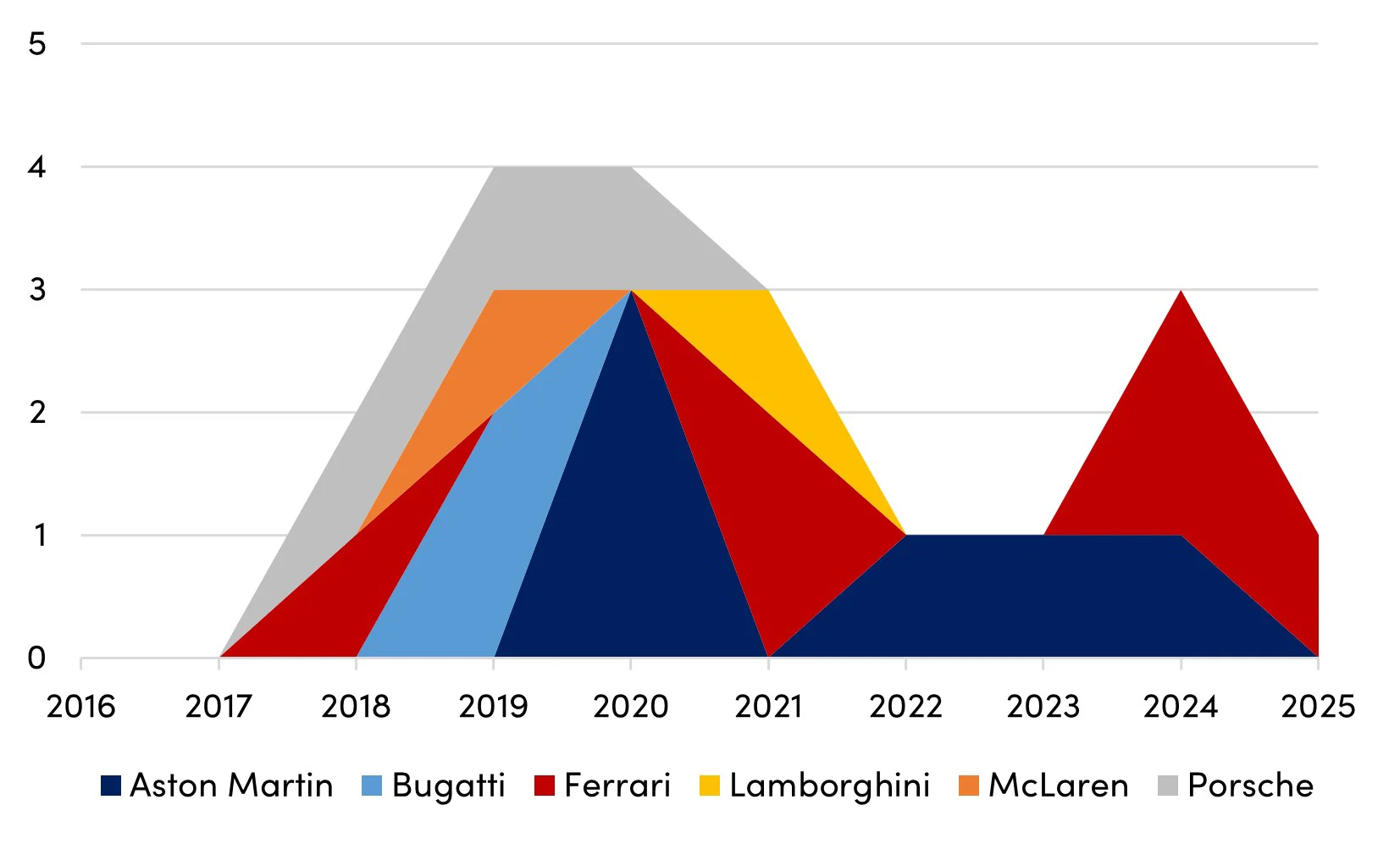
From the latest graph update it is evident how most of the trend has been limited to low-volume limited editions released between 2018 and 2021. Currently, Aston Martin, and even more Ferrari are strengthening it with their new products while other brands like Lamborghini and Porsche that make innovation and forward-looking vision key messages of their branding do not focus as much on it in their “regular” product line.
What about Ferrari?
Ferrari too started a while back with its Icona series. A unique initiative that created a separate product lineup made exclusively of rare (and very expensive) road-legal models directly inspired by the brand’s most iconic classic cars. Even more noteworthy, in this case, is the ones that inspired the two Icona series entries so far, Monza SP1/SP2 and Daytona SP3, are all racing and not road-legal vehicles.
However, different from its competitors, Ferrari pushed this initiative one step further. All the established automakers in the space strive to maintain their heritage intact to some extent. For example, Lamborghini with the wedge-shaped lines for its cars’ profiles, or Aston Martin with the flowing elegant lines and its iconic grille in the front.
However, in this case it is not just about maintaining single design elements through the product line, but about taking inspiration from single models’ design to give a unique character to a single one. And this is something that Ferrari started doing more and more in its latest generation that has already covered the entire key lineup of the brand with the sole exception of the SUV Purosangue which is a completely new vehicle category.
In the production models, this started with the 296 GTB, that took clear inspiration from the famous 250 LM in its overall profile, but even more in the side vents and rear shape (with some details also from the 1984 Testarossa) as well as the b-pillar cut.
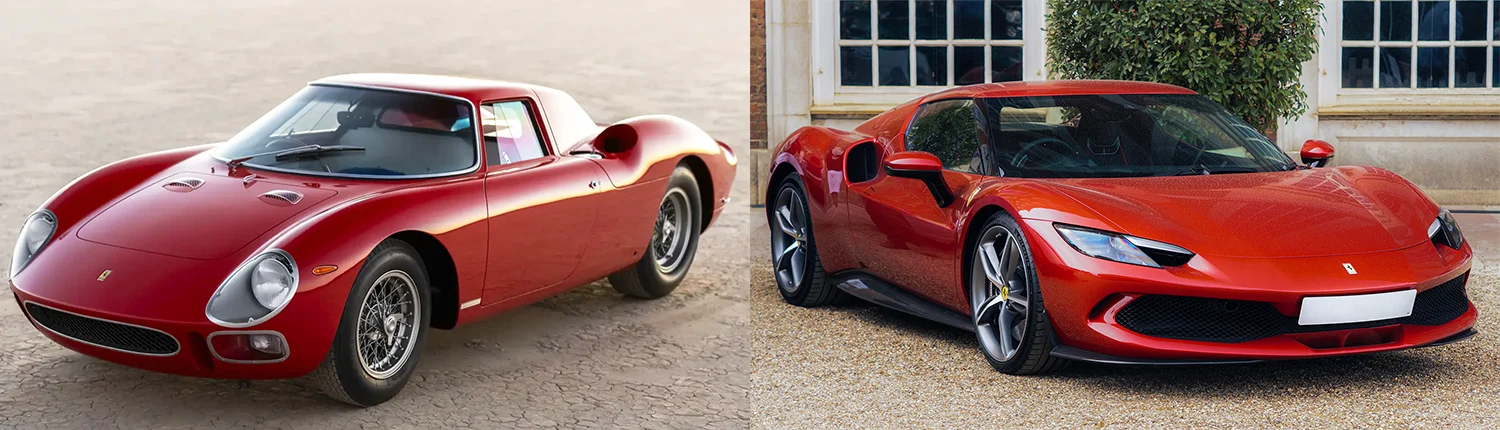 *250 LM and 296 GTB
Then, last year came the 12Cilindri. The car replacing the front-engine 812, celebrates the iconic design of the 60-70s 365 Daytona with modernised but very recognisable lines, especially in the front.
Right after that at the end of the year the LaFerrari successor F80 was released and that too brought some clear design inspiration from some icons of the past. In line with the “latest design language” by the brand it shares elements with the 12Cilindri but in particular, it recalls the most iconic of all, the F40. The last car approved by Enzo Ferrari himself.
Latest of the bunch is the 849 Testarossa, that right from the name recalls one of the most iconic Ferrari heritage pieces. The name was first attributed to a car back in 1956 when the heads of a reworked 4-cylinder engine were painted red, giving rise to what became the 500 TR (for Testa Rossa, literally Red Head). To the second version called 500 TRC soon followed by the 250 Testa Rossa, that featured a version of the V12 on the 250 Gran Turismo with the valve covers painted again in red. It was in 1984 that the name jumped from race cars to road-legal ones with one of the most recognizable Ferrari models ever that took the definition as the name itself turning it into a single word Testarossa (instead of the two separate ones).
The latest release from the house of Maranello, replacing the SF90 Stradale, draws from Ferrari’s heritage in its design as well, not just in the name. The overall design is more essential and angular, with a black band in the front that ties in with that of the 12Cilindri and F80 and a shape that takes inspiration from the 1980s designs such as 288 GTO or Testarossa. According to Ferrari, the back instead, with the two winglets and less busy surfaces compared with the predecessor SF90, take inspiration from the 1970s prototypes. This is quite evident when looking at racing prototypes such as the 512 S from which it takes also the two front bonnet extensions (already seen in the Daytona SP3 that was explicitly inspired by those same race cars).
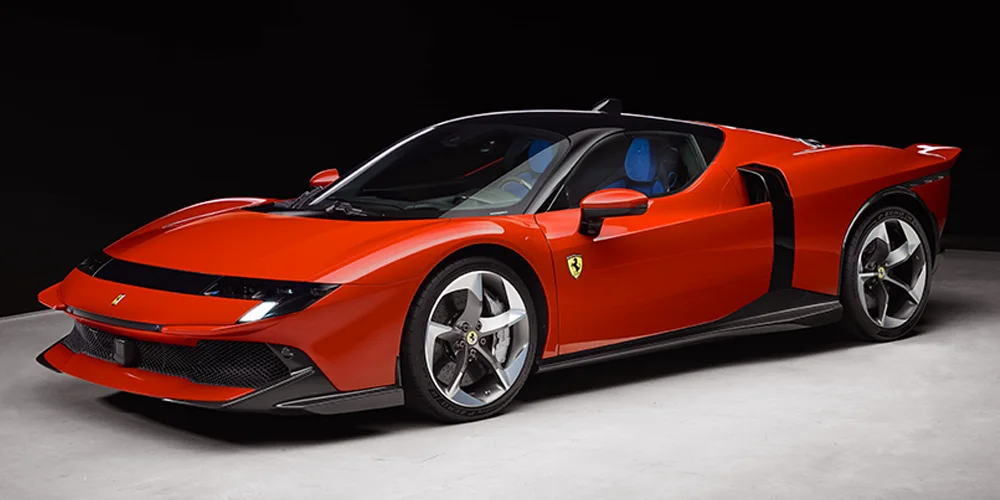 *Ferrari 849 Testarossa
The three production models currently on sale, along with the F80, cover the entire Ferrari lineup with cars that effectively take direct inspiration from models of the past.
What are the key advantages in today’s market?
There are several frameworks developed in marketing and business strategy that look into the potential of this kind of activity and product development.
According to Brown, Kozinets, and Sherry the so-called retro branding and retro brands, cater to the modern "inordinate fondness for revivals, reenactments, remakes, reruns, and re-creations". And while this was present in the early 2000s as per their research, in luxury automotive has certainly gained momentum over the past 6-7 years.
Their analysis identifies the 4As of retro branding. Allegory (brand story), Arcadia (idealized brand community), Aura (brand essence), and Antinomy (brand paradox).
Allegory indicates symbolic stories and narratives used to bring resolution to consumers’ ‘moral conflicts’. Arcadia refers to the utopia of a special and better past world and community. Aura evokes a powerful sense of authenticity communicated by the brand through uniqueness of brand values and ‘DNA’. Antinomy is identified as the paradox of technological development seen both as an unstoppable and necessary force, as well as the key factor pushing consumers to look for past simpler, slower, less stressful (and overall better) times.
Ferrari’s Allegory is built in its stories and narratives, right from the beginning with Enzo’s passion for racing, to its numerous successes and how the unique European industry in those days (in this specific case in Italy) developed with a unique attention to hand-crafting, luxury and quality, while the world was moving more and more toward mass production and the democratization of the automobile. The stories come from countless witnesses and even, in more modern days, from cinema and television, where the Ferrari brand always represented something aspirational and the ultimate dream and/or achievement.
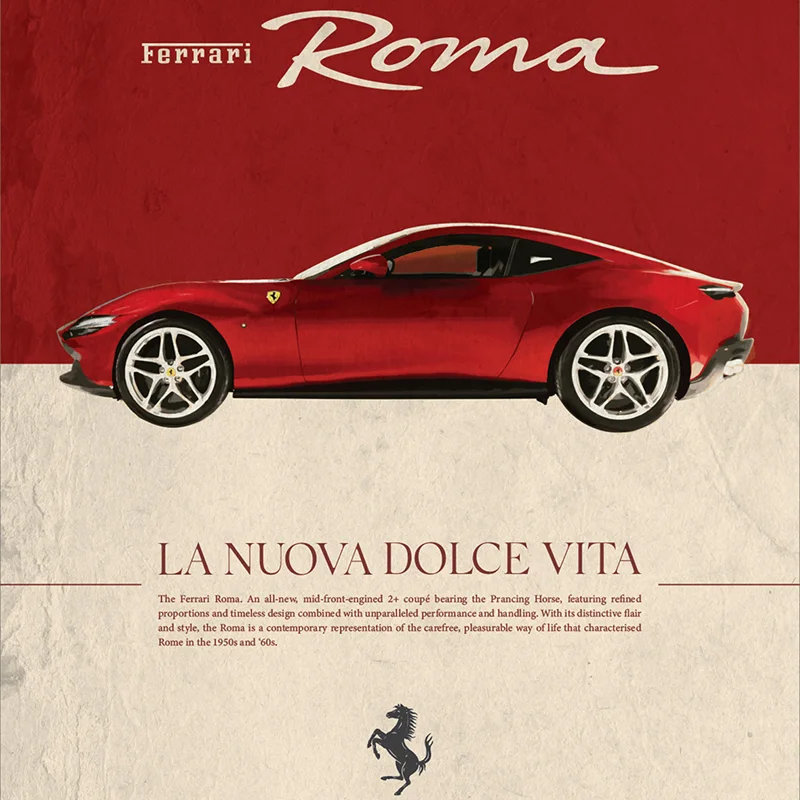
The concept of Arcadia connecting to the past, fits into Ferrari’s strategy in a modern world and automotive industry where electric vehicles and new technologies are increasingly levelling the playing field and lowering the entry barriers for new competitors. The current references to Ferrari’s past, both in naming and styling of new models, bring in today’s brand identity the continued successes and domination of a racing world that is the true essence of the brand, but built on a technology that is changing faster and faster. Even if it was replicated in numbers today, in fact, it would certainly have very different characteristics that could be replicated by modern competitors, differently from the past ones. Furthermore, this past world and its iconography are recalled once more with Ferrari’s Italian identity through naming. The recent entry-level lineup featured in order, Portofino, Roma, and now Amalfi. Places that, like the rest of the country, thanks to tourism have become more than ever the destination of people looking for classical beauty and the famous concept of ‘La Dolce Vita’, used by Ferrari itself in the initial marketing campaign of the Roma but quoted as 'La Nuova Dolce Vita' (The New sweet life).
As for Aura, with the objective of bringing the brand essence with these new products, while technology evolves, and Ferrari embraced it extensively, both in terms of powertrains and vehicle dynamics as well as interior software and hardware, designs, as mentioned are drawing increasingly from the brand’s past and bringing a retro essence. This kind of strategy can be risky, and has backfired recently for other brands. Consumers might ‘see through’ the initiative and consider it not genuinely adding value, but using ‘cheap nostalgia’ to short-term gains if it stopped at names or design features. This, however, has not been the case for Ferrari that, so far, has always brought significant improvements to each new model it has introduced.
Finally, Antinomy is conceptualised around the idea of the paradox in marketing driven by technological advancement and progress which are unstoppable but also cause people to desire to return to simpler, slower, less stressful times. In Ferrari’s case this paradox is evident in the push toward electrification and product digitisation against the heritage in design and “emotional” connection between driver and vehicle that made the brand what is today. Both are adopted today, in a product line that is embracing hybridisation and digital technology while, as stated before, design is increasingly staying connected to the brand’s roots.
The combination has worked effectively for limited runs in the Icona Series. On the other hand, one of the worst cases of depreciation in Ferrari’s recent history is the SF90 released in 2019, which attempted to innovate in both directions. Several pre-owned models are selling between 40 and 50% less than their original price after option. While this situation is certainly not exclusively due to car design or technical characteristics, Ferrari has corrected its course with the successor. High production numbers, along with a difficult automotive market condition certainly affected the SF90 resale value, but the 849 Testarossa aims at representing more closely the brand, adding more value to its presence in a crowded market even if potentially falling into the paradox of retro branding.
IF YOU WOULD LIKE TO SUPPORT ME AND THIS WEBSITE’s DEVELOPMENT
Learning

Latest articles
Related Articles


Unveilings
