Is China moving away from European Luxury?

  • Brand: Aston Martin, Ferrari, Lamborghini, Porsche
  • Topic: Electric Vehicle Market, Supercars Future

Over the past 10 years, the luxury car market has grown consistently, with several brands growing to financial and sales volume peaks in their history.

Yearly Luxury Vehicle Sales (2014-2024) 
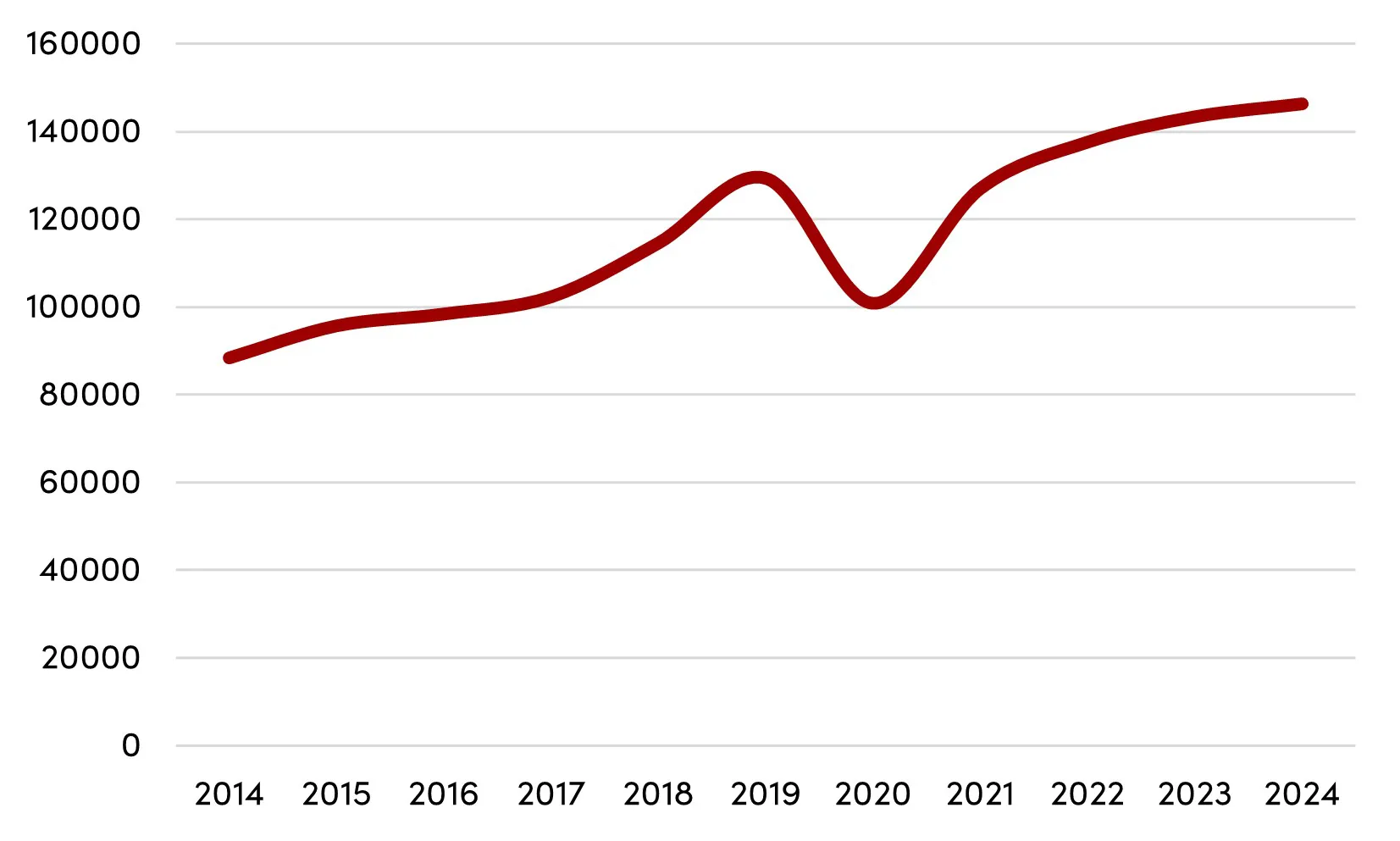
luxury sales*The Graph includes annual sales by Aston Martin, Bentley, Bugatti, Ferrari, Koenigsegg, Lamborghini, McLaren, Pagani, Rolls-Royce, and models above the €150,000 mark from Porsche, Lotus, Maserati, Audi, Mercedes, and BMW.

While in the aftermath of the pandemic, it took only two years for the luxury market to reach and exceed the previous peak reached in 2019, the trend that seems to emerge and that could be confirmed in 2025, considering the volume reported so far by major OEMs is one of gradual slowdown or, in a worst-case scenario, stagnation.

A big factor in this trend could be the radical transformation of the Chinese market. Because, in this growth over the 2010s, the USA has almost always been the largest single-country market for most of these OEMs. However, a close second, and quickly growing (for some even larger than the US), has been China.

Porsche is one of the best examples of this. After a launch in 2001, by 2015 China had become the single largest market for the German automaker and has remained so up until 2023, when, with a 25% share of sales overall, it was overtaken by the USA at 27% (while Porsche still recorded a healthy +3.3% volume growth). And this is part of a larger trend that can be observed across different companies.

A luxury slowdown in China

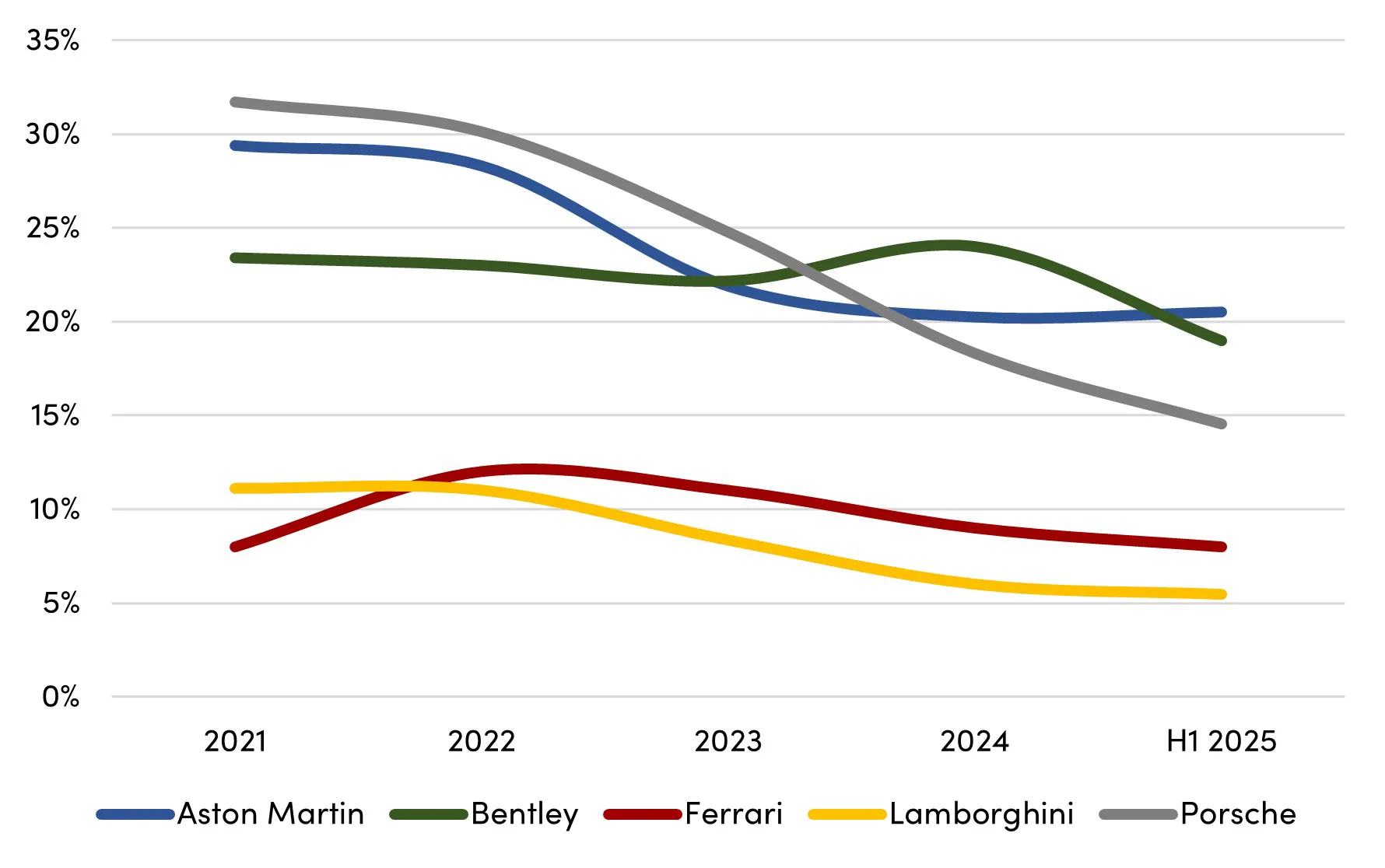
By looking at regional sales from automakers that shared the data over the past few years, it is evident a gradual slowdown in the Chinese market across the industry.

Luxury Automakers Yearly Share of Sales in the Chinese Market (2021-H1 2025)
china share

Since 2021, the one company that has remained more stable and for which China was never the largest market, as a much larger share of its sales relies on European Markets, with a sizeable one in the US as the largest single market, is Ferrari. Despite this, Ferrari too shows a slight decrease from the 2022 peak. A similar situation is observed for Bentley, for which China sales share remains quite stable, and a more noticeable slowdown is visible only in 2025 so far. It must be noted, however, that while shares for the British companies have remained mostly unchanged until last year, the overall sales figures haven’t. Sales in 2024 for Bentley were 30% lower than in 2022.

In the middle is Aston Martin, for which this decrease has been more evident, from a 29% share of sales in China in 2021 to 20% in 2024 and 2025 so far. The company, though, similar to what has been just said for Bentley, has also experienced a sales slowdown in 2024, and likely in 2025 too, albeit less dramatic than that of its British competitor.

Worse off, in this overview, instead appear Porsche and Lamborghini. With some ups and downs for the first one and consistent growth for the second, their presence in the Asian market has shrank more markedly than for the others. Both companies under the VW umbrella have seen their share of Chinese sales halved over these four and a half years. Porsche went from over 30% in 2021 to just 15% so far in 2025, and Lamborghini over the same period from 11% to just 5%.

Why is this happening?

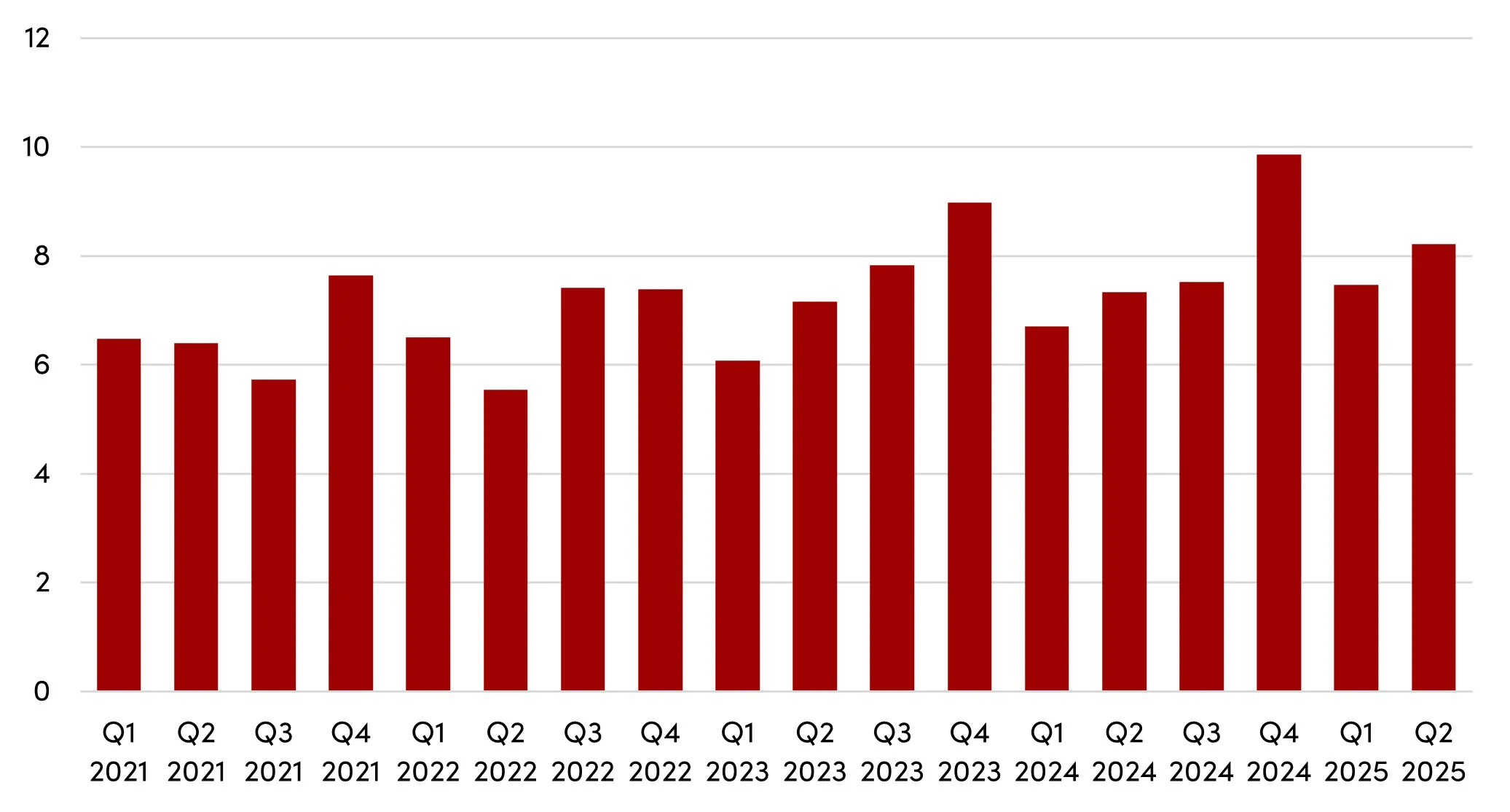
The Chinese automotive market has not slowed down, but actually kept growing after recovering from the pandemic, reaching 30 million in 2023, exceeding that in 2024, and 2025 seems on track to get even higher.

China Passenger Vehicle Quarterly Sales (2021- H1 2025) 
quarterly sales

However, Chinese customers are increasingly buying domestic brands, vehicles, and technology. The introduction of EVs has been the perfect opportunity for the Chinese government to push for a fast change in a market that had been dominated by European automakers up until a few years ago. This came mostly thanks to their performance, quality, and brand equity, all coming from a much longer experience. The most established segments, therefore, were the premium and luxury ones. On the volume side, while foreign OEMs had a consistent share, that was already decreasing earlier due customers' price sensitivity and Chinese OEMs' lower prices.

So when it came to luxury, the introduction of the electric powertrain leveled the playing field in terms of performance, and domestic companies also learned throughout the 90s and 2000s’ joint ventures with which foreign brands entered the Chinese market. Additionally, Chinese brands were better at interpreting their customers' preferences and offering them a new automotive experience focusing much more on software capabilities and convenience features compared to their European counterparts.

Some of the legacy luxury OEMs are actually going back to older solutions like the manual gearbox because their average customer wants that feeling of driving engagement that is lost with increasing automation. Chinese companies instead went in the opposite direction, going all-in on technology and creating a new and highly customizable experience for a customer base that generally has not the same long-standing attachment to combustion engines and the feeling they bring. Thus, it does not have the same expectations of driving performance from a luxury brand, but is actually showing to care more about technology.
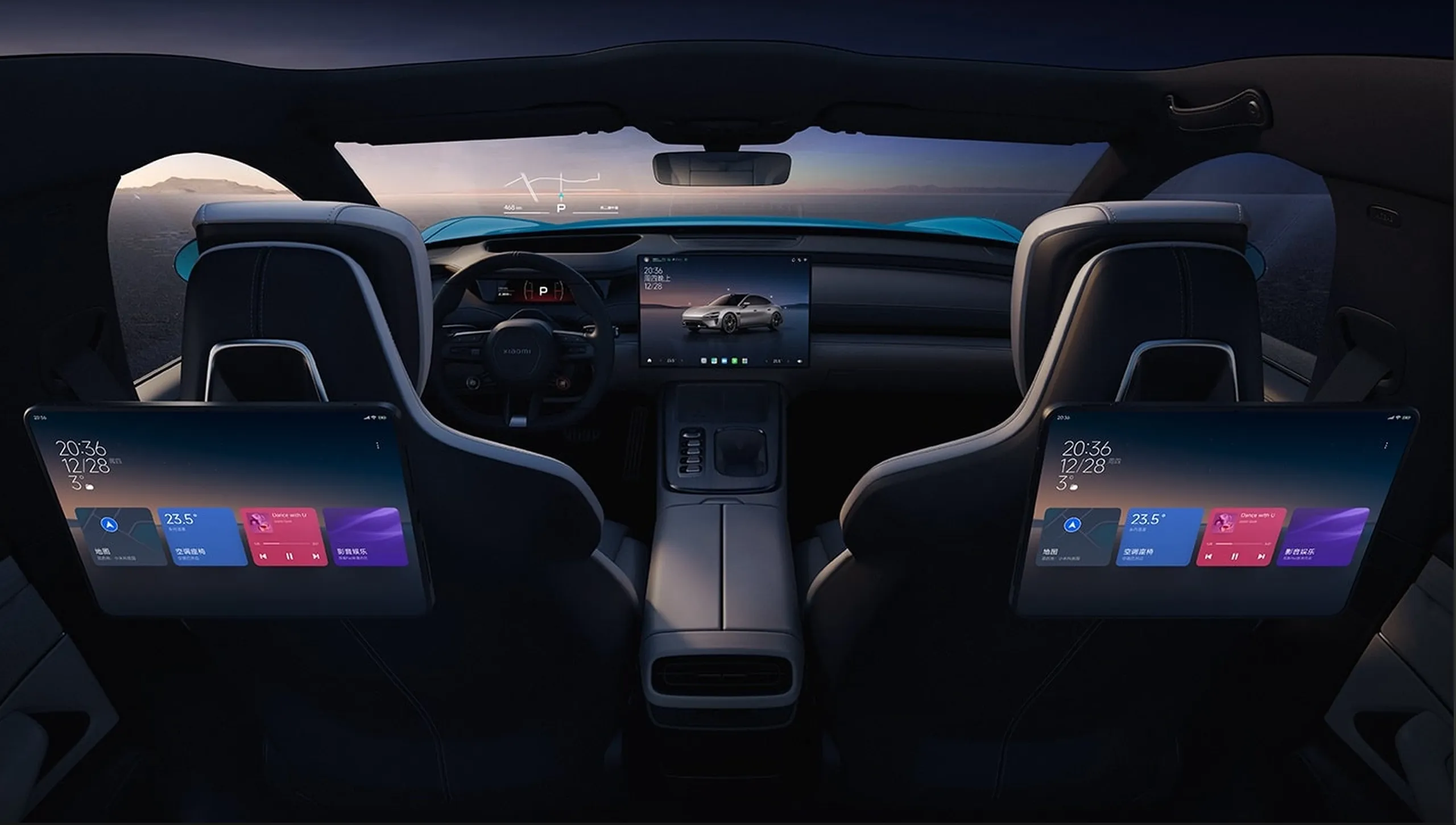
xiaomi su7*Xiaomi SU7 interior

With significantly cheaper prices, many Chinese OEMs offer an in-vehicle experience that aims at driving performance but also a lot more, while the value proposition of European OEMs offering has likely become somewhat less relevant to the point where even the stronger branding cannot compensate the perceived lack of features and technology.

Can European OEMs turn this around?

The stronger players in the sector are managing to keep stable sales and constantly improving financial results thanks to significant increases in revenues coming from personalisation programs.

This strategy has been working very well for most players involved, led by Ferrari and Lamborghini, but also OEMs in more uncertain conditions, like Aston Martin, have reaped the fruits of this trend improving consistently their average selling prices over the last few years.

A gradual diversification of the product lines with the introduction of fully-electric vehicles that have currently been postponed for most luxury OEMs, could bring back the interest in the Asian market. However, improving success in a single market, however large, might not warrant the substantial investment needed for the development of these models.

The other option could be to gradually shift toward even more exclusive and limited models with a strategy closer to what the likes of Koenigsegg or Pagani have been doing. This would definitely shake the current company structure for these established OEMs, but potentially ensure strong profits with a more limited production that could also shield customers from depreciation that has been plaguing the segment lately, even for limited-run models.
New Online Course Available Now

  • Brand: Aston Martin, Bentley, Bugatti, Ferrari, Lamborghini, Maserati, McLaren, Pagani, Porsche, Rolls-Royce, Mercedes, BMW
  • Topic: Electric Vehicle Market, Finance, Strategy & Marketing, Supercars Future

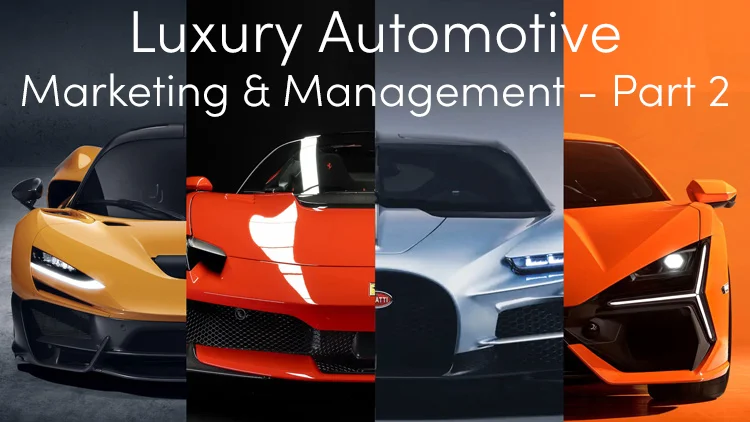
Following up on the first half of the Luxury Automotive Strategy and Marketing online course published a while back, the second half is now available on Udemy at the link HERE.
As for the previous one, this course too is thought for enthusiasts and university students who want to learn more about the workings of the industry. While it is not necessary to have completed the first half to be able to understand and learn this second one, the two are closely linked and form a complete picture.

So, after learning about the key players in the industry and how their branding and strategies compare to each other, this new section looks at market dynamics highlighting the main trends, some academic analysis of them, and an overall view of the global luxury market numbers. Last but not least, a couple of interesting case studies conclude the course comparing diversification strategies and innovation in luxury automotive.

I hope you'll enjoy it. Don't forget to leave feedback and get in touch to know more.

Cover homepage alt copy 3

Is luxury automotive marketing changing?

  • Brand: Aston Martin, Bentley, Ferrari, Lamborghini, McLaren, Pininfarina, Porsche, Rimac
  • Topic: Strategy & Marketing

Times of uncertainty and overall luxury market slowdown as highlighted in previous articles have brought difficulties to several brands in the segment. However, regardless of current and recent success or struggles, trends in brand, diversification, and marketing strategies have changed significantly.

Driven by various factors for different brands, whether one calls it a more cautious approach or a focused one, after quite a few years of expansion and diversification, most OEMs in the segment seem to be pulling back on both product and marketing strategies.

Diversification

While quite a few brands in the segment had diversified quite aggressively in the past, some of these strategies have gradually changed. One of the best examples of this is Aston Martin. As discussed in a previous article (Not just Luxury Cars: Aston Martin Diversification Strategy), through the 2010s the British automaker started several partnerships and diverse activities that materialized in several limited products and concepts including the likes of bicycles, speedboats, real estate, and even submarines and aircrafts. The latest of these projects is probably the motorcycle AMB 001 developed along with British motorcycle manufacturer Brough Superior and introduced in 2020 for a limited run of 100 units sold for around £100,000.

aston martin amb001*Aston Martin AMB 001

But Aston Martin is not the only one. Some of these activities continue and will most likely continue in the future. The collaboration with video game developers is by now one of the most established strategies in the industry in which every automaker takes part and that has even expanded in the last few years beyond just racing games.

Others however could have been a phase or one-offs to look for new opportunities or business models but seem to have been completely abandoned.

Real estate projects have been relatively popular for a while among luxury automakers, with the likes of Bugatti, Porsche, Pininfarina, and Bentley (as well as the just-mentioned Aston Martin) and more all entering partnerships with high-end developers for residential buildings in selected areas such as Dubai or Miami. These have recently slowed down or almost disappeared.

Similarly, various OEMs have also reduced the release of branded merchandise like Ferrari removing a significant share of everyday objects and accessories, or Bentley not following up on its collaboration with Fanatec for driving simulators steering wheels.

Product trends

On the product side, a key trend that seemed destined to get stronger in the coming years, but that, at least for now, has almost completely stopped is the production of one-offs.

An initiative that in the era of high customisation represented the absolute top of luxury automotive tailoring. Something that Ferrari has been doing for the past 20 years now, and that over the last 8 or 9 has been consistently growing with more OEMs developing similar initiatives year after year. This went on up until 2023, to almost completely stop in 2024.

Yearly One-Off and Few-Off production by Brand (2006-2023)

graph one off

A similar result would be displayed if few-offs were included. 2024 saw only a few releases and only some were very limited (below 100 units) and presented significant updates compared to the “regular models” like the Lamborghini Huracán STJ released in only 10 units to celebrate the end of the model’s lifecycle.

It is still unclear whether this is just a casual slowdown, while the automakers continue developing their own personalisation programs, but the slowdown is certainly noteworthy.

On the product side, 2025  so far has also seen a substantial slowdown in the release of production models, with only 2 major releases by an established automaker consisting of Aston Martin’s convertible versions of its new Vantage and Vanquish models. This is certainly not only due to strategic changes, as over the last 5-6 years, most established brands released entirely new product lines that in this market tend to last between 5-10 years, sometimes without any significant mid-life refresh. That said, uncertainty with electrification in the luxury segment and other factors have certainly played a role too, and overall the release rate over the first 4 months of 2025 represents an average 71% slowdown compared to the previous 6 years.

Reversing Course on Electrification

As just mentioned this is probably one of the biggest factors of instability in the current market. As the electric vehicle market started developing legacy OEMs and luxury brands started working on the development of luxury EVs. But things did not go according to plan.

Porsche was among the first and its Taycan has been one of the fastest depreciating vehicles on the market reaching a -51% in just 4 years, with over 30% over just one.

Similarly, other OEMs that launched electric supercars or hypercars have struggled to sell out even extremely limited runs. It has been the case for the likes of Pininfarina and Rimac too which has been at the forefront of this transition right from the start. However, since the beginning, even Rimac’s CEO Mate Rimac has been quoted saying that customers in this segment simply do not want full-electric vehicles, which will likely force the brand to introduce hybrid powertrains facilitated by its joint venture with Bugatti. Aston Martin too has currently delayed its first EV.

As traditional strategies have not worked as expected, OEMs had to rethink or expand their plans. Ferrari, set to release the first fully-electric vehicle in 2025, is likely to introduce a unique vision for it as discussed in a previous article (New Luxury Automotive: Going Beyond Performance?).

macan*Porsche Macan EV

Porsche while still struggling in selling its GT Taycan, despite the mid-cycle refresh which brought several improvements, seems to have found a solution to successfully build its EV portfolio. In 2025, 25.9% of the vehicles sold were EVs, led by the recently introduced Macan EV SUV. Over the first 3 months of the year, the SUV sales grew by 14% to 23,555 units sold. Of these over 60% (14,185) were full-electric ones, confirming a certain appetite for comfortable and sporty family luxury vehicles rather than exclusively performance ones.

This trend is surely going to reflect on the marketing and product strategies of luxury OEMs preserving their strong identity instead of exclusively focusing on what the future holds for the industry, which in turn could also give them competitive advantages against upcoming competitors.

Refocusing on motorsport

Beyond Formula 1 which has been skyrocketing in popularity over the last few years, endurance is certainly getting more attention and become a key marketing tool for most legacy luxury performance brands.

mclaren lmdh

Following Porsche and Ferrari, most other brands followed in rapid succession. Lamborghini announced its LMDh participation with the SC63, Aston Martin confirmed its entrance in the LMH category in 2025 with a racing version of its Valkyrie. Last but not least McLaren too announced they will be participating in the FIA endurance championship from 2027.

Conclusions

Luxury automakers’ marketing and programs' expansion slowed down over the past 1-2 years following difficulties in the industry for several brands driven by a general slowdown in automotive and in the larger luxury sector, along with changing trends in consumer preferences.

Where for a while it seemed like most companies were more and more frequently trying new strategies, these have ultimately been decreasing with automakers refocusing on core values, legacy products, and (when relevant) motorsport.

One exception however is coming from Ferrari. After the pull-back in diversification and the claim of wanting to become “a luxury brand”, a few days ago Chairman John Elkann announced a new project for a Ferrari sailboat coming soon. While the sailing segment is not exempt from crossovers with the luxury automotive one, this seems like it could be a larger project with a bigger commitment that will be discussed in future articles.

Automotive Luxury Market in 2022: The Growth Continues

  • Brand: Aston Martin, Bentley, Ferrari, Lamborghini, McLaren, Porsche, Rolls-Royce
  • Topic: Strategy & Marketing, Supercars Future

The luxury automotive sector showed significant resilience over 2020 as the Covid pandemic broke out. While the wider sector has been faltering in its recovery, the luxury segment kept growing in the following year and in 2022 as well. Along with the general growth though there are other interesting dynamics that can be observed.

Larger volumes

The top-end of the segment, driven by a few extremely successful brands, has registered yet another growth year, increasing over 2021 by about 9%, and a further 3% the next one as displayed in the graph below. The larger automotive sector instead despite a sizeable improvement in 2021, almost stagnated in 2022, with the main cause for delays and bottlenecks still being the shortage of semiconductors.

Luxury Automotive Market Sales Volumes (2018-2022)

volume

The main contributor to this success over the past two years has been the continued growth of brands like Bentley, exceeding 15,000 yearly sales for the first time in its history, Ferrari (13,221), Lamborghini (9,233), and Rolls-Royce (6,021) all posting record results. Other OEMs such as Aston Martin, Porsche, and Maserati (still on the path of recovery) instead have been consistent while probably not exceeding expectations. Finally, more niche brands still going strong like Pagani, Rimac, Koenigsegg, and the likes also contributed albeit with very low numbers. Of the public companies in the segment only McLaren, which has not published its full-year figures (and is accounted for here with an estimate), will likely report a drop in sales since it stood at -13% in Q3 YOY.

Reflecting the general health of the segment is the market size evaluated at €566 billion.

Luxury Automotive Market Value (2018-2022)

value market

Evolving market trends: prices and personalisation

The most interesting data that emerges from these reports though is that while the value of the market has not only recovered but exceeded the record of 2019, sales numbers haven’t.

This is reflected by the growth numbers of various companies in the segment. While for all these the sales numbers have increased, both revenues and operating profits reached much higher growth suggesting an overall improvement in efficiency, and most of all a trend already seen over quite a few years: the general increase of luxury vehicle prices.

2022 Luxury OEMs with the largest revenue and operating profit growths

table growth

This increase in average selling price (ASP) takes different forms.

In 2022, Aston Martin boasts a 26% increase in ASP exceeding the £200,000 mark. This has been mainly thanks to the destocking efforts over the past few years.

In other instances, the base price of production models has comparatively increased, either because of new technologies or because they represent new additions to a lineup, as is the case for Ferrari’s SF90 Stradale and Purosangue. The first is priced at £379,000, while the latter specifically substituting the GTC4 Lusso, introduced in 2016 and sold at a price of around £243,000, is offered now at a starting price of £313,000. This trend is observable in pretty much every other luxury car manufacturer, with even more extreme examples in super low-volume ones such as Pagani.

Last but not least, the other important trend that is common to all these companies and represents an important and increasing source of revenue is personalisation. Every luxury OEM over the last 10-15 years has introduced and gradually expanded its bespoke program. Over the last two years, most OEMs quote bespoke and coachbuilding programs as major contributors to the sudden increase in revenues and profits.

The luxury market keeps evolving and, as mentioned previously in the article Tailor-made: What luxury car customers can't go without, the product itself is not sufficient anymore. With general wealth increasing in most developed markets, and a higher number of HNWIs, expectations have become higher too. Clients are looking for more than a high-end car, they want something that is also unique and distinguishable. So, virtually limitless selections of colours, materials, interior, and exterior specifications have been added by every automaker.

The other method used by automakers to cater to this demanding audience is the release of limited-edition models. Often derived in most parts from production cars, limited runs usually feature a few unique additions that can, at times, be only cosmetic. These rare models are more desirable as they also suffer much less from depreciation. The peak of this trend is represented by one-offs which have also been constantly increasing over the past 10+ years as shown in One-off Supercars: What’s the next step for luxury automotive?

dbs 770 ultimate volante*Latest example of limited-run by Aston Martin DBS 770 Ultimate Volante

Additionally, each OEM used different methods to realise efficiencies in production and resource management. Bentley’s ‘Dream Factory’ realised with a £2.5 billion investment significantly reduced water consumption, improved waste management, and overall carbon footprint. Others such as Aston Martin optimised product development processes that allowed them to maximise cross-carline component sharing. In turn this reduced processes and engineering complexity.

Unfortunately, for some OEMs, this also corresponded to significant layoffs over the last two years, which surely contributed to the reported results.

Further Brand diversification

Other important factors contributing to the growth of luxury automotive brands apart from the delivery of new cars, and the ones quoted above, are the pre-owned market and events.

As discussed previously (Luxury Automotive Resale Value and Depreciation: How and Why) the pre-owned market is extremely important for luxury automakers, and not only because low depreciation makes cars more attractive for potential buyers, but also because most new clients when approaching their first purchase chose a used vehicle.

What often happens next is that these clients end up owning more than a single car, in fact over 50% of a large sample of owners claim to possess more than one luxury vehicle. This choice is often strictly tied to branding and brand value, so clients effectively become part of a restricted elite where they also get involved in a plethora of activities that offer OEMs more opportunities to create additional revenue streams.

Bentley's latest announcement on this field is particularly interesting. With its latest program called “Extraordinary Journeys”, the brand offers highly curated road trips in selected locations revolving around the best driving experiences possible while moving through high-end hotels, fine dining, and other interesting cultural activities. While this is something that many brands organise for their clients, what is unique in Bentley’s case is that for the first time, they are opening these programs to non-clients, giving them the opportunity to drive a range of different models during the trip. This is not only a great additional revenue source, but also a smart way to attract new potential buyers and create brand advocates thanks to a proper 360° experience that goes beyond just the product.

Coming Years

Over the coming years, the luxury market has new important opportunities coming from the transition to electrification and with new technologies. SaaS (Software as a Service) creates even more options for personalization throughout the entire customer journey. From early stages to after-sales, OEMs can offer additional services and make their ownership experience even more unique.

rr spectre*Rolls-Royce Spectre is the first offering a customisable digital cluster according to clients' preference

The segment has been more resilient despite the difficulties the wider sector went through over the past 3 years, and so far signs seem to indicate the positive momentum might continue.

Luxury automotive Q1 2022: diversification and changing management

  • Brand: Aston Martin, Bentley, Ferrari, Lamborghini, McLaren, Porsche, Rolls-Royce

The global automotive industry is still going through a difficult period, with sales in the first quarter of 2022 shrinking in each continent. With negative effects stemming from Covid-19 cases still present despite the general media indifference of the last few weeks, supply shortage, especially with semiconductors, and uncertainties with the Russia-Ukraine war, the outlook is still worrying.

March 2022 saw sales in both the US and EU drop by over 20%. Q1 decrease was less severe overall but still reached a significant -10% in both markets (Nasdaq, Statista, Unrae). Asia might partially be an exception. While Reuters reports a 14% drop in sales in Japan in January, according to CAAM, instead, China maintains the positive momentum with a 10% growth in March, and an 8% overall in Q1. Notable is also the sales of NEV doubling in March with around half a million units sold.

Automotive Market growth % in Q1 2022/March 2022 by Region

graph

This again shows the difference between the volume market compared to the high-end luxury one where. As discussed before, and while for some the hardship is not over yet, for “the usual winners” it all seems smooth sailing and more.

Luxury segment: Winners and Losers

The usual 5, Rolls-Royce, Ferrari, Lamborghini, Bentley, and Porsche, manage again to post yet another record quarter or a really strong one at least. In terms of sales, Rolls-Royce and Ferrari top the chart, increasing their respective sales both by 17% and reporting strong financial results as well.

Right after Lamborghini increases its sales by 4.8% and reports positive financial results as well with revenues and operating profits improving by 13 and 25%.

Porsche and Bentley both reported a sales drop of 4.9 and 4.6% but record financial figures signalling an important focus on business efficiency during this uncertain time. Revenues and operating profit at Bentley improved by 41 and a staggering 162%. At Porsche, the same figures grew by 4.1 and 17.4%.

table q1 2022

After a positive 2021, with a bold recovery from the previous year, thanks to the introduction of the SUV DBX, Aston Martin seems to be back in troubled waters. Sales decreased by almost 14% with only the GT segment improving, and the DBX sales dropping 41%. Also, despite the revenues increase, financial results are not positive as well.

What’s next?

The continued growth of the segment is probably coming from increasing property prices and the stock market growth of 2020 and 2021. According to property consultants, Knight Frank these unique conditions created over 51,000 new Ultra-high-net-worth individuals (UHNWI), classified as people with at least $30 million of investable capital, bringing the overall number to 610,569.

Top automakers are responding by following the current trend in the industry and expanding their portfolio to cover the widest portion of the market possible.

The one that paved the way over the last two decades and is still pursuing such a strategy is Porsche. Q1 of 2022 confirms the Taycan range as the third best-selling after the two SUVs, but above the 911, which is a key indicator of how more and more people are interested in the sporty luxury automotive experience (and in this case even electric mobility) without being “limited” by the typical sports car’s lack of practicality and everyday usability.

Notably, Ferrari has been doing the same. If it does maintain the growth rate by the end of the year, while still strictly controlling its sales numbers, it will have almost doubled the figure in 9 years, from the 7,000 units of 2013.

Ferrari Sales, Growth Percentage (2013-2021) and Product Range value Proposition

ferrari graph and percentage

Ferrari product

More important than that though, is the portfolio expansion. Since 2013, right after the LaFerrari, the brand added a 4-door line (FF, GTC4 Lusso), that will now be substituted with the SUV Purosangue, a new GT line (Roma), a higher-end, high-performance hybrid (SF90 Stradale). Most recently the new V6 Hybrid, that while dictated, as a choice, by the more restrictive environmental regulations, does not substitute the mid-engine V8 line (at least not yet).

Along with all this Ferrari makes sure to retain also the very top niche of its clientele with the personalisation program and the One-off, discussed more in detail as a trend here. Its latest born the SP48 Unica introduced just a few days ago.

The other brands Rolls-Royce, Lamborghini, and Bentley, as discussed have all very successfully entered the SUV segment, but that is not all. Much like Ferrari and Porsche, they too are nearing the release of additional models that will expand their lineup. For Lamborghini, it will be the full-electric fourth model, which according to what has been said by some representatives it could be more of a GT model. Rolls-Royce too has the full-electric Spectre coming soon. And last but not least, Bentley’s new model which debuts today will sit at the top of the range, expanding the brand’s reach, but not introducing a new electric powertrain.

Other OEMs that are going through difficulties or “losers” (in a figurative way regarding this last period, of course) are adopting similar strategies. But there is more going on behind the scenes for both McLaren and Aston Martin in the search for stability.

McLaren, whose market potential was investigated in the last article’s 5 forces analysis, unexpectedly has not released any report after Q3 of 2021. Its range expansion has consisted so far in the addition of the GT to the range. More importantly, however, there is also an important restructuring.

It is of last week the announcement of the new CEO finally taking place at the head of the British company after Mike Flewitt left its role. Michael Leiters will start in his new position effectively on July 1st. Before this, he held senior positions at Porsche and has been CTO at Ferrari. This important announcement followed some other major changes in important corporate roles within the company.

There is also the now long-standing rumour about the Audi buyout of McLaren’s F1 team that would at one point involve also the automotive division. The deal was first denied by McLaren in November, but speculations continued as ongoing discussions were not excluded. Despite various media outlets still talking about it, from recent statements by the likes of Zack Brown, it looks like nothing is going to happen (at least in the short term).

Similarly, it is of a few days ago the announcement of Aston Martin’s change of leadership. After just two years, Tobias Moers, the man behind the rise to power of AMG, called by Lawrence Stroll to save the British car manufacturer, will be substituted. While Moers will remain close to the top management of the firm, the role of CEO will go to ex-Ferrari Amedeo Felisa who held the same role in Maranello from 2008 to 2016. With him, another former Ferrari executive, who worked at Alfa Romeo and BMW, Roberto Fedeli will join Aston Martin as the new CTO. Both of them arrive from Chinese Silk-FAW which is attempting to establish a presence in the Italian motor valley to produce electric performance cars.

amedeo felisa roberto fedeli*Amedeo Felisa and Roberto Fedeli

Aston Martin too has a significant product expansion planned, but its recent difficulties have left it behind the competition. Especially in the transition to hybridisation and electrification. The mid-engines Valkyrie and Valhalla have already been significantly delayed. In an interview with the Guardian, Stroll himself said that Moers’s contribution was key to restructuring the company in a critical moment. Now, someone else is needed to bring it to the next stage. While all the people involved are certainly capable, and extremely experienced professionals, only time will tell if these fast changes in management will have the positive effect Mr. Stroll is hoping for. Aston Martin went through the rough destocking phase, and out of it had a good 2021. The financial risks however are not over, and this first quarter does not look promising.

Between restructuring and vast portfolio expansions, the luxury segment continues its overall growth while the rest of the industry falters. Despite the global increase of HNWIs, one wonders if all the contributing factors that caused such a severe contraction of the automotive sector in 2022 will eventually affect the luxury segment as well. For now, a few companies are setting the trend and look very much in control of the narrative and the direction of the market.

Lamborghini Releases Huracán Tecnica: Are Sports Cars losing their appeal?

  • Brand: Lamborghini, Porsche
  • Topic: Electric Vehicle Market, Supercars Future

A few hours ago Lamborghini released its latest and probably final version of the V10 Huracán as it approaches the hybridisation of its full line-up. The Huracán Tecnica. According to the Cor Tauri strategy, announced by CEO Stephan Winkelmann, and discussed here Lamborghini Reaches for the Stars with Stephan Winkelmann: Direzione Cor Tauri, over the next two years the company will renew its entire line-up and then move forward to release the fourth model which should finally introduce the full electrification at Lamborghini.

In the OEM’s history, the Huracán has been an extremely successful model, even more than the game-changing Gallardo before it. Also, thanks to the new updated releases it has proven to be resilient as well in its almost 10-year lifecycle. But then the Urus has come.

Huracan tecnica*Source: Lamborghini media

In the lower segment, however, the 2-seater sports car is somewhat losing relevance. Why is it happening? Can it still be the strategic answer for struggling automakers? And is this trend going to reflect on the top-end of the market as well?

Over the last few years, the “go-to model” to ramp up sales figures has been the SUV, and it is still the hottest segment at any level of the automotive industry. For a clearer view of the impact of SUV models on the luxury performance automotive market here are a few related pieces:

Looking back 25 to 15 years ago, that role was up to the “entry-level” sports car. But since then, things have changed. One example now is Porsche’s 718 family with Cayman and Boxster.

It is well-known how during the 90s’ Porsche was practically saved from bankruptcy by the introduction of the Boxster. However, lately, the segment has stagnated for a few years.

Porsche 718 Boxster/Cayman deliveries by Year (2005-2021)

boxster sales

Apart from the clear effect of the 2008 financial crisis, the Cayman/Boxster range has been steady and has actually shown a slight downward trend since 2017 (considering also the virus outbreak impact).

The factors determining this dynamic are various.

1. The Pandemic

As just mentioned, the pandemic is definitely a factor affecting the sales of sports cars in lower sections of the market. A report from Forbes shows how these two years with Covid-19 have unequally impacted different consumers in the US. Luxury vehicles sales from $70,000 upwards have increased. Below that, up until a $40,000 price threshold, they have just remained stable, while between $40,000 and less than $20,000, the sales drop has been gradually more severe as the prices get lower.

sportscar income*Source: Forbes

Also, while sports cars like the 718 are already in the premium pricing bracket, they represent the entry-level option. So while the super-wealthy are likely to opt for the top-of-the-line 911, younger customers or less wealthy ones will probably be more conscious about spending on a vehicle that does not provide everyday practicality. Porsche itself, in fact, claims that the average 718 buyer in China, its largest market, is 31 years old.

Car Industry Analysis confirms the trend reporting that over 2020 C and D sports segments in Europe suffered a -70% and -33% registrations respectively.

2. Chip Shortage

The lack of semiconductors supply following the lockdowns and the gradually recovering demand caused more sales delays and higher prices that even rippled into the pre-owned market. These factors have probably discouraged potential buyers from purchasing a sports car. So, the resources have likely been focused on everyday usable vehicles not just by consumers, but also by OEMs to reduce delays on cars more in demand.

3. Generational changes

Last but not least is the general change in preferences. SUVs today are generally preferred because of their practicality, and in many cases, they have just become more representative of the current lifestyle. Also thanks to technical development, automakers are able to produce sportier and more dynamic SUVs that offer a driving experience closer than ever to that of a sports car.

According to Road & Track in modern society, compared to the 1990s, financial conditions, and especially the housing market and even rent affordability are forcing millennials and genZs away from sports cars and car ownership in general.

Forbes too, along with financial reasons for younger generations, suggests a substantial underlying change in how they perceive driving as just a necessity to move from one place to another, and the ownership experience as a burden and a potential cause for concern. Not only that but it is suggested also that this combination of variables could be what eventually will drive the majority of people toward self-driving cars (when the technology becomes available). This would effectively negate the main value proposition of any sports car.

Going Forward

Going back to Porsche’s example, even though entry-level sports cars back in the day have done for OEMs what SUVs are doing today, it is difficult to imagine how the same situation could repeat itself. Especially considering that whatever market is present has been probably already captured.

This is where electrification could offer a new path. First of all in terms of appeal to younger generations. EVs are the most modern option and definitely closer to the way millennials and genZs are used to interacting daily. Secondly, environmental consciousness is also likely to play an important role in this potential development.

Unsurprisingly, as of now, there are no real full-electric affordable sporty options. Earlier last year though, Porsche showcased its vision for the future of this segment.

mission r*Source: Porsche Media

Presented in the shape of a race car, the Mission Rhas been said to potentially represent the future direction for the next generation 718. Also, it will be the most technologically advanced model that Porsche will produce in the near future. Offering performance, and technology but with (relative) affordability in mind. This paradigm shift could be key to revitalising the interest in small 2-seater sports cars.

The luxury market

Certain trends seen in higher volume sections of the market have transferred to the top-end luxury one. Entry-level, more affordable options for customers to gain easier access to aspirational brands have been successful in the past. Both Ferrari California, and Lamborghini Gallardo have proven that.

The Huracán has done even better and has been a consistent seller so far, reaching what President & CEO Automobili Lamborghini America LLC Andrea Baldi said to be the physical production capability limit of around 2,500 units per year.  

Lamborghini Gallardo/Huracán deliveries by Year (2005-2021)

huracan sales*Huracán sales began in 2014, summing up with the last 265 Gallardo units.

With over 18,000 units delivered it is the best-selling Lamborghini ever, even though Urus will exceed this figure soon. The SUVs' popularity, in fact, has taken the luxury market by storm as well.

However, even if luxury OEMs are boldly diversifying, extending their reach to attract different audiences, it seems highly unlikely that sports cars in this market will suffer the same fate as those from volume car manufacturers.

The main reason is that apart from luxury and exclusivity, the driving experience and car capabilities are not just part of the vehicle, but they are part of the brand. This is already a stronger value proposition. Plus, branding is much more important for luxury firms.

Secondly, luxury brands maintain exclusivity and resale value by limiting the production numbers. Even more so with the current trend of developing successive more focused limited runs, like we have seen earlier this year with the Aston Martin Vantage V12.

In the current market, the traditional 2-seater small sports car is not going back to what it was, and OEMs might decide to discontinue certain models (like Mercedes did with its SLC). While this loss of appeal could be part of the reason why we do not yet have an affordable fully-electric option on the market, some should arrive in the coming years. A different approach, like the one shown by Porsche to better communicate with younger generations, could prove to be the missing piece needed to revitalise this segment.

At the same time, low-volume manufacturers are gradually moving forward too, but thanks to the characteristics of the luxury market, its exclusivity, and the very own DNA of the majority of these brands, they are unlikely to see the same decline suffered by volume automakers.

Marketing Racing #14: Lamborghini NFT Moon Landing

  • Brand: Lamborghini
  • Topic: Marketing Racing, Strategy & Marketing

A few days ago Lamborghini has finally revealed its NFT project teased in December. it is one of the most creative, if not the most creative one seen so far in the automotive industry, with one important twist. And, as imaginable, it was a successful one as well, with all the five NFTs selling for a total of around $659,636.

As discussed a few weeks ago, when I introduced the topic in the article NFT in Luxury automotive: Ferrari and Lamborghini jump in, Lamborghini along with Ferrari is just the latest of an increasingly long list of automakers and high-profile brands to enter the NFT space. However, the non-fungible tokens' market is still in its infancy, and for as much potential it has for the future, there is still a lot of uncertainty regarding the legality of many initiatives that pop up daily on the internet. For this reason, there is still quite a lot of hesitation from the public, especially that share of people not into new tech, or the Web3 concept.

luggage closed

Lamborghini as many others does not seem to have any doubt about the future of this technology but actually bets on it with an innovative approach that no other automaker has matched so far.

So, how is the NFT space developing? Why Lamborghini would want to enter it? And how is the Italian brand setting itself apart from the competition?

The NFT market at the start of 2022

Despite all the uncertainty, the NFT market, like the rest of the blockchain-based technologies, has grown exponentially in these two years of pandemic, especially in 2021.

While according to a report from Reuters, the volume in 2020 reached over half a billion US dollars, in 2021 different platforms reported sales volumes all in the order of several billion. Chainalysis though claims that this market also suffers from significant trade washing. Meaning that buyer and seller is the same person completing a transaction from two different wallets. This, as it happens with cryptocurrencies, is done to deliberately drive up the trade volume of a specific asset or crypto eventually increasing its value. While according to the analysis a sizeable amount of profit was realised by trade washing NFTs (over $8.4 million) this has probably not impacted as much the overall token-related crypto transactions’ volume set at $44.2 billion in 2021. NFTs’ largest platform OpenSea also went back and forth on its unlimited NFT minting tool as it is has been prone to misuse.

Value of sales sent to major NFT platforms in 2021 (in $ million)

2021 ft nft sales*Data are for ERC721 and ERC-1155 NFT Contracts (from Jan to Dec) Source: FT via Chainalysis

The sudden growth in transaction volume over the summer from July and August on, up until December when it slowed down significantly could have different explanations. One could be the general amount of disposable income left by the pandemic’s impact especially with travel restrictions, as discussed in Why 2021 was a record year just for Luxury Automotive, which positively affected the luxury automotive market too.

Secondly, the fast increase of collections available on OpenSea has likely been a consequence and cause of the transactions’ volume development. Data from the previous graph and the weekly number of NFT collections available show a positive correlation.

Value of sales (in $ million) against Collections available on major NFT platforms in 2021 

nft collection and sales*Source: Chainalysis

Lastly, according to other sources, this sudden interest would have been driven by a few popular collections such as CryptoPunks, traded over 2,800 times in August alone. This data is interesting when put into the general context of the NFT market.  

Its structure gives an interesting indication of its current direction. The graph below shows the best-selling categories over one month between December 2021 and January 2022.

Number of NFT sales in popular categories over 1 month period

nft sales categories*Source: Nonfungible.com

This data indicates the current speculative nature of the NFT market, but also a sizeable volume of different segments that will be interesting to follow in the coming years, as awareness and new ideas develop.

How Lamborghini got into it

In December Lamborghini teased its new project through the hashtag #ToTheMoon. And indeed, with an attitude always projected into the future, it was aiming there. The automaker partnered up with Swiss artist Fabian Oefner, already famous for his photographic work, his colourful pieces created through scientific processes (such as magnetism used with specific liquids) establishing a direct connection with nature, and his cars disintegration (figurative). The latter consisted of high-quality models dismantled with each component carefully placed to simulate the car exploding. The same effect is reproduced in Lamborghini’s project too, but with real car components.

oefner ferrari 330*Fabian Oefner "disintegrating" Ferrari 330/P4

With regards to this idea Oefner said:

“This is about capturing an artificial moment in time. It is about capturing the exact moment a car explodes, when in fact, there’s never been such a moment. What looks like a car falling apart is in fact a moment in time that has been created artificially by blending hundreds of individual images together. There is a unique pleasure about artificially building a moment…freezing a moment in time is stupefying”

Lamborghini collaborated with NFT Pro and auction house RM Sotheby to develop the project and start the bidding for these NFTs on the first day of the new lunar year. February 1st.

But the references to the moon and space exploration do not end there. Each auction for one of the five NFTs created lasted 75 hours and 50 minutes, matching the time it took the Apollo 11 to reach the moon’s orbit.

Oefner realised five images of “exploding” Aventador Ultimae with the same principle as before. These however are set in space. The picture background is photographed by a weather balloon sent to the stratosphere. Then the artist crafted each image from over 1500 shots of single car components. But here comes the most interesting part of the whole project. The one that makes it unique and sets it apart from any other NFT released by other automakers.

Lamborghini paired each image with a physical object called “Space Key”. Each Space Key is actually a carbon fibre piece that was sent to a space station for research in 2020. Once back, they have been engraved with a QR code that links to the digital image.

space key

Finally, each auction that exceeds a certain value, will be accompanied by a Samsung 65’’ TV with a wide-screen image of Oefner’s artwork, his original signature, and customised TV frame.

What it means for the brand

Lamborghini found a brilliant way to bridge the digital asset and the physical unique item. It managed, in one single move, to reiterate its uniqueness, and create something that will not only appeal to tech enthusiasts, but also to other audiences that are approaching NFTs and will be much more likely to show interest in a project that includes an extremely rare physical piece. In this case, a key to “open” a beautiful artwork.

This project can benefit Lamborghini in different ways.

First of all, it is a communication masterpiece. As said by the artist: “The Ultimae is no longer a car, it has transformed into a rocket, reaching for the stars”, and this is pretty much what Lamborghini is about, what it should feel approaching this brand. In this era of automotive transformation, Lamborghini has more than ever the opportunity to be that “trendsetter” it claims to be in its publications.

As NFTs’ popularity increases, this project will most likely remain as a great example in the minds of many, and not just car enthusiasts. So, it could even strengthen its image in the eyes of a wider audience.

lamborghini nft artwork

Secondly, the project was pretty successful. Of the five NFTs sold, the top bid reached around $203,636. Considering it was the first auction and only the first “drop” (there will be more), they will most likely appreciate in the future. Even though the NFT sales that make the news are the multimillionaire ones (and there have been quite a few by now), the vast majority of them goes for a few hundred dollars.

As automakers increasingly diversify with complex strategies that include ever more touchpoints aimed at improving the brand’s reach, NFTs represent a unique opportunity. Especially for luxury and aspirational brands. As fashion apparel or limited edition items for clients are now important strategic tools for most automakers, NFT can quite easily become one too in the future, bringing the additional benefit of the appeal to younger generations.

In Conclusion

The first NFTs corresponding to physical art pieces came out a while back (Damien Hirst paved the way), but while Lamborghini has not been the first to develop such a concept, it surely executed it in a creative way giving birth to a very rare digital and physical asset.

This first foray has been a remarkable example of how NFTs can become powerful marketing tools. And this one has been realised in the most “Lamborghini way” possible, strengthening its message and identity.

Its success further proves this new platform’s potential, and the uniqueness of the approach that distinguishes Lamborghini from the competition even beyond its supercars. But this NFT drop also demonstrates how we are moving into a new era and gives a hint on what this space can become once it matures and sheds all the unnecessary, speculative appendages.  

Why 2021 was a record year just for Luxury Automotive

  • Brand: Aston Martin, Bentley, Lamborghini, Porsche, Rolls-Royce
  • Topic: Supercars Future

2021 just ended and several companies in the luxury space have been publishing news reporting record sales this year. In many sectors, a significant recovery from 2020’s crisis caused by the pandemic was expected, but few foresaw results exceeding or even equalling 2019’s ones. The average predictions claimed that the full recovery up to 2019 levels would be likely reached only by 2023.

It is early to talk about financial results since the complete annual reports will be published in a month or so from now. However, Q3 reports can already tell a lot, and the results indicate two important facts. One is the difference between the top-end of the luxury market and the lower segments. The second is that forecasts should always be considered with extreme care.

Luxury Automotive Revenue Percentage Change by Company (Q3 2019 Vs Q3 2021)

luxury revenue

Automotive Revenue Percentage Change by Company (Q3 2019 Vs Q3 2021)

mass revenue

The main reasons for the difficulties of high-volume car manufacturers are the uncertainty brought by the latest wave of the virus that impacted the market especially in the second half of the year, and the ongoing chip shortage that severely affected the supply chain and cars delivery to dealers and clients. The latter is discussed in more detail in Chip Shortage in Luxury Automotive: The Perfect Storm.

In Europe, in fact, over the 12 months of 2021, 11,774,885 vehicles were sold (UNRAE), a decrease of 1.5% over 2020 and 25.5 over 2019. The five major European markets, France, Germany, Italy, Spain, and the UK were mostly stable (with the exception of Germany that despite remaining the largest market lost 10%). The other important piece of data was the continued growth of BEV and PHEV. In France, Germany, Italy, Spain, and UK the increase in sales over 2020 was 64%, 72%, 128%, 66%, and 76% respectively. Even if starting from low numbers, the increase in just one year is quite significant.

5 Major European Market Total and Electrified Vehicles sales (2020-2021)

bev graph

So, what has made this year so different for luxury automakers?

Record Results

Quite a few companies at the top of the automotive luxury market announced their 2021 sales figures, and almost all were record-breaking. The last has been Rolls-Royce with 5,586 units, a 49% increase over last year. A few days before the British OEM, other announcements came from Bentley which sold 14,659 cars, up 31%, Lamborghini 8,405, +13%, and Porsche 301,915, +11%. Last but not least, Aston Martin also delivered 6,182 vehicles, thanks to a strong contribution of the new SUV DBX, for a total 82% improvement over 2020. While this is not a record result, it is still a strong improvement over 2020, and very close to the all-time high of 6,441 units of 2018.

How the luxury market reached record sales

There are several factors that distinguish the luxury segment from the rest of the automotive industry, most of which, in this case, were crucial to its success in 2021.

Semiconductors availability

Again the production volume plays a role in the resilience of luxury automakers in the current situation. With most of the companies producing in volumes below the 10,000 units, the chip shortage would arguably be more manageable than for companies producing in the hundreds of thousands or even millions of cars.

Additionally, companies that are part of a larger group benefit from the vast resources of their parent companies. Is the case of those under the VW umbrella, or Rolls-Royce with BMW. CEO Torsten Müller-Ötvös told Bloomberg:

“I’m very glad that we are part of the BMW Group. We had preferential delivery of semiconductors last year”

This allowed the company to fulfil every order in the book without delays and actually sustain a strong order book for this year as well.

dbx*Aston Martin DBX

Pandemic Indirect Effects

With regards to the record-breaking sales of Rolls-Royce, the CEO again interviewed, this time by Reuters, suggested that when Covid hit, travel restrictions followed leaving a lot of unspent disposable income. According to him a significant part of it has been spent on luxury goods.

Also, these past two years, surely made private vehicles the preferable choice over public ones for moving and even going on longer trips.

New models and hot segments

Each one of these manufacturers achieved the result thanks to one or two great performers. For low-volume manufacturers a single model can be a true game-changer, impacting the overall results much more than what a single model can do in the high-volume market. SUVs, once again,  were key in this context. Aston Martin is a good example. Its DBX, up until Q3 accounted for more than half of the overall sales. Lamborghini is too. In 2021, the Urus sales made up 60% of the total, with the Aventador slowing down again and the Huracán improving for the first time in three years thanks mostly to its new iteration, the STO.

Porsche improved also thanks to the success of its full-electric range. Another important trend, as mentioned in the beginning, is just starting now and it is set to accelerate in the coming years. Taycan and Taycan Cross-Turismo sold extremely well reaching 41,296 units, which made it the third most successful product range for the company, right below the two SUVs Macan and Cayenne, but above Panamera, 911, and 718. Porsche’s competitive advantage in the electric space could become even more important in the next years.

For Rolls-Royce instead, the new Ghost, and the release of its Black Badge version, contributed significantly to the record figure, along with the still successful Cullinan.

ghost black badge*Rolls-Royce Black Badge Ghost

A report from IEA claims that in 2021, SUV sales accounted for 45.9% of the total, reaching 35.5 million units globally. Clearly, the top-end luxury segment is still satisfying a strong and increasing demand. As proven by the numbers, most of the recent success and proper turnarounds, of luxury automakers are owed to the extreme popularity of this category, and the relevance of a single successful model in a relatively small product range produced in low volumes.

suv sales*Source: IEA

Environmental factors

An important role in the recovery of the luxury market in 2021 has been played by China, whose economy has grown by 8.1% this year, despite the challenges, and exceeding the 6% forecast established by the government.

Interestingly, the country had a major role during the 2008 global financial crisis as well. As the countries that were affected the most gradually recovered, a fast-growing China helped many companies offset the losses in other markets. This dynamic was reflected in the luxury market too of course.

All the automakers that reported great results in 2021 experienced significant growth in China. For some in particular, such as Bentley and Porsche (as visible in the Financials section) the APAC region is already the most important in terms of sales. So, a strong economy, paired with a significant concentration of high-net-worth individuals has been key, positively impacting their performance.

Considering the reports published in Q3, extremely positive results can be expected by the other competitors within the segment.

The factors that played a role last year will arguably continue to influence the market in 2022, but the electric transition will also play an increasingly important role. Like the SUV has helped drive many of these companies’ sales to new heights, the next turning point will likely be the introduction of electric vehicles and the capacity of the OEMs to connect their brand with the new automotive industry and a changing audience.

NFT in Luxury automotive: Ferrari and Lamborghini jump in

  • Brand: Ferrari, Lamborghini
  • Topic: Strategy & Marketing, Supercars Future

NFTs (Non-Fungible Tokens) have been around for a while, but only in 2021 we have seen this space literally boom. And this trend in technology directly linked to that of cryptocurrencies and blockchain, among others, is gradually affecting every industry in different ways.

NFTs are unique digital assets, corresponding to a unit of data stored on a blockchain. The blockchain technologyhas already proven to have a lot of potential for significant applications in automotive. In the case of NFTs, it ensures the authenticity of ownership through the digital ledger. This means that while an image, photo, video, or audio can be copied as any other digital piece of content, its ownership is securely determined.

In a world increasingly moving toward a digitalised everyday life and the creation of a metaverse, digital assets ownership will become key for future transactions and contracts. So, while we are still in the early stages of this revolution, new possibilities opened by this trend have sparked a lot of interest and a huge amount of new ventures. Automotive companies are also entering the space.

Among the first to try it, two examples that come to mind are Nissan and Alpine.

Alpine GTA Concept NFT

The Canadian branch of the Japanese automaker created an auction for some digital artworks of its iconic GT-R. The artworks realised by a local artist have been priced starting from a little over $200,000 and bundled with a real GT-R Nismo Special Edition that is sold for almost the same price, making the deal much more appealing. Additionally, all the profits above the initial sum have been destined for charity.

A little later Renault’s revamped motorsport brand Alpine sold artworks of its GTA Concept in five different liveries as NFTs. These have been offered then as the first branded models on the blockchain-based racing game REVV Racing where all the in-game cars are actual NFTs.

A lot of initiatives by the likes of Porsche, Maserati, VW (Malaysia), and Rolls-Royce followed these two with their own initial collection.

What about Ferrari and Lamborghini? How is this market developing and what can be expected for the future?

Italian luxury automakers jump on the bandwagon

Around a month ago, Lamborghini teased a new project under the hashtag #ToTheMoon and similar posts on social media have been published since. While the automaker has not revealed much yet, at the end of a few short trailers the NTF Pro logo appears. Lamborghini itself is featured in NFT Pro’s videos and appears in the long list of high-profile clients and partners (Juventus, Adidas, Atari, Accenture, Deloitte, AWS). The company specialises in digital transformation and promotes the importance of this new asset class in future markets through different solutions tailored for each specific client.

lamborghini to the moon

Just a few days ago, Ferrari too announced a new partnership in the same direction. The new collaboration is with Swiss technology company Velas Network AG. The company is building a blockchain-based ecosystem of services and products, which as Velas says, aims to “combine the best qualities of both centralised and decentralised solutions”.

While this might sound confusing, in its press release Ferrari tells us a bit more about its objective with this new partnership.

The agreement aims at delivering exclusive digital content for fans. This is an interesting choice, because differently from what we have seen so far for companies like Rolls-Royce, Ferrari did not include just its clients, but also its fans.

The direction is also confirmed by the fact that Ferrari wisely decided to use Velas as its title sponsor for the E-Sports series, both the one-make championship and the Formula 1 one.

ferrari velas

Before going on, it must be noted that as of now, NFTs have attracted also a lot of criticism for different reasons. First, due to the carbon footprint and energy consumption required by blockchain’s transaction validation. Second, due to the high amount of scams ongoing as the internet goes crazy for the latest innovation. All of which is also made possible by the fact that these markets, being so new, are mostly unregulated.

It is understandable then why both Lamborghini and Ferrari’s partners highlight the sustainability of their services and the effort and systems in place to grant the highest levels of cybersecurity.

NFT Market and what it means for luxury automakers

The overall size of the NFT market has grown exponentially in 2021. An analysis from Reuters says that the sales volume in the first three quarters of 2021 reached $10.7 billion in value, with the first two reaching “only” $2.5 billion. The frenzy for the new digital asset category seems to have slowed down in the last quarter, where the same analyst reports a total transaction value of $13.2 billion, which while considerable, is far lower than the growth registered in Q3.

Other agencies report different numbers, often depending on the asset category considered, whether is only on the blockchain or not. Nonetheless, it is always in the close-to-$10-billion range.

Another research led by McKinsey into sport-related NFTs reports how this category sales peaked in February at $138 million and dropped by over 90% up to July. This data can be relevant for automakers, as, especially for those involved in motorsport, a Sport NFT trend is definitely more significant than those related to art or other fields.

Sports NFTs sales by Month

sport nft*Source: McKinsey

That said, even more interesting is the segment about the buyers' demographic. The same research, in fact, reports that more than half of them are either speculators (which alone account for over one-third of the total) or tech enthusiasts, which also account for almost two-thirds of the overall spending. The rest is composed of collectors and sports fans.

This information paired with the data relative to the NFTs pricing by Reuters depicts an interesting picture.

NFT Sales by Price Bracket

nft prices brackets*Source: Reuters

While usually are the big numbers that make the headlines, when a few NFTs sell for millions, the majority of them is comprised between $100 and $1000. All these pieces of information suggest two conclusions. One is that despite what some enthusiasts claim, as of now, the NFT market has really little to do with art. The second is that it attracts a varied audience, not just super-wealthy individuals.

Thanks to their strong branding which is also one of their most powerful assets, luxury automakers can tap into that relatively small audience (at least for now) of fans that want to feel part of the brand. But it does not end there.

A proper dive into this technology like the one that Ferrari seems to be taking can open up many opportunities. Much like what was discussed in the presentation of Unreal Build: Automotive 2021, here too digital assets enabled by new technologies are an unprecedented way to enrich the brand and customer journey. This means that companies can deliver different types of materials to different targets, making the experience much more personalised. For owners with unique pieces that will increase the sense of belonging and the value proposition itself. For fans and enthusiasts something more to nurture their passion.

How Performance Automotive Innovates: Lamborghini’s Case Study

  • Brand: Lamborghini
  • Topic: Strategy & Marketing

The evolution of the automotive industry poses a lot of challenges especially when it comes to sports and supercars that for their nature are created to offer something more than just moving from A to B.

It is a different concept of driving. Emotions, thrill, and excitement are the cores around which a car is built. And they come in different forms.

Design, performance, sound are the three main drivers of these emotions, and as Lamborghini’s CTO Maurizio Reggiani in a recent TEDx claims, electrification poses the biggest challenges to these very characteristics that have become the distinguishing factors of this sector. Especially when it comes to weight, drivers’ engagement, sound, and even design.

R&D

According to OICA, the automotive industry invests around €85 billion yearly in Research and Development, making it one of the strongest innovators in the world. So, R&D spending is a big component of each company’s annual financial report. But there is, in fact, a substantial difference between low-volume and mass-produced car manufacturers, as shown in the graph below that compares Aston Martin and Ferrari to other large luxury and non-luxury high-volume European Groups.

AUTOMOTIVE COMPANIES R&D EXPENDITURE AS A % OF NET REVENUES (2019-2020)

graph

While Lamborghini does not disclose exact R&D-related figures, a few years back, upon launching the Huracán, Stephan Winkelmann claimed 20% of their turnover was dedicated to Research and Development. Also, when announcing the company’s new strategy ‘Cor Tauri’, he claimed R&D spending would increase to €1.5 billion over 4 years. Considering a revenue superior, or in line with the €1.81 billion of 2019, in these next years, this would result again in an average of 20% of R&D spending as a percentage of the company’s revenue. The figure is aligned with the industry competitors for which the spending percentage is around four and a half times as much as mass-production automotive companies according to 2019-2020.

INNOVATION AT LAMBORGHINI: FORGED COMPOSITE

According to Reggiani, what is needed at this moment in the industry is not evolution, but a proper revolution. Automakers, even in this technology-driven segment, have been evolving a concept extracting more performance from a similar technology, at least most of the time.

Electrification instead, for all the characteristics mentioned at the beginning, requires a new vision.

This is what Luciano De Oto, former Director of Advanced Composites Lightweight Structures Development at Lamborghini claimed was achieved with the Forged Composite. Something that significantly changed the production process compared with previous techniques of carbon fibre composite moulding.

Regardless of specific definitions, however, the forged composite development is an emblematic case of how change is achieved in luxury performance automotive as both the companies that participated in this process are outside the industry. This innovation push often comes from unexpected sources. So, companies look for radically different approaches than the ones that a long-time automotive professional would adopt. On this topic, even Dallara’s CEO Andrea Pontremoli a while back, quoting a research made on over 1,000 entrepreneurs from different countries, explained how on average up to 70% of the innovation in different fields is driven from outside a company.

In the case of Lamborghini, the catalyst was the work done by Boeing with the Advanced Composite Structures Laboratory (ACSL) and successively by Callaway.


exhaust-forged-carbon
forged-composite2
lamborghini-forged-composites
exhaust-forged-carbon
forged-composite2
lamborghini-forged-composites

*Forged Composite exterior and interior components on Sesto Elemento and Huracán Performante

The laboratory was initially sponsored by Boeing with the Federal Aviation Administration for the development of carbon fibre composites for the company’s aircrafts. Soon in 2007, Lamborghini entered the partnership to sponsor the research on chopped carbon composites. And this was not unprecedented, as already in the 80s, Lamborghini had brought in engineers from Boeing exactly for their expertise in composite materials development.

Fast forward to 2009 and the ACSL pioneered a new material called Forged Composite because it was obtained with a press technology. At this point, from an aerospace company, the new technology was transferred to a golf equipment manufacturer, Callaway. Its collaboration with Lamborghini gave birth to the commercial use of the forged composite, showcased for the first time at the 2010 Paris Auto Show with the Sesto Elemento that featured the entire tub made of it.

The structure that initially collaborated with universities, in 2013 became a research unit for product development and application. Along with it collaborated the Advanced Composite Research Centre (ACRC) and the Carbonfaserverstärkter Kunststoff (CFK) centre, that from the initial development of the ACSL, turn the new materials into products that are then introduced to the market.

THE BENEFITS OF INNOVATION

This partnership brought numerous advantages that went beyond the mere implementation of the new material.

The forged composite was initially employed for its specific qualities. While less resistant than the carbon fibre with continuous weaves, the new composite allowed for great repeatability and high-quality results, with drastically increased volume and time-saving in the production process. When the previous process took several hours, the new one is a matter of minutes. Additionally, thanks to its malleability the forged composite can be easily shaped and offers much more freedom.

forged carbon*Forged Composite applied to interior components

Significant engineering work has then gone into compensating for its lack of strength compared to the ‘regular’ carbon fibre that is still used extensively in every car.

Beyond this, however, the work with an aerospace developer gifted Lamborghini with a new testing process defined as Building Block Approach. By going through a pyramid of complexity in analysis and testing that minimises risks, Lamborghini managed to get the safety certification for the Aventador after just one crash test. While some competitors necessitated up to 48 crash tests for a single vehicle. This naturally translated into a significant time and cost-saving measure.

The second benefit of this collaboration was the TÜV’s certification. Technischer Überwachungsverein or Technical Inspection Association is an entity that inspects systems and processes to minimise hazards. Thanks to expertise transferred again from Boeing, Lamborghini was the first to receive this certification for the structural repair of carbon fibre by TÜV and other insurance companies.

Last but not least, as every automaker has realised, the carbon fibre that was initially “hidden” under the paint or interior materials in super sports cars, has become synonymous with performance and sportiness. This made it desirable. So, clients look for more carbon fibre aesthetic components. The trend reached its peak with the release of fully-exposed carbon fibre cars, like the Centenario or the Sesto Elemento. Following the trend, the forged composite too, as soon as it came along, became an aesthetic component both in the interior and exterior of the concept Asterion, the Huracán Performante, and more.

sesto-elemento
Centenario
Asterion
sesto-elemento
Centenario
Asterion

*In order from the left Sesto Elemento and Centenario showcasing exposed carbon body, and Asterion featuring forged composite exterior details

SOME HONOURABLE MENTIONS

Apart from the one described, there are numerous other examples of innovation coming from outside the automotive industry.

One source not discussed in this article but by no means less important is the University. To develop its vehicle of the future, the Terzo Millennio, Lamborghini targeted four main pillars, Energy, Innovation in Materials, Powertrain & Vehicle Architecture, Sound & Emotion. These four pillars were developed in collaboration with the MIT in Boston. And this is only one of the ongoing partnerships with major educational institutions around the world.

Lamborghini, of course, is not the only one in this respect. While companies such as Ferrari, McLaren, and now Aston Martin drive the majority of their innovation from their respective Formula 1 divisions, they too have programs involving superior education institutions. And as reviewed in ‘Not just luxury cars: Aston Martin diversification strategy’, the British company, at least up until a couple of years ago underwent several projects outside the automotive industry. Even if with different objectives from the ones described above, these as well are an example of how automakers can decide to drive innovation and technology research.

Lamborghini Reaches for the Stars with Stephan Winkelmann: Direzione Cor Tauri

  • Brand: Lamborghini
  • Topic: Strategy & Marketing

Just yesterday, on May 18th, Lamborghini CEO Stephan Winkelmann announced the company’s strategy for its electrified future under the evocative name ‘Direzione Cor Tauri’ (Heart of the Bull in Latin) and using the Taurus constellation’s brightest star, Aldebaran, as the symbolic representation of the company ‘Reaching for the stars’.

cor tauri stephan winkelmann*SourceLamborghini Media

The whole announcement revolved around a few main points. Unsurprisingly, all the new objectives stem from the need to set a clear path for the company to tackle effectively the increasingly restrictive regulations for CO2 emission reduction. This is certainly the biggest challenge for any traditional automaker today.

Lamborghini follows a general trend under which more companies are adopting new plans to achieve the required results in terms of sustainability and cater to the upcoming generation of potential clients who are more and more interested in electric vehicles. From Bentley’s Beyond100 to Porsche’s Strategy 2025 and Ferrari’s latest announcement by CEO John Elkann.

Clearly, all the companies under the VW umbrella are quickly moving in a similar direction to catch up with the competition from electric manufacturers and leave behind those traditional automakers still lagging. The German group claimed it will spend €73 billion over the next 5 years in R&D, with around half spent on BEV development, a further 37% for car digitisation and software capabilities development, and the remaining 15% for existing models hybridisation.

WHAT ABOUT THE REGULATIONS

The measures taken by luxury automotive manufacturers are in response to the increasingly restrictive environmental regulations. The Euro 1 standard introduced in 1992 has been updated around every 5 years up until now with the standing Euro 6 standards.

Euro standards table 150612 e14340995627871*SourceSMMT

These regulations have been further updated in 2019 and 2021, to reduce discrepancies between the laboratory emission testing WLTP (Worldwide Harmonised Light Vehicle Test Procedure) introduced in 2017, and the RDE (Real Driving Emission) arrived later. Where the initial deviation allowed was 110%, this has now been reduced to 43%. Also, new standards Euro 7 should come into force in 2025. This is the major driver for the fleet emission reduction programmed by Lamborghini in the near future as described below.

REACHING FOR THE STARS

So, let’s have a closer look at what points have been made for Lamborghini’s New Business Strategy.

1. A new group of customers

According to Mr. Winkelmann’s claim and as seen in similar announcements by other companies, these plans being shaped serve not only to comply with regulations but to capture an audience that is ever more aware and attentive toward environmental issues. A survey conducted a while back among sports car and luxury car owners clearly highlighted a higher acceptance of electric powertrains both in regular and luxury vehicles.

More automakers are rightfully betting on this growing generation to cover a new segment of the market that will most likely be composed of electrified and connected vehicles, while still remaining (at least to some degrees) truthful to their tradition.

2. Finding the right Balance

The regulations imposing emission reductions are forcing sports car manufacturers to go electric. But the current battery technology poses the risk of excessive weight. The new challenge then is to find the perfect balance between higher torque and power achievable through an electric, o hybrid powertrain while limiting the car weight.

We already have significantly different interpretations of this development like the few listed below:

DIFFERENT APPROACHES TO EV DEVELOPMENT - RIMAC C_TWO AND LOTUS EVIJA

comparison ev models

One example is Lotus's interpretation of an electric powertrain with the Evija. Quite different from its competitors as it features a significantly smaller battery pack to achieve a much lighter package overall. The company’s focus was to deliver the best driving experience possible, as close as that of an ICE Lotus as possible. Despite the slower 0-100 kmh, when compared with many modern competitors then, the Evija's strongest feature should be in fact its ability to reach 300 kmh in just 9 seconds. Will the nearly 350 km of range claimed for the Evija be enough for the average client? Only time will tell who got the best interpretation of their clients’ desires.

 A similar situation is found with hybrid powertrains as well, where Lamborghini is the one that stands out. While Ferrari and McLaren present differences in weight, power, speed, and EV range, which are likely dictated by their vehicles positioning (Artura is an entry-level model, while SF90 is a flagship one), Lamborghini is the only one to use Supercapacitors. A solution that allowed the company to give the car an electrical boost with a much higher power density at just a fraction of the weight of a lithium-ion battery.

DIFFERENT APPROACHES TO ELECTRIFICATION IN HYBRID POWERTRAINS - FERRARI SF90 STRADALE, LAMBORGHINI SIÀN, MCLAREN ARTURA

hybrid cars table*Lamborghini has not disclosed the Siàn exact weight figure. The data is derived from the claimed power/weight ratio

It is not clear whether Lamborghini will use again this technology or pair it with regular batteries in future models, since as it stands the Siàn has a mild hybrid powertrain that cannot run on electric power only, while the other two are Plug-in Hybrids. Mr. Winkelmann however claims in the presentation that Siàn "can be considered a rolling laboratory for what is to come". Indicating that at least part of this experience and know-how will trickle down to production models.

Another hypothesis is that we could see their components featured in future Lamborghini models, considering the investment that Porsche put into Rimac for electric technology and the fact that according to its CEO Mate Rimac the Croatian company would be working for an Italian luxury automaker. This kind of technology transfer would certainly benefit the development efficiency of new electrified models.

Finally, the choice not to use lithium-ion batteries right away could also be dictated by a current lack of technology. More companies now are said to be developing solid-state battery cells instead of regular ones using liquid electrolyte solutions. The promise of a smaller, lighter, cheaper battery with extremely higher energy density (and thus longer range), shorter recharge time, and safer technology, has caught the attention of every EV manufacturer for years now. Some prototypes have been said to reach a capacity of 400 Wh/kg, more than double that of many lithium-ion battery technologies present in the current electric vehicles. However, no one has yet managed to realise a scalable project that could make it to production. Solid-state batteries are still in the making but could represent a huge step up for future EVs, and an extremely important one for luxury performance automakers.

LITHIUM-ION BATTERY TECHNOLOGY BY ENERGY DENSITY, PROS, AND CONS

battery tech roundup*SourceFluxpower

 3. Improved Efficiency

Another point made in the presentation is directly connected with the events of 2020. Despite the slight drop in deliveries last year was the best in the company’s history in terms of operating margins.

The impact of the pandemic led many companies to reorganise (some were even forced to lay off part of their workforce) and review processes to avoid redundancies and improve efficiency. Something that has probably benefitted Lamborghini considered the financial results and ‘lesson learned’ in the words of Winkelmann when he mentions that ‘in order to stay competitive’ they will need to ‘shorten development times’.

4.  Celebrating the Combustion Engine but with innovation

With its success, the Urus has become the true backbone of Lamborghini’s product line, while the other two products are expected to regain momentum as their substitutes come in the next few years. The SUV's financial performance has become crucial for Lamborghini to keep investing in future products development. 

Even with electrification, the foreseeable future should still be centered around the ICE, which the majority of Lamborghini buyers are still demanding. Crucial to this is also the Squadra Corse. The racing division thanks to which Lamborghini can keep improving its road cars passing down technology initially developed for racing purposes, as it often happens in other companies with racing divisions.

direzione cor tauri*SourceLamborghini Media

5.  A hybrid product line

Lamborghini certainly plans to move fast to the next phase. Its 3-model product line will be entirely electrified by 2024.

It is not specified which model will be substituted and which will simply receive an update. While the Urus is still early in its lifecycle, both Aventador and Huracán are probably due for replacement, with the Aventador being now over 10 years old.

What is sure though is that all of them will get a hybrid powertrain by 2024.

6.  50% Fewer Emissions

This is the reduction in CO2 emissions target for 2025. Winkelmann set the objective to reduce the fleet carbon footprint by 50% in around 4 years as a further step in a process already started a few years ago.

Lamborghini’s factory has, in fact, been carbon neutral since 2015 thanks to its trigeneration plant reducing wastes and energy consumption.

lamborghini carbon neutral industrial plant*SourceLamborghini Media

7.  The 4th Model

In a previous interview, Mr. Winkelmann specified that we were unlikely to see a full-electric Lamborghini at least for the next decade. This time, however, he confirms the automaker’s commitment to delivering such EV within the second half of the 2020s.

Could this be the front-engine Lamborghini GT teased with the Estoque several years ago and still lacking in the firm’s product line?

What is probable anyway is that it will feature the MSB architecture platform developed by VW and used already for Bentley Continental GT and Flying Spur, Porsche Panamera, and most importantly for two cars that could feature similar characteristics to those of this upcoming Lamborghini, the Porsche Taycan and the Audi E-Tron GT.

lamborghini electric car*SourceLamborghini Media

8.  Unprecedented Investments

The OEM has also committed over €1.5 billion to fully develop this vision over the next 4 years.An amount that has never been used before over such a short period of time in the company’s history.

This should ensure the right shift into a long-term sustainable plan for the future.

CONCLUSION

Much of the competition in the EV space is going to play out in software development. Connectivity, self-driving capabilities, and other features are becoming more and more important, changing completely the paradigm on which a car was evaluated so far. This is the driver that is attracting many tech companies to the EV market.

These factors are going to be relevant for the luxury performance niche too, where Lamborghini is positioned. But the biggest challenge, as mentioned by Mr. Winkelmann, will be to keep delivering what the demanding clients expect from Lamborghini while improving performance and technology. The battle in this segment will most likely be fought on the battery technology side and its integration to deliver a unique driving experience. Something that could be at risk, once the V12 and some of the driving dynamics that make Lamborghini unique are lost, even more, if standardised and shared elements, such as VW platforms become more common.

However, Lamborghini approaches this crucial phase from a strong position in terms of branding and business performance. So far, it also distinguished itself from its competitors with the Siàn. Finally, even if the excessive standardisation might represent a risk, the backing of VW Group with the expertise accumulated so far in electric mobility can definitely play a crucial role in this new strategy's success.

Beyond Ferrari 2025 First Electric Car: Sustainability in Luxury Automotive

  • Brand: Bentley, Ferrari, Lamborghini, McLaren, Porsche
  • Topic: Supercars Future

Ferrari just held the Annual General Meeting of Shareholders, and the Exor CEO and current Ferrari CEO John Elkann gave some important statements. The most-reported these days has certainly been the one about the release of a full-electric model by 2025. The year promises to be full of surprises, as many of Ferrari’s direct competitors, Aston Martin, Bentley, and rumours say even Lamborghini, plan to release their own EV in 2025.

Most of the talks, however, have been focused on Ferrari “continuing to execute the electrification strategy in a disciplined way”. But in the modern automotive industry that has become almost a necessity. The most interesting partof the statement was arguably the following one:

“our interpretation and application of these technologies both in motorsport and in road cars is a huge opportunity to bring the uniqueness and passion of Ferrari to new generations”

It shows what is the rationale and the vision behind the first claim. The renewed strategy of the company that so far, in some ways, looked more detached from its younger audience of potential future clients. It shows Ferrari’s intention to be there to inspire EV enthusiasts, which are on average much younger like it has inspired generations before them with its ICE supercars and race cars.

ferrari sustainability cover*John Elkann, Exor CEO and Current Ferrari CEO

But there is more. Another part of that statement, in fact, confirmed the plan to become carbon neutral by 2030, putting Ferrari’s sustainability plan in line with those of its competitors like Bentley and Porsche.

The term sustainability in this context can be approached by various sides of a business. HR, Gender Equality, Risk Management, and more. The focus here is on environmental sustainability.

So how are Ferrari and other OEMs in this segment tackling the difficult tasks of sustainability and carbon neutrality?

ELECTRIC VEHICLES

Sustainability is a central topic in every industry and is approached in numerous ways. In automotive it is the factor that brought the largest change since its inception. I am referring to the electrification of course. The first automobiles to ever be produced were actually electric, but right after, the lack of technological development brought the industry in a different direction. Throughout the years then, luxury automotive and motorsport developed characteristics that nowadays are closely linked to internal combustion engines (i.e., sound and performance delivery). In the 90s GM tried again to mass-produce an electric vehicle and came remarkably close to succeeding. Then came Tesla.

EV1*GM 1990s first electric vehicle EV1. Source:GM Heritage Center

Environmental sustainability, however, is a different matter for low-volume manufacturers. Their overall emissions, due to the limited production and delivery numbers, as well as the reduced usage of the cars sold, are on a completely different scale compared to huge automotive groups such as VW or Toyota.

But now every company is moving at least toward partial electrification. And this is the case for luxury performance automakers. While for now, they cannot move away from ICE completely, they are taking steps to gradually move in that direction.

So, let’s see what measures automakers in the luxury segment are taking.

ENERGY EFFICIENCY

One of the first steps taken already several years ago by companies was energy consumption reduction. This is mainly achieved through a Cogeneration plant. A system that instead of dispersing the heat generated by electricity production, and producing the heat necessary through a separated process, solves both the problems at once. The Cogeneration system recovers heat that is used later where needed.

Similarly, the trigeneration plant produces cooling as well using the same process. This is the solution adopted by Ferrari, Lamborghini, Porsche, while McLaren uses a cogeneration solution paired with the waters of its lake used for cooling.

mclaren technology centre*McLaren Technology Centre

The second method adopted for energy efficiency is the use of renewable sources. Solar panels are quite common and usually installed either on rooftops or on dedicated sites.

Finally, energy-efficient lightingwith the use of LEDs or natural light instead of other solutions can give a significant contribution. According to McLaren, the Technology Centre thanks also to its large glass surface, saves around 13,000 kWh per year this way.

In this respect, Bentley has taken on the role of leader. A big part of its communication strategy today is directed at the sustainability problem. First with the EXP100 GT concept in the context of its Beyond100 Strategy, and secondly by achieving the certification of carbon neutrality for its plant with the aim of becoming carbon positive by 2030.

CIRCULAR ECONOMY

A circular economy is a system working in a closed-loop and aimed at avoiding wastes. It is created through the reuse, repair, recycling, and refurbishment of used raw materials and products. Of course, under the necessary condition of realising it with the use renewable energies.

Much like resources saved for energy efficiency, any waste that is recovered from the production and reused is an important step forward.

Circular economy and recycling along the entire value chain are two pillars of every manufacturer's sustainability strategy. From Aston Martin to Bentley, Ferrari, Lamborghini, McLaren, and Porsche, all have been improving sustainability policies, which for now are mainly aimed at the recycling of water, batteries, and carbon fibre.

circular economy graph

One increasingly common practice adopted by automakers is the remanufacture of components, which consists of rebuilding them using both used and new parts.

High-volume automakers use remanufacturing at different levels, and according to the European Automobiles Manufacturers Association, this can reduce by 80% the energy consumption for components production, as well as 88% less water, and 90% fewer chemicals. Overall, wastes are reduced by up to 70%.

Luxury automakers, however, do not indicate this process within their sustainability reports. This could be due to different reasons. The need for the best quality possible, both objective and perceived could force them to use only new components even with classic models being restored. Also, their models are part of a smaller product line and, most of all, the production numbers are extremely low, likely making remanufacturing a non-viable or limited option.

This factor brings up the next points.

RENEWABLE MATERIALS

An integral part of the circular economy is the increase in renewable materials use. This happens now both on the interior and exterior of the car. Common examples are the non-animal interior trim materials that have gained importance with the topic of sustainability in luxury cars. Every company now, especially with newer models, offers these options. From faux leather to vegan leather, to a vast range of textiles in specialised tailor-made programs, or Alcantara that has become synonymous with sports cars interiors, this trend has changed the staple of ‘leather seats’ in luxury cars, while being environmentally friendly.

Is not just leather anyway. Wood veneers and other interior elements are being increasingly sourced and developed from and with sustainable sources.

Bentley EXP 100 GT seats*Interesting concept of Vegan leather obtained by grape skins in the EXP100 GT Concept. Source: Bentley Media

Now exterior materials too are being experimented with. Natural fibres obtained by renewable sources. In 2019 Porsche showcased a 718 Cayman GT4 Clubsport MR featuring a body kit made of natural-fibre composite materials. Various components are already being manufactured using these natural fibres, both in the interior and exterior of vehicles. For non-structural parts these have proved to be similar in weight and stiffness to carbon fibre, complying too with safety regulations.

SUPPLY CHAIN TRACEABILITY

The best practices adopted internally for energy efficiency and recycling are promoted along the entire supply chain. The major effort for automakers here is the management and control of the supply chain which needs to be on par with the company’s standards and regulations.

So along with the quality, suppliers need to certify the ethical business conduction, responsible sourcing of raw materials, compliance with environmental, health, and safety policies.

Luckily, new technologies can serve the industry in this respect. One is certainly Blockchain, as discussed previously, that can help to make even long and complex supply chains more transparent, traceable, and safe at any time. Many companies such as Mercedes or BMW use it already. Porsche which seems ahead of its competitors with the application of new technologies is employing Artificial Intelligence for a similar scope.

bmw blockchain application*BMW Blockchain Application. Source:BMW Media

SPECIAL MENTIONS

In this race toward green technology, among the established luxury automakers, VW Group is making a clear effort to quickly redirect its business. Porsche was the first to release a fully electric car with great commercial reception and has just unveiled a second: the Taycan Cross Turismo. Bentley too, as mentioned above is at the forefront of this wave.

Italian design house and now also automaker Pininfarina, has taken a similar role going directly into EVs with its partner Rimac. Similar to these, many other young companies are trying to achieve such results in the luxury hypercar space.

Finally, when it comes to ICEs and sustainability, there is also the ongoing development of synthetic fuels. A new source that could not only prolong the life of ‘traditional’ cars, an important topic for sports cars but also actively contribute to the reduction of CO2 with industrial plants capturing it. Once again Porsche has important investments in this area, and McLaren too is planning developments in this direction.

Should Lamborghini produce a GT car?

  • Brand: Lamborghini
  • Topic: Strategy & Marketing

Nowadays, Lamborghini is, for the most part, synonymous with flashy, futuristic-looking, impractical, “uncomfortable”, but luxurious, beautiful, and crazy-fast 2-seater supercars. Naturally, being impractical, and uncomfortable, to a certain extent, is not a concern for a Lamborghini owner. Because anyone who buys a car like this knows exactly what is signing up for.

After the Miura in the 60s and 70s, and even more after the Countach that has become a proper Icon of the 80s, Lamborghini’s main focus has become producing V12-powered (later V10 too) flagship supercars. As the years passed, along with maintaining the values mentioned before, the main focus for these cars has been offering outstanding performance. And they have achieved some noteworthy results. The latest with the Aventador SVJ at the Nurburgring (and we could expect more from the recently released Huracán STO).But the top-class performance and the right driving experience come with a cost. Harsh ride quality and weight-saving measures are a natural requirement. So uncomfortable does not mean that who buys a Lamborghini gets bad seats but will get the most appropriate gear to drive fast and properly enjoy the car’s capabilities. The same goes for poor practicality, these cars are born for the track, not for long trips.

In the beginning, though, I wrote “for the most part”because at the end of 2017, to the two product lines Aventador and Huracán, Lamborghini added the SUV Urus. This latest addition certainly addresses both the characteristics of comfort and practicality that lack in the other two, as well as giving the brand access to the hottest market segment right now. Saying, in fact, that Urus is just a mere part of Lamborghini’s production might seem an understatement as since its inception it straight doubled the company’s numbers. In the last two years, it sold more than 50% of Lamborghini’s total output. 

LAMBORGHINI PRODUCTION (2015-2020)

table production*Source: VW Group report and Lamborghini News 

But there is another popular category when it comes to luxury super and sports cars. The Grand Touring, or GT. Usually, a 2+2, 2, or 4-door, high-performance car that is more practical and suited for long trips in style. A range of vehicles for customers who want the thrill of speed, and the status of an iconic brand while also being able to enjoy a daily-drive luxurious experience.

So, why does Lamborghini not produce GTs? And most of all, would it be a good idea?

HAS IT ALWAYS BEEN THE CASE?

The first criticism that could pop into one’s mind is that this kind of vehicle could be perceived as out of brand and dilute its image. But there are two strong arguments in favour. First is the success of the Urus which speaks for itself. Second, as some purists still criticise the idea of a different class of Lamborghini cars, it is sufficient to back up a little and have a look at the manufacturer’s history.

At its birth, in the vision of the founder Ferruccio Lamborghini, the company would have produced luxurious and sporty grand tourers. Its first cars, the 350GT, and the successor 400GT were just that. Lamborghini did not want to sacrifice interior refinement and comfort in favour of performance.

350gt and 400gt*From left: Lamborghini 350GT and 400GT

Later came the Espada from the previous concept Marzal. At the same time, Lamborghini produced also a short run of the GT Islero, followed by the Jarama. After these models, through the 80s the direction changed, with an increasing focus on super and sports cars. From the flagship Countach to the entry-level Urraco, Silhouette, and Jalpa.

It is on the back of this tradition, that in 2008 in Paris, Lamborghini introduced the GT concept Estoque, celebrating the Espada even in the name (which is also the name of the bullfighters’ weapon). Why then, the Estoque never became a production model?

There has been quite a lot of speculation on this topic. Some bring the marketing factor, some the brand image. However, one factor that likely affected the decision-making process was also the most severe financial crisis of the 2000s that at the time of the Estoque reveal, 2009, was in its worst phase.

lamborghini estoque*Lamborghini Estoque Concept

WHAT ABOUT THE FUTURE?

Right now, there are rumours of a 4-door Lamborghini set to arrive in 2025 and representing effectively a fourth product line for the company. But as its development should begin this year and might have well been delayed by the pandemic aftermath, there are no sure info about it.

But would it be worth it? Is the market big enough for such a model? After all, the largest automotive trend of the last few years in pretty much every price segment is the SUVs growing popularity. That meant a general loss of interest for saloon cars. This is reflected in the overall sales within the luxury market too. 

LUXURY AUTOMOTIVE SALES BY SEGMENT (2015-2020): GTS, SUVS, AND OTHER (SPORTS, SPECIAL, AND LIMITED SERIES)

industry graph*Data are based on official data from Aston Martin, Bentley, Bugatti, Ferrari, McLaren, Lamborghini, Porsche, Rolls-Royce.
**Porsche’s data include only 911 and special/limited series due to pricing

The graph shows some interesting trends. In the last five years, as expected the SUV segment has been expanding and remained consistent in 2020 despite the exceptional situation that brought an overall decrease in sales in the sector. Additionally, this product type segment will most likely expand even more. The new Aston Martin DBX, which has experienced strong sales and order, has just been delivered in Q4 of 2020, and Ferrari will soon release its own competitor Purosangue.

At the same time though, it is also interesting to observe that the GT segment, after losing 24% in 2016 compared to the previous year, has remained strong up until 2020, where it also endured a drop. But, if Porsche’s experience with SUVs before any other company (not included in the graph because of the different price bracket) is anything to go by, there might be a new factor strengthening the GT section. It is electrification. Only in its first year, the Taycan has been a commercial success with over 20,000 units delivered. So, not only the GT segment is currently strong, but, even if it does not have the SUV momentum, it shows growth potential through new technologies.

In this sense, Lamborghini would have a range of options. Excluding the pure ICE due to increasingly restrictive environmental regulations, a new GT coming in the next 4 to 5 years, could either use a hybrid powertrain or be even more daring with a full-electric one. In both cases, Lamborghini has the big advantage of a platform used extensively within the VW Group.

The MSB architecture, born in 2016 with the Panamera, has been used as a platform for Bentley Continental GT and Flying Spur, as well as for the EVs Taycan and the new Audi e-Tron GT. Like it happened for the Urus this would help drive the development costs down significantly.

etron-gt
taycan-turbo-s
panamera-hybrid
bentley-continental-gt
etron-gt
taycan-turbo-s
panamera-hybrid
bentley-continental-gt

Also, Lamborghini’s success on social media indicates that the brand enjoys a younger audience than other competitors, which as highlighted in a previous analysis is more open to electrification even in the luxury sports car segment. 

In this regard though, there is the potential challenge of a GT car perception. Grand Tourers are often aimed at a more mature audience or families. So, even if just partially, such a model could be more disconnected from the brand’s core audience.

SOME CONCLUDING THOUGHTS

In the modern luxury automotive market, along with Porsche that diversified its offering heavily way earlier, many competitors are adopting a similar strategy. Even with different starting points, the majority of the companies are expanding to cater to vastly different audiences. From Aston Martin that just introduced an SUV and will soon release its first line of mid-engine supercars, to Ferrarithat after a shooting brake, further expanded with the new GT Roma, the hybrid SF90 Stradale, and will soon release its own SUV, to McLarenwith its GT. Even, a super low-volume production company like Koenigsegg, on constant research for innovation with the Gemera offered an extremely different product.

Lamborghini removed any doubts about brand dilution with the success of the Urus. And as much as the SUV was part of its history thanks to the LM002 in the 80s, the GT is too when the very origins of the company are taken into consideration.

The parent company platforms present an extremely advantageous opportunity to reduce R&D costs. So, as long as the Italian automaker maintains its image of ‘Future Shaper’ without compromising on features and quality, creating a daily-driver that can appeal to a wider and younger audience, its strong crowd of customers and admirers who might become clients, will likely follow new and daring projects.

One-off Supercars: What’s the next step for luxury automotive?

  • Brand: Aston Martin, Bentley, Ferrari, Lamborghini, McLaren, Rimac, Rolls-Royce
  • Topic: Strategy & Marketing

The automotive industry sales have been decreasing for 3 years now. The drop in fact has begun in 2018, way before the impact of Covid-19, mainly due to stagnation in the Chinese market. The same cannot be said for the luxury automotive segment though. Both 2018, and 2019 were positive years for the sector overall, and in 2020 despite the virus, it experienced a minor drop compared to the mass market.

AUTOMOTIVE MARKET GLOBAL SALES FIGURES BY YEAR

LUXURY AUTOMOTIVE MARKET SALES FIGURES BY YEAR

graphs lkdn*Mass market data source:OICA
*Luxury market data include Aston Martin, Bentley, Bugatti, Ferrari, Lamborghini, McLaren, Rolls Royce, Porsche (including only sales figures of 911 and limited series). Source: Annual Reports

With a sector in good health and several new millionaires every year the sales figures of luxury cars have grown. But this brings two relevant consequences.

First, it is crucial for manufacturers to maintain highly controlled numbers in order to preserve brand exclusivity. Second, “regular” luxury is not sufficient anymore. A while back, I touched on how the Customer Journey has become a necessary component of pretty much any luxury good, and this is especially true when it comes to luxury cars.

But along with extremely detailed customer services, there is another dynamic developing in the industry. Tailor-made one-off or few-off supercars.

Luxury car manufacturers are raising the bar with an increasing release frequency of these exclusive models. This time though, it is not about having the best performance of all (considering that all these cars are already capable of extreme performances) or being personalised in a unique way. This time there is more, and it is, as of now, the highest level of service imaginable by a luxury automaker.

In the early days of the automotive industry, it was common for wealthy clients to have a vehicle especially made for them by an OEM. Then it came mass production with concepts like economies of scale, so everything changed.

Now, instead, oftentimes luxury appears almost “too common” and having a car specified in a very original and creative way is not quite enough for some clients. So, luxury car companies are implementing programs and improving their capabilities, to take their clients on an even more unique journey by working together to design and manufacture their very own car.

one off few off programs*Includes only one-off or few-off projects developed working closely with clients or projects that started a similar wider program

THE TREND

From the graph above it is evident how Ferrari has been developing unique models for their clients for a while. From the first P4/5, it followed the 2008 SP1, with the name indicating the first model of the Ferrari Special Projects or Portfolio Coachbuilding Program. The Program has been started to bring back the experience of old days coachbuilding.

It is not surprising to see Ferrari being the first to embrace this kind of strategy. Not only they are one of the oldest companies in the space, but they have also been developing an extremely complex marketing mix whose example is being followed by other automakers in various instances.

The second trend observable in the graph is the overall increasing number of one-off or few-off projects. Much like bespoke personalisation programs, in the last decade, many companies claimed the intention to introduce their own highly bespoke division to produce unique models regularly.

ferrari-sp1
ferrari-sp38
ferrari-omologata
zonda-zun
la-voiture-noire
Bentley-Bacalar
aston-martin-victor
sc20
mclaren-sabre
ferrari-sp1
ferrari-sp38
ferrari-omologata
zonda-zun
la-voiture-noire
Bentley-Bacalar
aston-martin-victor
sc20
mclaren-sabre

*In order Ferrari SP1, Ferrari SP38, Ferrari Omologata, Pagani Zonda Zun, Bugatti La Voiture Noire, Bentley Bacalar Mulliner, Aston Martin Victor, Lamborghini SC20, McLaren Sabre

McLaren’s MSO before Sabre had stated the will to move in this direction. Pagani too, which already produced an extremely low volume of cars, started introducing unique highly modified models for their wealthiest clients.

Additionally, over the last three years, more companies joined this exclusive club. Lamborghini released its second one-off SC20 again developed by a client working with Squadra Corse, after the SC18 Alston. In Aston Martin, the Victor could only be the firstborn of a project called Prototype Operations teased by Andy Palmer in 2017 during an interview for Road & Track. The then CEO claimed their intention to ramp this production up to two cars per year. Bentley too withMulliner and the super limited Bacalar (only 12 units scheduled) reintroduced its concept of bespoke coachbuilding.

SOME OBSERVATIONS

It will be interesting to see if this dynamic turns into a proper trend. As of now, it does seem the direction these automakers are moving toward. If so, it would represent an entirely new competition stage that could, in time, even change how “regular” luxury performance cars are perceived and how wealthy clients approach these brands.

If these projects become more frequent, it can be expected to see more and more clients requesting this kind of service. In turn, some OEMs could either decide to partially lower their production volumes to focus more on limited series (following Bugatti, Pagani, or Koenigsegg business model), or sell their “slots” for even higher prices, considering that these one-off cars already sell for several million each.

In this respect, market regulations and restrictions evolving in the coming years might play an important role too.

An interesting point of view comes from Mate Rimac.

In a recent interview, he draws a parallelism between the future of car ownership and horse ownership before the advent of modern vehicles. According to Rimac’s CEO, like horses were once the main mean of transportation and were substituted by tractors and cars, the same is bound to happen to cars leaving space to electric and autonomously driven ones.

As governments ban the sales of ICEs and, especially in big cities, the ownership of a vehicle becomes increasingly inconvenient, cars will eventually become a luxury for the few.

mate rimac

The ownership of the vehicle ‘to go from A to B’ will cease to exist. In his hypothesis, when cars will not be allowed to drive on the road anymore as it happens for horses even today, they will survive thanks to enthusiasts who will keep driving them on tracks or other designated locations.

While some assumptions might be debatable, and the role of modern cars in our society, as well as their intrinsic and symbolic values, are probably quite different from those of horses, Mate Rimac’s vision is worth mentioning as it could tie in with the one-off cars trend. If luxury sports cars become objects for an even smaller customer base, one-offs could become even more relevant within the brand strategy and this could be the beginning of something bigger for the future of the industry.

*Cover Image byLamborghini Media

5 Christmas Automotive Social Media Marketing Campaigns

  • Brand: Bentley, Ferrari, Lamborghini, McLaren, Porsche
  • Topic: Strategy & Marketing

As this strange 2020 draws to a close, I thought it would be fun and fitting to review the best social media marketing campaigns and different approaches used by the luxury automakers over the Christmas period to either celebrate the holidays or give an outlook on their 2020.

1. THE CHRISTMAS GIFT – LAMBORGHINI

As usual, by now, Lamborghini publishes the most successful Christmas-themed video of all. It is called The Christmas Gift, quickly approaching 6 million views in around two weeks on YouTube and over 14 million on Instagram.

The ad perfectly captures the spirit of this year’s holidays spent, in the majority of cases, away from friends and loved ones. Even so, and almost without showing the car Lamborghini manages to convey the most important values of its brand. Passion and love for the thrill of driving.

Much like the two campaigns released in previous years, this one has been received enthusiastically.

The same video, in fact, is already the second most-watched on the recently created Lamborghini official Tik Tok Channel with over 3 million views. Lamborghini being the second company in the space after Mercedes Benz to enter the platform and shortly followed by Porsche, while all the others

2. BENTLEY TAKES ON A VERY SPECIAL COMMISSION – BENTLEY MOTORS

This is in my opinion the smartest and funnier Christmas ad published by a brand in the luxury performance niche this year.

Bentley receives a commission for its flagship Flying Spur by Santa Claus himself. The video featured in the latest article about Bentley Marketing Strategy involves not only Product and Design managers, and a Mulliner’s specialist (Bentley’s personalisation division), but also showcases some high-end bespoke features and craftsmanship capabilities

The ad got a good reception on other platforms as well. On Instagram instead, Bentley has started a series of holiday-related posts under different hashtags both through @bentleynewsroom and the official page @bentleymotors to promote winter initiatives like #BentleyFestiveTour, #12DaysofBentley, and the challenge #BentleyFestiveLights.

3. A MESSAGE FROM AN F1 TEAM TO THE OTHER - MCLAREN

McLaren’s initiative has also been received with praise on every online platform even though it was not through its automotive company channel but via the official McLaren one. The company from Woking used its most powerful channel right now, the Formula 1 team.

Building on the 2020 season’s success and the extreme popularity of its drivers among the sport’s enthusiasts, the Formula 1 team published a video sending Scuderia Ferrari the Christmas wishes along with a gift. Formula 1 driver Carlos Sainz, who will be joining the Scuderia next year after two successful years in McLaren.

This has been one of the most captivating social media initiatives not only in the automotive space but also in Formula 1 as a great example of the values that move and shape the sport. So despite not being dedicated to fans or enthusiasts but specifically to a Formula 1 team, I thought it definitely deserved to be mentioned here.

Another interesting campaign is the 25 Days of McLaren published on Instagram and Twitter under the hashtag #25DaysofMcLaren. A series of short videos published once per day and leading to the 25th of December inspired by the Christmas Carol 12 Days of Christmas. Each one is a throwback to an important moment of the company’s year, remembering achievements and important successes in this difficult year.

4. DRIVE DEFINES HER AND THE 12 DAYS - PORSCHE

Porsche has published the first episode of what will likely be a series celebrating gender diversity(and maybe more) not just among automotive professionals but also its customer base through different professional paths. Drive Defines Her.

This first video features Nayla Al Khaja. She is the first female director and producer in the UAE, who also manages a production company a film Club in Dubai. Al Khaja is also active on social media and events as an influencer.

This is a sensitive topic that will resonate differently from more conventional automotive ads with its audience. However, it is an important statement on this topic.

Finally, much like McLaren and Bentley Porsche too had its own 12 Days of Porsche published on Twitter. A video each day featuring real music and Porsche-related lyrics.

5. A LOOK BACK AT 2020 - FERRARI

On December 23rd Ferrari released a video revisiting the main events of its 2020. It is an interesting piece of content to appreciate the variety of activities within the Ferrari Business and Marketing Strategy as well as the help offered to the community during the pandemic. E-sports, GT competitions, new models, merchandising, museums, the respirator valves, Formula 1, and more.

AN HONORABLE MENTION - MERCEDES

This is not listed among the others because along with a few ‘more traditional’ posts on social media, the piece of content in question has not been published on the major platforms and is dedicated to a specific demographic. The people working in the media.

After this difficult year, Mercedes with this short and “light-hearted” video published on its website celebrates the effort of the professionals involved in the industry who kept working to bring news and information about their products during these times.

Definitely an interesting point of view that no one else expressed.

Which ad or campaign was the best this year? Share your thoughts and comments below or on social media!
In the meantime, I hope this was a light and fun read.
Best Wishes of a Happy New Year!

Privacy Policy - Cookie Policy