Luce: A Misstep, or Ferrari’s Smartest Gamble?

  • Brand: Ferrari
  • Topic: Electric Vehicle Market, Supercars Future

A few days ago, Ferrari released its much-awaited first electric model, the Ferrari Luce. Since the launch, there has been a continuous stream of opinions and pieces discussing its controversial exterior (and interior) design, whether the car truly represents the brand’s values or not, whether it is going to be a success or not, and whether it is going to damage the brand value in the long run or not.

When a company like Ferrari releases a new model, given its history and status, there will always be massive expectations around it by enthusiasts, experts, and actual customers. For this reason, when the design language changes, initial reactions are often mixed. In time, however, the perception shifts and eventually, as people get used to that new aesthetic, without fail, opinions become vastly favourable.

This time the initial reaction has been significantly stronger and (apparently) unanimous, moving personalities of the calibre of former Ferrari president and CEO Luca Cordero di Montezemolo, who expressed dismay towards the new vehicle and its potential detrimental effect on the brand. After this first negative wave, as it often happens, a second one arrived of people supporting the “underdog” and thus going against most negative views of the Luce.

Time will tell who is right, and the truth could very well be in the middle. In the meantime, it is useful and interesting to take a step back and look at the new Ferrari Luce from a higher perspective.

A New Vehicle

Although the Luce’s design, by Apple’s former Chief Design Officer Jony Ive and industrial designer Marc Newson (who previously worked on automotive and transportation projects like the Ford 021C), has been criticised, we all know Ferrari does know how to produce beautiful vehicles even beyond the collaborations with famous Italian coachbuilders such as Pininfarina, Scaglietti or others. Two of the most recent examples are the acclaimed 296 GTB and Daytona SP3. Vehicles that strike a perfect balance between modern lines, tribute to some of the best designs in Ferrari’s history and overall captivating looks. Beyond that, we can also confidently assume that Ferrari, being a company filled with talented people, fully expected the reaction they got at the Luce’s launch. So, what is the rationale behind this vehicle and its looks and what are its true target and purpose?

sp3 296*Ferrari Daytona SP3 and 296 GTB

Some key statements released by Ferrari’s key people are useful to start looking at the Luce with a better understanding:

“This type of operation allows us to explore alternative territories, encouraging what we call cross-fertilisation. In many cases, it is something out of the ordinary precisely because the designer was given the freedom to conceive a form completely outside the box.” Flavio Manzoni, Ferrari Chief Design Officer

“This is going to be the most versatile car we have in our range. Is not one size fits all, but is a car that is going to be great for any possible occasion” […] “Whenever we unveil a car, there are going to be incredible discussions. We’re going to have some great lovers and we’re going to have a lot of haters. We do expect this” Emanuele Carando, Ferrari Head of Global Product Marketing

“To my petrol heads that I meet, I always tell them, please don’t buy the Luce” Enrico Galliera, Ferrari Chief Marketing and Commercial Officer

These words already reveal the company’s stance toward the new electric model. There is a clear intention to cater to a new audience. An audience that potentially does not care for roaring engines and timeless Ferrari design identity, but for which the historical badge on a new practical, fast and technologically advanced electric vehicle is worth more. They are expected to represent around 80% of the buyers of the Luce. Reinforcing this vision is CEO Benedetto Vigna himself who said Ferrari would not force Ferrari clients to buy the Luce to have access to other models like it happens for more special ones. While not usually explicitly stated, it is well-known that Ferrari only invites and allocates slots for its most limited and sought-after models to its most loyal clients and collectors. It seems the Luce will not be part of this.

Last but not least, as car-related YouTuber Tim Burton (Shmee150) highlighted, one of the first internet personalities to release Luce-related content online this time was Marques Brownlee. A tech reviewer. One with a second channel discussing electric cars, but most famous for being a tech reviewer, not one of the countless car experts active on many platforms today.

It is important to remember that, whether one might agree or not, the modern Ferrari company is not afraid to experiment with new solutions to keep up with the times. The clearest example of this, even more than the first two hybrid models, is the SUV Purosangue. Although right from the name, to the V12 engine, and the strictly 4-seat interior Ferrari clearly wanted to maintain a strong connection with its heritage with this one, there is no doubt that the vehicle layout itself is something that was never attempted before in the history of the brand. And the markets so far have proven Ferrari right. Purosangue has been a success in sales and its resale value has been quite stable so far, something that cannot be taken for granted in today’s market, even for a brand like Ferrari.

Ferrari Models Average Depreciation Percentage in 2026 by Model Year

depreciation

Average depreciation in the UK for the most innovative Ferrari models SF90 Stradale, 296 GTB, and Purosangue (the first two because of the hybrid powertrain and the third because of the body type), considering an additional £50,000-£75,000 for options, is actually much lower for the SUV. Despite the scepticism of some toward electrification, this could be unexpected for some considering the much more conventional vehicle type of the other two from the perspective of a Ferrari customer expectation.

This success has probably given Ferrari even more confidence in the project that has been in the works for quite a while.

What is the Luce like?

While the Ferrari SUV has been a great success so far, the company was surely aware of the market rejection of the “electric supercar” as a concept itself. Superfast and more classically beautiful full-electric supercars such as Pininfarina Battista, Rimac Nevera, and even a GT like Porsche Taycan have not been a success, for both sales and resale value. Mate Rimac himself, involved in the future of Bugatti stated that there is simply no appetite for full-electric supercars.

battista*Pininfarina Battista

From there, the vision of a different electric Ferrari.

From a design perspective, except for the quad round taillights the Luce has basically nothing of the Ferrari look one might expect. The interior, while luxurious and highly refined has no visible carbon fibre, but mostly leather, aluminium, and glass. Also, while Ferrari has a great history of luxurious grand tourers, no four-door car was ever produced, before the Purosangue and Luce.

The Luce is also not the fastest Ferrari. While very quick (0-100 km/h or 0-62 mph in 2.5 seconds, and 310 km/h or 193 mph top speed), other Ferrari models match it or exceed its performance as do countless much cheaper fully electric competitors. This is relevant as another controversial fact about the Luce (despite Ferrari certainly not being famous for its affordability) is the price. The Luce is expected to start in the UK between £440,000 and £470,000. Significantly more than any other production model in the lineup.

ferrari luce*Ferrari Luce

On the technological side, Ferrari famously filed around 60 new patents for it. Among the most significant features is its four-motor electric architecture. Each wheel is independently driven, allowing Ferrari to manage torque for vehicle handling, not just a source of acceleration. Through advanced torque vectoring, the car can actively influence traction, rotation and stability in real time.

Another key development is the active suspension, four-wheel steering and electronic torque management to counteract the mass of the battery and preserve the vehicle’s agility despite size (the longest Ferrari ever at over 5 metres) and weight (2,260 kg). These should help make the car feel lighter, sharper and more responsive.

Its battery pack, while very large at 122 kWh, does not allow for an equally impressive range, rated at 530 km (330 miles). It is, however, developed with a long-term “Forever” philosophy. Reports indicate that the Luce’s battery has been conceived with a modular structure that could allow future cell upgrades as battery technology evolves.

The Luce also reinterprets Ferrari’s traditional gearshift paddles for the electric era. With no gearbox, the paddles adjust the car’s torque delivery and regenerative braking, giving the driver a more active role in shaping the car’s response.

Finally, the Luce introduces a new approach to electric sound. Instead of imitating a combustion engine, Ferrari uses the real mechanical vibrations of the electric drivetrain, particularly from the rear axle, and processes them according to the driving mode as previously discussed in New Luxury Automotive: Going Beyond Performance? This solution gives the car an authentic acoustic identity, rather than a synthetic soundtrack.

Questions and potential risks

One of the main reasons for this decisive change of direction could be the drastic evolution of the Chinese market. Once one of the largest, if not the largest market for most European OEMs, particularly premium and luxury ones, today, it is shrinking by the day under the fierce competition of technologically advanced and price-competitive domestic brands. While sales in China were never the largest share of Ferrari’s yearly volume, the sales in the region have been decreasing for the Italian automaker as well.

Ferrari Yearly Sales in Mainland China, Hong Kong and Taiwan (2021-2025)

sales

This different approach could help boost the interest in the brand’s future in the Asian market. According to many though, regardless of the reasons behind it, it comes with severe risks.

The first is to be seen as derivative and dilute the brand value. One of the most common phrases heard in these days from the countless pieces and videos about the Luce goes more or less like this: “You could put any other badge on it and you would not know it is a Ferrari”. Something that would definitely never happen with most iconic Ferrari models of the past, even recent ones. Usually, the comment that follows is that Ferrari should have put the car under a separate badge like it happened for the Dino in 1969.

Another reasonable doubt or potential risk regards the EV-enthusiast audience itself. The new vehicles increasingly rely on an excess of screens, technological and connectivity features. Ferrari took a very refined and aesthetically toned-down route with the Luce, using several tactile physical controls and a somewhat restrained use of screens. This could be potentially seen as a limitation for a part of that audience that the Luce seems to be aimed at.

Finally, the more existential question that some pose is: Does Ferrari even need a new audience? One could argue that in 20 years Ferrari almost tripled its sales, which are always tightly controlled to maintain exclusivity. Thus to remain an exclusive, low-volume automaker it does not really need more sales or new audiences.

Ferrari’s electric future

The truth is that electrification is here to stay and it has to be a part of an automaker planning a long-term strategy. Ferrari has made a bold move in releasing a different vehicle such as the Lucewhile many competitors such as Lamborghini, Aston Martin, Pagani, have either cancelled or delayed their plans for fully electrified vehicles.

Does the Luce run the risk of feeling “disposable” as many other luxury EVs released over the past few years?

Enzo Ferrari famously said: “I don’t sell cars; I sell engines. The cars I throw in for free, since something has to hold the engines in”. Despite the lack of the iconic engine, it is quite safe to assume that Ferrari will sell quite a lot of Luce, as it has done lately with every model. Early reports suggest that the order book is already approaching the end of 2027. But the true measure of success will be in its desirability (or lack thereof) in the after sales and pre-owned markets.

Some have said the Luce took its place as the new Multipla. It is a provocative comparison, but not necessarily an empty one: the Multipla, after all, is still remembered for being an extremely smart and ingenious vehicle even if beauty was never its strongest argument. Ferrari, however, is also about beauty and that makes the Luce a far more delicate experiment. By establishing a presence in the EV market with a very different and more practical and approachable, yet highly refined, vehicle could enable Ferrari to draw in new enthusiasts. If successful, this would not only allow Maranello to gain valuable expertise, but also to preserve its positioning in a changing market and in time, introduce more “classically Ferrari” models, preserving its precious and unique heritage even in the EV space. Time will tell.
Porsche’s vision beyond electrification?

  • Brand: Porsche
  • Topic: Electric Vehicle Market, Strategy & Marketing, Supercars Future

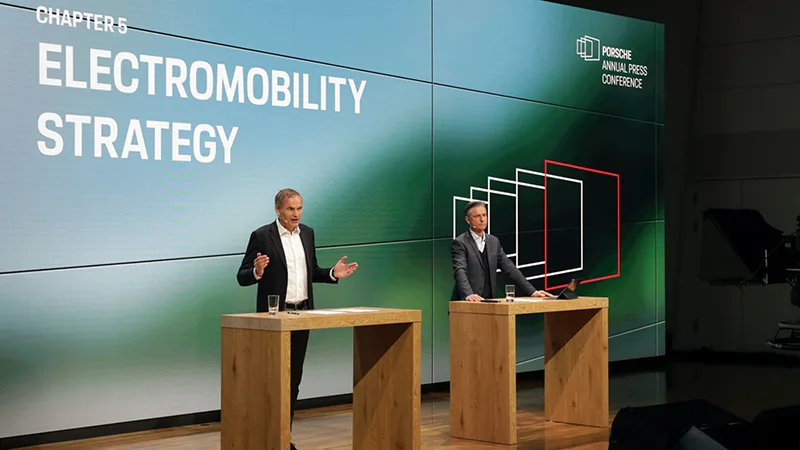
Porsche recently shared an official announcement detailing its strategy for the foreseeable future. At first sight, it could look like the company is going back on its electrification plans after a few years of relatively underwhelming performances and heavy depreciation that affected the Taycan so much, it has almost become a symbol for the risks of buying luxury electric vehicles. However, on a second look, it appears there is more to it. But let’s back up a bit and look at the brand’s recent history.

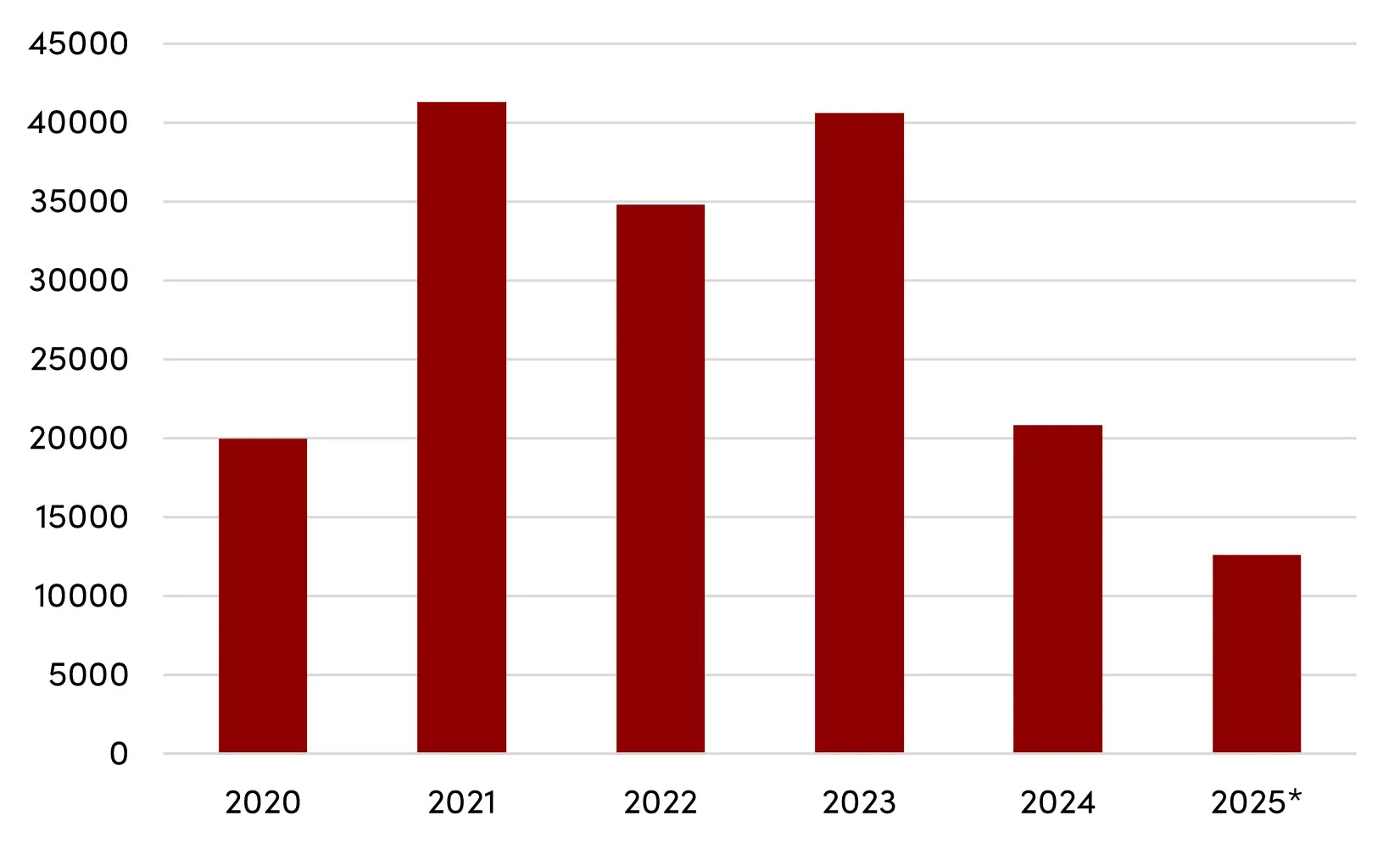
Since launch, after a first period of strong interest by early adopters during which the Taycan sales grew quickly, the performance of full-electric vehicles has not satisfied expectations. After peaking in 2021, sales have stagnated at best through to 2023, and due to low demand and depreciation, they halved in 2024, going back to 2020 levels. In the first 9 months of 2025, Taycan sales fell by another 10% compared to an already poor 2024, but the new full-electric Macan seems to have obtained good results overall with over 36,000 units sold. These not only outpaced the 28,533 ICE ones but resulted in a total of 64,783, increasing by 18% the Macan sold up to Q3 2024.

Porsche's Yearly EV Sales (2021- Q2 2025*)

ev sales porsche

So, going back to Porsche’s recent announcement, while a substantial scale-back on electrification is definitely a key step in this renewed business and product strategy, the objective is not just steering away from it. But first, let’s see the announcement in detail.

Porsche’s key measures

The first line in the press release states the upcoming product line will be supported by ‘brand-defining’ models featuring combustion engines. These will likely include the 911 ahead of any other, and all its derivates.

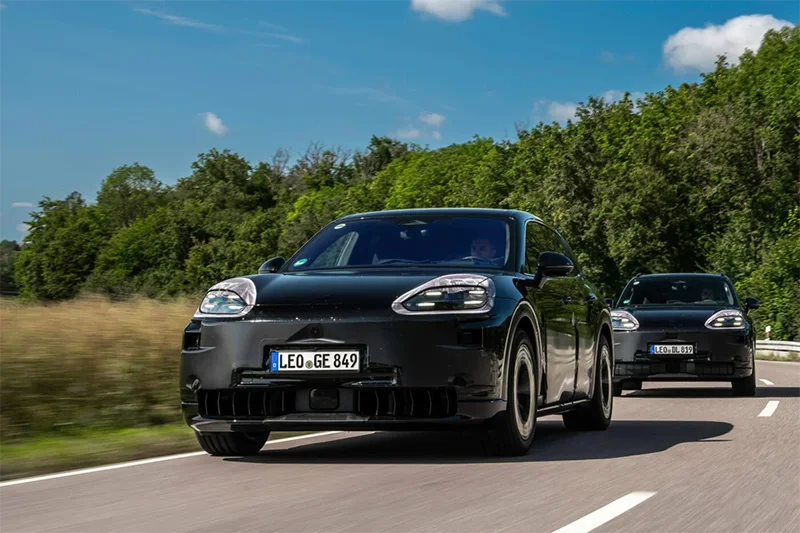
Additionally, the new SUV line, which will be positioned above the Cayenne as was initially planned as full-electric, will be offered at least in its early phase only with an internal combustion engine (ICE) or as a plug-in hybrid (PHEV).  

The ICE models already present in the lineup will receive a longer life cycle, and in between these and the eventual electrified substitute, more models have been added. Similarly, the new EV-dedicated platform planned to be released in the 2030s will be delayed.

porsche cayenne copy*New Cayenne testing

Finally, the current full-electric models (Taycan, Taycan Cross Turismo, and Macan) will continue to receive updates and remain a consistent component of the product lineup. Additionally, a new all-electric Cayenne and 718, derived from the Mission-R teased a few years ago, will be added to the lineup as well.

According to the statement, while these measures are organised to secure long-term financial success, Porsche expects them to lead to additional depreciation and potential provisions. The financial expectations for the year are of similar revenues, but lower returns than previously forecasted. Lower automotive EBITDA is expected as well.

What does it mean for Porsche’s strategy?

The potential of electric vehicles is not overlooked, but requires a more cooperative effort by the group. After the many difficulties faced by Volkswagen software developer CARIAD, the Group has turned to American Rivian to create a Joint Venture that will grant them expertise to develop SDV platforms, both hardware and software, for the upcoming generation and new software.  

In the words of Porsche’s CEO Oliver Blume, with this strategic shift, the OEM wants “to meet new market realities and changing customer demands”, “These decisions build on the previously announced initiatives and help us to achieve a very balanced portfolio. This increases our flexibility and strengthens our position in a currently highly volatile environment. […] we want to meet the entire range of customer requirements.”

oliver blume*Porsche CEO Oliver Blume

The new strategic arrangement allows Porsche to be ready and more responsive to such an uncertain and fast-changing market. Sports cars, GT, and SUV lines will all offer choices between ICE, PHEV, and BEV powertrains to be able to cater to any potential new request. Through innovation and flexibility, companies can reduce risk by diversifying the product portfolio to maintain business stability. On top of that, effective marketing is the key to communicating to clients this diversity, the relative added value, and competitive advantages, building a stronger brand image. In these market conditions, this strategy builds resilience and ensures relevance by also playing on the brand strengths in the face of inevitable change and an increasingly stronger competition.

In time, this could also translate into a deeper diversification by adopting a geography-based approach that is usually not applied (or in a very limited way) by luxury brands such as Porsche. A 2019 research by the Journal of Risk and Financial Management investigates how this type of diversification can positively impact a company’s financial performance both in terms of return on assets and return on equity. From the research, the varying results obtained with different diversification models are explained through inefficient utilization of resources, especially in terms of innovation for a specific market. Additional risk with this approach is identified for both product diversification and geographic diversification based on the Agency Theory, with managers opting for diversification strategies that fit their personal benefits. These instances naturally negatively affect the financial performance, even though not in the totality of cases.

While it would be extremely capital-intensive for a luxury automaker to develop entirely new products for a single market (even though there could be noteworthy considerations to make for large markets such as China), a higher-level strategy seems feasible. One relatively common solution for the Asian markets in the past has been to introduce exclusively for those regions extended-wheelbase models. As the Chinese EV market continues to grow more rapidly than any other, Porsche caters to a more “traditional” audience used to the added value of its ICEs performance stabilising its business globally. At the same time, it can continue to develop its next-gen electrified generation more effectively and with less pressure to address the Chinese market and other more EV-focused ones that might develop in the coming years.

Is China moving away from European Luxury?

  • Brand: Aston Martin, Ferrari, Lamborghini, Porsche
  • Topic: Electric Vehicle Market, Supercars Future

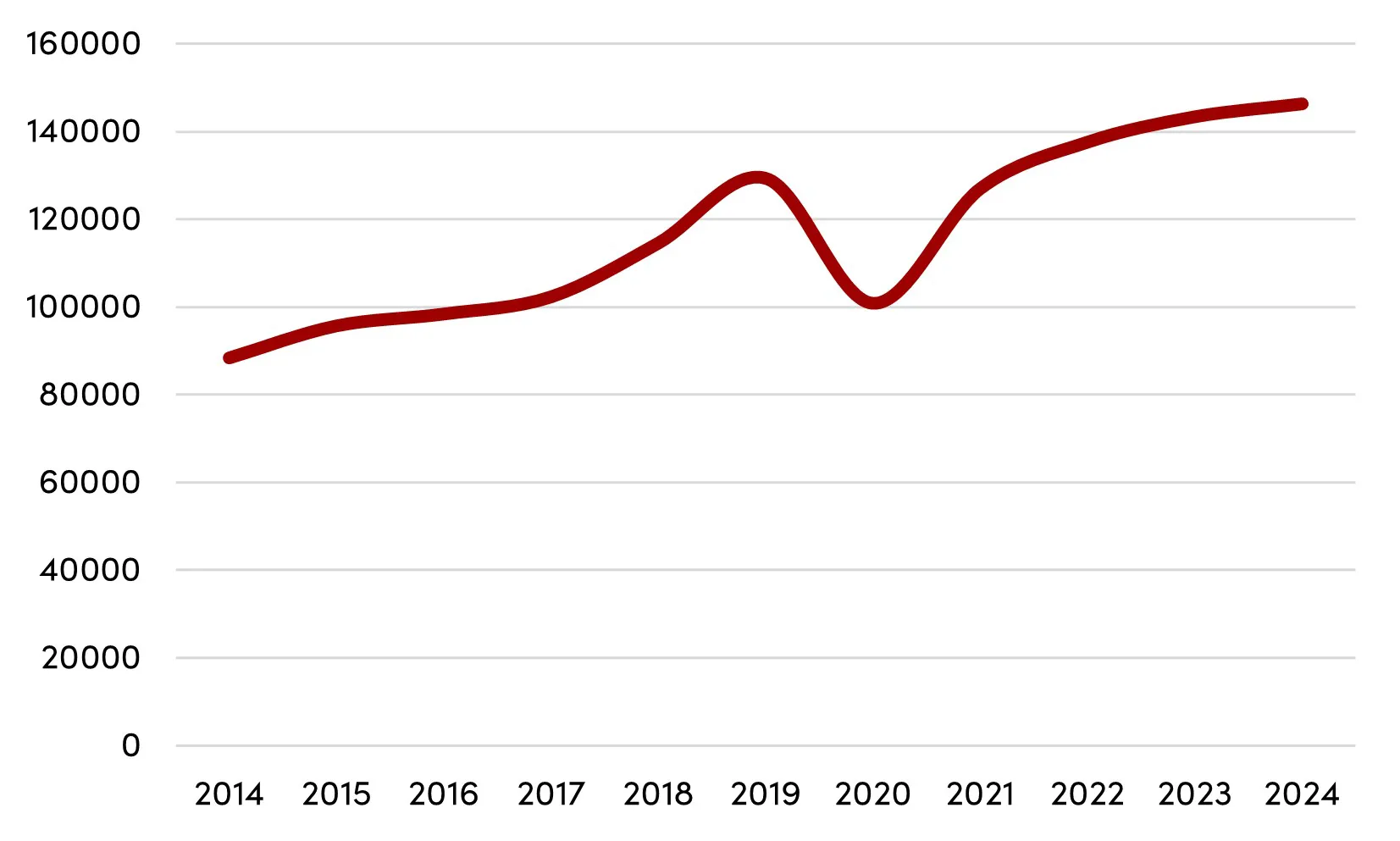
Over the past 10 years, the luxury car market has grown consistently, with several brands growing to financial and sales volume peaks in their history.

Yearly Luxury Vehicle Sales (2014-2024) 

luxury sales*The Graph includes annual sales by Aston Martin, Bentley, Bugatti, Ferrari, Koenigsegg, Lamborghini, McLaren, Pagani, Rolls-Royce, and models above the €150,000 mark from Porsche, Lotus, Maserati, Audi, Mercedes, and BMW.

While in the aftermath of the pandemic, it took only two years for the luxury market to reach and exceed the previous peak reached in 2019, the trend that seems to emerge and that could be confirmed in 2025, considering the volume reported so far by major OEMs is one of gradual slowdown or, in a worst-case scenario, stagnation.

A big factor in this trend could be the radical transformation of the Chinese market. Because, in this growth over the 2010s, the USA has almost always been the largest single-country market for most of these OEMs. However, a close second, and quickly growing (for some even larger than the US), has been China.

Porsche is one of the best examples of this. After a launch in 2001, by 2015 China had become the single largest market for the German automaker and has remained so up until 2023, when, with a 25% share of sales overall, it was overtaken by the USA at 27% (while Porsche still recorded a healthy +3.3% volume growth). And this is part of a larger trend that can be observed across different companies.

A luxury slowdown in China

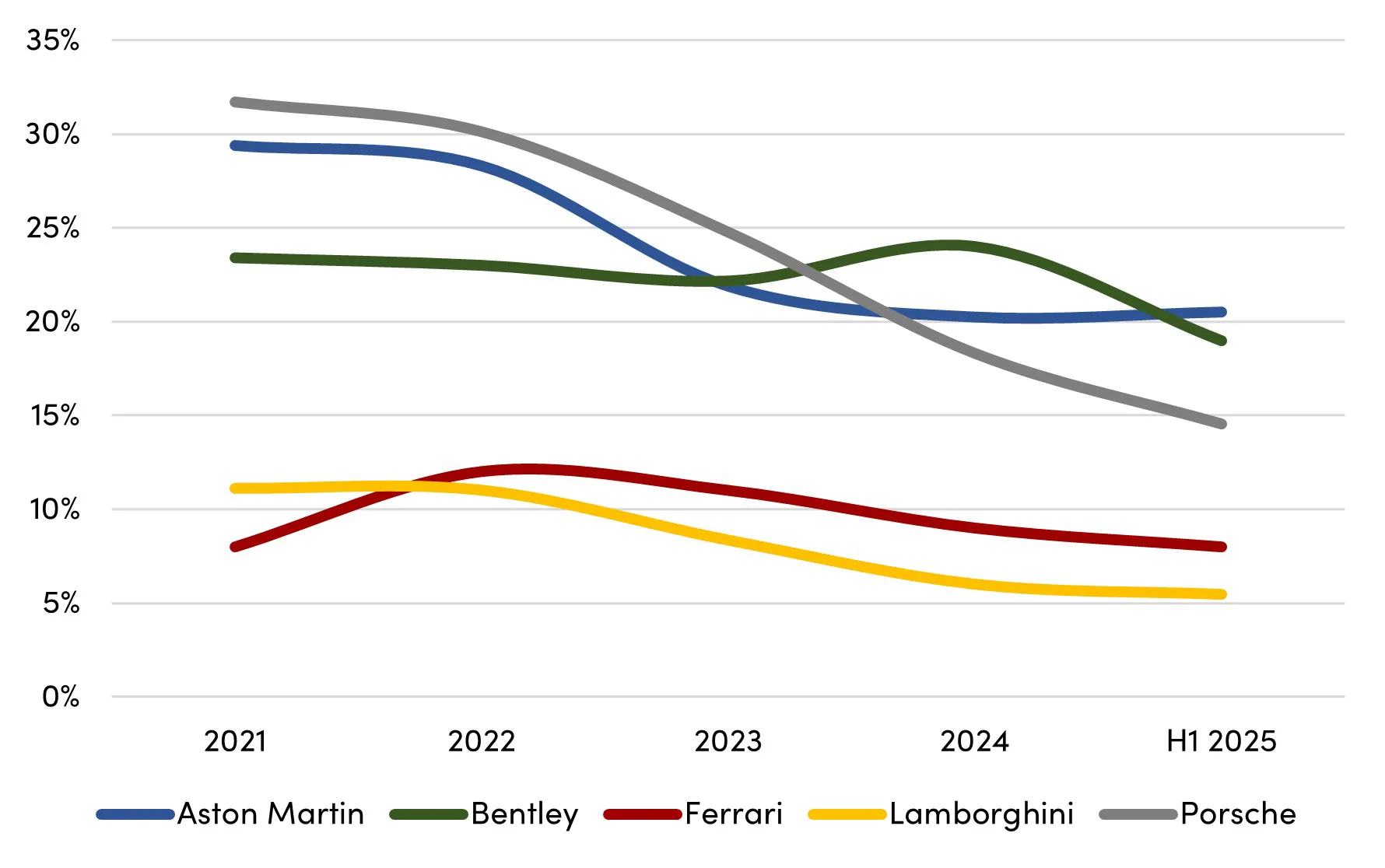
By looking at regional sales from automakers that shared the data over the past few years, it is evident a gradual slowdown in the Chinese market across the industry.

Luxury Automakers Yearly Share of Sales in the Chinese Market (2021-H1 2025)

china share

Since 2021, the one company that has remained more stable and for which China was never the largest market, as a much larger share of its sales relies on European Markets, with a sizeable one in the US as the largest single market, is Ferrari. Despite this, Ferrari too shows a slight decrease from the 2022 peak. A similar situation is observed for Bentley, for which China sales share remains quite stable, and a more noticeable slowdown is visible only in 2025 so far. It must be noted, however, that while shares for the British companies have remained mostly unchanged until last year, the overall sales figures haven’t. Sales in 2024 for Bentley were 30% lower than in 2022.

In the middle is Aston Martin, for which this decrease has been more evident, from a 29% share of sales in China in 2021 to 20% in 2024 and 2025 so far. The company, though, similar to what has been just said for Bentley, has also experienced a sales slowdown in 2024, and likely in 2025 too, albeit less dramatic than that of its British competitor.

Worse off, in this overview, instead appear Porsche and Lamborghini. With some ups and downs for the first one and consistent growth for the second, their presence in the Asian market has shrank more markedly than for the others. Both companies under the VW umbrella have seen their share of Chinese sales halved over these four and a half years. Porsche went from over 30% in 2021 to just 15% so far in 2025, and Lamborghini over the same period from 11% to just 5%.

Why is this happening?

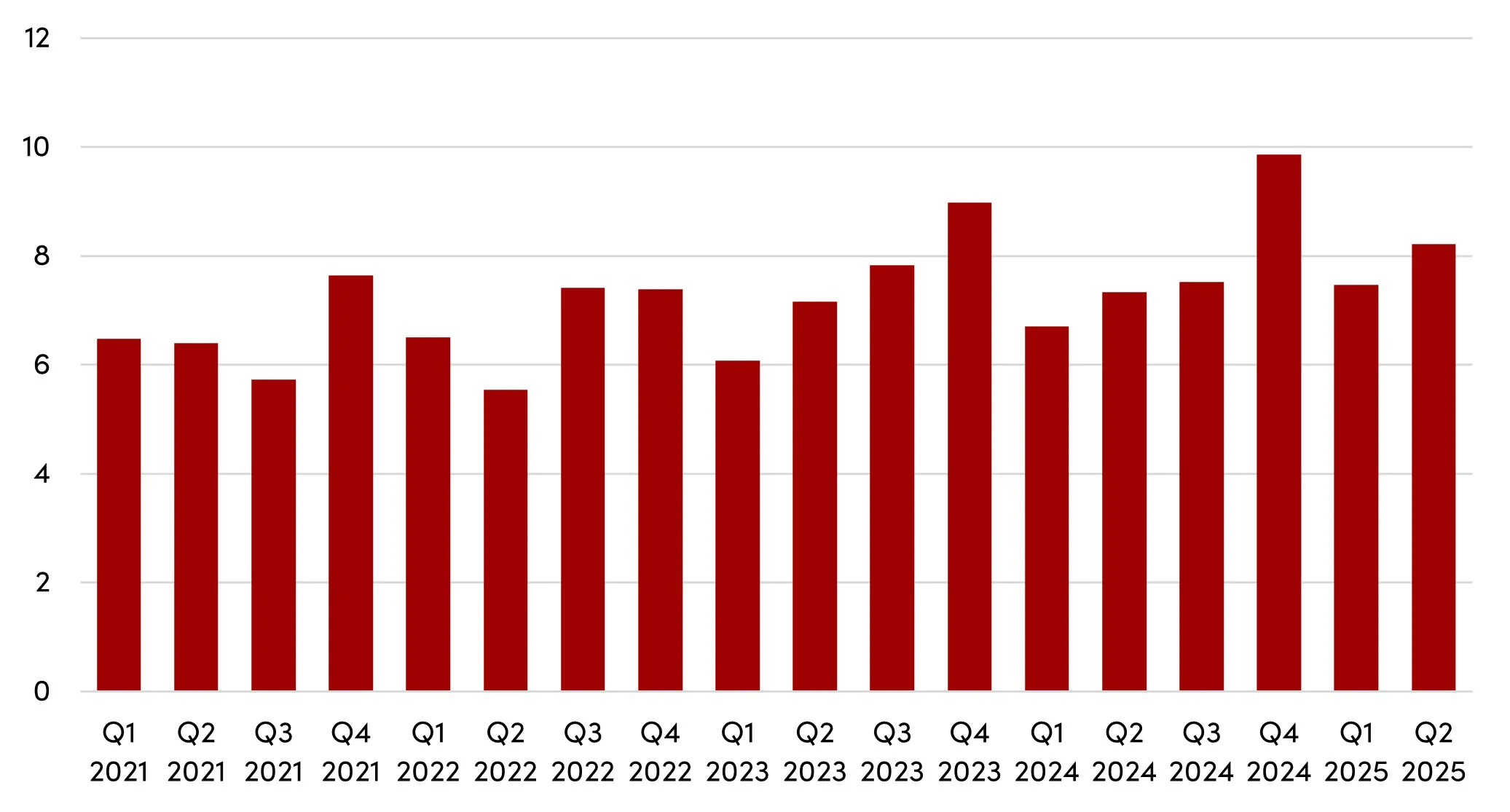
The Chinese automotive market has not slowed down, but actually kept growing after recovering from the pandemic, reaching 30 million in 2023, exceeding that in 2024, and 2025 seems on track to get even higher.

China Passenger Vehicle Quarterly Sales (2021- H1 2025) 

quarterly sales

However, Chinese customers are increasingly buying domestic brands, vehicles, and technology. The introduction of EVs has been the perfect opportunity for the Chinese government to push for a fast change in a market that had been dominated by European automakers up until a few years ago. This came mostly thanks to their performance, quality, and brand equity, all coming from a much longer experience. The most established segments, therefore, were the premium and luxury ones. On the volume side, while foreign OEMs had a consistent share, that was already decreasing earlier due customers' price sensitivity and Chinese OEMs' lower prices.

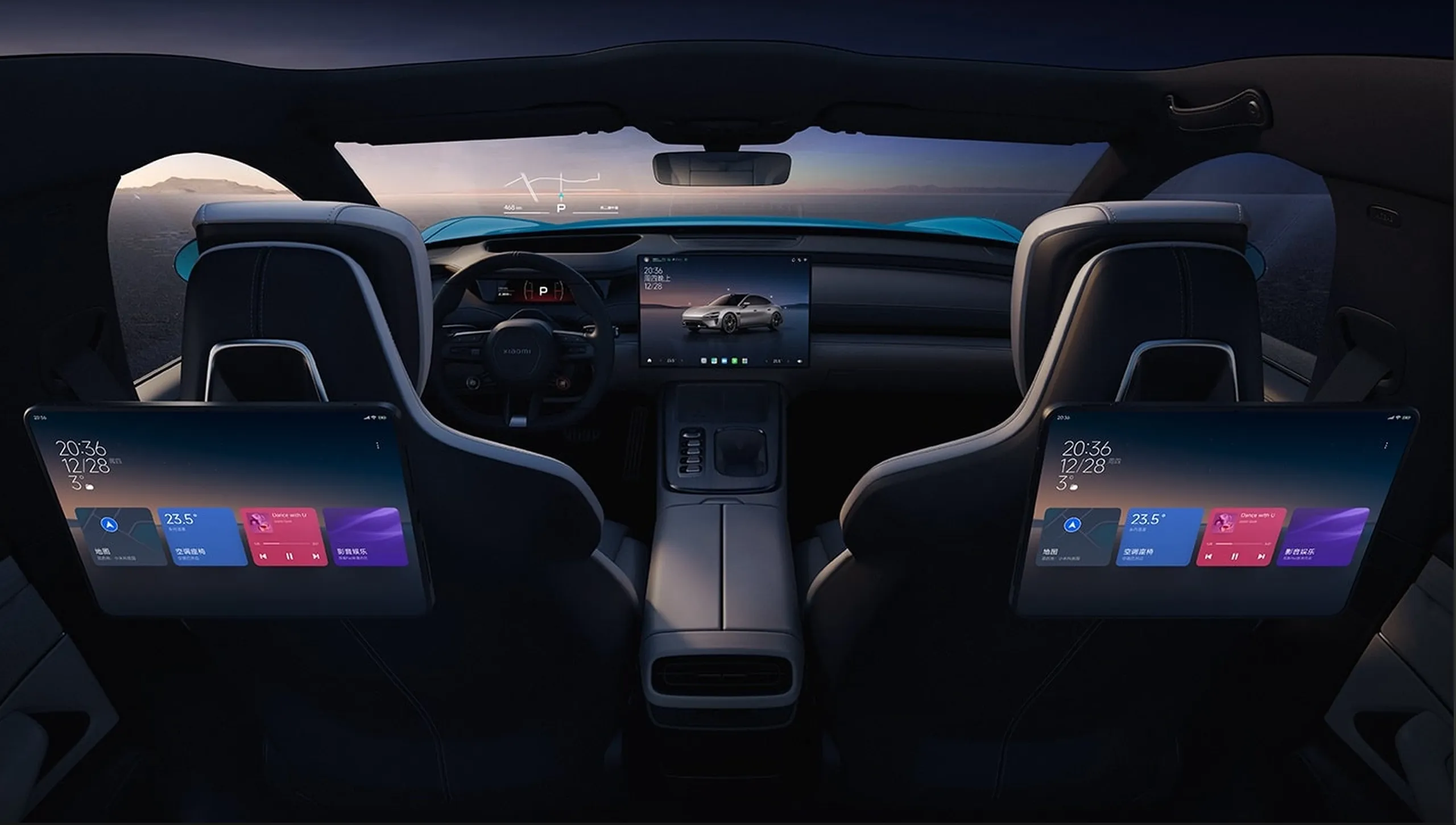
So when it came to luxury, the introduction of the electric powertrain leveled the playing field in terms of performance, and domestic companies also learned throughout the 90s and 2000s’ joint ventures with which foreign brands entered the Chinese market. Additionally, Chinese brands were better at interpreting their customers' preferences and offering them a new automotive experience focusing much more on software capabilities and convenience features compared to their European counterparts.

Some of the legacy luxury OEMs are actually going back to older solutions like the manual gearbox because their average customer wants that feeling of driving engagement that is lost with increasing automation. Chinese companies instead went in the opposite direction, going all-in on technology and creating a new and highly customizable experience for a customer base that generally has not the same long-standing attachment to combustion engines and the feeling they bring. Thus, it does not have the same expectations of driving performance from a luxury brand, but is actually showing to care more about technology.

xiaomi su7*Xiaomi SU7 interior

With significantly cheaper prices, many Chinese OEMs offer an in-vehicle experience that aims at driving performance but also a lot more, while the value proposition of European OEMs offering has likely become somewhat less relevant to the point where even the stronger branding cannot compensate the perceived lack of features and technology.

Can European OEMs turn this around?

The stronger players in the sector are managing to keep stable sales and constantly improving financial results thanks to significant increases in revenues coming from personalisation programs.

This strategy has been working very well for most players involved, led by Ferrari and Lamborghini, but also OEMs in more uncertain conditions, like Aston Martin, have reaped the fruits of this trend improving consistently their average selling prices over the last few years.

A gradual diversification of the product lines with the introduction of fully-electric vehicles that have currently been postponed for most luxury OEMs, could bring back the interest in the Asian market. However, improving success in a single market, however large, might not warrant the substantial investment needed for the development of these models.

The other option could be to gradually shift toward even more exclusive and limited models with a strategy closer to what the likes of Koenigsegg or Pagani have been doing. This would definitely shake the current company structure for these established OEMs, but potentially ensure strong profits with a more limited production that could also shield customers from depreciation that has been plaguing the segment lately, even for limited-run models.

New Online Course Available Now

  • Brand: Aston Martin, Bentley, Bugatti, Ferrari, Lamborghini, Maserati, McLaren, Pagani, Porsche, Rolls-Royce, Mercedes, BMW
  • Topic: Electric Vehicle Market, Finance, Strategy & Marketing, Supercars Future

Following up on the first half of the Luxury Automotive Strategy and Marketing online course published a while back, the second half is now available on Udemy at the link HERE.
As for the previous one, this course too is thought for enthusiasts and university students who want to learn more about the workings of the industry. While it is not necessary to have completed the first half to be able to understand and learn this second one, the two are closely linked and form a complete picture.

So, after learning about the key players in the industry and how their branding and strategies compare to each other, this new section looks at market dynamics highlighting the main trends, some academic analysis of them, and an overall view of the global luxury market numbers. Last but not least, a couple of interesting case studies conclude the course comparing diversification strategies and innovation in luxury automotive.

I hope you'll enjoy it. Don't forget to leave feedback and get in touch to know more.

Cover homepage alt copy 3

Are Luxury Performance EVs Dead in 2025?

  • Brand: Porsche, Rimac, Rolls-Royce, Mercedes
  • Topic: Electric Vehicle Market, Supercars Future

2024 was a complex year for the automotive industry, with legacy automakers losing significant ground either in EV market shares, financial results, or both. This is due to several factors affecting the industry. Geopolitical, technological, and trends among consumers. While there is no doubt that the future of automotive is electric (at least in large part if not completely), the same might not be completely true for the luxury performance niche for the foreseeable future.

EVs are “young”. While cars have been around for well over a century, the true development of consumer-ready electric cars is barely around 15 years, and there are still countless areas of significant improvements that can completely change the product and user experience in years to come. Going from batteries to software, and more.

After early adopters jumped on the bandwagon and the excitement “died down”, it left space to critics and doubters. This, particularly in 2024, is reflected in a significant drop in EV sales in the West. China is the great exception, with EVs not only growing but reaching around 65-70% of the global share.

Luxury Automotive OEMs review their electrification strategies

It is throughout this difficult period for the industry with many OEMs committing significant investments in EV-related technology, like Ford's $14 billion for the EV expansion in the US, that some started going back on their development strategies.

The latest of which is none other than Porsche. The German automaker has been a strong and early promoter of the new powertrain technology, with its Taycan, initially named Mission E, and many more in between from concepts like the Mission R, or Mission X, to actual all-electric production version of its “traditional” lineup like the latest Macan.

It has to be said that Porsche never fully went in only one direction. A while back they made the headlines with their big investment in E-fuel development for their legacy models and classic cars (Link E-fuel article here), but an estimate of their investment in EV technology just in the last 3 years is around $25 billion.

Only a few months ago Porsche announced it was reviewing its EV strategy stating they are reducing their EV development targets. Key reasons for this have been sluggish sales of its EV models due to low demand, the significant investment required to continually develop software and technology for its new models, and, not to be underestimated in the luxury sector, the drastic depreciation hitting EVs in general, trend for which the Taycan has unfortunately become a symbol.

Porsche Taycan Depreciation over 1 and 4 years

depreciation

A quick look at the Taycan (Coupé) current rate of depreciation shows a quite worrying situation, that any buyer in this segment would seriously consider before the purchase. Compared to 2024’s prices for the different trim levels as new starting at £86,000, and topping at £161,000 (excluding the Turbo GT version that was not available in the previous generation Taycan), models purchased earlier in the same year depreciate by an average of 31% on starting prices that do not include options yet, and over 51% in 4 years. If options were included in original sales prices these percentages would increase even more.

A first announcement by the German automaker stated that the previous target of 80% of BEV sales by 2030 might not be achieved due to factors previously stated. Chairman Lutz Meschke said: “We will refresh our combustion engine cars, including the Panamera and the Cayenne, and of course, we will continue to rely on plug-in hybrids”. He continued “When it comes to research and development, you’ll see more flexibility in the upcoming years. We will develop new combustion-engined derivatives in order to give the right answer to customer demand”. This could, for example, be reflected in the decision of releasing an ICE version of the upcoming 718 that was notoriously set to become a BEV only, announced by the Mission R concept a few years ago, to try and renew the product line and revive its sales that has been somewhat slow over quite a few years.

mercedes cla elettrica*Mercedes-Benz BEV CLA Concept

Right before the German automaker, compatriots at Mercedes-Benz went through a similar process. Initially the development of the MB.EA-Large EV platform planned for 2028 was halted, then came the delay of the target of 50% sales of electrified models (BEVs and PHEVs) from 2025 to 2030, and it’s a few days ago the announcement that the production of the CLA concept unveiled a while back has also been delayed due to development issues.

In Great Britain too, automotive OEMs follow the trend. Aston Martin, amid a slowly and very gradually recovering financial situation, delayed the announcement of its first EV to 2026 which was initially set to come this year. Geely-owned Lotus has reportedly abandoned the plans to go 100% electric and Bentley too, which was set to reach the same target by 2030 confirmed that hybrids will likely remain on sale even after that date.

Is there more to this trend?

As mentioned previously, China is going strong and its EV market is in constant evolution with serious competitors coming to the global stage and making the headlines with important achievements. These days in the Western media the peak of this wave has surely been Xiaomi’s SU7 which in its “Ultra Prototype” iteration (which is not road legal) managed to attract everyone’s attention with a lap time of 6:46.874 at the Nürburgring Nordschleife becoming the fastest EV on the track. It comfortably outpaced the £1.8 million Rimac Nevera (7:05.29) and the new £186,000 Porsche Taycan Turbo GT with Weissach Package (7:07.55) with a prototype that is said to cost just around £94,000.

While this is working well for the mass market though in China, luxury automakers have a different and much smaller customer base, and on top of that for several of these brands the largest markets are still in the West (usually the USA) and currently made on average in larger part of people around 50+year-old or older. This demographic, grown up with specific expectations about the performance and sensations that a performance luxury car can and should offer seems fairly opposed to electrification and its added value proposition compared to combustion-engined cars. So, this is the obvious and most likely factor due to which the market niche is highly likely to remain mostly ICE-driven in the short to medium term, with hybrids decisively taking their place.

There are potential alternatives with the likes of Ferrari attempting a new approach to BEVs as discussed previously, or a new developing trend of Extended-range Electric Vehicles (EREV) which is mostly aimed at solving range-anxiety and thus not likely to make luxury car buyers fall in love with performance EVs.

xiaomi record*Xiaomi sets lap time at the Nordschleife

The most emblematic example of this change happening over the last year or so is the statement released by Rimac’s CEO Mate Rimac confirming that luxury car buyers simply do not want performance EVs. According to some, this could be hinting that upcoming models by the Croatian brand will get some sort of internal combustion powertrain component. In terms of sales the only exception in the year just passed has been the Rolls-Royce Spectre, which is naturally not focused on performance and thus (as founder Charles Rolls said over 100 years ago) takes advantage of the silent and smooth powertrain enhancing all the characteristics that brand’s clients look for.

What could be next?

As the market composition, especially for traditional luxury automakers seems unlikely to drastically change in the short term, a significant change could be once more driven by forward-looking markets like China.

With the offering of sporty BEVs increasing in China, customers more used to, or growing up in a market dominated by EVs may first start trends that define new value propositions more suited to the electric powertrain that go beyond straight-line acceleration (already proven not sufficient to convince sceptics) and would probably fall in technology applications and EV-specific driving-related use-cases.

Last but not least, a determinant factor that could change traditional performance car buyers’ mind is a revolution in EV battery technology. If new chemistries bring a significant improvement not much in power density, but in volume and weight reduction like some such as solid-state promise, they could help OEMs bringing down the overall cars' weight to the 1,500 kg average of current performance cars and thus significantly benefit dynamics and driving capabilities.

Has Luxury Automotive Peaked in 2024?

  • Topic: Electric Vehicle Market, Supercars Future

2024 has seen mixed results so far for luxury automotive companies, with brands continuing their strong performances (albeit with an ever-shifting business model), others that are stabilising, and others again that are instead going through significant difficulties.

Luxury Automotive Yearly Sales (2019-2024) 

sales*2024 Projection accounts for Q4
**The Graph Includes sales from Aston Martin, Bentley, Ferrari, Lamborghini, McLaren, Porsche, Rolls-Royce

The graph including the key brands in the space, shows the market's continued growth over the past 8 years averaging over 15% even with the sharp drop due to the pandemic impact which has seen a recovery with results exceeding 2019 levels just a year later.

Winners and Losers

Most brands with generally strong sales figures have seen a significant decline in sales or remained mostly stagnant up to Q3 2024. Specifically, British iconic brands Aston Martin, Bentley, and Rolls-Royce, volumes shrank by 17%, 27%, and 13%  respectively.

Aston Martin is rebuilding its brand and has recently renewed its entire lineup with the latest Vanquish, and the new Vantage following the updated DBX and DB12. With increased average selling price once more, if volumes are delivered, the brand is expecting positive financial results in 2025.

Bentley and Rolls-Royce attribute the slowing sales to challenging market conditions and a calculated slowdown due to renewing lineup respectively.

Porsche (numbers here including only their 911s' sales) and Ferrari remained mostly consistent with just a 2.5% and 0.1% increase, which especially in Ferrari’s case, with improving financial performance, is deliberately limited indicating a continued positive period for the Italian brand, as reported in the previous article New Luxury Automotive: Going Beyond Performance?.

The only ones that saw a strong improvement were the other Italian brand Lamborghini with a +8.6% thanks to the entirely renewed lineup featuring 100% hybridised models Revuelto, Urus SE, and the latest Temerario, and McLaren whose sales grew by 17% although it must be noted that this performance is still part of the brand’s gradual recovery after the 2018 peak and drop in 2020. McLaren too is in a renewal phase with the recent launch of its W1 following the updates with GTS and 750s models.

lamborghini lineup*New Lamborghini fully hybridised lineup

The projections following the 2024 trend for each brand bring for the first time in several years sales that are smaller in volume than those of the previous one. But what could that mean? Has the industry peaked, is it general economic conditions or there is something more specific going on in the industry?

Wider trends

What is happening in Luxury Automotive could be part of a larger trend in the luxury space. In 2024 in fact, several reports warn of a modest decrease between 1 to 3% in the first 2 quarters of the year, with projections for the close of the year equally cautious, varying between -4% and +4%.

The faltering demand in many sectors is attributed to macroeconomic factors. Rising prices (well documented in luxury automotive) against stagnating GDP in many countries, geopolitical uncertainty with conflicts increasing and public perception more and more divided would all contribute to a crisis that has the potential to affect different sectors in luxury for some time. Part of this ongoing trend is also China. With a 20% downturn the Asian country, which for many brands (and not only in automotive) is by far the largest market, affects negatively the global one. The situation is likely to be exacerbated by the recent US Election and the threat by President Trump of additional tariffs on Chinese goods. So, the more conservative approach toward disposable income might continue into next year as well.

A report from Vogue Business analyses the problem as a loss of sense of belonging among customers toward luxury brands. The value proposition in luxury products accompanied by unique services and customer experience is apparently shifting and not sufficient anymore.

"Brand VIP experiences have become homogenised, which makes the high-net-worth customer value them less" says an industry expert interviewed on the report.

What about Automotive going forward?

The wider automotive market is also struggling globally. S&P Global reports a -18.3% in Europe in 2024 so far, and -12% for the USA. China, on the other hand, in the volume market saw a modest 4-5% increase in the first quarter driven by new subsidies followed by generally uncertain results over the following months. This brought a 2.4% growth overall in the first 9 months of the year, as reported by CAAM.

China Domestic Market Monthly Sales (2022-2024)

china sales*Source: China Association of Automotive Manufacturers

Despite the different dynamics in the two segments, one constant for both is the decline in electric vehicle sales or commitment by some brands. Electrification seemed to be the next step even for luxury automotive, with more groups introducing hybrid models, and some starting with full-electric as well. Additionally, there have been the likes of Rimac, Pininfarina, and a plethora of other startups that started working on highly limited runs of electric hypercars claiming eye-watering performance figures that no ICE performance car ever reached. For a while, these cars looked like the new competitors that legacy brands would have to face and follow if they wanted to avoid being left behind. However, ultimately, consumers chose, and their voice (as a relatively small crowd) was loud. Brands started going back on their strategies and production plans to preserve their internal combustion engines.

Overall this slowdown is most likely caused by a mix of factors listed in this article, and while in business we can’t predict the future by looking at the past, it is possible to interpret the meaning of the current trends in the industry.

The past decade has seen consistent growth in the luxury automotive industry, driven by an increase in wealth in rich countries, with the emergence of new large markets (China ahead of everyone else). Also, the advent of social media, with a culture often based around an exterior image of success, shifted the attention toward material goods, and at the same time, the new wave of young wealthy individuals often coming from these very contexts became an increasingly significant share of buyers for luxury automotive brands. Porsche and many others reported how the average age of luxury car buyers has sharply decreased over the past decade.

The new business model in luxury automotive with cars themselves becoming more and more just a “part” of the whole experience, now enriched by personalisation and exclusive services, has also helped brands increase their margins (again as shown in the previous article) even with sales remaining the same, which in turn helped their exclusivity. But here too, like in other sectors of luxury, the value proposition that customers look for might be changing.

The automotive industry, regardless of the powertrain of choice, is changing and with it its customer base. The “saturation” reached over the past 10-15 years, saw new trends, but brands should ask what is next. A key challenge will be to decide whether to remain flexible and as dynamic as possible to accommodate new preferences and trends or maintain the course focusing on a core product line and strengthening exclusively the brand’s values.

Beyond products and services, in this industry the one constant that keeps proving a key factor for success is brand identity. A brand has to stand for something that consumers aspire to be a part of, whether it is because of its history or its success in motorsport, or its meaning in our wider culture.

New Luxury Automotive: Going Beyond Performance?

  • Brand: Aston Martin, Ferrari, Pagani, Rimac
  • Topic: Electric Vehicle Market, Strategy & Marketing

The current luxury automotive landscape is shaped by a specific trend that has influenced various players and could increasingly define new products in the near future. In a way, it might even seem like the industry is going backwards. But the truth is that recently something has fundamentally changed in how the value proposition of luxury cars is conceived. And electric cars might be a big part of this.

In the early days of the automotive industry, cars were rare objects for the rich and the daring who wanted to experiment first-hand with this new technology. Cars were not thought for the mass market and were entirely built by hand and highly personalised, at least until the advent of the Ford Model T in the early days of the past century. In Europe in particular the trend of hand-crafted cars and coachbuilders who would specify a body according to the client’s specifications continued for a while. Along with the aesthetics, one of the defining characteristics of cars at the time was performance, and racing was a powerful marketing tool for it.

This is true today as well, but there is more going on. I have already touched previously on how customization is gaining more importance today, and how it has become a significant share of companies earnings (to know more check Tailor-made: What luxury car customers can't go without and One-off Supercars: What’s the next step for luxury automotive? ). In its Q2 2024 report, Ferrari quotes a +16.2% in revenues, and as it happened several times already, among the contributing factors is consistently mentioned increased popularity of personalisation programs, which also allows for the significant margins made on every single vehicle sold. But in the modern industry of supercars and hypercars it is becoming more and more common to see taglines about “the fun of driving” or “driving involvement" rather than the continued comparison of 0-100 km/h (or 0-62 mph) times and top speeds that has been the benchmark of most new performance cars’ headlines for many years.

The trend has been developing for a few years now. Ferrari is a prime and most successful example of this and it is visible in the comparison between revenues and sales figures over the last few years. Right after the pandemic and the quick 2021 recovery, revenue growth remained consistent at almost 20% while sales growth has been gradually limited toward the 15,000 units mark dropping significantly to around 3% in 2023 highlighting the increasing margins made on each model thanks to increasing personalisation demand. 

Ferrari's Sales and Revenues Growth Percentage by Year (2020-2023)

ferrari growth

Enjoyment over performance

With the advent of electric performance cars, obliterating normal combustion engine cars in acceleration performance, some initially thought this new technology benchmark would be the driver for the future of the industry. But, at least for now, things are going in a different way.

Despite environmental regulations limiting emissions and engines’ size, which have been the main factors in the growing adoption of turbochargers and superchargers for automakers to keep boosting performance, we are seeing more “going back” to naturally aspirated large high-revving engines. This is naturally, in part, allowed by the fact that environmental restrictions are different for low-volume manufacturers, but hybridisation is one key enabler for this. Supporting electric power allows OEMs to maintain engines that become the centrepiece of a vehicle by offering more involving and immediate response when driving, along with the soundtrack that all collectors love.

The same goes for manual gearboxes. While dual-clutch transmissions and other more daring alternatives (from the likes of Koenigsegg) have reached high levels of refinement with smooth and lightning-quick gear changes, once again OEMs are finding a key selling point in the involvement and driving enjoyment that a manual stick shift offers. While more classics-inspired low-volume automakers like GMA had that single formula right from the start, others are going back to it. Aston Martin recently produced a few limited editions with manual gearboxes. The same goes for Pagani, which not only reintroduced it in its latest Utopia but also made it available for unique iterations of the Huayra. The Italian automaker also claimed that so far over 70% of the very limited Utopia production run has been ordered with a manual gearbox.

manual gearbox*Aston Martin Valour and Pagani Utopia reintroducing manual gearbox

All these trends suggest that as technology has improved and made a leap forward, unlike in the old days, some OEMs have understood that performance numbers can only go so far, and what counted the most at the end of the day for a car owner was the enjoyment and driving involvement, rather than 0.1 seconds less to reach 100 km/h.

Luxury OEMs changing plans

One of the most controversial pieces of news around the topic came a few months ago from an interview with Mate Rimac. The founder and CEO of Rimac Automobili has, in just over 10 years, become the one symbol worldwide for performance automotive electrification as discussed in previous articles on Rimac’s growth and marketing. Its Nevera has become the fastest-accelerating road-legal car in the world to the point where most other top-of-the-line high-performance supercars would seem slow in comparison and has also broken many records. After all this, however, a few months ago, Rimac has been quoted as saying that the future of electric hypercars is uncertain because clients simply do not want them. The reasons for this would apparently, be a refusal to accept a product that is seen as “imposed by politics” with environmental regulations pushing greener vehicles, and a lack of emotional connection with such cars. As mentioned earlier, clients today want more and more something that is unique. Electric vehicles are becoming mainstream, and at the same time instead loud cars with big engines that were already rare are becoming even more so. These would be the key reasons driving clients away from EV supercars and toward a more familiar experience of performance and sound involvement, even if this means inferior performance.

In this context, two companies are taking different but equally interesting action on the matter. On one side, Aston Martin recently announced that they delayed their upcoming EV by at least 1 year (from 2025 to 2026) due to low demand. They instead stuck with big V12 engines and a limited application of hybrid powertrains on the likes of Valkyrie and the upcoming Valhalla.

On the other, Ferrari is trying to “make the EV emotional”, by doing it differently from anyone else. A patent filed by Ferrari a while back shows a unique project for the potential development of an upcoming electric prancing horse.

 Ferrari's EV patent

ferrari new patents

The plans show how the new EV would feature an e-drive axle and a sound-transmission devise that uses air pressure and vibrations to send sound to the cabin via an acoustic conduit. No electronics or speakers were used to produce sound, making it not just an imitation like some proposed at times, but a proper sound, just likely different. Ferrari would also add resonators on the axles that should amplify the sound coming from the e-motors. Specific valves enabled by an ECU would allow the sound profile and volume to change and adjust in the same way as an active exhaust system opens and closes valves to increase the volume. According to Ferrari, the solution is not devised exclusively for added drama, but also to give drivers a better awareness of what the car is doing at any given time.

Conclusions

The industry seems to have come full-circle since its early days. On the marketing side, personalisation is an increasingly important requirement for clients and OEMs are getting an equally growing share of revenues from customisation programs along with unique limited runs of special editions, or unique models. And like in the early days of the industry, these cars have to be unique to represent the owner's status and identity.

On the other hand, though the technical driving force has changed. Technology for the sake of evolution and performance is being “refused”, with demand steering manufacturers toward larger combustion engines, manual gearboxes, and tactile analogue controls that one might have thought would start disappearing in favour of electric motors, automatic gearboxes (or none at all), and 100% of control integrated into digital infotainment systems. Performance is not as defining as it used to be, while experience both in the car and outside is so more than ever.

Lamborghini Releases Huracán Tecnica: Are Sports Cars losing their appeal?

  • Brand: Lamborghini, Porsche
  • Topic: Electric Vehicle Market, Supercars Future

A few hours ago Lamborghini released its latest and probably final version of the V10 Huracán as it approaches the hybridisation of its full line-up. The Huracán Tecnica. According to the Cor Tauri strategy, announced by CEO Stephan Winkelmann, and discussed here Lamborghini Reaches for the Stars with Stephan Winkelmann: Direzione Cor Tauri, over the next two years the company will renew its entire line-up and then move forward to release the fourth model which should finally introduce the full electrification at Lamborghini.

In the OEM’s history, the Huracán has been an extremely successful model, even more than the game-changing Gallardo before it. Also, thanks to the new updated releases it has proven to be resilient as well in its almost 10-year lifecycle. But then the Urus has come.

Huracan tecnica*Source: Lamborghini media

In the lower segment, however, the 2-seater sports car is somewhat losing relevance. Why is it happening? Can it still be the strategic answer for struggling automakers? And is this trend going to reflect on the top-end of the market as well?

Over the last few years, the “go-to model” to ramp up sales figures has been the SUV, and it is still the hottest segment at any level of the automotive industry. For a clearer view of the impact of SUV models on the luxury performance automotive market here are a few related pieces:

Looking back 25 to 15 years ago, that role was up to the “entry-level” sports car. But since then, things have changed. One example now is Porsche’s 718 family with Cayman and Boxster.

It is well-known how during the 90s’ Porsche was practically saved from bankruptcy by the introduction of the Boxster. However, lately, the segment has stagnated for a few years.

Porsche 718 Boxster/Cayman deliveries by Year (2005-2021)

boxster sales

Apart from the clear effect of the 2008 financial crisis, the Cayman/Boxster range has been steady and has actually shown a slight downward trend since 2017 (considering also the virus outbreak impact).

The factors determining this dynamic are various.

1. The Pandemic

As just mentioned, the pandemic is definitely a factor affecting the sales of sports cars in lower sections of the market. A report from Forbes shows how these two years with Covid-19 have unequally impacted different consumers in the US. Luxury vehicles sales from $70,000 upwards have increased. Below that, up until a $40,000 price threshold, they have just remained stable, while between $40,000 and less than $20,000, the sales drop has been gradually more severe as the prices get lower.

sportscar income*Source: Forbes

Also, while sports cars like the 718 are already in the premium pricing bracket, they represent the entry-level option. So while the super-wealthy are likely to opt for the top-of-the-line 911, younger customers or less wealthy ones will probably be more conscious about spending on a vehicle that does not provide everyday practicality. Porsche itself, in fact, claims that the average 718 buyer in China, its largest market, is 31 years old.

Car Industry Analysis confirms the trend reporting that over 2020 C and D sports segments in Europe suffered a -70% and -33% registrations respectively.

2. Chip Shortage

The lack of semiconductors supply following the lockdowns and the gradually recovering demand caused more sales delays and higher prices that even rippled into the pre-owned market. These factors have probably discouraged potential buyers from purchasing a sports car. So, the resources have likely been focused on everyday usable vehicles not just by consumers, but also by OEMs to reduce delays on cars more in demand.

3. Generational changes

Last but not least is the general change in preferences. SUVs today are generally preferred because of their practicality, and in many cases, they have just become more representative of the current lifestyle. Also thanks to technical development, automakers are able to produce sportier and more dynamic SUVs that offer a driving experience closer than ever to that of a sports car.

According to Road & Track in modern society, compared to the 1990s, financial conditions, and especially the housing market and even rent affordability are forcing millennials and genZs away from sports cars and car ownership in general.

Forbes too, along with financial reasons for younger generations, suggests a substantial underlying change in how they perceive driving as just a necessity to move from one place to another, and the ownership experience as a burden and a potential cause for concern. Not only that but it is suggested also that this combination of variables could be what eventually will drive the majority of people toward self-driving cars (when the technology becomes available). This would effectively negate the main value proposition of any sports car.

Going Forward

Going back to Porsche’s example, even though entry-level sports cars back in the day have done for OEMs what SUVs are doing today, it is difficult to imagine how the same situation could repeat itself. Especially considering that whatever market is present has been probably already captured.

This is where electrification could offer a new path. First of all in terms of appeal to younger generations. EVs are the most modern option and definitely closer to the way millennials and genZs are used to interacting daily. Secondly, environmental consciousness is also likely to play an important role in this potential development.

Unsurprisingly, as of now, there are no real full-electric affordable sporty options. Earlier last year though, Porsche showcased its vision for the future of this segment.

mission r*Source: Porsche Media

Presented in the shape of a race car, the Mission Rhas been said to potentially represent the future direction for the next generation 718. Also, it will be the most technologically advanced model that Porsche will produce in the near future. Offering performance, and technology but with (relative) affordability in mind. This paradigm shift could be key to revitalising the interest in small 2-seater sports cars.

The luxury market

Certain trends seen in higher volume sections of the market have transferred to the top-end luxury one. Entry-level, more affordable options for customers to gain easier access to aspirational brands have been successful in the past. Both Ferrari California, and Lamborghini Gallardo have proven that.

The Huracán has done even better and has been a consistent seller so far, reaching what President & CEO Automobili Lamborghini America LLC Andrea Baldi said to be the physical production capability limit of around 2,500 units per year.  

Lamborghini Gallardo/Huracán deliveries by Year (2005-2021)

huracan sales*Huracán sales began in 2014, summing up with the last 265 Gallardo units.

With over 18,000 units delivered it is the best-selling Lamborghini ever, even though Urus will exceed this figure soon. The SUVs' popularity, in fact, has taken the luxury market by storm as well.

However, even if luxury OEMs are boldly diversifying, extending their reach to attract different audiences, it seems highly unlikely that sports cars in this market will suffer the same fate as those from volume car manufacturers.

The main reason is that apart from luxury and exclusivity, the driving experience and car capabilities are not just part of the vehicle, but they are part of the brand. This is already a stronger value proposition. Plus, branding is much more important for luxury firms.

Secondly, luxury brands maintain exclusivity and resale value by limiting the production numbers. Even more so with the current trend of developing successive more focused limited runs, like we have seen earlier this year with the Aston Martin Vantage V12.

In the current market, the traditional 2-seater small sports car is not going back to what it was, and OEMs might decide to discontinue certain models (like Mercedes did with its SLC). While this loss of appeal could be part of the reason why we do not yet have an affordable fully-electric option on the market, some should arrive in the coming years. A different approach, like the one shown by Porsche to better communicate with younger generations, could prove to be the missing piece needed to revitalise this segment.

At the same time, low-volume manufacturers are gradually moving forward too, but thanks to the characteristics of the luxury market, its exclusivity, and the very own DNA of the majority of these brands, they are unlikely to see the same decline suffered by volume automakers.

Lotus’s first SUV Eletre and China’s strategy for Europe

  • Topic: Electric Vehicle Market, Strategy & Marketing

Today, car companies seem to have generally adopted one single strategy to boost sales and secure their financial performance. Releasing an SUV. And this happens at every level of the market, so in the luxury one too.

Porsche has been doing it for years, and each of its SUVs consistently sells around double the numbers of its other models combined (although the EVs addition has changed that slightly). Mercedes, BMW, and Audi are doing the same.

At the top end of the market came Bentley, Lamborghini, Aston Martin, and soon Ferrari. And all these brands (except for the latter as of now), have either doubled their sales, or the SUV has simply taken over 40-50% of the entire delivery volume.

Now, as we move deeper and deeper into the industry electrification OEMs are quickly moving to release electric SUVs. And this space in the premium segment between models available and coming soon will quickly become extremely crowded. To name some: BMW iX and iX3, Audi e-Tron, Sportback, and Q4 e-Tron, Mercedes EQA, EQB, and EQC, Porsche Macan, Volvo XC40 Recharge, Tesla Model X, Polestar 3, Alpine GT X-Over, Rivian R1S, Fisker Ocean, Lexus UX 300e, Jaguar I-Pace, Cadillac Lyriq.

In this context, Lotus, which has been acquired in 2017 by the Chinese automotive holding Geely, introduced the Eletre last week. Its first SUV seems to turn completely upside-down the company’s philosophy. But naturally, there is more to it.

lotus eletre 3 quarters*Electric SUV Eletre Source: Lotus

Lotus Heritage

Lotus is one of the most beloved British car brands with a rich history in automotive and even more in motorsport. Its founding date, in fact, corresponds to the year in which founder Colin Chapman built his first racing car, 1948.

The brand always distinguished itself for the principle behind every model which is well expressed by its founder’s quotation:

“Simplify, then add lightness”

Or with a few more words:

“Adding power, makes you faster on the straights, subtracting weight makes you faster everywhere”

This is the focus that has driven Lotus since the 50s and that led it to create a strong identity and an extremely successful presence in Formula 1. Involved from 1954 to 1994, Team Lotus secured 74 Grand Prix victories, an overall 165 podiums, 7 Constructors’ Championships, and 6 Drivers’ Championships in almost 500 races.

The light-weight focus was maintained in the road cars production. Lotus’s last generation of road cars before the current one released under Geely ownership maintained the same ethos. The three models Elise, Exige, and Evora, ranged from a weight of just 866 Kg to 1,176 Kg, to 1,380 Kg respectively.

lotus elise*Lotus Elise Source: Lotus

Lotus under Geely and Vision80

As mentioned, almost 5 years ago, Lotus has been acquired with a 51% share stake by Zhejiang Geely Holding Group (浙江吉利控股集团有限公司). Since then, the company has been boldly revamped with two models.

The Evija not only introduced Lotus to electrification but also attracted a lot of attention as one of the most awaited electric hypercars release on the market today. Along with its unique aesthetic and technical solutions, the Evija respects also Lotus’s principle with a weight of just 1,680 Kg, which is significantly lower than its electric competition, especially with a power output of 1,970 hp.

lotus evija*Lotus Evija Source: Lotus

Right after, followed the Emira which instead seems to evolve the concept of the classic Lotus sports cars, and is offered with a combustion engine.

So, everything looked pretty much on brand until the release of the Eletre. And there is a specific reason, called Vision80. This is the name of the Business Strategy drawn to guide Lotus toward its 80th anniversary (hence the name). The keyword in the new plan is “Transformation”, which refers to many aspects of the business and also to its expansion. The aim, from a product perspective, is to preserve Lotus’s ethos while embracing Geely’s technological advancement and enriching the model range to compete in more segments.

This is something that many niche brands are doing today. As recently discussed for Ferrari’s business strategy and product diversification with the new Purosangue, the key to a thriving automotive business today is seen as the product expansion to achieve as much market coverage as possible. A perspective that is driven by the growing importance of branding in today’s market, and by the synergies enabled by electrification and modularity.

The Eletre and Chinese OEMs

The big electric SUV thanks to its size, prospected performance, and luxury features will go in direct competition with the likes of BMW iX, Mercedes EQS SUV, and the others mentioned at the beginning.

eletre interior*Electric SUV Eletre's Interior Source: Lotus

Considering the product expansion Lotus will expect the SUV to become a big seller to properly kickstart this revolution.

The Eletre, however, is important also for Geely for different reasons. First, it represents another opportunity to establish a presence in Western Markets.

With the shift to electrification, Chinese OEMs (at least some of them) have successfully managed to establish a strong presence in their national market that has been dominated for years by foreign automakers. Now, they are looking to enter foreign markets, which is much more difficult. As an important purchase decision, customers are generally more aware, price-sensitive, and emotionally attached to it. This is probably the main reason why Chinese OEMs have not yet penetrated Western markets as they did with consumer electronics.

The strategy used to circumvent this obstacle so far has been the acquisition of foreign brands. This has worked well for Geely through Volvo and Polestar, but also for Chinese automotive production in general. China Association of Automobile Manufacturers (中国汽车工业协会) reports that in the first two months of 2022 412,000 cars produced in China were exported, which represents a 75% year-over-year increase. Among these, the NEV grew by 52%, and overall 331,000 were passenger cars for which the growth percentage increases to 84%.

China's car export by year (in '000 vehicles)

caam graph*Source: China Association of Automobile Manufacturers (中国汽车工业协会)

The other reason that makes the Eletre important for Lotus and its parent company is the creation of an ecosystem.

A factor that creates strong economies of scale for modern OEMs is the synergy between brands.

Geely too adopted an aggressive strategy with SUVs development, which is particularly evident with Volvo. The Swedish company, acquired in 2010, offers now a range of 9 models, 5 of which are either SUVs or Crossovers. For Polestar too an electric SUV is coming.

All these models share their platforms with Geely and its other brands like Lynk & Co, and Zeekr. CMA standing for Compact Modular Architecture is the platform used for the Polestar 2, Volvo XC40, and C40, Geely Xingyue, Xingrui, and Xingyue L, and Lynk & Co 01, 02, 03, and 05. Like CMA, platforms for more EVs called SEA (Sustainable Experience Architecture) and SPA2 (Scalable Product Architecture 2) are being adopted.

volvo cma platform*Volvo/Geely CMA Platform. Source: Alexander Migl

Along with the platform more shared components like powertrains, battery packs, electric drive systems, connectivity, and other pieces of software, as well as logistics, create an important competitive advantage.

In a similar way, Eletre’s EPA (Electric Premium Architecture) will be the basis for a range of new Premium lifestyle performance EVs.

Eletre diverges from other models that embodied Lotus’s ethos, and it does so to start a proper revolution for the brand. One that should see it extend its market coverage, and increase its volumes exponentially. The SUV is important for Geely as well as the most direct way to enter the western markets and gain expertise. A strategy that is not exclusive to this Chinese OEM, and will likely become more common in the near future.

With more and more brands diversifying to reach as many market segments as possible creating fierce competition in the process, it remains to be seen if this ambitious strategy will work in the future, or if being a niche automaker is still an option.

Mercedes Vision EQXX and the EV Battery Challenge

  • Brand: Mercedes
  • Topic: Electric Vehicle Market, Strategy & Marketing

A few hours ago, Mercedes-Benz CEO Ola Kaellenius went back to the much-discussed Vision EQXX. The focus is again on the impressive range the concept would be capable of.

The Vision EQXX was presented first at the beginning of the year and developed in just 18 months. Most importantly, it showcased in numbers all the aspects that Mercedes truly believes are key for the EV sector of tomorrow, and which the OEM has already been pursuing with all the other models of the EQ range (its EV product line). The first two metrics mentioned by Kaellenius himself are in fact drag coefficient and battery range.

rear eqxx*Source: Mercedes Media

How is the market shaping the EV purchasing decisions? Which are the factors affecting the choice and how different OEMs in the segment are approaching it?

Challenges in the EV market

From the customer point of view, demand is surely increasing, and mass adoption is expected rather soon. According to a report by McKinsey, the most important factors affecting customers’ decision are always related to battery, range performance, and charging capabilities.

Also, there is a difference in general preferences with regards to features, where EV buyers are on average more accustomed to the use of digital channels, more personalised and seamless options that rely on new technologies. Naturally, considering the overall direction of our everyday life, and our evolving relationship with technology, it is easy to see how connectivity and other digital integrations will likely become increasingly important for a purchase decision. Especially in the volume market, they will presumably become proper deal-breakers.

Naturally, along with these come different variables separated from the specific characteristics of a vehicle but that still influence the overall EV adoption rate.

Regulations and Subsidies

The main ones are regulations and incentives. China which, as mentioned by Reuters, is reducing its subsidies by 30% in 2022 and intends to completely phase them out from 2023 on, is a good example. In the first month of the year, the BEV sales dropped by 18.6% following the incentives cut, and this is something that happened already before and on which Beijing went back and forth a few times already.

interior*Source: Mercedes Media

Infrastructure

Infrastructure development is another defining factor, directly connected with “range anxiety”, especially in countries where this is felt the most.
In my overview EV Market growth 3 years later: China and the rest of the world I highlighted how best-selling models’ characteristics in different continents change significantly. In particular, in China except for the booming Model 3, small and cheap EVs with pretty short-range are by far the best selling ones, which indicates how price sensitivity is more relevant than range anxiety there.

On the other hand though, in Europe and the US, this is definitely important. Tesla got and still has a significant advantage over the competition thanks to its “apple-like” model. The OEM created a vertically integrated ecosystem that gives it complete control over its charging network resulting in the most prominent competitive advantage over any other manufacturer today.

To secure a stronger position in the EV segment, McKinsey again proposes a series of 7 steps that could help OEMs' go-to-market strategy, or even strengthen that of brands that have already moved into the electrification space.

mckinsey graph

This is particularly interesting because some points reflect strategic moves that have already been adopted by some OEMs.

  • Branding is definitely one of them. From subtle changes like a logo restyling (VW, BMW, Nissan, Peugeot, to name a few), to wider communication strategy updates.

logos evolution

  • When it comes to creating the charging ecosystem, as mentioned, right now this is probably Tesla’s most relevant and least replicable competitive advantage. Other automakers are trying to catch up by developing plans for private charging solutions as well.

  • Generating income from the vehicles' life cycle instead is something that is happening through digitalisation. Increment in OTA updates and software development translate into new occasions for OEMs to vary the offering

  • An omnichannel approach is being adopted not just for the brands’ communication strategies, but also for new sales models. Like it was discussed in the case of AMG’s Pop up store and changing dealerships function, several automakers are moving toward an online sales strategy.

Mercedes Vision EQXX, and the rest of the industry

Mercedes claims some proper class-leading numbers with this concept, which if achieved in relatively short times could be real game-changers.

The Vision EQXX claims a drag coefficient of just 0.17, the lowest in the industry. A record that right now is held at 0.2 by both the American Lucid Air, and again Mercedes’s flagship EQS. The German automaker has been aggressively pursuing this target, which is very evident from their decisive change in design with the entire EQ model range.

Secondly, the range is set at 1000 km thanks to higher battery energy density, with the current record-holder still being the Lucid Air which is claimed to reach a range of 830 km thanks to around 105 kWh of battery capacity.

table cars

Overall, within the same segment of 4-door luxury saloon cars, there is a certain alignment in terms of charging and range performance, with two main differences. The first is that the BMW i4 (which is soon to be followed by the i7) is much cheaper than the competition, around half the price of most other models. So, a relatively lower performance can be expected. The second is that VW Group seems to have taken a different approach to this trend. Both Taycan and E-Tron GT, in fact, have a significantly lower range than their competitors but charge from 10 to 80% significantly quicker.

Different strategies could be more successful in certain countries and vice versa. While it seems that the majority of the luxury players are focusing on the increased range, the path taken by Porsche and Audi that here share the same platform too for Taycan and E-Tron GT could be the best as range anxiety fades.

Mercedes Vision EQXX anyway, sets important targets, and not just for range, but for weight as well. Because the OEM claims a battery pack weight reduction of 30% which is a massive deal, considering that batteries weight has been one of the major factors affecting car performance and driveability, especially for sporty models. Time will tell in which way the market will move forward, and major brands taking quite different approaches make everything even more unpredictable.

AMG’s First Pop-up Store: Car Dealerships Changing for Good

  • Brand: Mercedes
  • Topic: Electric Vehicle Market, Strategy & Marketing

Following the example of the parent company, AMG recently opened its first pop-up store called UNXPCTD in Munich. Pop-up stores are not a new thing. Mercedes-Benz itself is surely one of the most active brands in this sense. Since 2016 the brand started quite a few similar initiatives in Europe, Asia, and the US. Before these, it had already extended the concept of car dealerships with the “me Stores”. In proper luxury automaker style Mercedes me Stores included “information, consultancy, restaurant, and events all rolled into one”, and as CEO Ola Källenius said:

“All Mercedes me Stores, with their welcoming bistro and event concepts, are designed to appeal to both young and new customers”

The German company is not the only one of course. Other players such as Jaguar Land Rover, Ford, Audi, Porsche, Lamborghini and, Tesla also adopted this model.

amg pop up store lounge

However, this time is different. In 2020 and 2021 there has been a return to this model with several new initiatives for two main reasons that distinguish this “wave” from the previous ones.

A New Motivation

The first reason is, of course, the virus outbreak. The continuous change of conditions and the uncertainty in several countries forced OEMs to be more cautious and adopt a more flexible model that required a minor commitment. Hence, the pop-up setup.

The second reason is well-expressed by Porsche’s latest initiative announced at the end of the year. The automaker is set to open almost 40 new locations. Naturally, these will not be the regular car dealerships that we are used to seeing. They will be split into two different types of locations called Porsche Studios and Porsche NOW. While similar in concept, the first will be permanent while the second will be a pop-up shop, so only temporary. For both these new stores though, the most important aspect is enabling a direct connection with the target and new audiences.

porsche studio*Source: Porsche

Data has become the most important currency in any industry to understand customer preferences and behaviour. In-car software provides a lot of it, so automakers need to close the gap. The aim here is to reduce the distance between OEM and customers, and the traditional car sales process is increasingly detached and outdated. Alternative sales models offer a more direct point of contact with the customers allowing manufacturers to gather crucial information.

Advantages of pop-up store models

Pop-up shops fit into this changing scenario in several different ways.

As mentioned, they offer more flexibility as they are not permanent by definition. Thanks to this, brands can also attach special events, or limited-edition merchandise releases that further increase the “hype” from enthusiasts and grow the word-of-mouth effect.

Since they are only temporary and most of the time small, they are placed in very strategic positions. The location plays a crucial role. For instance, it is possible to find them in large malls or shopping centres. Regardless of the interest of a single individual, such locations grant a continuous stream of people, giving much more exposure to the brand than normal dealerships that are usually located in more peripheric areas, and clustered with other similar activities.

Also, with these, the automaker brings the product and the brand to the audience and not vice versa. Porsche’s Sales Retail Director Marco Kana said:

“With the urban sales' formats, we have sought and found new ways to reach customers. Whether it is a Porsche Studio or one of our Porsche NOW sales pop-ups, these innovative formats offer easy access to the brand and are ideally suited to developing contact opportunities with new target groups”

A pop-up store, in fact, can be more focused on the simple marketing activity. Along with selling cars, these spaces are focused on delivering the brand experience and identity through digital integrations (i.e. Mercedes placing an F1 Simulator in its Liverpool pop-up store a while back), test drives, and just the overall environment. And this in turn creates a true and direct connection with the public that can become brand loyalty, which is extremely difficult to achieve through other forms of advertising.

Most of all, in fact, they offer a smart way to promote a brand. Today advertising has often a negative connotation. Ads are often considered just interruptions in social media content consumption or annoying pop-ups, and new generations end up paying to get rid of them. Pop-up stores offer the opportunity to engage with potential customers delivering an engaging experience to those who want to. And they provide instant gratification.

The Next Step

Going back to AMG’s initiative, along with pop-up store, came also a survey aimed at improving the understanding of people’s preference when purchasing a performance car entirely online.

The importance of these new sales models, in fact, is also in the fact that they represent a departure from the traditional process, and a step toward online sales. The chip shortage meant that in many markets dealerships faced (and are facing) a severe lack of availability, which is causing a bubble in pricing for both new and used cars.

While dealers might somewhat benefit from it in the short term, the overall direction of the market is as much toward EVs as it is toward online sales.

Estimated rate of new car sales purchased online in the United States, Europe, and China(2020-2025)

online sales*Source: Statista

Back in 2019 Tesla announced that it was adopting a 100%-online-sales policy, maintaining fewer locations with the main function of delivering services to the customer, while maintaining just a small stock for customers who decided to come in and buy a car right away. The same year 78% of its Model 3 sales were completed online, and up to 82% of the buyers did not need a test drive. In a similar way, Volvo confirmed that by 2030 it will only sell electric vehicles and shift to online sales. Its showrooms will become centres for servicing, models’ display, pick-up of new vehicles delivery, and other services to the client.

VW too, upon announcing its sales model restructuring through online platforms, teased five new sales formats including city showrooms and pop-up stores. It then visualised also the “dealer of tomorrow”.

vw dealership tomorrow*Source: VW

Online sales will mean a much shorter value chain and more transparency and consistency for customers. Ironically, this translates into an even closer relationship between OEMs and clients, thanks to the access to a bigger volume of data on purchasing behaviour and preferences. So, with electric mobility developing rapidly, every major automaker is also investing to develop its sales model in a new direction that increasingly involves digital touchpoints and transactions.

Digital Sales Matrix

car sales matrix

Some Conclusions

Technology and digitalisation are changing the automotive industry in every aspect. Not just that of the final product. Car manufacturers are experimenting with different solutions, and gradually moving away from the traditional sales process.

New experiences like pop-up stores have become a popular way for automakers to promote their products and connect in a new and positive way with existing and new audiences. As a consequence of the pandemic, they also offer a more flexible and less risky way for OEMs to approach direct promotion. Covid-19 also brought a sharp increase in online purchases, and every major automaker is developing digital platforms. Automotive E-commerce developer GForces claimed a 1228% rise in online transactions in 2020.

Car dealerships as we know them today are changing for good. The viable path for them will be to transform into integrated touchpoints within the automaker ecosystem, providing a range of services, from car servicing to financial advice, and more. An ecosystem that will be complemented by online platforms and alternative models, like the ones described above. Thanks to data shared at different levels, and technology these will integrate digital and live services to offer a new and more transparent experience.

India: New Opportunities for Luxury Automakers

  • Topic: Electric Vehicle Market, Supercars Future

As of now, India is the fourth largest automotive market in the world. The luxury segment though accounts for less than 2% of the total due to high import tariffs that can be as high as 100% and due to the unique peculiarities of the Indian market. This subsequently hampers the growth efforts of high-end foreign automakers. 2021 has even seen this percentage drop below 1%.

The pandemic further exacerbated this situation as in 2021, imported vehicles’ sales were down by over 51%, to a mere 19,781 units (Zigwheels.com) compared to 2020.

However, there might be opportunities for these car manufacturers to establish a more solid presence in the Indian market, and it starts with electrification. But first, let’s back up a bit and see what is happening and how these automakers can hope to secure a foothold in this part of Asia.

Indian market overview

Despite the huge population and the size of the mobility sector, the market composition is extremely different from that of other large countries in Asia, Europe, or America. Over 80% of the market, in fact, is composed of two-wheelers. Passenger cars instead do not reach a 15% share of the market. As for sales they peaked at 3.4 million in 2019, as did the market overall with 26.8 million vehicles sold. The remaining percentage is accounted for by commercial vehicles and three-wheelers. This balance has remained pretty much unchanged over the last 15 to 20 years.

Passenger car sales in India by Year (in million units)

graph sales*Source: Statista

The government expects the market to grow to reach third place behind only China and the US pushed also by a CAGR of 44% of the EV segment between 2020 and 2027. But again it is probably not the EV segment that many can imagine. India so far has a per capita income of around $2000, but it has increased rapidly since the 2000s. Over the last 20 years, it increased by 374%.

India GDP Per Capita by Year

india gdp per capita*Source: Datacommons.org

Also, in 2020, India recorded a 5.9% growth in the High-net-worth individuals (HNWI) population, which was higher than the whole Asia-Pacific region. But the country is still far behind other large developed or developing nations. In the US, which has the highest number of HNWIs and represents the single largest national market for several luxury automakers, this group of people accounts for 2% of the entire population. In India, right now, it only reaches 0.02% of the population.

High-Net-Worth Individuals population in India (in '000)

hnwi graph*Source: Statista & World Wealth Report by Capgemini

Import Tariffs and EV Market

Currently, India applies:

  • 100% taxation on imported completely built-up (CBU) cars with petrol engines over 3000 cc or diesel engines over 2500 cc that have overall cost, insurance, and freight (CFI) over $40,000.
  • 60% on passenger cars below that price level and with engines with a smaller displacement
  • 30% tariff is applied on Completely knocked down (CKD) passenger cars including engines, gearbox, or transmission in pre-assembled status but not already assembled on the car’s body.
  • Import duty on used cars is 125% (SIAM)

Adding Goods & Services Tax (GST) and Compensation cess, the duty can go up by another 50% on large SUVs and luxury cars. And here is also where the difference with Electric vehicles starts. GST on EVs in fact is only 5%.

In 2015, the Indian government started a scheme called Faster Adoption and Manufacturing of Hybrid and Electric Vehicles (FAME), dedicating INR 8.95 billion (£88.5 million, €106 million) for subsidies on every category of electric vehicles, from two to four wheels. Incentives can reach up to €1,775 (£1,480) under this scheme.

FAME has been subsequently revised in 2019 and called FAME II. The second phase of the program instead established an INR 100 billion (£988 million, €1.183 billion) investment with around 85% dedicated to incentives for the purchase of EVs and the remaining 15% for the infrastructure development. Incentives come in direct price reduction for the consumer which is then reimbursed by the Government to the OEM who has registered at the National Automotive Board of the Department of Heavy Industry. They are calculated as INR 10,000 (£99, €118) per kWh for passenger cars (and they are 50% higher for two-wheelers).

The Indian Ministry of Heavy Industries reports an INR 8 billion (£79 million, €95 million) of incentives claimed so far with 225,011 EVs sold.

As far as import duty, electric vehicles right now do not enjoy any preferential treatment. And this, a few months ago, attracted the concern of Tesla’s CEO Elon Musk. Despite being invited by different Indian States Government representatives to set up production locally, Musk has called for import taxes cut more than once.

mercedes eqs*Source: Mercedes Media

Reuters reports that discussions between the company and the Indian government are stalling as it seems that no tax reduction is to be expected anytime soon. At the same time, Musk refuses to commit to any plan to set up factories in India as long as the Government does not grant any tax relief. So, from the outside, it looks like a vicious circle for now.

Other companies too have been outspoken regarding this issue. Mercedes-Benz India MD Martin Schwenk told the Economic Times that this policy hinders the market development and introduction of new technologies. Also, Mercedes which in 2020 sold 7,893 units in India, reckons that despite some locally assembled models, localising the production locally is not a viable option. The low volumes do not justify the investment required to set up production in India, and Indian Finance Minister has further increased by 5-7.5% the import duty on several components. Nonetheless, the company plans to expand its line-up bringing the full-electric EQS to India in 2022.

Is there an opportunity for Luxury Automaker?

The scenario for foreign OEMs is quite complicated, and with the change to electrification, it probably will not improve for ICE cars. Right now, the Government’s push to develop an EV market though is an important opportunity for those companies that assemble CKD vehicles in India.

Thanks to much lower GST (only 5%) and import duty compared to CBU cars, selling EVs is not going to be as expensive. This also means less commitment to the market which, as of now, could not have a wide enough target audience, as observed earlier. So, even though it has developed rapidly over the last 20 years, it could still be a risky bet for the future. For this reason, it seems unlikely that any of these OEMs will decide to directly establish production locally. And right now competitors like Audi, BMW, and Volvo too, along with Mercedes are mostly looking at imports or local assembly.

volvo electric india*Source: Volvo India

This, of course, represents an even bigger obstacle for manufacturers at the top of the segment, such as Aston Martin, Ferrari, McLaren, or Lamborghini. Even the pre-owned market, which is a big part of this industry segment and one that many new owners approach first is not a viable option due to even higher tariffs. Since they can only resort to importing, potential opportunities lie in the Government's decision-making first, and then in the EV market development that is arriving later in this segment anyway.

Ultimately in fact, even if the economic growth will continue as it did so far (except for these two years of pandemic), it will be up to the Government to stimulate the sector development in the right way, attracting investments and favouring a healthy competition.

Circular Economy in Automotive: BMW i Vision Circular Concept

  • Brand: BMW
  • Topic: Electric Vehicle Market, Supercars Future

BMW has recently introduced its vision for the sustainable automotive industry and car of the 2040. The i Vision Circular. A compact four-seater developed with the objective of exploring what more can be done by automakers in terms of sustainability. The final aim with it is to begin the journey to become the most sustainable automotive company in the world. A claim that we have already seen by other companies such as VW, or Bentley (part of the same group), as nowadays, like in any other industry, sustainability has become a key marketing factor.

This is extremely important because, while in the short-term can induce some to promote the proverbial “greenwashing”, in the long term translates into a win-win situation for consumers and OEMs.

cgi graph*Source: BMW Media

Circular economy, introduced when discussing sustainability in luxury automotive, aims at saving 100% of the used materials, avoiding wastes, and establishing a closed-loop through reuse, repair, and recycling. Ideas and concepts are several. But, how is the circular economy working for the industry? And how it has been employed so far?

BMW gave this new strategy a graphic representation and synthesised it in its four pillars: Re:think, Re:duce, Re:use, and Re:cycle. These have been applied to the i Vision Circular concept.

Re:think

This is the initial phase that involves rethinking the production process of the car as well as its life cycle. It starts then from conceiving how to build the new model using as few materials as possible. The first example of this (and something that other automakers have already tried in the past) is the absence of bodywork paint. The i Vision, in fact, showcases the anodised aluminium body, and no paint is used on any component both inside and out.

Secondly, there is the energy-saving problem. Today, several automakers are already moving their production facilities toward carbon neutrality, reducing drastically the waste of water and recovery the heat that was previously dispersed to produce energy.

Rethinking involves also the engineering and composition of materials in a simpler way to make them easier to disassemble and replace.

Last but not least, in the rethinking of the entire process falls also the the supply chain's reshaping, and as discussed previously the blockchain has an important role to play, and BMW is already applying its technology

bmw blockchain application*Source: BMW Media

Re:duce

The reduce principle is expressed well by the “do more with less” saying. It can be particularly challenging for automakers in the premium and luxury segments. Modern-day cars in these markets usually boast refined exteriors and complex interiors with an extreme variety of materials. This is also something that clients have come to expect when buying a car from any of these automakers.

BMW however tries to show the way to achieve that premium feel while still reducing the use of different materials. Chrome and other trim elements are completely absent on the outside. Instead, the digital technology used for the headlights replaces the traditional “BMW face” integrating the “kidneys” and providing the option to even modify their aesthetic look.

bmw kidneys*Source: BMW Media

The same theme is present in the minimal interior with the prevalent use of alcantara and textiles, a few trim elements, and other glass components, used as digital surfaces for the various software integrations of the future.

Re:use

In the context of recyclability, modern technology plays a big role in many ways. Digital integration is the first. Thanks to OTA updates, in fact, the ever more important car software can stay up-to-date for several years, without any need for hardware components substitution or upgrade.

Secondly, BMW envisioned a system of easy-release mechanisms that allows the quick substitution of worn-out or damaged components.

The two aspects together ensure a much longer product life compared to current cars.

joyful circular system*Source: BMW Media

Re:cycle

The previously mentioned reduced use of materials, along with the single component quick disassemble mechanism, make recycling much easier and more advantageous.

The i Vision Circular is, in fact, already built from 100% recycled materials. And this is the final principle that creates the circular economy. Keeping every component within the loop of use and repair, reuse, recycle, and remanufacture.

Different approaches

As mentioned at the beginning, BMW is not the only one experimenting with concepts to visualise a concrete future for the company.

Direct competitor Mercedes-Benz did it a year earlier with the Vision AVTR (standing for Avatar, the 2009 movie from which the initial concept of the car was derived). Different from BMW, Mercedes focused much more on technological and driving experience evolution while still maintaining a focused eye on sustainability. And, as incredible as it seems, a working prototype has been realised as well.

The Vision AVTR aimed at creating a fluid object that looks and feels less like a car and more like a natural element with which we can interact. So, gone are the steering wheel and other traditional commands, substituted by a minimal central console and some visual light-activated controls.

mercedes-avtr1
mercedes-avtr2
mercedes-avtr3
mercedes-avtr1
mercedes-avtr2
mercedes-avtr3

*Source: Mercedes Media

The overall prototype concept seems much farther away compared to the BMW one, but Mercedes paid attention to the current direction, by using 100% recycled and sustainable materials that could be reused too.

Back in 2019, Bentley showcased its vision of a sustainable future in perfect style with the EXP 100 GT. This car in a way is closer to BMW’s concept but takes a different approach.

While it looks to evolve the user experience through technology, as it happens in the i Vision Circular, is not completely revolutionary and unprecedented in that respect as the Mercedes Vision AVTR. It actually attempts (and arguably succeeds) to preserve the same refined and luxurious experience of any other Bentley, while being completely sustainable. But the EXP 100 GT does not follow the “do more with less” principle. Instead, both interior and exterior feature a wide variety of materials, that are however all sustainable and sustainably sourced. This likely entailed next-level material research efforts, as the concept features unique things like recycled rice husks paint, wine-making derived leather-like interior upholstery and more.

What about the industry?

As of now, all the attention in the industry’s sustainability has been focused on powertrains emission and the transition toward electrification. And major automakers are rushing to adapt their strategies to this change that is coming faster than expected.

The European Commission expects to reach 30 million zero-emission vehicles on the road by 2030 in the continent. According to McKinsey in this scenario, a third of the total carbon emissions will actually come from materials production, and this percentage could go up to 60% by 2040. Especially, considering that Evs' production material emissions are calculated to be 1.5 to 2 times higher than those of an ICE.

Investigation into BEV vs. ICE life-cycle and material emissions

graph1

So, circular economy can already be considered as important as the powertrain transition for the decarbonisation of the industry. This shift can happen through the collaboration of various stakeholders in defining common objectives and best practices within the entire value chain in order to define a new industry standard.

In this sense, the most important industry-wide initiative so far is arguably the “Circular Car Initiative” developed at the beginning of the year by the World Economic Forum along with McKinsey and Accenture.

Starting from the analysis of carbon emission reduction from material production, the report defines several measures that can be taken to direct the industry and EV manufacturing in the right direction. Through the visualisation of abatement cost curves, it is possible to analyse the impact of the decarbonisation of various components both in terms of CO2 emissions reduction and costs (or savings).

Two major contributors to EV production’s emissions are steel and batteries, with the latter also representing the biggest difference between EVs and current ICEs, as visible in the left part of the graph above. Steel instead constitutes around 50 to 60% of the vehicle weight and can account for up to 40% of its material-related emissions (something that BMW is addressing as well in a separate project). Below are the abatement cost curves relative to these two components.

Possible steel abatement cost curve for low-carbon traditional steelmaking pathway in 2030

steel curve*Ccs: carbon capture and storage

Full battery abatement levers

battery curve

To achieve these complex goals the WEF Circular Car Initiative suggests a collaborative and non-competitive behaviour around specific topics that should involve the major number of stakeholders possible. The five key areas identified are:

  • Design: indicating the need for a revised approach to car manufacturing. From the components' production to the assembly, and finally to the disassembly phase at the end-of-life. BMW’s i Vision Circular is a great example of this.
  • Recycling: with particular attention to materials composition and collaborations with suppliers to reintegrate scrap materials into the cycle.
  • Financing: required for all those capital-intensive decarbonisation activities that at least initially will command significant investment.
  • Transparency: here once again, the discussion falls on the supply chain’s transparency and clear decision-making that can be helped (and in some cases is already) by blockchain applications.
  • Capability-building: to optimise processes and strategies based on communal sustainability targets.

Within the increasingly faster growth of the EV sector, production material circularity will become a central topic in the decarbonisation discussion. Not many players in the industry have shown a pro-active attitude toward this subject. BMW brought the issue to the public eye thanks to its concept presented in Munich and offered an interesting and feasible solution that addresses several questions raised at the industry level.  

Restomod: a celebration of heritage as the industry changes for good

  • Topic: Electric Vehicle Market, Strategy & Marketing, Supercars Future

The restomod trend in automotive is nothing particularly new but has been gaining traction in the last few years as the core technologies change with digitalisation and electrification.

The term indicates cars, usually classic models, that are not only restored but also updated (internally) to bring their performance, usability and safety up to modern standards while leaving the aesthetics almost untouched.

To confirm the trend, several companies started their own project just over the last five years. The graph below shows over 40 of the most active companies in these years. While some started many years ago with different activities involving motorsport or ‘simple’ vehicle restoration, many others especially since 2015 were established directly with this purpose.

Restomod firms foundation year

restomod companies

But what characterises these firms that decide to manufacture these unique models? And how does this phenomenon relates to the current context of the automotive industry?

About Restomod Firms

The first characteristic that defines these manufacturers is their craftsmanship. Most of these companies are or at least have started from, small workshops with a few employees. Secondly, they all come from a strong passion for a specific field of automotive, or a brand, or sometimes even a single model, as is the case of Alfaholics or Eagle.

The general purpose, along with bringing these models back with improved performance, safety, and comfort, is to offer a unique customer experience.

Naturally, these vehicles are produced in extremely limited numbers, and there will hardly ever be two equal to each other. Personalisation is a strong factor for the majority of these specialists, which, in this time and age, is key in the luxury automotive industry as discussed before in different occasions. The search of a certain target group of customers for unique, and special products, in fact, is arguably one of the reasons for the recent success of restomod.

lancia-futurista
kaege-retro
eagle-e-type
emory
icon-fj44
lancia-futurista
kaege-retro
eagle-e-type
emory
icon-fj44

*Photos by Automobili Amos, Kaege Retro, Eagle, Emory Motorsports, and Icon 4x4

Pricing generally reflects the manual labour involved, the personalisation level, the development costs, the scarcity, and so on. This means that one of these restored cars’ price (sometimes regardless of the initial model’s value) can vary from $150,000 to well over $1.5 million.

Also, there are a few markets where this movement has gained more momentum, and they are generally the US first, followed by the UK and Germany. There are, however, other brilliant examples from other markets with long and deeply rooted automotive history such as Italy, or France.

Established Automakers

There have been a few examples of large automotive manufacturers that applied similar principles for special projects.

One is Porsche, with the one-off Classic’s Project Gold mentioned last week developed from the original chassis of a 911 993.

porsche project gold

Another similar and probably more peculiar project is the Jaguar E-Type Zero. Announced in 2017 first as a concept and then as a proper conversion for E-Types, it was Jaguar’s conversion of the roadster E-Type into an electric car.

According to some media outlets, the project would have been halted or just temporarily paused, but could nonetheless see the light in the future.

etype zero

If these models by early adopters become popular among enthusiasts and wealthy owners, other companies might decide to take the same path set by the likes of Jaguar and Porsche. So, we could see other established manufacturers in the future deciding to start a special bespoke program for this kind of conversion.

The EV conversion though is still a project that presents several risks. Like for the E-Type Zero, a lot of enthusiasts might not have been happy about seeing such an iconic car "stripped of its identity", and the same could happen for other vehicles with similar status.

While Jaguar had a few difficult years which seriously challenged its brand reputation, the same cannot be said for other companies in the same market segment. So, it seems highly unlikely to imagine OEMs like Ferrari, Porsche, or Aston Martin turning limited, classic cars they so carefully preserved throughout the years in electric vehicles. First, for the impact that this decision could have on the brand itself, but most of all for the loss of value and collectability of a classic car being heavily modified. This would limit also more “traditional” restomod projects for these automakers.

For instance, Aston Martin in its DB5 Continuation project rebuilt 25 units of the iconic grand tourer and did not renew or apply any modification or gadget to the original models.

Restomods in the Modern Automotive Market

History is cyclical, and design trends tend to reappear after a few generations in every industry.

Today, automotive is driven by technological development with EVs characteristics often defined by the "form follows function" principle. This translates into exterior and interior design that are affected by cumbersome battery packs, and the need for low drag coefficients. So, there is a significant change in the design language of some major automakers both for this reason and for the research of a more futuristic expression.

As it happens sometimes, however, with all this sudden change, comes also an opposite push, which in this case does not mean moving backwards, but forward following specific guidelines.

The electric revolution has sparked interest in the idea of applying modern tech to a recognisable design. To see how classic lines would translate in a modern language. Or simply to avoid a complete leap of faith into “the unknown” for both the company and its customers by remaining attached to something familiar. From this idea, two of the most attention-grabbing EV concept of the last few years were born. The Honda E (successively turned into a production vehicle), presented at the 2017 Frankfurt Motor Show, and the recent Renault 5 Prototype based on the famous R5.

In this context comes the restomod trend. And the ongoing revolution could very well be one of the main reasons for its sudden surge in popularity. The will to celebrate and preserve what has been done best so far.

This factor ties well into the strategy applied recently by luxury automakers such as Ferrari and Lamborghini. Through products like the Icona Series and the new Countach, they too pay a modern tribute to the highest achievements in their history.

Secondly, as mentioned before, scarcity and uniqueness are major drivers in the modern luxury industry, and these cars’ value proposition certainly satisfies both requirements.

Finally, social media and the internet, in general, provided an extremely powerful platform for all these small specialised workshops to promote their products worldwide. Such coverage has surely been key to reaching a target audience of enthusiasts willing to pay a significant premium for this kind of unique vehicle.

COP26: what does it mean for the Automotive industry?

  • Topic: Electric Vehicle Market, Supercars Future

The 26th Conference of the Parties (COP) or United Nations Climate Change Conference is being held in Glasgow these days and will last until the 12th of November.

The meeting of representatives from 197 countries is expected to define new improved measures to fight climate change compared to those of the 2015 Paris Agreement. This is referenced as the so-called ‘ratchet mechanism’ establishes a new accord every five years (which was delayed in 2020 due to the pandemic).

cop26 cover

The main goals of the previous one in Paris (UNFCCC), signed a little later in 2016, were:

  • Holding the increase in the global average temperature to well below 2 °Cabove pre-industrial levels and to pursue efforts to limit the temperature increase to 1.5 °Cabove pre-industrial levels, recognizing that this would significantly reduce the risks and impacts of climate change;

  • Increasing the ability to adapt to the adverse impacts of climate change and foster climate resilience and low greenhouse gas emissions development, in a manner that does not threaten food production;

  • Making finance flows consistent with a pathway towards low greenhouse gas emissions and climate-resilient development.

What appears clear is that the world is on course to exceed the limits established during the 2015 conference, so further and more binding actions are requested this time. Where previously countries were not asked to provide a roadmap or framework of how these targets would be achieved, this time it will not be the case. This meant presenting a Nationally Determined Contribution plan or (NDC), and it is around these well-defined measures, the new targets ambitions, and the negotiations going on behind closed doors that the success of COP26 will be measured.

The European Union and the UK pledged to reach net-zero carbon emissions by 2050, as did the United States, the second biggest polluter in the world. As for developing countries, realistic targets have usually been set for a later date. Particular attention has been paid to China and India, respectively the world’s first and third biggest polluters who set their targets to 2060 and 2070.

COP26 AND THE AUTOMOTIVE INDUSTRY SUSTAINABILITY

Road transport accounts for 10% of the global emissions, and the change toward electrification that is seen as the issue solution for the mobility sector is underway. Despite the increasingly faster diffusion of EVs though, the transition is not advanced enough to meet the Paris Agreement goals.

To reach such targets COP26 proposes different measures:

  • Countries and states: ensure that all new car and van sales are zero-emission vehicles by 2035 in advanced markets, and by 2040 in developing ones; put in place policies to accelerate the uptake of zero-emission cars, vans, buses, and trucks.

  • Vehicle manufacturers:sell only zero-emission vehicles (EVs or FCEV) by 2035 or earlier.

  • Fleet-owning businesses: achieve a fully zero-emission fleet by 2030 or earlier; join the EV100 initiative.

  • Civil society: build support for all of the above measures.

A report by Peter Campbell et al. at Financial Times, however, claims that the deal is not getting much traction as some major automakers and governments including the US, Germany, and China are refusing to sign it. The hesitation from some governments would be the major factor stopping automakers to agree as well. In general also, the uneven deadlines for ICE phase-out that would hinder the penetration of certain automakers into developing markets, concerns over the sourcing of electricity from coal, and the exclusion of the synthetic-fuel option would be other reasons for these institutions to delay the agreement.

world map cop26*Source: COP26

These targets, in fact, while extremely important, are not all there is to it. In the automotive industry, it is not just about the cars’ powertrain, but also the production, the supply chain, and energy production. The biggest task for many countries is to decarbonise the energy sector.

2018 emissions*Data Source: Climate Watch

According to Bloomberg, 33% of China’s CO2 emissions come from the energy sector which is also its biggest source, followed at 30% by the construction sector. In the context of its NEV sector rapid expansion and already within the largest automotive market in the world, this means an increasing demand for energy that as of now is created in most part through coal-powered plants, despite China leading in terms of renewable energy. The government has just started the construction of a 100-gigawatt renewable energy site that will be among the biggest in the world.

Renewable along with nuclear and hydrogen will be the main sources of China’s energy in the road to 2060.

china roadmap*Source: International Energy Agency (data for 1990-2040); Tsinghua University (2060 estimates) via Bloomberg

This is, of course, the plan for several countries, and the discussion around nuclear energy is becoming more and more relevant these days.

As for production, many companies are working to reach carbon neutrality, through water, heat, and other by-products reduction, but the supply chain remains an issue common to many industries. Much has to do with transparency, traceability and, accountability. In the article looking into the application of the Blockchain to the automotive industry, it is highlighted how supply chain sustainability is closely linked with the use of this technology in the sector. Every passage or transaction would be recorded in a ledger hard to tamper with and immediately verifiable by all the parties involved.

The blockchain has the potential to help the decarbonisation of automakers even further making the processes more streamlined and less prone to errors, as well as enhancing productivity.

LOW-VOLUME LUXURY AUTOMAKERS AND NET-ZERO EMISSIONS

Low-volume automakers, most of the time, are using a gradual approach. The type of product calls for it. The experience of driving itself is, most of the time, central to the value proposition, as the car is not just a tool to go from A to B.

Nonetheless, like any other automaker, companies in this niche too are committing to the electric transition. The last of which has been Rolls-Royce with the announcement of the full-electric Spectre coming soon.

A couple of months ago, an Italian Minister communicated his intention to start a discussion with the European Union to obtain a delay for the ICEs ban for supercars that represent an important reality in Italy (home Ferrari, Lamborghini, Maserati, Pagani, Dallara, and Ducati). This was formulated on the basis of the sector being just a niche that has a minor contribution to the CO2 emissions of the mobility sector. The idea, however, was not welcomed by other industry representatives. And the companies, in the meantime, have all pledged to step up their transition plans by 2025 at least.

There are also some companies looking into potential alternatives to EVs.

One is Porsche, that despite its advanced plan for EV development compared to the competition, is also investing in the research and development of synthetic fuels. Koenigsegg’s latest vehicle too, the Gemera, can run on a similar fuel called Vulcanol, which is obtained with a similar process except for the CO2 that is gathered from the emissions of semi-active volcanoes in Iceland. A while back, McLaren’s COO Jens Ludmann teased a potential vehicle running on synthetic fuels conceived to demonstrate they could be an alternative to BEV, not a mutually exclusive option.

This is naturally a sustainable option as long as it is produced through renewable energy as well. In that case, this solution has its advantages. Along with preserving the combustion engine (for those who want to), it would also allow using the present infrastructure and car fleet with only minor modifications, saving money and potential further emissions.

On the other hand, as mentioned above, the current discussion around climate change does not even consider this option among the viable ones beyond 2035 and 2040. Thus, the only options are either prove that synthetic fuel can indeed be a sustainable alternative before that date or just use it to reduce emissions in the meantime to eventually switch to EVs anyway.

Ultimately, it is likely that the decision will be “taken” by the market itself even before the deadline comes. 

LUXURY CAR OWNERS BY AGE GROUP ANSWERING ON WHETHER THEY BELIEVE EVS WILL BE THE FUTURE OF THE LUXURY PERFORMANCE AUTOMOTIVE MARKET (%)

survey barchart

The survey I conducted at the end of 2019 among supercar owners showed that the majority of the current buyers have doubts regarding electric performance vehicles, or they are simply not interested. In less than two years, however, things have changed, and many automakers (Porsche, Audi, Rimac, Tesla, Pininfarina to name a few) have proved the extreme capabilities of EVs. So, opinions too might have changed. Most of all, though, the survey revealed that younger generations were much more open to the possibilities of EVs in the luxury performance niche.

So, as the years go, it will become evident whether the younger generations have an interest in ICE-powered performance vehicles or not, probably even before 2035. In which case, investing in ICE development might simply become financially unviable.

Privacy Policy - Cookie Policy