Marketing Racing #15: Ferrari goes sailing

  • Brand: Ferrari
  • Topic: Marketing Racing

In a different phase for the luxury automotive sector, where marketing diversification is changing for different brands (as discussed in Is luxury automotive marketing changing?), at the beginning of the year Ferrari released a statement that changes things quite a bit once more.

It is of a few years ago the announcement that Ferrari was cutting back significantly on its marketing diversification by reducing its licensing agreements by 50% and the product categories offered by 30%. This decision came along with the creation of a proper department dedicated to the creation of fashion items and apparel. High-quality, limited edition items entirely created in-house for a division that is expected to eventually account for 10% of the company's total revenues.

This time the initiative could be of the same magnitude if not greater. CEO Benedetto Vigna stated that the Italian automaker will enter the sport-sailing segment. While this is not the first time that the brand has been associated with the world of sailing (an example is the longstanding partnership with yacht maker Riva) and, definitely not the only one (many companies such as Aston Martin, Lamborghini, Maserati, and Bugatti realised speedboats in collaboration with industry partners, or sponsored sailing competitions), this one seems different.

lamborghini 63*Tecnomar & Lamborghini 63


What and how

First of all this one will not just be a sponsorship, a marketing collaboration, and not even a limited run of luxury boats made for clients.

The joint statement by Ferrari's chairman John Elkann and Vice President Piero Ferrari read:

"We are about to embark on a thrilling journey that will expand our racing heritage. With this new competitive challenge, motivated by our capability to innovate, and our commitment to sustainability, we will push ourselves beyond our current limits. We are happy to be able to rely on Giovanni's extraordinary experience, determination, and team spirit."

In the statement, they are referring to famous Italian sailor Giovanni Soldini who will participate in this project acting as team principal of this new division. The competition is aimed at achieving records such as the Jules Verne Trophy for the fastest unassisted world circumnavigation by any type of boat.

This one by Ferrari in particular, despite the scarce details so far, is expected to be a state-of-the-art hydrofoil sailboat with next-generation technical solutions that will be realized in a dedicated facility in Pisa, Tuscany. It is said it will likely be a monohull sailboat close to the AC75s for the America’s Cup.

Focused expansion

From a business perspective, this is an interesting initiative for several reasons.

First of all, it does not just represent a marketing opportunity, and it is unlikely to be the start of a “reopening” of Ferrari’s strategy after it scaled back its activities. So far, it looks more like a focused expansion in an industry that is closely associated with luxury and (as mentioned previously) with luxury automotive. This would mean that Ferrari will expand but in a very controlled manner, which can be resource intensive but if successful would grant even greater visibility and learning opportunities as well regardless of the final outcome. This is enabled also by Ferrari’s financial performance that, over quite a few years now, has comfortably exceeded that of any competitor. In 2024, once more the company improves reaching an operating profit of €1,8 billion in a year when most of its direct competitors struggled to even remain profitable and those who did not were still far from such results.

hydrofils

The second aspect that is potentially extremely valuable about this initiative, (might seem obvious to write it) is its uniqueness. This project sets Ferrari apart from the rest of the industry. As mentioned, other projects in the same industry were all focused on either sponsorships or collaborations with industry manufacturers to produce motor yachts, never a hydrofoil boat with a dedicated team. With no competition on the same level, this initiative can substantially increase its brand equity expanding it to new audiences as well.

Last but not least, as for many projects within this industry, this will not just be about sailing for the sake of it, but it will also target the development of both racing (likely aerodynamics) and sustainability technologies development. In performance luxury automotive, innovation can come from the most diverse sources and industries. The project then has the opportunity to become for Ferrari something similar to the XX Program. A development platform which, even if on quite a different scale, and in a very different context, might actually be even more helpful in providing new solutions and ideas.

Ultimately, this initial endeavour could lead to more initiatives in the same industry establishing Ferrari as a true “player” in this market as well. This would contribute to its racing reputation and potentially also to new product opportunities in the future.

In Marketing

Two well-known Brand Equity Models from Aaker and Keller look at brand equity from different perspectives, and both can be useful to frame Ferrari’s latest initiative in a competitive ecosystem.

The first one looks at assets and liabilities in terms of brand awareness, loyalty, perceived quality, brand association, and proprietary assets, while the second, also known as the Customer-Based Brand Equity (CBBE) Model, looks at creating brand image by building ideal touch points with customers to shape their perception through four key phases, or levels, Identity, Meaning, Response, and Relationships.
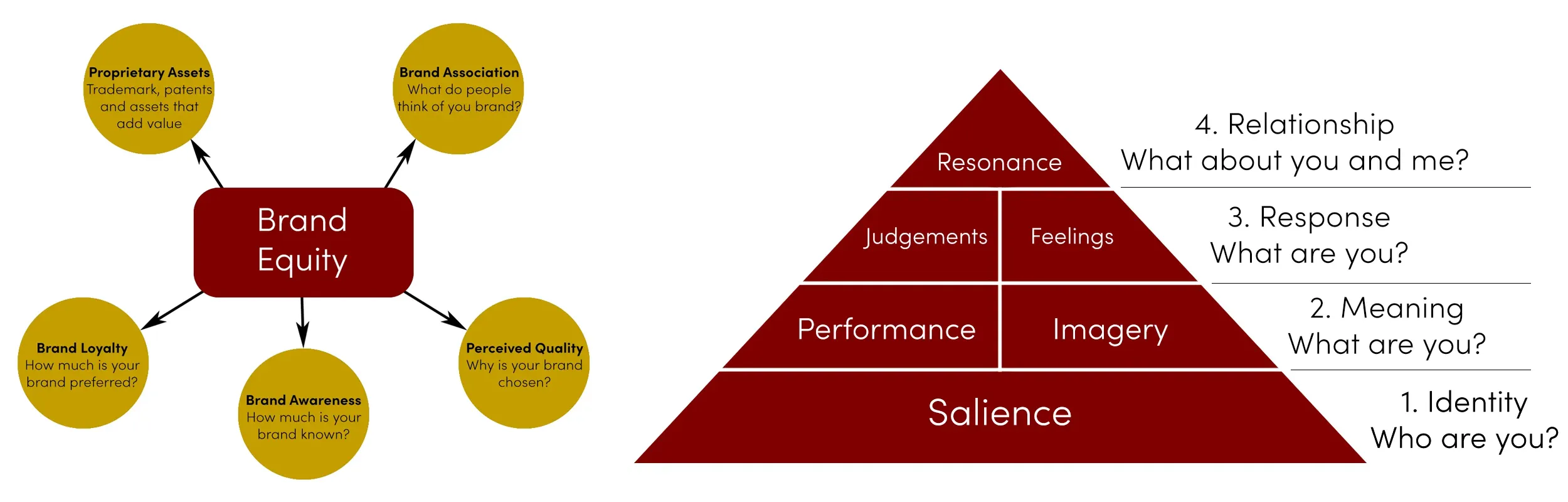
frameworks*Aaker (left) and Keller (right) Brand Equity Models

In terms of brand extension or diversification, one should look at Leverage, how much core brand equity transfers, and Fit, or whether the new field feels natural to consumers.

Ferrari’s initiative leverages similar principles of research of peak performance with lightweight construction, use of composite materials, carbon fibre, study of aerodynamics, and computational fluid dynamics. These are present in racing whether it is Formula 1, Endurance (recently reintroduced with the WEC LMH program), and even in the luxury performance car development and production.

As for Fit, sailboats are naturally very different from cars, and the target audience might differ significantly as well. Core values of the brand and value proposition of its product such as sound, smell, and quality, for example, could risk dilution or simply not fit entirely. On the other hand, however, we know that sailboats and the world around them are culturally linked to luxury automotive, even in key places like Monaco, and as demonstrated by the many industry crossovers so far. Beyond this though, it is clear to understand why Ferrari focused this new challenge on racing. Racing and its success are at the core of Ferrari’s brand value, and this endeavour’s execution choices, by involving Italy’s Luna Rossa successful skipper Giovanni Soldini, and other Maranello’s key figures, ultimately consolidate that perception.

Marketing Racing #14: Lamborghini NFT Moon Landing

  • Brand: Lamborghini
  • Topic: Marketing Racing, Strategy & Marketing

A few days ago Lamborghini has finally revealed its NFT project teased in December. it is one of the most creative, if not the most creative one seen so far in the automotive industry, with one important twist. And, as imaginable, it was a successful one as well, with all the five NFTs selling for a total of around $659,636.

As discussed a few weeks ago, when I introduced the topic in the article NFT in Luxury automotive: Ferrari and Lamborghini jump in, Lamborghini along with Ferrari is just the latest of an increasingly long list of automakers and high-profile brands to enter the NFT space. However, the non-fungible tokens' market is still in its infancy, and for as much potential it has for the future, there is still a lot of uncertainty regarding the legality of many initiatives that pop up daily on the internet. For this reason, there is still quite a lot of hesitation from the public, especially that share of people not into new tech, or the Web3 concept.

luggage closed

Lamborghini as many others does not seem to have any doubt about the future of this technology but actually bets on it with an innovative approach that no other automaker has matched so far.

So, how is the NFT space developing? Why Lamborghini would want to enter it? And how is the Italian brand setting itself apart from the competition?

The NFT market at the start of 2022

Despite all the uncertainty, the NFT market, like the rest of the blockchain-based technologies, has grown exponentially in these two years of pandemic, especially in 2021.

While according to a report from Reuters, the volume in 2020 reached over half a billion US dollars, in 2021 different platforms reported sales volumes all in the order of several billion. Chainalysis though claims that this market also suffers from significant trade washing. Meaning that buyer and seller is the same person completing a transaction from two different wallets. This, as it happens with cryptocurrencies, is done to deliberately drive up the trade volume of a specific asset or crypto eventually increasing its value. While according to the analysis a sizeable amount of profit was realised by trade washing NFTs (over $8.4 million) this has probably not impacted as much the overall token-related crypto transactions’ volume set at $44.2 billion in 2021. NFTs’ largest platform OpenSea also went back and forth on its unlimited NFT minting tool as it is has been prone to misuse.

Value of sales sent to major NFT platforms in 2021 (in $ million)

2021 ft nft sales*Data are for ERC721 and ERC-1155 NFT Contracts (from Jan to Dec) Source: FT via Chainalysis

The sudden growth in transaction volume over the summer from July and August on, up until December when it slowed down significantly could have different explanations. One could be the general amount of disposable income left by the pandemic’s impact especially with travel restrictions, as discussed in Why 2021 was a record year just for Luxury Automotive, which positively affected the luxury automotive market too.

Secondly, the fast increase of collections available on OpenSea has likely been a consequence and cause of the transactions’ volume development. Data from the previous graph and the weekly number of NFT collections available show a positive correlation.

Value of sales (in $ million) against Collections available on major NFT platforms in 2021 

nft collection and sales*Source: Chainalysis

Lastly, according to other sources, this sudden interest would have been driven by a few popular collections such as CryptoPunks, traded over 2,800 times in August alone. This data is interesting when put into the general context of the NFT market.  

Its structure gives an interesting indication of its current direction. The graph below shows the best-selling categories over one month between December 2021 and January 2022.

Number of NFT sales in popular categories over 1 month period

nft sales categories*Source: Nonfungible.com

This data indicates the current speculative nature of the NFT market, but also a sizeable volume of different segments that will be interesting to follow in the coming years, as awareness and new ideas develop.

How Lamborghini got into it

In December Lamborghini teased its new project through the hashtag #ToTheMoon. And indeed, with an attitude always projected into the future, it was aiming there. The automaker partnered up with Swiss artist Fabian Oefner, already famous for his photographic work, his colourful pieces created through scientific processes (such as magnetism used with specific liquids) establishing a direct connection with nature, and his cars disintegration (figurative). The latter consisted of high-quality models dismantled with each component carefully placed to simulate the car exploding. The same effect is reproduced in Lamborghini’s project too, but with real car components.

oefner ferrari 330*Fabian Oefner "disintegrating" Ferrari 330/P4

With regards to this idea Oefner said:

“This is about capturing an artificial moment in time. It is about capturing the exact moment a car explodes, when in fact, there’s never been such a moment. What looks like a car falling apart is in fact a moment in time that has been created artificially by blending hundreds of individual images together. There is a unique pleasure about artificially building a moment…freezing a moment in time is stupefying”

Lamborghini collaborated with NFT Pro and auction house RM Sotheby to develop the project and start the bidding for these NFTs on the first day of the new lunar year. February 1st.

But the references to the moon and space exploration do not end there. Each auction for one of the five NFTs created lasted 75 hours and 50 minutes, matching the time it took the Apollo 11 to reach the moon’s orbit.

Oefner realised five images of “exploding” Aventador Ultimae with the same principle as before. These however are set in space. The picture background is photographed by a weather balloon sent to the stratosphere. Then the artist crafted each image from over 1500 shots of single car components. But here comes the most interesting part of the whole project. The one that makes it unique and sets it apart from any other NFT released by other automakers.

Lamborghini paired each image with a physical object called “Space Key”. Each Space Key is actually a carbon fibre piece that was sent to a space station for research in 2020. Once back, they have been engraved with a QR code that links to the digital image.

space key

Finally, each auction that exceeds a certain value, will be accompanied by a Samsung 65’’ TV with a wide-screen image of Oefner’s artwork, his original signature, and customised TV frame.

What it means for the brand

Lamborghini found a brilliant way to bridge the digital asset and the physical unique item. It managed, in one single move, to reiterate its uniqueness, and create something that will not only appeal to tech enthusiasts, but also to other audiences that are approaching NFTs and will be much more likely to show interest in a project that includes an extremely rare physical piece. In this case, a key to “open” a beautiful artwork.

This project can benefit Lamborghini in different ways.

First of all, it is a communication masterpiece. As said by the artist: “The Ultimae is no longer a car, it has transformed into a rocket, reaching for the stars”, and this is pretty much what Lamborghini is about, what it should feel approaching this brand. In this era of automotive transformation, Lamborghini has more than ever the opportunity to be that “trendsetter” it claims to be in its publications.

As NFTs’ popularity increases, this project will most likely remain as a great example in the minds of many, and not just car enthusiasts. So, it could even strengthen its image in the eyes of a wider audience.

lamborghini nft artwork

Secondly, the project was pretty successful. Of the five NFTs sold, the top bid reached around $203,636. Considering it was the first auction and only the first “drop” (there will be more), they will most likely appreciate in the future. Even though the NFT sales that make the news are the multimillionaire ones (and there have been quite a few by now), the vast majority of them goes for a few hundred dollars.

As automakers increasingly diversify with complex strategies that include ever more touchpoints aimed at improving the brand’s reach, NFTs represent a unique opportunity. Especially for luxury and aspirational brands. As fashion apparel or limited edition items for clients are now important strategic tools for most automakers, NFT can quite easily become one too in the future, bringing the additional benefit of the appeal to younger generations.

In Conclusion

The first NFTs corresponding to physical art pieces came out a while back (Damien Hirst paved the way), but while Lamborghini has not been the first to develop such a concept, it surely executed it in a creative way giving birth to a very rare digital and physical asset.

This first foray has been a remarkable example of how NFTs can become powerful marketing tools. And this one has been realised in the most “Lamborghini way” possible, strengthening its message and identity.

Its success further proves this new platform’s potential, and the uniqueness of the approach that distinguishes Lamborghini from the competition even beyond its supercars. But this NFT drop also demonstrates how we are moving into a new era and gives a hint on what this space can become once it matures and sheds all the unnecessary, speculative appendages.  

Marketing Racing #13: Bentley brings the Christmas Decorations in 2021

  • Brand: Bentley
  • Topic: Marketing Racing, Strategy & Marketing

With the holidays approaching, a lighter theme seems due. So, here is a follow-up on the 2020’s video about Christmas-related automotive social media marketing campaigns and YouTube videos.

For the second year in a row, Bentley published a Christmas video for the holiday. Last year’s one, included in the 2020’s article 5 Christmas Automotive Social Media Marketing Campaigns, showed the Bentley Mulliner division producing a tailored-made Flying Spur for Santa Claus himself. This year, there is another clever idea. When Christmas decorations go missing, Bentley apprentices come together in secret to use their skills and create unique decoration pieces from cars’ materials to save the day.

Another great idea because along with bringing a festive and light atmosphere the video displays the creative potential and craftsmanship abilities of Bentley’s staff. Skills applied for these little creations and the same that are used for each car’s component.

So far, the video has been really successful. Views are, in fact, way above those of other videos published throughout 2021 at over 800,000. Just 13 days after its publication, it is already the 5th most viewed video of Bentley’s official channel. This definitely shows once more the potential of alternative themes that even when touching the automotive topic only indirectly or through emotional connections, can become even more attractive to the target audience than the regular commercial showcasing the car or its performance.

This is the case for other brands’ similar campaigns too. Here are a few examples.

Proofs from Previous examples

Other companies have not (or not yet) published any special video for the holidays or the end of the year. Nonetheless, the numbers shown in the graph below suggest some interesting observations.

Bentley, Lamborghini, and McLaren Holiday videos' view count against 2021 results

views graph*McLaren boxplot includes both the automotive and F1 channels

Among the automotive companies in the luxury and performance segments, Bentley, Lamborghini, and McLaren are the ones that produced dedicated content for the Christmas holidays in the last few years. As visible from the graph, the dark red points correspond to the holiday videos, and here are compared to all the others published in 2021 by each company. It is not a surprise then, that in terms of views count they are always outliers in the top part of the boxplot.

In the extreme case of Lamborghini, not only all three videos are at the top, but the views exceed those of any other video on the official channel by a significant margin. The video “Lamborghini Real Lover”, at 23,6 million views is not just the most successful video published by Lamborghini, but also one of the most successful automotive marketing campaigns on YouTube overall, behind only Porsche’s “The Heist”, and Mercedes-Benz “Magic Body Control”.

Also, even though Lamborghini has the most prolific channel among the ones in the graph, considering that McLaren content is split into the automotive and the racing one, the number of videos published has no statistical relationship with the channel’s success.

This is evident by looking at the same graph for Ferrari’s channel, the most active by far, with over 1,700 videos published (while Lamborghini reaches “only” 613 and McLaren 1,091 with both channels). Here, Ferrari uploads every piece of content, from Formula 1 to the automotive business, to customer racing, and more. Views are in general much lower than those of its competitors though, and the year-end celebration video of 2020 too is just slightly above the boxplot’s third quartile.

Ferrari 2021 and Year-end 2020 videos views count 

ferrari boxplot

So, as reviewed in the Marketing Racing articles about Porsche’s “The Heist” and McLaren Marketing Strategy there is more involved in the success of social media campaigns.

Other 2021 Campaigns

As mentioned at the beginning of the article, not many other companies have joined Bentley so far this year. McLaren has been the only one so far through different platforms.

On both Facebook and Twitter McLaren automotive is publishing its own version of the “25 days of Christmas”, with the hashtag #25DaysofMcLaren. Each daily post features a short video with a car and some design or technical detail about it.

On YouTube, once again, McLaren went for the Formula One channel for the Christmas video. The element that has proven key to its success on social media is replicated here. The protagonists are the two current F1 drivers Lando Norris and Daniel Ricciardo, and the internet is responding, with the video reaching already over 120,000 views in just 6 hours.

The Formula One team has been the most important communication channel for the brand, ensuring the biggest following in F1 and a huge audience on every platform. Most of the views shown by the boxplot’s outliers are, in fact, from the F1 channel in the graph above.

Another mention goes to Lamborghini which, so far, did not follow up the previous years’ successes. However, it promoted a charitable initiative through LinkedIn for the International Human Solidarity Day supporting the Parents’ Association for Pediatric Hematology and Oncology. The Italian brand also teased something new coming under the hashtag #tothemoon, which will most likely be an NFT-related initiative that could end up referencing the holiday period. This would make Lamborghini the second automaker to enter this new space after Alpine sold the A110 GTA Concept as a Non Fungible Token.

Last but not least, BMW published its own Christmas video. A fun short film in which even actor Christoph Waltz is involved. This one too in just four days has received a lot of visibility reaching over 7 million views.

Edit: Lamborghini too on the 23rd released its usual Christmas Celebration video called "Lamborghini Christmas Gift 2021". With the same narrative of previous videos, Lamborghini shows the true emotions of driving in a Lamborghini.

This year Bentley has got the right formula for Christmas. And as the numbers show these activities can definitely pay off in terms of exposure. We might still see some new interesting campaigns in time for Christmas or New Year’s Eve 2021, in the meantime, I wish everyone a Merry Christmas!

Marketing Racing #12: Ferrari and Epic Games' Fortnite Deal

  • Brand: Ferrari
  • Topic: Marketing Racing, Strategy & Marketing

Automotive companies’ collaborations with video games developers to promote their own image and product are not a new thing, and racing video games have been around for a while now.

It started with Atari’s Gran Trak 10 in 1974, but it took until the mid-80s, thanks to the evolution of the graphics, to start seeing models that resembled the car every player dreamed of driving. Then, the 90s with the introduction of 3d graphics changed the game completely and opened the path for what we have today. Players had the possibility to choose from an increasing range of different models, and gradually get to more expensive and prestigious ones as they proceeded in the game.

fortnite cover ferrari blog intra

These early digital experiences were instrumental for many players born in the 80s to start developing their passion and influence their future preferences and decisions. As stated by Luca Venturi in our interview in regard to his experience at Pagani, clients who drove the Pagani in a videogame as kids grew up with the dream of owning one (and a few skilled ones managed to). For this reason, in terms of marketing games have soon become as important as cinema, if not more.

GLOBAL VIDEO GAME MARKET VALUE FROM 2020 TO 2025 (IN BILLION USD)

graph1*Source: Statista

Certainly, the videogame industry is now larger than the film industry, and, according to Business Insider, thanks also the boost received during the pandemic lockdowns the industry revenues in 2020 exceeded those of the sport and film industry combined.

It is no secret then why video games and sim-racing have become such an important marketing channel for car manufacturers. The latest episode of the Marketing Racing series focused as well on an interesting case related to the virtual racing industry.

But going back to Ferrari's appearance in Fortnite, what is different from other similar marketing initiatives? And how?

FORTNITE

First of all, Fortnite is not a racing game. It is an online third-person shooter multiplayer whose main playing mode is the battle royale, and up until a year ago, it did not even feature cars.

The game was first released in July 2017 with a different mode. The Battle Royale was added two months later as a free-to-play game that included also in-game microtransactions, which turned into the main revenue source for the developer. As it happens in numerous free-to-play games today, microtransactions allow players to purchase a range of virtual items for small amounts of money. They can vary from simply cosmetic ones to objects that help to win the game.

In this context, since its inception, came numerous collaborationswith Fortnite. The vast majority is from the entertainment world, with items or skins from movies, tv, and animated series. Star Wars, Marvel Cinematic Universe Avengers, John Wick, Batman, to name a few. Some also came from sports personalities, like Neymar Jr. or LeBron James, or important sporting events and leagues, such as NFL, or UEFA Euro 2020.

Ferrari, however, is the first automaker to establish a partnership with Epic Games in its successful multiplayer. And this surely is a significant departure from the ‘regular’ appearance in a racing game. 

FORTNITE REVENUES FROM 2018 TO 2020 (IN MILLION USD)

graph2*Source: Epic Games
**In 2020 the game generated also $1.1 billion on mobile platforms before its ban
 

Following the rise in popularity of this kind of game, Fortnite quickly turned into a success too, becoming the major source of revenue for the company.

As of now, with an estimated 350 million accounts in 2021, and 80.4 million monthly active users Fortnite is one of the most successful games in the world.

FORTNITE USERS FROM 2017 TO 2021 (IN MILLION)

graph3*Source: Epic Games

Figures regarding streaming platform Twitch also indicate a massive and still growing audience, despite a flattening slope, if compared to the first two years.

graph twitchSource: TwitchTracker

So let’s have a look more in detail into Epic Games’ deal with Ferrari and its potential meaning.
 

296 GTB AND THE COLLABORATION

In Fortnite, the newly-released 296 GTB replaces one of the few cars available in the game (incidentally the sports car that has a clear resemblance with a classic 80s model by Lamborghini). This is also a unique feature among the game’s collaboration that usually involves items and skins that can be purchased by players.

In addition, with the car comes a series of secret achievementsthat players can try to complete. This is an even better way to involve them with the brand presence.

Finally, the special initiative includes also a bundle of clothing itemsthat can be purchased for the characters. These are clearly inspired by Ferrari’s recent fashion show, which again was, at least partially, aimed at the young demographic who is more likely to play Fortnite.

FORTNITE PLAYERS AGE GROUPS (%)

graph4*Source: Statista 2018 Data

The update is not permanent, even though the time frame is not specified. Through social media, the deal received mixed reactions. On the one hand, some met the news with scepticism, probably fearing a loss of focus or prestige of the brand. On the other, there was excitement both for the presence of such an important brand and for the game itself.

Most importantly, the ones who welcomed the new collaboration are the people to whom the initiative was directed at. The quantity of streaming and video content produced on the matter, with several million views on different platforms (YouTube, TikTok, Twitch) in just a few days signal the attention that both the game and the brand are getting from a certain audience as well as the interest toward this unprecedented partnership.

ferrari bundle*Ferrari Bundle available for purchase in Fortnite store. Source: Fortnite

The combination of these initiatives (the fashion show, the collaboration with Epic Games), along with the announcement of the incoming electric model by John Elkann a few months back (which has many more implications beyond this one) are clear moves to renew the brand image, keep up with the times and increase Ferrari’s appeal in the eyes of the young generations. Something that so far other brands like Lamborghini did better than Ferrari.

As said by the former CEO:

“our interpretation and application of these technologies both in motorsport and in road cars is a huge opportunity to bring the uniqueness and passion of Ferrari to new generations”

Finally, an indirect advantage of this collaboration is the application of Epic Games’ Unreal Engine. As shown during the Unreal Build: Automotive 2021 the potential for use cases within the automotive industry are numerous, and not just with configurators. So, this experience could be the start for the development of interactive digital content for clients and future more ambitious collaborations.


Marketing Racing #11: Bentley and Fanatec unite Real and Virtual Motorsport

  • Brand: Bentley
  • Topic: Marketing Racing, Motorsport, Strategy & Marketing

It is from last week, an important announcement by Bentley regarding a further step into the world of e-sports with a unique initiative and the collaboration with an extremely active player within the sector: Fanatec. But first, let’s see what has been going on so far.

Back in 2020, right after the pandemic hit, the world of motorsport experienced a significant and sudden change. Sim-racing, like official virtual competitions in numerous other fields and videogame genres, was already on the rise. But the global lockdowns, and other health and safety measures put in place to contain the spread of the virus gave the booming e-sports industry a further push.

The mean of choice for this were the various Livestream platforms on the internet. Countless personalities, both born online and coming from real racing (such as almost the entire new generation of Formula 1 drivers) found themselves spending more time involved in e-sports events.

In addition, leagues and brands joined the movement organising major events and racing leagues like never before. Along with Formula 1 continuing its official e-championship, FIA WEC Le Mans Virtual 24 hours was also held for the first time.

The audience increase is clearly reflected in the number of views and hours watched recorded by Twitch for major racing simulators such as iRacing, Assetto Corsa, and Assetto Corsa Competizione.

IRACING TWITCH VIEWERS AND HOURS WATCHED

iracing

ASSETTO CORSA TWITCH VIEWERS AND HOURS WATCHED

assetto corsa

ASSETTO CORSA COMPETIZIONE TWITCH VIEWERS AND HOURS WATCHED

assetto corsa competizione

*Graphs sourceTwitchtracker

Other simulators and games recorded similar results. Even previous editions of Codemasters’ F1 series, Forza Horizon, and Forza Motorsport experienced a renewed interest in early to mid-2020.

Most importantly, looking at the data, the trend started in 2020 so far does not look like just a short-term change, but consistent audience interest suggests that the e-sports increased popularity is here to stay. And it is one that will eventually benefit the real-world racing leagues as well.

BENTLEY AND FANATEC COLLABORATION

Fanatec is one of the world’s leaders in sim-racing hardware development including steering wheels, pedals, force feedback, and cockpit setups for all the major consoles and PCs.

Fanatec’s parent company Endor AG was founded in 1997, but the brand has gained a lot of popularity thanks to the mentioned rise of sim-racing and official e-sports leagues. The firm in fact previously started partnerships with Porsche upon its return to the 2021 Esports Spring Challenge Canada, F1 Esports Pro Series, NASCAR, eSports WRC Championship, and SRO E-Sport GT Series.

The good performance of the company is reflected in its 2020 financial statement. Its share price recorded at a low of €31 in March reached an all-time high of €149 in October, and an overall +254% in 2020.

ENDOR AG SHARE PRICE PERFORMANCE IN 2020

endor share price*SourceFanatec Annual Report

Not only Endor was not strongly affected by the pandemic aftermath, but the market conditions actually benefitted the company. Revenues in 2020 were up 146%, reaching €88.1 million, net income was also up by 300%, from 2019’s €3.98 million to €15.96 a year later. The outlook is extremely positive for 2021 as well, with revenues up by 84% from €11.9 million to €21.9 million in the first quarter and forecasts predicting sales for the 2021 full year to reach the low three-digit million range for the first time in the company’s history.  

So, back in April 2020, Bentley announced its first participation in an official e-sport series. The 2020 SRO E-Sport GT Series in the ‘Pro’, ‘Silver’, and ‘Am’ class.

Last week the automaker announced a truly unique partnership with Fanatec. They developed a special steering wheel dedicated to both Bentley’s Continental GT3 Pikes Peak and virtual racing. The car takes its name from one of the most famous Hill Climb races for which it has been specifically tuned, called Pikes Peak International Hill Climb. The wheel is realised using high-quality lightweight materials such as carbon fibre and magnesium alloy, and it is definitely a first of its kind. As for its characteristics, according to Bentley’s statement:

The centre of the GT3 steering wheel is given over to a circular digital display that offers the driver vital telemetry and information about their performance. 

Exclusive Bentley design details include signature knurling on the rotary encoders. Other key features include a forged carbon display bezel, two 7-way FunkySwitch directional sticks with encoder functionality, a pair of aluminium thumb wheels with optical encoders, and four magnetic paddles – two for gear shifting and two auxiliaries, based on the design of the Continental GT road car.

fanatec bentley gt3 wheel*SourceBentley Media

The project represents a unique opportunity for enthusiasts and car owners to experience sim-racing with unprecedented levels of realism. But it does not end here.

This initiative brings attention to the event itself in which Bentley already holds two important records. One for the fastest production SUV with the 2018 Bentayga and one for the fastest production car with the 2020 Continental GT. In 2021 however, Bentley missed the desired result mainly due to a technical issue that caused the car a power loss. Nonetheless, the GT3 finished 4th in the overall rankings.

continental gt3 pikes peak*SourceBentley Media

There is another important aspect of this initiative that ties into Bentley’s renewed strategy to become the most sustainable luxury car manufacturer. The specially built GT3, mounting a revised twin-turbocharged V8 and producing 750 bhp and 1000 Nm of torque, is designed to run on zero-emission renewable synthetic fuels.

Also, going back to the collaboration with Fanatec, Bentley’s choice to develop a special steering wheel for this specific event is also important as Pikes Peak presenting sponsor is Gran Turismo, one of the most well-known virtual racing and driving series ever. So, as a marketing tool, this collaboration is perfectly positioned in an event set to attract esports enthusiasts along with ‘regular’ motorsport fans.

In broad terms, in fact, this partnership is relevant to Bentley’s marketing strategy for strengthening a new platform as e-sports gain popularity and reaffirming the importance of the brand’s motorsport identity and heritage.

This partnership is not only a unique project and an important step for Bentley’s strategy, but also extremely interesting for what it indicates about the motorsport industry’s direction. New integrations between virtual and real-life racing emerge almost every day both in motorsport as a development tool and in the entertainment sector. With increasingly refined hardware developed by the likes of Fanatec, software and graphic engines like Unreal, further integrations of AI, and Virtual reality all working alongside automakers the potential future scenarios are numerous and the boundaries between real and simulated racing will likely become more blurred than ever. More to come soon!

Marketing Racing #10: How McLaren Social Media Strategy is Making a Difference

  • Brand: McLaren
  • Topic: Marketing Racing, Strategy & Marketing

During the Cannes Lions Awards that are being held between the 21st and the 25th of June, on the festival’s website has been published a panel discussion about a very interesting partnership started last year between McLaren, Coca-Cola, and Amazon.

The first two have been partners since 2018 when for the first time in history the Coca-Cola logo appeared on a Formula 1 car. On this occasion, however, the project involved also a second American giant: Amazon. This resulted in ‘Driven to Deliver’, an entertaining video featuring the two McLaren F1 Team drivers Lando Norris and Carlos Sainz (who has since moved to Ferrari) driving around in a Coca-cola-branded 600LT and delivering Amazon parcels and Coca-Cola Zero bottles to people.

land and carlos video*Carlos Sainz and Lando Norris on the set of Drive to Deliver. Photo byAmazon

The video was the first step of a collaboration that continued with other initiatives such as branded merchandise drops and even giveaways of signed items or exclusive materials from McLaren F1.

The interesting discussion went through the details of the collaboration and how it came to be.

The people involved were Zach Johnson, Director, Global Accounts and International Sales at Amazon Advertising, McLaren’s Marketing Executive Director Claire Cronin, Coca-Cola Vice President overseeing the partnership with Amazon Matt Tarallo, Brad Ross, Vice President of Global Sports and Entertainment Marketing and Partnerships at Coca-Cola, and finally the McLaren F1 team driver Lando Norris.

HOW THE PARTNERSHIP STARTED

The first concept highlighted is the importance of the collaborative effort put in by each company and how, in marketing, the best projects are almost always the result of such cooperation. The panelists then proceed by introducing the different factors that played a role in the realization of this project.

Brand alignment was the first. Two companies must share similar values at least partially to begin a constructive conversation.

Other factors for success in this collaboration were:

  • Understanding and leveraging every brand-specific strength or uniqueness

  • Developing common objectives

  • Having a shared audience

companies values and mission*SourceCoca-Cola,McLaren,Amazon

In the case of these three companies, there are several overlapping values such as the ones advocating for leadership in their respective sectors, innovation, and quality. Most of all, however, is the focus on customer-centricity. Even if applied in different ways, the driving force that shapes each business is to deliver the best product and service possible to the respective customers.

Relative to the results of this campaign started with the video, McLaren’s Marketing Director Cronin said:

“For us [McLaren] is really about creating memorable money-can’t-buy experiences that drive real social currencies”

Matt Tarallo of Coca-Cola also expresses another important point:

“When we drew it out we wanted something that people would remember […] and how do you have that authentic experience? [...] I think the biggest reward here is leveraging the two drivers and having them in the car together […] you were able to see really the true characters of both drivers…”

And this is arguably the most important factor that not only brought even more attention to the campaign thanks to b-roll and ‘memes’ shared by the drivers on social media but also helped giving it visibility for a long time.

And this is something that the team at McLaren has already understood and is doing better than anyone else.

MCLAREN UNBOXED

The genuine approach employed in ‘Driven to Deliver’ showing the true interactions between the drivers, which resulted in some really entertaining comedy, has been used for a while now by the racing division. McLaren like other manufacturers (not just those in F1) keeps two separate channels for the automotive and racing divisions. The two overlap on more than one occasion anyway.

mclaren unboxed*McLaren Unboxed thumbnail images

The brand is really leveraging effectively its rare advantage of being both a luxury automaker and a Formula 1 team. Two years ago they created the successful series called ‘McLaren Unboxed’. A series of short ‘documentaries’ bringing the audience straight into the life in the Formula 1 paddock during each race of the calendar. These give an unfiltered (most likely not 100%, but at least for the most part) look into the life of the drivers, but also the rest of the team during the whole race weekend. This is a very genuine and unique insight into the sport, offering a new perspective and countless details that the general public and enthusiasts would never discover otherwise. And this innovative approach is rewarding McLaren which as of now is by far the most followed channel of any Formula 1 team on the grid.

Part of the initial success was surely due to the strong personality of the two drivers and the chemistry between them. It helped to bring visibility to these pieces of content. However this is definitely not the main reason now, as the drivers’ line-up changed in 2021 with Ricciardo replacing Sainz, but the popularity of the show did not.

With Unboxed, McLaren found the perfect formula, which is evident by looking at the difference in engagement that the other teams (even the big ones) get in comparison.

FORMULA 1 TEAMS’ YOUTUBE CHANNEL VIEWS OVER A 1-YEAR PERIOD (IN THOUSANDS)

Views boxplot*Ferrari has a single channel for its automotive business and racing division, so only data relative to Formula 1 content has been included. Also, a single video by Mercedes with a total of almost 4 million views is not included as it would impact the graph clarity
**Alpine and Aston Martin channels are not included as they are new in season 2021 so only have a few months’ worth of content

Then, of course, the social media effect must be taken into account. Much like it happened for ‘Driven to Deliver’, the content published by the company is complemented by that published regularly by the team members and drivers. This creates a perfect synergy as well as an almost constant flow of material for the audience to enjoy and engage.

In this synergy, an important part is played by Formula 1 itself. Thanks to an effective social media strategy, with varied and engaging content on every platform, Formula 1 has experienced significant growth in the last few years. In 2020, also due to the difficult situation, the world went through, and people being forced to stay home, the sport registered a staggering 99% increase in social media engagement, more than any other major sports league.

Formula one social engagement*SouceFormula 1

Every company in automotive and even more in motorsport is going through a gradual transition, adapting its content to the expectations of a modern audience that wants to engage with the real people behind a brand or a team. McLaren's communication and marketing have gained a strong momentum thanks to a bold and innovative idea. Many, on the other hand, still fail to achieve similar levels of success as they deliver content that does involve the people within a brand but often feels too artificial.

In the words of McLaren’s Claire Cronin:

“Customers nowadays can see through any kind of badging exercise and they can see that it’s inauthentic”

And McLaren is indeed the perfect example of how to develop a genuine communication with fans and customers.

Marketing Racing #9: Rimac Social Media Strategy: Mate and his Technology

  • Brand: Rimac
  • Topic: Marketing Racing, Strategy & Marketing

Rimac is the latest success in the luxury automotive industry, and in just 10 years distinguished itself for being an extreme innovator with its high-performance electric powertrains as well as other correlated technologies. As Mate Rimac stated during an interview:

In order to survive, we basically became, at the very beginning, a technology company”.

ctwo production line*Rimac C_Two Production Line©Rimac Media

This is indeed the reason that attracted large investments from numerous top-tier automotive companies, both in the luxury segment and lower ones. The latest one being a stake increase by Porsche which already owned 15.5% of the company, and last week, with an additional €70 million investment brought it to 24%. To this and other companies that have already established strategic partnerships with the Croatian OEM, new European manufacturers could follow, especially in the performance market segment.

In the last few months, 2016 F1 World Champion Nico Rosberg's interest and C_Two's final purchase brought a lot of media attention. However, with only an extremely low number of Concept One produced and the C_Two still in development, Rimac (at least for now) cannot compete with other luxury automakers when it comes to content like car reviews and certain communication strategies.

Let’s see then which strategy the company is adopting on social media and which strength it is playing on.

MONDAYS WITH MATE

By far the most interesting is YouTube. In a previous analysis about the latest luxury automotive start-ups entering the market, it was highlighted the importance of a main figure at the top. An inspiring personality that becomes the proper face of the company. And as for the two before, Pagani and Koenigsegg, Rimac too adopted this narrative. One of their most prolific series on the official YouTube channel is ‘Mondays with Mate’, a particularly good example of that.

As the title suggests, in fact, each video is hosted by Mater Rimac himself, going in-depth into the topic chosen and usually supported by a professional working in that specific area of interest.

But there is more. The series is based mainly on questions received from the viewers, and the topics picked again, most of the time, revolves around technical aspects of the C_Two and other Rimac technologies development.

The series includes what could be called the three ‘pillars’ of Rimac’s online communication. Mate Rimac’s figure, the company’s technological prowess, and audience involvement.

For the first one, the brand’s identity is consistently communicated throughout the various platforms. A really unique history with the founder racing his electrified BMW E30 and later on starting the company.

The last two instead are present in numerous other videos and posts. The majority of content published, as said, regards the engineering and technological side of the business. This is always carried out with an eye on audience engagement. Are frequent the Q&As with company employees replying to viewers, and references to work opportunities at Rimac and talent acquisition activities.

PART OF RIMAC’S MESSAGE

Another way in which the young company achieves that and raises its popularity among aspiring professionals is through online challenges and giveaways. Especially, in 2020 there have been a few initiatives, directed at designers and proposing them to come up with their own concepts for a helmet, or a futuristic car.

To this, is connected another theme. The company’s origin, and most of all the country's lifestyle. Croatia, in fact, has no other established automotive companies. This, according to Mate himself, has been one of the biggest challenges to overcome, but one that, as people said it would have become an obstacle, probably gained even more importance.

As a result, the attachment to the motherland and national identity is strong in the company’s image, and part of the communication is dedicated to that. The presence of such a prestigious brand (even if young) will surely help the popularity of Zagreb and Sveta Nadelja.

sveta nadelja*Sveta Nadelja

Last but not least, and particularly connected with the technology performance content is everything dedicated to the Concept One and even more to the C_Two. The whole development journey, coming now remarkably close to the official start of production, is detailed through posts and videos. They bring an extremely insightful wealth of information about the hypercar's different development steps, safety, and track testing. On more appropriate platforms such as Instagram, naturally, part of the content is just aimed at showcasing the beauty and design features of the cars.

This kind of content will most likely increase as soon as the C_Two reaches production and the first completed models are delivered to clients. Nico Rosberg who has become an ambassador for the brand in the meantime will surely be involved too, publishing on his platforms which have an even stronger following.

IN SHORT

Rimac’s social media communication is as unique as it reflects all the peculiarities that make this company successful and one-of-a-kind. From its founder and his unique story to the technology that is changing the industry and bringing in countless partners and clients, to being a proper gem in the Croatian landscape where no automotive tradition has ever been established before.

It will also be interesting to follow Rimac’s strategy in the coming months of 2021 as it will likely evolve as the journey of the company continues, with a first important step coming when the C_Two delivery starts.

Marketing Racing #8: Porsche Taycan Marketing and its Records

  • Brand: Porsche
  • Topic: Electric Vehicle Market, Marketing Racing, Strategy & Marketing

The Porsche Taycan has been a big deal for the industry since its first appearance as a concept under the name Mission E. It was the first long-standing established luxury manufacturer to start the production of an electric vehicle, which is something that very few do even today.

During its first year, Taycan has been a commercial success too, selling 20,015 units. It prominently entered Porsche’s lineup, exceeding the Boxster/Cayman 19,263 sales of 2019, which was a year of general strong growth. Additionally, as of today, outside of China, EVs have been mainly sold in the premium segment of the market. Mostly due to battery pack costs and customer habits.

For a while now, China’s customers, in fact, have seemed to be less concerned with maximum range and tend to favour more affordable cars instead, to move mainly in the city as highlighted in the Chinese Market Research.

PRICE OF THE BEST-SELLING EV MODELS IN CHINA AND EU-US IN 2017

China VS Eu US Evs*Source: 搜狐 Sohu, 2017 年纯电动乘用车销量前十名车型品牌, European Alternative Fuels Observatory *prices in the brackets are after incentives

In western countries instead, the range is generally considered one of the most important features for EVs and one of the main stages of competition between companies. And the trend is still partially unchanged, but with signs of balancing. Especially with the popularity of Tesla’s Model 3 in the EU and US. Tesla so far has been the dominant player in the premium-luxury EV segment. At least until Porsche’s entry.

2020 MAIN PREMIUM EV MODEL SALES

lkdn graph*Tesla reports Model S and Model X sales figures together
**Audi data accounting only for the first 9 months of the year
***New Data for Mercedes EVs coming on February 18th

Along with the good results shown in this graph, there are two important factors to keep in mind. The first is that except in its base version, Taycan is generally much more expensive than the competitors listed here (the new Tesla Model S and X Plaid come closer to it). Secondly, Model X, Audi E-Tron, and I-Pace are all in the small SUV or Crossover segment which is definitely more sought after these days. These two factors make the Taycan results even more impressive and more interesting the potential for the upcoming Cross Turismo.

This scenario is likely to change significantly in 2021 as a number of high-profile competitors have entered the market in mid to late 2020. Polestar 2, BMW iX3, Ford Mustang Mach-E to name a few.

Determined the Taycan noteworthy success, even within a competitive segment that is not the most popular nowadays, let’s have a look at how Porsche achieved this success. What kind of campaigns did Porsche employ for its first EV Promotion?

MODERN ONLINE MARKETING

Taycan like many other luxury vehicles, especially during 2020 with lockdowns and restrictions got a lot of visibility thanks to online reviews and driving tests. Since its release, in fact, it made the first page of pretty much every automotive social media outlet, not only for the novelty of being an electric Porsche but thanks to its characteristics. From the overall build quality far superior to that of its competitors to its driving capabilities.

Chris Harris, like others, in his review points out how the car driving dynamic and agility is superior to other electric vehicles and actually extremely close to the one in a regular Porsche ICE Sportscar despite its considerable weight.

Additionally, a consequence of the interest in the new drivetrain and technology started by Tesla’s success is that Taycan too caught the attention of a new audience that does not necessarily overlap with that of car enthusiasts. EVs have in fact grown in popularity among the tech fans community. Satisfying the needs and wishes of this new (and generally very young) audience can benefit Porsche by bringing in new potential clients and increasing brand loyalty.

These are crucial components of modern marketing for any luxury car. In the case of the Taycan though, there is more…

SOME UNIQUE MARKETING

I previously discussed the success of The Heist, the second most-viewed automotive video on YouTube, and a great example of the power of storytelling in automotive marketing that many other automakers are following. This is already quite a unique achievement and a display opportunity for Porsche.

The second one-of-a-kind initiative to promote Taycan has been realised in Seoul on the occasion of its launch in Korea. The show itself featured an extraordinary light show symbolising the futuristic look and technology employed for this car. What is even more surprising though, is that in the days leading up to the event, a lorry carried around through the city an installation with a 3D Hologram representing running horses. The idea comes from the name of the car which according to Porsche ‘can be roughly translated to mean soul of a spirited young horse’.

taycan-korea-horses
taycan-korea-horses-1
taycan-korea
taycan-korea-horses
taycan-korea-horses-1
taycan-korea

*Source:Porsche

While very impressive, this is not the last unusual campaign organised by Porsche to push the EV to maximum visibility. So here comes the Guinness World Records.

On two separate occasions, Taycan achieved World Records for the longest drift with an electric vehicle and the highest indoor vehicle speed.

On the first, driving instructor Dennis Retera completed 210 laps of a 200 metres circle, for a total of 42,171 Kilometres covered in 55 minutes. This specific record served also to showcase the potential of the rear-wheel-drive Taycan, produced exactly to enhance the fun and feeling of a true sportscar.

taycam-drift-1
circle
taycan-drift
taycam-drift-1
circle
taycan-drift

*Source:Porsche

The second record instead was set by racing driver Leh Keen reaching a top speed of 165.1 Km/h in an enclosed building. This time the AWD Taycan was used to maximise grip, acceleration, and crucially, deceleration, as the space available was limited by the Guinness World Record rules.

This was an important showcase of top performance. Complete trust in the vehicle’s capabilities on a tricky slick surface, allowed the driver to achieve the record on the first attempt.

taycan-acceleration
taycan-decelrating
taycan-indoor
taycan-acceleration
taycan-decelrating
taycan-indoor

*Source:Porsche

CONCLUDING THOUGHTS

Even though from an everyday performance perspective these achievements might not seem to mean much, this is different for car enthusiasts and will likely prove to be a smart move. Proving that a good electric sportscar is more than just straight-line speed, might help to convince current luxury performance car buyers that generally meet EVs with a certain scepticism.

If all the rest was not enough, this will at least be another way to record the Taycan on the history pages.

Marketing Racing #7: MSO & McLaren Sabre

  • Brand: McLaren
  • Topic: Marketing Racing, Strategy & Marketing

Despite the pandemic and the many difficulties for automotive manufacturers, 2020 has been a year full of surprises. Numerous limited series or few-offs, as well as one-offs and highly anticipated new production models, have seen the light. But the last one to come in the year is a special one for many reasons. I am, of course, talking about the McLaren Sabre.

Let’s see something about the car, why it is special and why is relevant for McLaren’s marketing.

mclaren sabre three quarter*McLaren Sabre, Source:Top Gear

MORE ABOUT THE SABRE AND WHY IT IS SO SPECIAL

First of all, it is a highly limited series. Only 15 units will be produced and will go for well over $3 million each, also every car will be completely different from the others as far as personalisation goes. The car in fact is not a production model, but it is a Bespoke Commission by McLaren MSO (McLaren Special Operations). To make the project even more interesting, the Sabre has been heavily influenced, even started, by a group of high-profile American clients that approached McLaren with a proposal.

mclaren-sabre-open
mclaren-sabre-interior
mclaren-sabre-rear
mclaren-sabre-side
mclaren-sabre-open
mclaren-sabre-interior
mclaren-sabre-rear
mclaren-sabre-side

Secondly, it is the most powerful non-hybrid McLaren car so far. The Twin-Turbocharged 4 litre V8 engine produces, on this, 824 bhp and 800 Nm of torque, making it more powerful than the Senna where it “only” produced 789 bhp and Elva’s 804. Above this number, there are only the two hybrids P1 and Speedtail which complement their internal combustion engine with electric motors to get 903 and 1035 bhp, respectively.

McLaren has not shared much about performance details so far. It is known though that the car is developed on the Ultimate Series platform, which includes, Senna, Senna GTR, Elva, and Speedtail, with around 70% of new components unique to it. It is road-legal, it can reach 218 mph (350 kph), which makes it also the fastest two-seater McLaren.

Third, there is the looks. No McLaren really passes unnoticed. Even the more tamed GT still has a unique presence. But with Sabre, MSO pushed the boundaries even further thanks to the fact that the car is specific for the US market. McLaren had to homologate the car just for the US Federal Standards. Thus, they were able to make aesthetic choices both outside and inside that would have not been allowed if the car had been developed for the global market.

sabre details*Details of Wing Mirror and Central Panel developed according to US Standard only

WHAT DOES THAT MEAN FOR MCLAREN MARKETING?

So far, McLaren except for the X-1 released in 2012, has never produced one-off or few-off models like this. While the X-1 received mixed opinions though, just 8 years later, the Sabre not only got massive attention and media coverage, but it was an overwhelmingly positive one throughout every platform on the internet.

x1*One-off McLaren X-1

Also, while the company has developed several highly limited series, the level of clients’ involvement, in this case, is unprecedented. It represents a crucial milestone for a company in this market space, as only a one-off project developed in a similar fashion would have a higher exclusivity value.

Back around when this project started, head of MSO Ansar Ali claimed that the company had, by then, the necessary infrastructure in place to develop more than one highly bespoke project every year. So, in 2021, this might only be the beginning of a really exciting journey for McLaren Automotive, as the overall number of such multi-million projects within the industry increases. Only this year, before Sabre we have seen Lamborghini SC20, Bugatti Bolide, Ferrari Omologata, Aston Martin Victor, Lamborghini Sián Roadster, Lamborghini Essenza SCV12, Aston Martin V12 Speedster, Bentley Bacalar Mulliner, and Pagani Imola.

This might interest you as well:6 Most significant One-off cars  

For such a young company, McLaren Automotive in 2010 has entered a really competitive space, even with all its motor racing heritage. Over the last decade, in fact, all the major companies have established or greatly enhanced their respective personalisation programs.

The Sabre was developed by MSO under the Bespoke Commission program. This is conceived to enable a constant and close relationship with the clients commissioning the car. They have been involved from the early stages of design, being shown the clay model and, in some instances, even affecting the process with suggestions. This process, according to Global Bespoke Commission Manager Neil Underwood led to a proper track test of the camouflaged prototype. An experience that is usually reserved for industry workers only.

sabre camouflaged*Camouflaged McLaren Sabre, Source:Top Gear

This unique customer journey creates a personal experience, which is arguably the strongest tool to inspire clients’ loyalty and elevate the brand’s reputation. For these reasons, this is a significant step forward for McLaren after a difficult period, and it makes the future of the company as well as the competition in the market niche even more exciting.

Marketing Racing #6: Porsche’s Heist and the power of Storytelling

  • Brand: Porsche
  • Topic: Marketing Racing, Strategy & Marketing

The Heist is Porsche’s video released at the beginning of 2020 and it is also the most-viewed automotive commercial on YouTube with almost 22 million views reached in a matter of months. The video promotes the new all-electric Taycan in a clever way but does even more.

*EDIT: After reaching over 24 million, the video has been deleted from the company's official Channel

I talked about Porsche’s strategy for its upcoming electric lineup previously and you can find the full article here Porsche EV Development Strategy. The video is not only fun but along with the characteristics of the vehicle, it cleverly shows what the brand is really about by appealing to people’s emotions. It sells a lifestyle in an engaging way.

WHY IT IS IMPORTANT AND WHY IT WORKS?

A research by McKinsey shows Over-the-top services, such as YouTube, have the highest CAGR compared to all the other sub-sectors with, of course, Digital Advertising and Video Games as close seconds. This data clearly shows why efforts in this sector and more and more relevant, and likely to become so even more in the future. For insights on the Video Games industry applied to automotive have a look at the previous article How Covid-19 Turbocharged the E-Sports Racing Industry.

mckinsey graph*Source:McKinsey©

There are different factors that contribute to the success of this video. One is its length. According to McKinsey, the habit of consuming ‘bite-sized’ content stems just from platforms such as YouTube or Instagram. The 2:31 minute length of the video results ideal then for major consumption, which is proven by other companies’ videos of similar genre and length performing above the average, while longer ones tend to get less attention.

PORSCHE’S YOUTUBE CHANNEL VIDEOS VIEWS COUNT (IN MILLIONS) AGAINST LENGTH

graph youtube*The Heist video and two full races videos have not been included in the graph as too far from the average in terms of views and length respectively.

The graph above confirms McKinsey’s data but shows some other interesting detail. For instance, short videos, between 1 and 3 minutes, show a high fluctuation in views figures, from over 10 million to a few hundred thousand (this is partially due to the fact that it is also the most popular type of video), this fork gradually reduces toward lower numbers as the video length grows. Another interesting observable data is that truly short videos below 1 minute instead (at least in Porsche’s case) tend to receive considerably less interest compared to slightly longer ones.

In the same research are described three tools that brands can use to grow and improve customers’ loyalty.

David ogilvy

The first is Distinctive content creationthat focuses on specific strategic goals. David Ogilvy considered the Father of Advertising, in his book expresses some similar concepts that can be applied to the modern market. One is “Compromise has no place in advertising. Whatever you do, go the whole hog” (Confession of an Advertising Man, 1963). “The Heist” is indeed built around few visual, well-highlighted points. The car electric powertrain, its performance, and its desirability. As for the strategic focus, it is of course the aim at becoming the leader of the luxury performance EV segment helped by the fact of being significantly ahead of the competition.

The video is also distinctive in the sense that Porsche plays showing characteristics of their car indirectly. From its silent powertrain when it is first stolen from the museum without anyone noticing, to its performance when it is always ahead of the others and is actually the car being chased. They also establish an emotional connection when in the end the characters almost compete to be the next to drive the Taycan.

Most of all though, everything is tied together by engaging storytelling. Even in such a short video, which is what makes it an even greater example, there are unexpected elements and appealing visuals that make the viewer want to watch until the end.

At the same time also, Porsche makes sure to remind us about its status in the automotive world. At the beginning we are shown its beautiful museum, then comes a consistent chunk of its history with the cars selected for the chase. From a tractor Porsche-Diesel Standard 218 to the racing legacy with the 917K in the Gulf Oil livery, and various classic and modern road cars and limited editions, 718 Cayman, 911, GT2RS, 918 Spyder. All come, of course, after the EV Taycan.

The second factor is Content Curation to maximise engagement. The original idea behind the video proves the Porsche team's understanding of its fans and customer base. So it does the rest of its online presence.

youtube1

The graph here shows clearly how despite not being the first brand in terms of following in his segment, Porsche manages to obtain far more engagement than all the other brands. This indicates knowledge of the niche and a consistent strategy to give the right media experience, which is key as the overall content published online multiplies exponentially every day and it becomes more and more difficult to gain attention. You can also see how the company fares against its competitors on the other major platforms here Automotive Social Media Marketing: Why Lamborghini is Winning.

The third tool regards the gradual consolidation of the media industry, especially regarding online streaming outlets, which gives companies the opportunity to access better data to gain insights about customer preferences and trends. This factor refers to the wider strategy and is thus not applicable to this specific case.

WHAT ABOUT OTHER AUTOMAKERS?

The whole industry is adapting to a finer, more creative, emotionally, and visually appealing online communication.

Within the same market niche, Lamborghini's social media marketing actually gets the strongest results of all on multiple platforms. On YouTube it achieves similar results with its two most successful campaigns called Lamborghini Real Lover and A true Christmas Story for Lamborghini’s real lovers discussed previously here Automotive Social Media Marketing: Why Lamborghini is Winning and now counting respectively 17.9 and 8.1 million views. Despite the different narratives, in this instance, Lamborghini’s storytelling also appeals to people’s emotions epitomising the supercar dream through the children's imagination.

Ferrari is also gradually moving in a similar direction. The best example of this is the video for the latest addition to the lineup, the Roma. In their official video, which is already the second most viewed of their channel, Ferrari presents the whole concept behind the new model through music and suggestive images. This makes particular sense as the model aims at a new market niche previously not completely covered by the brand and well represented here by the ‘La Nuova Dolce Vita’concept.

McLaren does it as well very cleverly and in its own way with the 2019 GT presentation which is too the most viewed commercial on its channel. And replicates original ideas for other models too such as the P1 or the latest 765LT.

As for the other British automakers, Aston Martin brings an amazing example of storytelling with the SUV DBX introduction which probably gets the timing wrong though. The video, in fact, has been published only a few days ago, while the car has unfortunately already been teased, presented, and reviewed several weeks ago.

dbx
la-nuova-dolce-vita
mclaren-our-rules
dbx
la-nuova-dolce-vita
mclaren-our-rules

Finally, at the beginning of the video, I specified that ‘The Heist’ is the most viewed automotive commercial. It is not in fact the most-viewed automotive video. This honour goes to Bugatti’s Chiron 0-400-0 video. I did not include this in my review, as the company has such a selected customer base, with its super-low production volume that the business model and communication are, as a result, substantially different. The video is a pure performance demonstration.

Is probably not a case then that both Pagani and Koenigsegg most viewed videos are performance demonstrations respectively for the Zonda R and Agera RS. The two competitors like Bugatti have a production of fewer than 100 cars per year which all sell for way above £1 million. Along with luxury, rarity, and high prices then, it is engineering at the absolute extreme that has to represent these companies. Of course, fewer resources allocated to online marketing in this case is likely a major variable for these three really small companieswhen compared to the aforementioned luxury automakers.

SOME CONCLUDING THOUGHTS

Porsche as for its EV development shows vision and market knowledge. As online media and virtual entertainment continue to gain traction though, competitors’ strategy aligns with successful content, and the quality level grows accordingly and increasingly faster. This means that more of this and even better can be expected in the future, but also that incoming VR and AR integrations are likely to bring a further leap forward soon.

Marketing Racing #5: Ferrari’s Art side of the Business

  • Brand: Ferrari
  • Topic: Marketing Racing, Strategy & Marketing

Here is a new article of my ‘Marketing Racing’ series, where I look closely and discuss the most interesting and innovative new and old marketing campaigns launched by luxury car manufacturers. Last month I looked at Lamborghini’s Huracán EVO RWD Spyder. This week is Ferrari’s turn, with a really fresh idea launched back in 2018. A webcomic. Despite being likely overlooked by many it is still worth mentioning as an example of creative thinking and how diverse marketing can become to appeal to a new target audience.

ferrari we race cover

FERRARI’S MARKETING

Ferrari as a company has a wide variety of unique channels and marketing resources thanks to its history and standing reputation, as well as its unique nature. The main pillars of its marketing mix are its racing heritage, which includes its Formula 1 history and team, its brand, named more than once ‘Most Powerful Brand in the World’ by Brand Finance, which brings numerous important sponsorships and several merchandising lines and collectors’ items.

For brand enthusiasts museums and limited-time exhibitions, such as Michael 50 and Universo Ferrari, are a great way to experience the brand. For clients instead, specialised events and activities, such as presentations and the FXX Programmes or F1 Clienti.

All these activities and marketing channels are analysed more in-depth in my Brand Market Potential Analysis.

ART FOR FERRARI

After the Grand Prix Posters introduced a year earlier, in 2018 Ferrari added a new art wave to its portfolio to celebrate its racing DNA. It launched a daring but definitely original initiative through a really unexpected mean this time. The Ferrari-branded webcomic ‘We Race’. It has been written by Giulio Antonio Gualtieri and drawn by Riccardo Burchielli. Here below is the official trailer published online by Ferrari.

The comic is a sci-fi set in a dystopian future where the earth has become a wasteland, but a futuristic version of Formula 1 is still practiced. The storytelling naturally revolves around motorsport and its possible future. The story arc is divided into three different periods, 2057, 2058, and 2095 and deals with different themes such as teamwork, competition in sports, gender inequality, the relationships of humans with machines in a highly technological environment, and, of course, the passion for motorsport. As the quote ending the introduction of the comic reminds us: ‘Because the world may change, but certain thrills never do’.    

References to Ferrari’s tradition, apart from the protagonists’ red car, even in this far future are subtle. In the panel below, the background shows what resembles a 1959 Ferrari 250 SWB and the Scuderia Ferrari badge, even if it is never mentioned in the actual story.

Ferrari background

The mean itself is well suited for this kind of product. Set between a traditional art form and new technology, much like Ferrari itself, We Race has the capacity to really immerse the reader thanks to parallax scrolling effect, music, and sound effects accompanying the panels that unfold scrolling the page.

THE WEBCOMIC EXPERIENCE AND ITS MEANING

The webcomic was an interesting experiment directed at a potentially different demographic. Not only that of comics enthusiasts (not necessarily mutually exclusive with motorsport) but definitely a younger one.

The stories in the two time periods connect and conclude at the end of the third series. Considering the rather limited nature of the comic there is not much space for the writer to go in-depth with the character development and the unfolding events. This eventually ends up feeling a somewhat superficial reading experience, which also suggests this was more of an attempt than a proper fully developed long-term project.

What it achieves though, apart from being a technically impeccable and original product, is creating brand awareness and showing Ferrari’s willingness to try different things, celebrate motorsport and connect with its fans at many different levels. And this is one of the most important factors that contribute to creating a well-rounded marketing strategy for the most powerful brand in the world.

Marketing Racing #4: A Lamborghini in your Living Room

  • Brand: Lamborghini
  • Topic: Marketing Racing, Strategy & Marketing

It was around a month and a half before the 2020 Geneva International Motor Show that Lamborghini announced it would have skipped the event. Then, even with the pandemic affecting the entire industry, media and enthusiasts got a degree of satisfaction. New models were presented through online events streamed on every social media platform.

Fast-forward to two months later, and it looks like Lamborghini managed once again (here are more insights on Lamborghini’s online marketing) to steal the online show with the presentation of its new Huracán EVO RWD Spyder. This time not only by picking a date for a separate event but by being the first company ever to present a new car with Augmented Reality (AR).

huracan ARh©Lamborghini

WHAT IS THE NEW HURACÁN LIKE AND WHY IT IS IMPORTANT

The EVO RWD Spyder is the soft-top version of the latest iteration of the ‘entry-level’ Lamborghini. And like its predecessors it is a very important addition to the lineup. As the coupé, it is cheaper than the all-wheel-drive (AWD) version, with the MSRP at £188,000 instead of £218,000 (all before options of course), and has new technology, but it is slightly less powerful.

560518
huracan3
huracan1
huracan2
560518
huracan3
huracan1
huracan2

Lamborghini’s statement for both Huracán EVO RWD Coupé and Spyder is “Rewind to Rear-Wheel Drive”, and in this sentence sits the reason for the existence of this new version of the car. The RWD configuration, common in older Lamborghini’s flagships up until the 90s, has been substituted by the AWD one, for improved traction and acceleration. The new one instead will ‘deliver pure, unfiltered driving excitement’(Lamborghini), and the majority of the press so far seems to agree.

By looking at the sales history since its introduction in 2013, and 2015 for the Spyder, the model’s success is evident. Even more when thinking that up until 2019 the best-selling Lamborghini of all was the Gallardo with 14,022 vehicles. As of 2019, Huracán has reached 14,528 produced units, and it just got a cheaper version with updated technology and that promises a more exciting driving experience. 

LAMBORGHINI PRODUCTION FIGURES BY MODEL (2013-2019)

table lamborghini sales

THE PRESENTATION

On May 7th 2020, Lamborghini published on its social media platforms the link to access the new page containing technical details and information about the vehicle, 3D visualisers, and, most importantly the option to use the AR.

This allowed people to look at the car through the screen of their device like the vehicle was sitting there in front of them, whether indoor or outdoor. Unfortunately, the experience is available only for Apple users, and not for Android devices. This could be for branding reasons or more likely for compatibility ones, being the Android ecosystem much more varied and less controlled.

HURACÁN PRESENTATION ENGAGEMENT ON SOCIAL MEDIA

graph social media*Data refer to the last 3 months of activity on each channel

Regardless, the campaign was an innovative way to stand out from the competition. This is, in fact, an unprecedented way to unveil a new model in the automotive industry, which ties perfectly with Lamborghini’s values of uniqueness and technological innovation.

The announcement of the 7th on the main social media channels got a slightly below average engagement (which is already very high for the industry’s standard), while performing well above it on LinkedIn as shown in the chart.

But considering that social media traffic accounts only for about 2% of the total, estimated over the past 30 days, the Huracán unveiling generated significant attention as highlighted in the global ranking improvement based on traffic and engagement since May 7th. This is especially true for the US, Lamborghini’s largest market, where the website ranks 7857th (Source Amazon Alexa.com). The combination of eye-catching yet easy to access technology along with avoiding the direct competition, as it happened for the Virtual Geneva International Motor Show has been very effective.


LAMBORGHINI’S WEBSITE GLOBAL RANKING BASED ON TRAFFIC & ENGAGEMENT, AND TRAFFIC SOURCES (IN %)


IN SHORT

Remaining truthful to its brand, Lamborghini launches the latest iteration of its best-selling model in an unprecedented way. Regardless, of the positive traffic and engagement results, this AR unveiling is an important display of technological innovation that no other company has exploited so far in this context.

This marketing idea plays perfectly in Lamborghini’s desired image. The concept is perfectly synthesised by the statement used for the Sant’Agata Bolognese Museum rebranding: “Future Shapers Since ‘63”.

Marketing Racing #3 – Rocket Science to market a luxury car

  • Brand: McLaren
  • Topic: Marketing Racing, Strategy & Marketing

In the luxury performance car market McLaren, despite being young, has already distinguished itself for producing some of the cars with the most alien and imposing presence, which often translates to performance as well. This is thanks to the state-of-the-art engineering work done in Woking where, every line, vent, and winglet has a specific aerodynamic purpose and, at McLaren, they rightfully never forget to remind us. Their marketing strategy expresses perfectly the value of ‘Form Follows Function’ that the company embodies.

Mclaren 720s Marketing strategy

Looking at the vehicles’ characteristics some might say it really seems like ‘Rocket Science’. Well, McLaren took it literally. So, who better than an actual Rocket Scientist could convey the value and the achievements of the work done on one of these cars?

The model is 720S. Since its presentation at the International Auto Show in Geneva it gained praises by the automotive world thanks to its innovative technical solutions and performance capabilities considered the top of its segment and even comparable to much more expensive limited series. Even though there are no official numbers from McLaren, the company, in fact, claims the 720S to be one of the major contributors to its huge jump in sales in 2018 along with the 570S Spider (both unveiled in 2017). From two fairly stable years, 2016 with 3,286 units sold, and 2017 with 3,340, 2018 instead saw a 45.6 per cent increase up to 4,863 units.

THE MARKETING STRATEGY

The video published a while back on McLaren’s Channel is a noteworthy example of how to market a model in a different and innovative way.

The trend across the majority of manufacturers’ channels is to publish videos that vary from 50 seconds to 2 minutes with no comments and where the car is shown in very cinematographic shots either standing still or driving along some beautiful road.

Here instead, Ph.D. Ryan W. Conversano starts the video referencing a rearranged version of Newton’s Second Law of Motion: Acceleration = Force/Mass. The decision to use each element of the equation to describe the car’s characteristics while relating them to real rocket science is a smart one. It allows McLaren to showcase its engineering and aerodynamics innovation as it would happen in a review video, but with some additional values.

Of course, a normal review on a car manufacturer’s channel, even if truthful, would be perceived as biased. This way instead, McLaren showcase the 720S only indirectly, and by doing so it adds also some interesting and quite surprising notions (always explained in common people’s language luckily), and most importantly it once again ties its brand and message to an idea of extreme technological development. One that sets the company apart from all its competitors.

WHERE AND HOW THE STRATEGY IS SUCCESSFUL?

This marketing message is in fact consistent over time, well-targeted to McLaren’s client base, and overall successful so far.

Consistent because the same kind of communication has been chosen already in the past throughout social media. The video below, though quite different from the previous one because shorter and without any talking in it, uses the same way of indirectly (in this case there is not even the actual car in the video) showcasing a vehicle’s characteristic, here aerodynamics.

As mentioned, this type of communication going beyond the ‘simple’ aesthetics or a mere didactic list of performance numbers seems to cater well to McLaren enthusiasts as much as the concept of function and performance above form.

In terms of views on McLaren’s channel, the two videos are respectively 62nd and 35th out of 282. Longer videos though get on average fewer views, and as standard for several manufacturers’ online automotive marketing, the majority of content is fairly short, between 1 and 4 minutes. The ‘Science of Speed’video despite being 7 minutes long ranks 6th out of 32 videos above 5 minutes in length. The threshold has been selected because of a noticeable drop in the number of views for videos over 5 minutes which are also much fewer overall as shown in the graph below.

MCLAREN’S YOUTUBE CHANNEL - NUMBER OF VIEWS VS. VIDEOS LENGTH

video length vs views

Three videos are not included as the high number of views would squeeze the rest of the data on the lower side of the graph. Two fit the trend while the third is the only exception, respectively at 1:04, 0:41, and 5:28 of length and with 4.1, 1.9, and 1.6 million views. It must be said though that despite the trend the statistical correlation is not as strong as it might look considering the quantity difference between ‘short’ and ‘long’ videos. The remaining 250 are all between 10 seconds and just less than 5 minutes. The result indicates a good level of interest overall by McLaren’s audience, even more, if it is considered that both the videos have been published a while back, especially the ‘McLaren Vs Aerodynamic – The Next Chapter’ one which is much shorter but was published back in 2012, to introduce the Hypercar P1 to an arguably way smaller audience.

Finally, McLaren’s focus on performance over style looks also well-targeted for its customer base as proved by a survey I conducted among 244 luxury car owners. Respondents had to indicate on a scale from 1 to 10 the importance of different factors in their purchase decision, namely price, brand, performance, design, company’s robustness, model’s rarity, and personalisation options. McLaren’s buyers on average scored the Performance factor higher than what all the other brands’ owners gave as a reason for choosing a specific car.

IMPORTANCE OF PERFORMANCE FACTOR IN THE CAR PURCHASE DECISION BY BRAND (SCALE 1-10)

performance mark chart

TO CONCLUDE…

Overall, the videos, are just two examples (among several) of luxury performance automotive marketing online with an interesting and innovative approach. While every car company has its own specific focus on online marketing, the contents often overlap consistently. McLaren instead does it in a different way showing in various instances originality that not only helps set it apart from the competition but also aligns well with what clients and prospects are expecting from the brand.

Marketing Racing #2: Bentley bets on sustainability as it turns 100 years old

  • Brand: Bentley
  • Topic: Marketing Racing, Strategy & Marketing

Differently from the example of marketing strategy analysed in the previous article, this one might seem less ‘unexpected’. It is noteworthy nonetheless for the range of business aspects it involved and ultimately for its daring commitment, which was instrumental for the company to recover from one of the worst financial years in its history.

Bentley exp100 top*Bentley EXP 100 GT - Photos byBentley Media©

2019 was the 100th anniversary of the foundation of Bentley Motor Company. The firm from Crewe had its own share of hardships throughout one century of history. And since the arrival of the current owner VW, 2018 was its worst year, which ended up with an operating loss of €288 million, due to delayed product launch, production issues and lengthy process to certify engines for global emission standards. To come out from such a bad situation, along with other measures and while retaining all its core values of ultra-luxury and performance, Bentley focused its strategy on sustainability.

Numerous manufacturers are moving in this direction, not only because it is necessary for our environment and to comply with increasingly strict regulations, but because as of now even customers are increasingly aware of this necessity and willing to buy into the renewing automotive sector. When it comes to electric vehicles especially, younger generations of luxury car owners consider them the viable future for the industry and sometimes even the more desirable option. The graphs below show the opinions of luxury performance car owners when asked whether they thought EVs could be the future of the mass automotive market and of the luxury one. The younger age group clearly shows a higher reliance on this technology. The percentage of people believing in it decreases significantly for the luxury performance market, but it represents a consistent share nonetheless, and much higher than for the other two groups.

 LUXURY CAR OWNERS OPINIONS ON EVS BEING THE
FUTURE OF THE AUTOMOTIVE MASS MARKET BY AGE GROUP (%)

graph ev

LUXURY CAR OWNERS OPINIONS ON EVS AS THE FUTURE OF THE LUXURY AUTOMOTIVE MARKET BY AGE GROUP (%)

graph supercars

At the top of the luxury market though, so far is Bentley has embraced the sustainability challenge with a stronger commitment to tackling the issue from different perspectives.

THE PILLARS OF BENTLEY’S MARKETING

The company from Crewe started this journey even earlier though. In 2017 specifically, at the Geneva International Motor Show, when it revealed the EXP 12 Speed 6E Concept. The electric luxury convertible first showed glimpses of the company’s sustainable future in materials sourcing and was instrumental for the development of its first hybrid car presented in 2018, the Bentayga Hybrid.

Fast forward to 2019, in its centenary the major element of the marketing campaign has been an even more extreme and surprising concept car. The EXP 100 GT, Bentley’s vision for its full-electric sustainable 2035 Grand Tourer. Its success as a statement for the company has been confirmed by the ripple effect created online among reviewers and once more, at the beginning of February, by the award received from GQ as Concept Car of the Year 2020. Upon receiving the award Bentley’s CEO Adrian Hallmark said: “…The car represents every aspect of Bentley’s future, and we’re already working on introducing the design DNA, sustainable materials, and upcoming technologies showcased in EXP 100 GT into the next generation of Bentleys” (Bentley, 2020).

Bentley-EXP-100-GT-seats
bentley-exp-100-gt-interior
Bentley-GQ-awards
detail
EXP-100-GT-Awards
EXP100Gt-bentley
Bentley-EXP-100-GT-seats
bentley-exp-100-gt-interior
Bentley-GQ-awards
detail
EXP-100-GT-Awards
EXP100Gt-bentley

Photos byBentley Media©

Details about its construction have been highlighted to strengthen the concept car’s proposition: “the use of 5,000-year-old copper-infused riverwood, exterior paint made from recycled rice husks, 100 per cent organic leather-like interior textiles derived from wine-making; Cumbrian crystal interfaces; British farmed wool carpets and embroidered cotton interior finishes all combined to reconnect passenger and driver to the authentic, natural world around them” (Bentley, 2020).

The second pillar of Bentley’s strategy has been the start of the Bentayga Hybrid deliveries at the beginning of October. The SUV, that as for many other OEMs in these years, has outsold any other model in the product line was rightfully the first to get a hybrid powertrain. Even though not in 2019 as Bentayga is already advanced in its product cycle while the Continental GT received its update more recently, since its launch, half of Bentley’s sales were thanks to this single SUV model, while the other half was reached by four different ones.

BENTLEY BENTAYGA SALES FIGURES AGAINST CONTINENTAL GT, CONTINENTAL GT CONVERTIBLE, MULSANNE, AND FLYING SPUR SALES COMBINED. (2016-2018)

bar chart

This move makes sense not only for the numbers but also considering the end-user of such model. The SUV is generally aimed at families or people who are less interested in the driving experience but, in the case of the Bentayga, much more in the luxury feeling and might be more sensitive to environmental issues (not even considering gas mileage which is arguably not an issue for someone spending over £130,000 before options on an SUV). The Bentayga hybrid has been in fact the ‘most sought-after’ since its announcement at the Geneva auto show of 2018.

Bentley’s restructuring seems to have worked well as its sales in 2019 increased by 5% and exceeded the 11,000 units.

MORE SOLUTIONS TOWARD A SUSTAINABLE FUTURE

As mentioned at the beginning, Bentley’s sustainability challenge involved different aspects of the business. It involved the powertrain evolution, realised with the Bentayga Hybrid and with the eye-catching EXP 100 GT, but also the sustainable sourcing of materials with new and innovative solutions. The other two factors that complement the former are the energy supply and headquarters’ efficiency.

For its 100th anniversary, during UK’s National Tree Week, Bentley planted 100 trees around the factory.

bentley trees

With this initiative, the manufacturer acknowledges the importance of environmental protection and reflects also how they source wood (as well as other materials) only through suppliers employing ethical practices.

While 100 trees might seem just a symbolic effort for such an important company, the sustainability journey has been developing for a while now and in various concrete ways. Through social media Bentley proudly displays how 100 per cent of the electric energy is provided by over 30,000 solar panels to the Crewe factory which is now certified carbon-free. How they halved water consumption in 6 years and committed to a zero-to-landfill policy with enhanced recycling. New policies have also drastically reduced plastic consumption among employees, improved the supply chain efficiency, and even established a site for beekeepers to house big colonies of honeybees and help biodiversity.

TO CONCLUDE

Bentley’s commitment to becoming the leader in sustainable practices and environmental protection within the luxury automotive sector seems to be paying off. While it was certainly not the only factor that helped the company come back from its financial distress at the end of 2018, it certainly helped to strengthen its image and show its clear vision.

This restructuring and marketing campaign are also especially beneficial in relation to Bentley’s competitors. Within the segment, only Porsche (still part of VW Group) jumped ahead of the curve with the full-electric Taycan, which is anyway aimed at a different target. The same is true for its SUVs Cayenne and Macan, which despite being in the premium segment do not reach the luxury refinement (and price) of Bentley’s. The only direct competitor, Rolls-Royce, is right now employing a different strategy, skipping the hybrid technology to move directly to full electric in the future. As of now though, it certainly looks behind or simply not as interested as Bentley is in sustainability.

However, in a time when climate change is arguably the most sensitive topic in any sector, and consumers’ awareness has never been higher, this multi-faceted strategy proves the company’s management efficiency and effectiveness in establishing its presence as one of the strongest competitors in the niche. The award-winning beautiful, elegant and sustainable EXP 100 GT tops it all and closes the circle with a sparking success.

Marketing Racing #1: A Porsche at a gaming convention

  • Brand: Porsche
  • Topic: Marketing Racing, Strategy & Marketing

This new article is numbered because I want this to become a regular series for me to revisit and analyse unique or particularly innovative marketing campaigns. Marketing Racing is about the competition within the luxury performance automotive industry and the companies’ race to new and effective marketing solutions.

gt2rs cover

One of the most interesting examples in the last few years is that of the limited-edition Porsche GT2 RS. Stuttgart manufacturer’s fastest road-legal car, that in September 2017 set the record of 6:47.25 for the fastest lap of the Nürburgring Nordschleife completing it 10 seconds quicker than the £800,000 918 Spyder.

While one might expect a special car like this one to be presented at some exclusive event or big international auto show, this was not the case. Porsche surprised everyone by unveiling its most powerful 911 ever in June 2017 at the E3 (which stands for Electronic Entertainment Expo) convention in Los Angeles. A video gaming conference.

HOW AND WHY DID PORSCHE DECIDE TO USE THIS UNCONVENTIONAL PLATFORM FOR SUCH AN IMPORTANT MILESTONE?

Two months earlier, in April 2017, the company at the New York International Auto Show announced a 6-year partnership with Microsoft. This naturally interested specifically the Xbox’s most important racing titles Forza Motorsport and Forza Horizon. This was an important move for numerous reasons.

First of all, it was perfectly timed. E3 2017 was the first edition of the convention open to the public. Up to 2016, the event was reserved for professionals in the gaming industry. 2017 instead, ensured a huge coverage with a large audience of young automotive and motorsport fans. The timing was important also as back then, according to Dan Greenawalt, Forza Motorsport Creative Director, the franchise had already gained enough momentum and counted around 4.8 million active users to which Porsche had the opportunity to showcase more than 20 different models in the new game released Forza Motorsport 7.

microsoft xbox game

Another reason was perfectly explained by Porsche’s board member and Sales & Marketing Executive Detlev von Platen who said: “Racing games and eSports connect the real and virtual worlds and enable us to gain further access to the young target group. It means that they can develop a passion for Porsche even before buying their first sports car”. This has not changed in 2019/2020, if possible, the competition in this segment has even got fiercer.

Official eSports events related to motorsport and automotive have become a regular occasion for companies to show off new products or raise brand awareness. For instance, the Formula 1 eSport championship throughout the years has become bigger and more influential up to 2019 when every single F1 team had its own official eSport representative in the championship. The same was for the 2019 FIA certified Gran Turismo championship finals in Monaco, where Aston Martin invited internet personalities to participate by giving them the opportunity to arrive in Monaco driving one of their cars. There is no denying then that for car manufacturers video games have become extremely relevant. They improve brand recognition while targeting a young audience of future fans and potential buyers, yet no one has done what Porsche did with the GT2 RS.

This leads me to the next point: the first-mover advantage. Even though not in the strict sense of the term, considering that a new partnership is not as complicated or time-consuming as for example entering a foreign market, this decision paid-off also in terms of visibility simply for its originality and boldness.

game cover

Deals between car manufacturers and games developer have existed for a while now. There have been examples before of games giving major visibility to a specific brand, but this level of commitment was definitely a first and it is worth remembering. Ford upon presenting the new GT in January 2015 at the North American International Auto Show, announced a similar partnership with Microsoft for the upcoming Forza Motorsport 6 game. The car showed at an E3 closed to the public though, had already been revealed, and was not yet in its final form that would have come out later in 2017.

CES in Las Vegas, a show focused on consumer electronics, that often hosts video games related exhibitions, has also seen an increasing involvement of car manufacturers, as more and more technological integrations enter cars, especially with electrification and connectivity. Porsche itself had previously a 16-year-long licensing deal with Electronic Arts that gave the developer exclusive rights on the use of Porsche cars’ image, apart from rare minor deals with other houses. It started in 2000 with a branded game called Need for Speed – Porsche Unleashed and continued in numerous titles. The license contract ended in December 2016, right on time for the new one to be signed.

Finally, being an ongoing partnership this one between Porsche and Microsoft, the German manufacturer has also a competitive advantage over other companies for the future as well. With a franchise that is arguably one of the biggest if not the biggest in its genre right now, Porsche has ensured itself a great, and potentially preferential, exposure to a young audience while not excluding its presence from other franchises and gaming platforms.

Privacy Policy - Cookie Policy