New Online Course Available Now

  • Brand: Aston Martin, Bentley, Bugatti, Ferrari, Lamborghini, Maserati, McLaren, Pagani, Porsche, Rolls-Royce, Mercedes, BMW
  • Topic: Electric Vehicle Market, Finance, Strategy & Marketing, Supercars Future

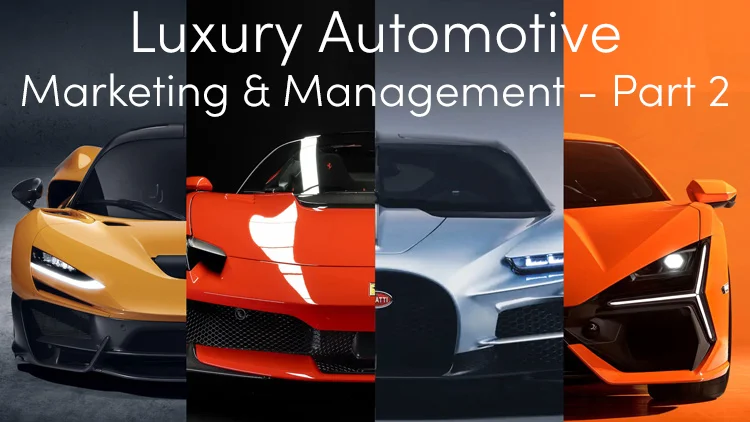
Following up on the first half of the Luxury Automotive Strategy and Marketing online course published a while back, the second half is now available on Udemy at the link HERE.
As for the previous one, this course too is thought for enthusiasts and university students who want to learn more about the workings of the industry. While it is not necessary to have completed the first half to be able to understand and learn this second one, the two are closely linked and form a complete picture.

So, after learning about the key players in the industry and how their branding and strategies compare to each other, this new section looks at market dynamics highlighting the main trends, some academic analysis of them, and an overall view of the global luxury market numbers. Last but not least, a couple of interesting case studies conclude the course comparing diversification strategies and innovation in luxury automotive.

I hope you'll enjoy it. Don't forget to leave feedback and get in touch to know more.

Cover homepage alt copy 3

Are Luxury Performance EVs Dead in 2025?

  • Brand: Porsche, Rimac, Rolls-Royce, Mercedes
  • Topic: Electric Vehicle Market, Supercars Future

2024 was a complex year for the automotive industry, with legacy automakers losing significant ground either in EV market shares, financial results, or both. This is due to several factors affecting the industry. Geopolitical, technological, and trends among consumers. While there is no doubt that the future of automotive is electric (at least in large part if not completely), the same might not be completely true for the luxury performance niche for the foreseeable future.

EVs are “young”. While cars have been around for well over a century, the true development of consumer-ready electric cars is barely around 15 years, and there are still countless areas of significant improvements that can completely change the product and user experience in years to come. Going from batteries to software, and more.

After early adopters jumped on the bandwagon and the excitement “died down”, it left space to critics and doubters. This, particularly in 2024, is reflected in a significant drop in EV sales in the West. China is the great exception, with EVs not only growing but reaching around 65-70% of the global share.

Luxury Automotive OEMs review their electrification strategies

It is throughout this difficult period for the industry with many OEMs committing significant investments in EV-related technology, like Ford's $14 billion for the EV expansion in the US, that some started going back on their development strategies.

The latest of which is none other than Porsche. The German automaker has been a strong and early promoter of the new powertrain technology, with its Taycan, initially named Mission E, and many more in between from concepts like the Mission R, or Mission X, to actual all-electric production version of its “traditional” lineup like the latest Macan.

It has to be said that Porsche never fully went in only one direction. A while back they made the headlines with their big investment in E-fuel development for their legacy models and classic cars (Link E-fuel article here), but an estimate of their investment in EV technology just in the last 3 years is around $25 billion.

Only a few months ago Porsche announced it was reviewing its EV strategy stating they are reducing their EV development targets. Key reasons for this have been sluggish sales of its EV models due to low demand, the significant investment required to continually develop software and technology for its new models, and, not to be underestimated in the luxury sector, the drastic depreciation hitting EVs in general, trend for which the Taycan has unfortunately become a symbol.

Porsche Taycan Depreciation over 1 and 4 years

depreciation

A quick look at the Taycan (Coupé) current rate of depreciation shows a quite worrying situation, that any buyer in this segment would seriously consider before the purchase. Compared to 2024’s prices for the different trim levels as new starting at £86,000, and topping at £161,000 (excluding the Turbo GT version that was not available in the previous generation Taycan), models purchased earlier in the same year depreciate by an average of 31% on starting prices that do not include options yet, and over 51% in 4 years. If options were included in original sales prices these percentages would increase even more.

A first announcement by the German automaker stated that the previous target of 80% of BEV sales by 2030 might not be achieved due to factors previously stated. Chairman Lutz Meschke said: “We will refresh our combustion engine cars, including the Panamera and the Cayenne, and of course, we will continue to rely on plug-in hybrids”. He continued “When it comes to research and development, you’ll see more flexibility in the upcoming years. We will develop new combustion-engined derivatives in order to give the right answer to customer demand”. This could, for example, be reflected in the decision of releasing an ICE version of the upcoming 718 that was notoriously set to become a BEV only, announced by the Mission R concept a few years ago, to try and renew the product line and revive its sales that has been somewhat slow over quite a few years.

mercedes cla elettrica*Mercedes-Benz BEV CLA Concept

Right before the German automaker, compatriots at Mercedes-Benz went through a similar process. Initially the development of the MB.EA-Large EV platform planned for 2028 was halted, then came the delay of the target of 50% sales of electrified models (BEVs and PHEVs) from 2025 to 2030, and it’s a few days ago the announcement that the production of the CLA concept unveiled a while back has also been delayed due to development issues.

In Great Britain too, automotive OEMs follow the trend. Aston Martin, amid a slowly and very gradually recovering financial situation, delayed the announcement of its first EV to 2026 which was initially set to come this year. Geely-owned Lotus has reportedly abandoned the plans to go 100% electric and Bentley too, which was set to reach the same target by 2030 confirmed that hybrids will likely remain on sale even after that date.

Is there more to this trend?

As mentioned previously, China is going strong and its EV market is in constant evolution with serious competitors coming to the global stage and making the headlines with important achievements. These days in the Western media the peak of this wave has surely been Xiaomi’s SU7 which in its “Ultra Prototype” iteration (which is not road legal) managed to attract everyone’s attention with a lap time of 6:46.874 at the Nürburgring Nordschleife becoming the fastest EV on the track. It comfortably outpaced the £1.8 million Rimac Nevera (7:05.29) and the new £186,000 Porsche Taycan Turbo GT with Weissach Package (7:07.55) with a prototype that is said to cost just around £94,000.

While this is working well for the mass market though in China, luxury automakers have a different and much smaller customer base, and on top of that for several of these brands the largest markets are still in the West (usually the USA) and currently made on average in larger part of people around 50+year-old or older. This demographic, grown up with specific expectations about the performance and sensations that a performance luxury car can and should offer seems fairly opposed to electrification and its added value proposition compared to combustion-engined cars. So, this is the obvious and most likely factor due to which the market niche is highly likely to remain mostly ICE-driven in the short to medium term, with hybrids decisively taking their place.

There are potential alternatives with the likes of Ferrari attempting a new approach to BEVs as discussed previously, or a new developing trend of Extended-range Electric Vehicles (EREV) which is mostly aimed at solving range-anxiety and thus not likely to make luxury car buyers fall in love with performance EVs.

xiaomi record*Xiaomi sets lap time at the Nordschleife

The most emblematic example of this change happening over the last year or so is the statement released by Rimac’s CEO Mate Rimac confirming that luxury car buyers simply do not want performance EVs. According to some, this could be hinting that upcoming models by the Croatian brand will get some sort of internal combustion powertrain component. In terms of sales the only exception in the year just passed has been the Rolls-Royce Spectre, which is naturally not focused on performance and thus (as founder Charles Rolls said over 100 years ago) takes advantage of the silent and smooth powertrain enhancing all the characteristics that brand’s clients look for.

What could be next?

As the market composition, especially for traditional luxury automakers seems unlikely to drastically change in the short term, a significant change could be once more driven by forward-looking markets like China.

With the offering of sporty BEVs increasing in China, customers more used to, or growing up in a market dominated by EVs may first start trends that define new value propositions more suited to the electric powertrain that go beyond straight-line acceleration (already proven not sufficient to convince sceptics) and would probably fall in technology applications and EV-specific driving-related use-cases.

Last but not least, a determinant factor that could change traditional performance car buyers’ mind is a revolution in EV battery technology. If new chemistries bring a significant improvement not much in power density, but in volume and weight reduction like some such as solid-state promise, they could help OEMs bringing down the overall cars' weight to the 1,500 kg average of current performance cars and thus significantly benefit dynamics and driving capabilities.

New Luxury Automotive: Going Beyond Performance?

  • Brand: Aston Martin, Ferrari, Pagani, Rimac
  • Topic: Electric Vehicle Market, Strategy & Marketing

The current luxury automotive landscape is shaped by a specific trend that has influenced various players and could increasingly define new products in the near future. In a way, it might even seem like the industry is going backwards. But the truth is that recently something has fundamentally changed in how the value proposition of luxury cars is conceived. And electric cars might be a big part of this.

In the early days of the automotive industry, cars were rare objects for the rich and the daring who wanted to experiment first-hand with this new technology. Cars were not thought for the mass market and were entirely built by hand and highly personalised, at least until the advent of the Ford Model T in the early days of the past century. In Europe in particular the trend of hand-crafted cars and coachbuilders who would specify a body according to the client’s specifications continued for a while. Along with the aesthetics, one of the defining characteristics of cars at the time was performance, and racing was a powerful marketing tool for it.

This is true today as well, but there is more going on. I have already touched previously on how customization is gaining more importance today, and how it has become a significant share of companies earnings (to know more check Tailor-made: What luxury car customers can't go without and One-off Supercars: What’s the next step for luxury automotive? ). In its Q2 2024 report, Ferrari quotes a +16.2% in revenues, and as it happened several times already, among the contributing factors is consistently mentioned increased popularity of personalisation programs, which also allows for the significant margins made on every single vehicle sold. But in the modern industry of supercars and hypercars it is becoming more and more common to see taglines about “the fun of driving” or “driving involvement" rather than the continued comparison of 0-100 km/h (or 0-62 mph) times and top speeds that has been the benchmark of most new performance cars’ headlines for many years.

The trend has been developing for a few years now. Ferrari is a prime and most successful example of this and it is visible in the comparison between revenues and sales figures over the last few years. Right after the pandemic and the quick 2021 recovery, revenue growth remained consistent at almost 20% while sales growth has been gradually limited toward the 15,000 units mark dropping significantly to around 3% in 2023 highlighting the increasing margins made on each model thanks to increasing personalisation demand. 

Ferrari's Sales and Revenues Growth Percentage by Year (2020-2023)

ferrari growth

Enjoyment over performance

With the advent of electric performance cars, obliterating normal combustion engine cars in acceleration performance, some initially thought this new technology benchmark would be the driver for the future of the industry. But, at least for now, things are going in a different way.

Despite environmental regulations limiting emissions and engines’ size, which have been the main factors in the growing adoption of turbochargers and superchargers for automakers to keep boosting performance, we are seeing more “going back” to naturally aspirated large high-revving engines. This is naturally, in part, allowed by the fact that environmental restrictions are different for low-volume manufacturers, but hybridisation is one key enabler for this. Supporting electric power allows OEMs to maintain engines that become the centrepiece of a vehicle by offering more involving and immediate response when driving, along with the soundtrack that all collectors love.

The same goes for manual gearboxes. While dual-clutch transmissions and other more daring alternatives (from the likes of Koenigsegg) have reached high levels of refinement with smooth and lightning-quick gear changes, once again OEMs are finding a key selling point in the involvement and driving enjoyment that a manual stick shift offers. While more classics-inspired low-volume automakers like GMA had that single formula right from the start, others are going back to it. Aston Martin recently produced a few limited editions with manual gearboxes. The same goes for Pagani, which not only reintroduced it in its latest Utopia but also made it available for unique iterations of the Huayra. The Italian automaker also claimed that so far over 70% of the very limited Utopia production run has been ordered with a manual gearbox.

manual gearbox*Aston Martin Valour and Pagani Utopia reintroducing manual gearbox

All these trends suggest that as technology has improved and made a leap forward, unlike in the old days, some OEMs have understood that performance numbers can only go so far, and what counted the most at the end of the day for a car owner was the enjoyment and driving involvement, rather than 0.1 seconds less to reach 100 km/h.

Luxury OEMs changing plans

One of the most controversial pieces of news around the topic came a few months ago from an interview with Mate Rimac. The founder and CEO of Rimac Automobili has, in just over 10 years, become the one symbol worldwide for performance automotive electrification as discussed in previous articles on Rimac’s growth and marketing. Its Nevera has become the fastest-accelerating road-legal car in the world to the point where most other top-of-the-line high-performance supercars would seem slow in comparison and has also broken many records. After all this, however, a few months ago, Rimac has been quoted as saying that the future of electric hypercars is uncertain because clients simply do not want them. The reasons for this would apparently, be a refusal to accept a product that is seen as “imposed by politics” with environmental regulations pushing greener vehicles, and a lack of emotional connection with such cars. As mentioned earlier, clients today want more and more something that is unique. Electric vehicles are becoming mainstream, and at the same time instead loud cars with big engines that were already rare are becoming even more so. These would be the key reasons driving clients away from EV supercars and toward a more familiar experience of performance and sound involvement, even if this means inferior performance.

In this context, two companies are taking different but equally interesting action on the matter. On one side, Aston Martin recently announced that they delayed their upcoming EV by at least 1 year (from 2025 to 2026) due to low demand. They instead stuck with big V12 engines and a limited application of hybrid powertrains on the likes of Valkyrie and the upcoming Valhalla.

On the other, Ferrari is trying to “make the EV emotional”, by doing it differently from anyone else. A patent filed by Ferrari a while back shows a unique project for the potential development of an upcoming electric prancing horse.

 Ferrari's EV patent

ferrari new patents

The plans show how the new EV would feature an e-drive axle and a sound-transmission devise that uses air pressure and vibrations to send sound to the cabin via an acoustic conduit. No electronics or speakers were used to produce sound, making it not just an imitation like some proposed at times, but a proper sound, just likely different. Ferrari would also add resonators on the axles that should amplify the sound coming from the e-motors. Specific valves enabled by an ECU would allow the sound profile and volume to change and adjust in the same way as an active exhaust system opens and closes valves to increase the volume. According to Ferrari, the solution is not devised exclusively for added drama, but also to give drivers a better awareness of what the car is doing at any given time.

Conclusions

The industry seems to have come full-circle since its early days. On the marketing side, personalisation is an increasingly important requirement for clients and OEMs are getting an equally growing share of revenues from customisation programs along with unique limited runs of special editions, or unique models. And like in the early days of the industry, these cars have to be unique to represent the owner's status and identity.

On the other hand, though the technical driving force has changed. Technology for the sake of evolution and performance is being “refused”, with demand steering manufacturers toward larger combustion engines, manual gearboxes, and tactile analogue controls that one might have thought would start disappearing in favour of electric motors, automatic gearboxes (or none at all), and 100% of control integrated into digital infotainment systems. Performance is not as defining as it used to be, while experience both in the car and outside is so more than ever.

Automotive Luxury Market in 2022: The Growth Continues

  • Brand: Aston Martin, Bentley, Ferrari, Lamborghini, McLaren, Porsche, Rolls-Royce
  • Topic: Strategy & Marketing, Supercars Future

The luxury automotive sector showed significant resilience over 2020 as the Covid pandemic broke out. While the wider sector has been faltering in its recovery, the luxury segment kept growing in the following year and in 2022 as well. Along with the general growth though there are other interesting dynamics that can be observed.

Larger volumes

The top-end of the segment, driven by a few extremely successful brands, has registered yet another growth year, increasing over 2021 by about 9%, and a further 3% the next one as displayed in the graph below. The larger automotive sector instead despite a sizeable improvement in 2021, almost stagnated in 2022, with the main cause for delays and bottlenecks still being the shortage of semiconductors.

Luxury Automotive Market Sales Volumes (2018-2022)

volume

The main contributor to this success over the past two years has been the continued growth of brands like Bentley, exceeding 15,000 yearly sales for the first time in its history, Ferrari (13,221), Lamborghini (9,233), and Rolls-Royce (6,021) all posting record results. Other OEMs such as Aston Martin, Porsche, and Maserati (still on the path of recovery) instead have been consistent while probably not exceeding expectations. Finally, more niche brands still going strong like Pagani, Rimac, Koenigsegg, and the likes also contributed albeit with very low numbers. Of the public companies in the segment only McLaren, which has not published its full-year figures (and is accounted for here with an estimate), will likely report a drop in sales since it stood at -13% in Q3 YOY.

Reflecting the general health of the segment is the market size evaluated at €566 billion.

Luxury Automotive Market Value (2018-2022)

value market

Evolving market trends: prices and personalisation

The most interesting data that emerges from these reports though is that while the value of the market has not only recovered but exceeded the record of 2019, sales numbers haven’t.

This is reflected by the growth numbers of various companies in the segment. While for all these the sales numbers have increased, both revenues and operating profits reached much higher growth suggesting an overall improvement in efficiency, and most of all a trend already seen over quite a few years: the general increase of luxury vehicle prices.

2022 Luxury OEMs with the largest revenue and operating profit growths

table growth

This increase in average selling price (ASP) takes different forms.

In 2022, Aston Martin boasts a 26% increase in ASP exceeding the £200,000 mark. This has been mainly thanks to the destocking efforts over the past few years.

In other instances, the base price of production models has comparatively increased, either because of new technologies or because they represent new additions to a lineup, as is the case for Ferrari’s SF90 Stradale and Purosangue. The first is priced at £379,000, while the latter specifically substituting the GTC4 Lusso, introduced in 2016 and sold at a price of around £243,000, is offered now at a starting price of £313,000. This trend is observable in pretty much every other luxury car manufacturer, with even more extreme examples in super low-volume ones such as Pagani.

Last but not least, the other important trend that is common to all these companies and represents an important and increasing source of revenue is personalisation. Every luxury OEM over the last 10-15 years has introduced and gradually expanded its bespoke program. Over the last two years, most OEMs quote bespoke and coachbuilding programs as major contributors to the sudden increase in revenues and profits.

The luxury market keeps evolving and, as mentioned previously in the article Tailor-made: What luxury car customers can't go without, the product itself is not sufficient anymore. With general wealth increasing in most developed markets, and a higher number of HNWIs, expectations have become higher too. Clients are looking for more than a high-end car, they want something that is also unique and distinguishable. So, virtually limitless selections of colours, materials, interior, and exterior specifications have been added by every automaker.

The other method used by automakers to cater to this demanding audience is the release of limited-edition models. Often derived in most parts from production cars, limited runs usually feature a few unique additions that can, at times, be only cosmetic. These rare models are more desirable as they also suffer much less from depreciation. The peak of this trend is represented by one-offs which have also been constantly increasing over the past 10+ years as shown in One-off Supercars: What’s the next step for luxury automotive?

dbs 770 ultimate volante*Latest example of limited-run by Aston Martin DBS 770 Ultimate Volante

Additionally, each OEM used different methods to realise efficiencies in production and resource management. Bentley’s ‘Dream Factory’ realised with a £2.5 billion investment significantly reduced water consumption, improved waste management, and overall carbon footprint. Others such as Aston Martin optimised product development processes that allowed them to maximise cross-carline component sharing. In turn this reduced processes and engineering complexity.

Unfortunately, for some OEMs, this also corresponded to significant layoffs over the last two years, which surely contributed to the reported results.

Further Brand diversification

Other important factors contributing to the growth of luxury automotive brands apart from the delivery of new cars, and the ones quoted above, are the pre-owned market and events.

As discussed previously (Luxury Automotive Resale Value and Depreciation: How and Why) the pre-owned market is extremely important for luxury automakers, and not only because low depreciation makes cars more attractive for potential buyers, but also because most new clients when approaching their first purchase chose a used vehicle.

What often happens next is that these clients end up owning more than a single car, in fact over 50% of a large sample of owners claim to possess more than one luxury vehicle. This choice is often strictly tied to branding and brand value, so clients effectively become part of a restricted elite where they also get involved in a plethora of activities that offer OEMs more opportunities to create additional revenue streams.

Bentley's latest announcement on this field is particularly interesting. With its latest program called “Extraordinary Journeys”, the brand offers highly curated road trips in selected locations revolving around the best driving experiences possible while moving through high-end hotels, fine dining, and other interesting cultural activities. While this is something that many brands organise for their clients, what is unique in Bentley’s case is that for the first time, they are opening these programs to non-clients, giving them the opportunity to drive a range of different models during the trip. This is not only a great additional revenue source, but also a smart way to attract new potential buyers and create brand advocates thanks to a proper 360° experience that goes beyond just the product.

Coming Years

Over the coming years, the luxury market has new important opportunities coming from the transition to electrification and with new technologies. SaaS (Software as a Service) creates even more options for personalization throughout the entire customer journey. From early stages to after-sales, OEMs can offer additional services and make their ownership experience even more unique.

rr spectre*Rolls-Royce Spectre is the first offering a customisable digital cluster according to clients' preference

The segment has been more resilient despite the difficulties the wider sector went through over the past 3 years, and so far signs seem to indicate the positive momentum might continue.

Luxury automotive Q1 2022: diversification and changing management

  • Brand: Aston Martin, Bentley, Ferrari, Lamborghini, McLaren, Porsche, Rolls-Royce

The global automotive industry is still going through a difficult period, with sales in the first quarter of 2022 shrinking in each continent. With negative effects stemming from Covid-19 cases still present despite the general media indifference of the last few weeks, supply shortage, especially with semiconductors, and uncertainties with the Russia-Ukraine war, the outlook is still worrying.

March 2022 saw sales in both the US and EU drop by over 20%. Q1 decrease was less severe overall but still reached a significant -10% in both markets (Nasdaq, Statista, Unrae). Asia might partially be an exception. While Reuters reports a 14% drop in sales in Japan in January, according to CAAM, instead, China maintains the positive momentum with a 10% growth in March, and an 8% overall in Q1. Notable is also the sales of NEV doubling in March with around half a million units sold.

Automotive Market growth % in Q1 2022/March 2022 by Region

graph

This again shows the difference between the volume market compared to the high-end luxury one where. As discussed before, and while for some the hardship is not over yet, for “the usual winners” it all seems smooth sailing and more.

Luxury segment: Winners and Losers

The usual 5, Rolls-Royce, Ferrari, Lamborghini, Bentley, and Porsche, manage again to post yet another record quarter or a really strong one at least. In terms of sales, Rolls-Royce and Ferrari top the chart, increasing their respective sales both by 17% and reporting strong financial results as well.

Right after Lamborghini increases its sales by 4.8% and reports positive financial results as well with revenues and operating profits improving by 13 and 25%.

Porsche and Bentley both reported a sales drop of 4.9 and 4.6% but record financial figures signalling an important focus on business efficiency during this uncertain time. Revenues and operating profit at Bentley improved by 41 and a staggering 162%. At Porsche, the same figures grew by 4.1 and 17.4%.

table q1 2022

After a positive 2021, with a bold recovery from the previous year, thanks to the introduction of the SUV DBX, Aston Martin seems to be back in troubled waters. Sales decreased by almost 14% with only the GT segment improving, and the DBX sales dropping 41%. Also, despite the revenues increase, financial results are not positive as well.

What’s next?

The continued growth of the segment is probably coming from increasing property prices and the stock market growth of 2020 and 2021. According to property consultants, Knight Frank these unique conditions created over 51,000 new Ultra-high-net-worth individuals (UHNWI), classified as people with at least $30 million of investable capital, bringing the overall number to 610,569.

Top automakers are responding by following the current trend in the industry and expanding their portfolio to cover the widest portion of the market possible.

The one that paved the way over the last two decades and is still pursuing such a strategy is Porsche. Q1 of 2022 confirms the Taycan range as the third best-selling after the two SUVs, but above the 911, which is a key indicator of how more and more people are interested in the sporty luxury automotive experience (and in this case even electric mobility) without being “limited” by the typical sports car’s lack of practicality and everyday usability.

Notably, Ferrari has been doing the same. If it does maintain the growth rate by the end of the year, while still strictly controlling its sales numbers, it will have almost doubled the figure in 9 years, from the 7,000 units of 2013.

Ferrari Sales, Growth Percentage (2013-2021) and Product Range value Proposition

ferrari graph and percentage

Ferrari product

More important than that though, is the portfolio expansion. Since 2013, right after the LaFerrari, the brand added a 4-door line (FF, GTC4 Lusso), that will now be substituted with the SUV Purosangue, a new GT line (Roma), a higher-end, high-performance hybrid (SF90 Stradale). Most recently the new V6 Hybrid, that while dictated, as a choice, by the more restrictive environmental regulations, does not substitute the mid-engine V8 line (at least not yet).

Along with all this Ferrari makes sure to retain also the very top niche of its clientele with the personalisation program and the One-off, discussed more in detail as a trend here. Its latest born the SP48 Unica introduced just a few days ago.

The other brands Rolls-Royce, Lamborghini, and Bentley, as discussed have all very successfully entered the SUV segment, but that is not all. Much like Ferrari and Porsche, they too are nearing the release of additional models that will expand their lineup. For Lamborghini, it will be the full-electric fourth model, which according to what has been said by some representatives it could be more of a GT model. Rolls-Royce too has the full-electric Spectre coming soon. And last but not least, Bentley’s new model which debuts today will sit at the top of the range, expanding the brand’s reach, but not introducing a new electric powertrain.

Other OEMs that are going through difficulties or “losers” (in a figurative way regarding this last period, of course) are adopting similar strategies. But there is more going on behind the scenes for both McLaren and Aston Martin in the search for stability.

McLaren, whose market potential was investigated in the last article’s 5 forces analysis, unexpectedly has not released any report after Q3 of 2021. Its range expansion has consisted so far in the addition of the GT to the range. More importantly, however, there is also an important restructuring.

It is of last week the announcement of the new CEO finally taking place at the head of the British company after Mike Flewitt left its role. Michael Leiters will start in his new position effectively on July 1st. Before this, he held senior positions at Porsche and has been CTO at Ferrari. This important announcement followed some other major changes in important corporate roles within the company.

There is also the now long-standing rumour about the Audi buyout of McLaren’s F1 team that would at one point involve also the automotive division. The deal was first denied by McLaren in November, but speculations continued as ongoing discussions were not excluded. Despite various media outlets still talking about it, from recent statements by the likes of Zack Brown, it looks like nothing is going to happen (at least in the short term).

Similarly, it is of a few days ago the announcement of Aston Martin’s change of leadership. After just two years, Tobias Moers, the man behind the rise to power of AMG, called by Lawrence Stroll to save the British car manufacturer, will be substituted. While Moers will remain close to the top management of the firm, the role of CEO will go to ex-Ferrari Amedeo Felisa who held the same role in Maranello from 2008 to 2016. With him, another former Ferrari executive, who worked at Alfa Romeo and BMW, Roberto Fedeli will join Aston Martin as the new CTO. Both of them arrive from Chinese Silk-FAW which is attempting to establish a presence in the Italian motor valley to produce electric performance cars.

amedeo felisa roberto fedeli*Amedeo Felisa and Roberto Fedeli

Aston Martin too has a significant product expansion planned, but its recent difficulties have left it behind the competition. Especially in the transition to hybridisation and electrification. The mid-engines Valkyrie and Valhalla have already been significantly delayed. In an interview with the Guardian, Stroll himself said that Moers’s contribution was key to restructuring the company in a critical moment. Now, someone else is needed to bring it to the next stage. While all the people involved are certainly capable, and extremely experienced professionals, only time will tell if these fast changes in management will have the positive effect Mr. Stroll is hoping for. Aston Martin went through the rough destocking phase, and out of it had a good 2021. The financial risks however are not over, and this first quarter does not look promising.

Between restructuring and vast portfolio expansions, the luxury segment continues its overall growth while the rest of the industry falters. Despite the global increase of HNWIs, one wonders if all the contributing factors that caused such a severe contraction of the automotive sector in 2022 will eventually affect the luxury segment as well. For now, a few companies are setting the trend and look very much in control of the narrative and the direction of the market.

Why 2021 was a record year just for Luxury Automotive

  • Brand: Aston Martin, Bentley, Lamborghini, Porsche, Rolls-Royce
  • Topic: Supercars Future

2021 just ended and several companies in the luxury space have been publishing news reporting record sales this year. In many sectors, a significant recovery from 2020’s crisis caused by the pandemic was expected, but few foresaw results exceeding or even equalling 2019’s ones. The average predictions claimed that the full recovery up to 2019 levels would be likely reached only by 2023.

It is early to talk about financial results since the complete annual reports will be published in a month or so from now. However, Q3 reports can already tell a lot, and the results indicate two important facts. One is the difference between the top-end of the luxury market and the lower segments. The second is that forecasts should always be considered with extreme care.

Luxury Automotive Revenue Percentage Change by Company (Q3 2019 Vs Q3 2021)

luxury revenue

Automotive Revenue Percentage Change by Company (Q3 2019 Vs Q3 2021)

mass revenue

The main reasons for the difficulties of high-volume car manufacturers are the uncertainty brought by the latest wave of the virus that impacted the market especially in the second half of the year, and the ongoing chip shortage that severely affected the supply chain and cars delivery to dealers and clients. The latter is discussed in more detail in Chip Shortage in Luxury Automotive: The Perfect Storm.

In Europe, in fact, over the 12 months of 2021, 11,774,885 vehicles were sold (UNRAE), a decrease of 1.5% over 2020 and 25.5 over 2019. The five major European markets, France, Germany, Italy, Spain, and the UK were mostly stable (with the exception of Germany that despite remaining the largest market lost 10%). The other important piece of data was the continued growth of BEV and PHEV. In France, Germany, Italy, Spain, and UK the increase in sales over 2020 was 64%, 72%, 128%, 66%, and 76% respectively. Even if starting from low numbers, the increase in just one year is quite significant.

5 Major European Market Total and Electrified Vehicles sales (2020-2021)

bev graph

So, what has made this year so different for luxury automakers?

Record Results

Quite a few companies at the top of the automotive luxury market announced their 2021 sales figures, and almost all were record-breaking. The last has been Rolls-Royce with 5,586 units, a 49% increase over last year. A few days before the British OEM, other announcements came from Bentley which sold 14,659 cars, up 31%, Lamborghini 8,405, +13%, and Porsche 301,915, +11%. Last but not least, Aston Martin also delivered 6,182 vehicles, thanks to a strong contribution of the new SUV DBX, for a total 82% improvement over 2020. While this is not a record result, it is still a strong improvement over 2020, and very close to the all-time high of 6,441 units of 2018.

How the luxury market reached record sales

There are several factors that distinguish the luxury segment from the rest of the automotive industry, most of which, in this case, were crucial to its success in 2021.

Semiconductors availability

Again the production volume plays a role in the resilience of luxury automakers in the current situation. With most of the companies producing in volumes below the 10,000 units, the chip shortage would arguably be more manageable than for companies producing in the hundreds of thousands or even millions of cars.

Additionally, companies that are part of a larger group benefit from the vast resources of their parent companies. Is the case of those under the VW umbrella, or Rolls-Royce with BMW. CEO Torsten Müller-Ötvös told Bloomberg:

“I’m very glad that we are part of the BMW Group. We had preferential delivery of semiconductors last year”

This allowed the company to fulfil every order in the book without delays and actually sustain a strong order book for this year as well.

dbx*Aston Martin DBX

Pandemic Indirect Effects

With regards to the record-breaking sales of Rolls-Royce, the CEO again interviewed, this time by Reuters, suggested that when Covid hit, travel restrictions followed leaving a lot of unspent disposable income. According to him a significant part of it has been spent on luxury goods.

Also, these past two years, surely made private vehicles the preferable choice over public ones for moving and even going on longer trips.

New models and hot segments

Each one of these manufacturers achieved the result thanks to one or two great performers. For low-volume manufacturers a single model can be a true game-changer, impacting the overall results much more than what a single model can do in the high-volume market. SUVs, once again,  were key in this context. Aston Martin is a good example. Its DBX, up until Q3 accounted for more than half of the overall sales. Lamborghini is too. In 2021, the Urus sales made up 60% of the total, with the Aventador slowing down again and the Huracán improving for the first time in three years thanks mostly to its new iteration, the STO.

Porsche improved also thanks to the success of its full-electric range. Another important trend, as mentioned in the beginning, is just starting now and it is set to accelerate in the coming years. Taycan and Taycan Cross-Turismo sold extremely well reaching 41,296 units, which made it the third most successful product range for the company, right below the two SUVs Macan and Cayenne, but above Panamera, 911, and 718. Porsche’s competitive advantage in the electric space could become even more important in the next years.

For Rolls-Royce instead, the new Ghost, and the release of its Black Badge version, contributed significantly to the record figure, along with the still successful Cullinan.

ghost black badge*Rolls-Royce Black Badge Ghost

A report from IEA claims that in 2021, SUV sales accounted for 45.9% of the total, reaching 35.5 million units globally. Clearly, the top-end luxury segment is still satisfying a strong and increasing demand. As proven by the numbers, most of the recent success and proper turnarounds, of luxury automakers are owed to the extreme popularity of this category, and the relevance of a single successful model in a relatively small product range produced in low volumes.

suv sales*Source: IEA

Environmental factors

An important role in the recovery of the luxury market in 2021 has been played by China, whose economy has grown by 8.1% this year, despite the challenges, and exceeding the 6% forecast established by the government.

Interestingly, the country had a major role during the 2008 global financial crisis as well. As the countries that were affected the most gradually recovered, a fast-growing China helped many companies offset the losses in other markets. This dynamic was reflected in the luxury market too of course.

All the automakers that reported great results in 2021 experienced significant growth in China. For some in particular, such as Bentley and Porsche (as visible in the Financials section) the APAC region is already the most important in terms of sales. So, a strong economy, paired with a significant concentration of high-net-worth individuals has been key, positively impacting their performance.

Considering the reports published in Q3, extremely positive results can be expected by the other competitors within the segment.

The factors that played a role last year will arguably continue to influence the market in 2022, but the electric transition will also play an increasingly important role. Like the SUV has helped drive many of these companies’ sales to new heights, the next turning point will likely be the introduction of electric vehicles and the capacity of the OEMs to connect their brand with the new automotive industry and a changing audience.

Rolls-Royce Marketing Mix: The 8Ps of a luxury goods company

  • Brand: Rolls-Royce
  • Topic: Strategy & Marketing

Each company in the luxury automotive industry has its own "niche within the niche". Being an oligopoly, characterised by a very limited, and very demanding customer base, this market requires each one of the few key players to distinguish itself creating something outstanding.

Some manage to do it better than others, and I have discussed previously the difficulties to enter this market due to its very nature.

In all this, Rolls-Royce, producing cars under the BMW Group since 2003, is definitely one of the most unique examples for many reasons. So much so, that it could almost be said it does not really compete with other firms. In those characteristics that make this brand unique in fact, there is pretty much no one coming close, and its strategy and pricing are a reflection of that.

An essential factor in this is how the company approaches the market, which is expressed perfectly by its CEO, Torsten Müller-Ötvös, words during an interview with CNBC:

"We are not lowering prices just for the sake of volume. That's not Rolls-Royce. We're in the high-end exclusivity business. We are luxury goods. Probably not cars really, our clients see us as luxury goods, and it is to be maintained like that.[...]Rolls-Royce is not at all in any trading business. We are not in the car business at all."

With these premises, it is interesting to look more in-depth into what defines Rolls-Royce's marketing mix.

For previous articles about luxury automotive company's marketing mix 8Ps check the links:

Ferrari Marketing Mix: The Prancing Horse's 8Ps

Aston Martin Marketing Mix: The Company's 8Ps

Bentley Marketing Mix: The Company's 8Ps

METHOD

The framework applied, as before, comes from the original 1981's work from Booms and Bitner's 7Ps which analyses every business as a service-based one. This fits every modern automotive company, as already discussed, and even more Rolls-Royce when considering it as a luxury goods company, not an automobile manufacturer. For this reason too, a big part of what Rolls-Royce sells is actually intangible. A lifestyle, and the brand's value that customers want to belong to.

The 8th P concept hypothesised by Goldsmith (1999) and revolving around Personalisation and segmentation claims that modern business has to be the opposite of one-size-fits-all. And Rolls-Royce's business model perfectly incarnates it. While every company in this space now applies a high degree of customisation, these extremely high standards become increasingly harder to maintain as numbers grow. Rolls-Royce keeping strict control over its growth sits on top with only Pagani (which however produces much fewer cars, just between forty and fifty a year) coming close in terms of personalisation.

rolls royce 8p scheme

PRODUCT

Whether you see them as luxury cars or luxury goods as claimed by its CEO, Rolls-Royce vehicles are in a league of their own for what they want to achieve. The brand name is synonymous with top-end luxury for a reason, and the quality has to be the best in every small detail. The best materials are picked for every component, and not a single piece that is going to be touched or used in their interiors is made out of plastic.

This attention to quality is applied to achieve also the main driving characteristic of any Rolls-Royce, its refinement and capability to isolate from the outside world. While not lacking in power and performance by any means, differently from other luxury automakers, Rolls-Royce is not concerned with numbers. Especially knowing that for most of their models, owners will not even drive the car but most of the time will be chauffeured around. A serene experience is the most important feature of the Rolls-Royce drive.

Features and options follow the previous concept. They are countless and offered to accommodate every client's preference to mostly unprecedented levels. So naturally, a big component of the product, purchasing, and ownership experience offered by Rolls-Royce consist of its personalisation range, which is discussed later on.

The design language is very recognisable as well. It is essential and clean. So much so that at Rolls-Royce it is said that every model's design can be captured with just three lines. At the same time though, each design is very imposing and conveys Rolls-Royce's stability and luxury character.

Rolls Royce products

The product line consists of five main products. Starting from the Phantom, is a 4-door saloon, full luxury flagship, and thus the most expensive, and the largest. It is the quintessential car for the owner that leaves the driving to the chauffeur.

It follows the Ghost, which is still a full-fledged 4-door luxury car but slightly smaller than Phantom, and conceived to engage the driver more. The latest model to be renewed, launched in 2020 according to the concept of Post Opulence, and it is extremely being the best selling model of the company's history so far. In its statement, Rolls-Royce claimed that more clients than expected actually liked to drive their own Ghost, and for this reason, they paid attention to provide an engaging driving experience as well.

Talking about sales figures, the third model is the Rolls-Royce Cullinan, the latest introduction in terms of vehicle types. The Cullinan, in fact, followed the SUV popularity trend bringing the Rolls-Royce luxury into this vehicle in high demand in the current market. As for other automakers in similar segments, since its launch, in the last two years, the Cullinan alone accounted for around 50% of the total sales of the entire company.

Dawn and Wraith are too fairly recent addition to the line-up. 2-door, 2+2 coupé and convertible versions of Rolls-Royce's ultimate grand tourer. These as well are meant to be driven by their owners, offering a sportier and more engaging drive while still preserving every luxury feature.

The last three models mentioned Cullinan, Wraith, and Dawn are offered also in their Black Badge versions. The Black Badge upgrade usually includes a slight increase in power, and some aesthetic changes such as the use of carbon fibre for some interior components, and the exterior chrome details (including the Spirit of Ecstasy) painted in black.

Finally, the two 4-door Phantom and Ghost instead have both an extended wheel-base version that is popular in certain countries such as China.


ghost
phantom
cullinan
wraith
dawn
ghost
phantom
cullinan
wraith
dawn

*Source:Rolls-Royce Media

The pinnacle of craftsmanship for the British company is Coachbuild. Access to this service is granted only to, according to Rolls-Royce, ‘individuals of extraordinary achievement, culture, and vision'. Here these highly selected clients working closely with the Rolls-Royce team can create their very own car. Unique, or extremely limited pieces that directly become part of the brand's history due to their rarity. Two have been the examples of this within the last decade: The Sweptail and the Boat Tail.   

Every new Rolls-Royce comes with a 4-year warranty that covers unlimited mileage, as well as servicing, repairs, and maintenance.

As for the accessories, Rolls-Royce offers a wide range of specially designed objects to complement the cars. From luggage sets to pic-nic sets, lifestyle items, every piece's quality is of course up to standard with the rest of the company's production.

PRICE

As quoted from CEO Torsten Müller-Ötvös, pricing strategy is essential to Rolls-Royce. None of their products will ever be offered below the current price range. And it is again a unique price positioning, as it is significantly higher than that of any other luxury company.

The ‘entry-level' model in the line-up is the Ghost which starts at £233,235, follows the Wraith at £258,000, and the SUV Cullinan at £264,000. The most expensives of the line-up are the convertible Dawn, MSRP £282,000, and last of course the Phantom for £363,300.

This is another example of Rolls-Royce being on a different level from any competition. Bentley and Mercedes' luxury division Maybach most expensive models which are usually compared to Rolls-Royce are sold for starting prices of £157,900 and £162,390 respectively.

Naturally, the prices mentioned are all before options, which can easily amount to an additional £100,000.

rolls royce window sticker*SourceImgur andQuita Lease

Rolls-Royce's perceived value is of course at the top of the automotive industry as well-considered its unquestioned status as one of the best luxury brands in the world and of any industry. One issue that could affect it however is depreciation. As discussed previously when reviewing Luxury Automotive Resale Value and Depreciation, Rolls-Royces are affected by a quite significant depreciation happening with both age and mileage. Either 10,000 miles or 3 years can account for well over 25% of loss over the car's original price.

This will most likely not happen to Coachbuild models mentioned above that initially sell for several million (Boat Tail was indicated at a price of around £20 million with only 3 units to be built) and thanks to their rarity should at least hold their value.

PLACE

Rolls-Royce sells through a network of 138 authorized dealers spread in 50 different countries. Like its sales numbers, the dealer network too is slightly smaller than that of other companies in similar segments, which sell their cars through networks of 150-160+ dealers.

As seen previously, in the case of Rolls-Royce too each dealer is located strategically in areas with a higher density of high-net-worth individuals or in ‘cluster areas' where other luxury automotive dealerships are located. The image below shows a dealers' area of London in Mayfair.

rolls royce dealer

PROMOTION

As expected, the majority of Rolls-Royce's communication is focused on the luxury aspect of its products, the search for perfection, and for great achievements, which is what makes it unique. This is expressed clearly already in the company's vision statements:

  • Inspiring Greatness. For over 100 years, Rolls-Royce Motor Cars has pushed the boundaries of luxury, creating new realities both within and beyond automotive design.

  • Our strive for perfection guides us.
    Rolls-Royce is an everlasting expression of the exceptional, where everything we do reflects our persistence and commitment towards the remarkable.

The strategy is naturally consistent throughout all its online channels. Entire sections of the website hardly mention or show cars. Focus is again on the ownership experience, and in getting the clients involved in that unique lifestyle.

This is done, as it is common in today's industry segment, through exclusive eventsmeant to enrich the brand's value and increase loyalty. Some of these are organised to surprise owners, which become effectively part of the brand's family, with exciting and unique journeys in selected locations. Then there are cars presentations, history revivals, and even art-related events.

Artis in fact another important component of Rolls-Royce's communication strategy. A theme that is found in numerous activities. One example is Muse, a program with which Rolls-Royce supports artists working with moving imagery and using different technological means. Another is the ‘Evelina Art for Allergy X Dine on the Line' event, a philanthropic initiative to support medical research organised with the collaboration of Rolls-Royce and artist Marc Quinn.


video-artist
artist
debut
debut1
video-artist
artist
debut
debut1

*Source:Rolls-Royce Media and Jake Curtis

The social media pages alternate car-related content to art and inspirational collaborations with important personalities or people of great success in different paths of life. These too contribute to creating a consistent image for the brand.

PARTICIPANTS

Participants are one of the most important tiles of this complex mosaic. In an industry that, especially after the pandemic, is looking more and more at how to make things easier and faster through digitalisation and automatic processes, Rolls-Royce and the rest of the luxury segment go in the opposite direction.

The contact with clients is extremely important as it is an integral part of the brand experience. It starts in the dealer with the initial specification of the vehicle and then varies depending on the involvement of the clients on further steps. When collaborating with the Bespoke division, buyers enter in direct contact with artisans at Rolls-Royce. A staff of highly-trained professionals taking care of every detail.

The final touch added in early 2020 is Whispers, the app for Rolls-Royce owners that features social functionalities for the community, a store, and exclusive experiential offerings by the company itself.

PHYSICAL EVIDENCE

Everything in Rolls-Royce's physical (and digital) environment reflects the brand's search for luxury, art, and perfection.

From the showrooms and dealers to the ateliers, to locations and settings where events are located everything exudes luxury and opulence. Clients are welcomed and can spend time in dedicated lounge areas or ateliers equipped with proper working spaces to work closely with Rolls-Royce staff to specify their car's customisation.


atelier2
atelier1
atelier3
atelier2
atelier1
atelier3

*Source:Rolls-Royce Media andH.R. Owen Rolls-Royce

PROCESS

The process is changing. Technology enriches the experience for clients in many ways, the first of which is the increasing power and accuracy of car configurators. The pillars of these steps, which are partially described in previous sessions, remain the same. Policies and best practices are maintained to create the best ownership experience.

Length and involvement depend on the customisation level required by each client. Some might just choose ‘basic' features, while more demanding ones could specify unique paint colours or bespoke embroideries, up to those rare lucky who access the Coachbuild program. On average, however, the whole process takes around six months, during which each car component is carefully handcrafted.

PERSONALISATION

As it is obvious by now, this is a big part of what Rolls-Royce is all about nowadays. Customisation options range from the general choices like the bodywork paint to the smallest detail, such as the steering wheel spokes, down even to the accessories like the umbrellas hidden in the door panels.

Rolls-Royce's very own division Bespoke takes care of every detail of the car specification at such a level that is rarely seen anywhere else. There are countless examples of the level of craftsmanship reached.

For instance, sales managers can use dedicated lamps to show how different lights depending on the locations, season, or moment of the day, would hit the car paint colour. When specifying the veneer for the interiors, clients can even select the piece of wood to use. There is then the famous starlight headliner, for which Rolls-Royce artisans using over 1,000 fibre optics create a bespoke pattern mimicking specific constellations chosen by the client.

interior8
interior7
interior6
interior5
interior4
interior3
interior2
interior1
interior9
interior8
interior7
interior6
interior5
interior4
interior3
interior2
interior1
interior9

*Examples of ‘Phantom Galleries', interiors, Starlight Headliner, bespoke details, Boat Tail, Source:Rolls-Royce Media

Even the art theme is found again in the personalisation process. The fascia running almost the entire width of the Phantom dashboard is called ‘The Gallery'. For this piece enclosed in glass, clients can commission bespoke art pieces to include and showcase in their cars.

The ultimate level of this service is, of course, the Coachbuild program mentioned before which gave life to unique projects like Sweptail and Boat Tail where even the exterior design is unique and comes from clients' inspiration.

As wealth increases in many countries, the luxury segment of the automotive industry is likely to see increasingly high levels of customisation developing due to increased competition and demanding clientele. Rolls-Royce is well-positioned to deliver a service as no other company does in this space. Even the Coachbuild projects could become more ‘frequent' fundamentally changing the industry as we know it.

One-off Supercars: What’s the next step for luxury automotive?

  • Brand: Aston Martin, Bentley, Ferrari, Lamborghini, McLaren, Rimac, Rolls-Royce
  • Topic: Strategy & Marketing

The automotive industry sales have been decreasing for 3 years now. The drop in fact has begun in 2018, way before the impact of Covid-19, mainly due to stagnation in the Chinese market. The same cannot be said for the luxury automotive segment though. Both 2018, and 2019 were positive years for the sector overall, and in 2020 despite the virus, it experienced a minor drop compared to the mass market.

AUTOMOTIVE MARKET GLOBAL SALES FIGURES BY YEAR

LUXURY AUTOMOTIVE MARKET SALES FIGURES BY YEAR

graphs lkdn*Mass market data source:OICA
*Luxury market data include Aston Martin, Bentley, Bugatti, Ferrari, Lamborghini, McLaren, Rolls Royce, Porsche (including only sales figures of 911 and limited series). Source: Annual Reports

With a sector in good health and several new millionaires every year the sales figures of luxury cars have grown. But this brings two relevant consequences.

First, it is crucial for manufacturers to maintain highly controlled numbers in order to preserve brand exclusivity. Second, “regular” luxury is not sufficient anymore. A while back, I touched on how the Customer Journey has become a necessary component of pretty much any luxury good, and this is especially true when it comes to luxury cars.

But along with extremely detailed customer services, there is another dynamic developing in the industry. Tailor-made one-off or few-off supercars.

Luxury car manufacturers are raising the bar with an increasing release frequency of these exclusive models. This time though, it is not about having the best performance of all (considering that all these cars are already capable of extreme performances) or being personalised in a unique way. This time there is more, and it is, as of now, the highest level of service imaginable by a luxury automaker.

In the early days of the automotive industry, it was common for wealthy clients to have a vehicle especially made for them by an OEM. Then it came mass production with concepts like economies of scale, so everything changed.

Now, instead, oftentimes luxury appears almost “too common” and having a car specified in a very original and creative way is not quite enough for some clients. So, luxury car companies are implementing programs and improving their capabilities, to take their clients on an even more unique journey by working together to design and manufacture their very own car.

one off few off programs*Includes only one-off or few-off projects developed working closely with clients or projects that started a similar wider program

THE TREND

From the graph above it is evident how Ferrari has been developing unique models for their clients for a while. From the first P4/5, it followed the 2008 SP1, with the name indicating the first model of the Ferrari Special Projects or Portfolio Coachbuilding Program. The Program has been started to bring back the experience of old days coachbuilding.

It is not surprising to see Ferrari being the first to embrace this kind of strategy. Not only they are one of the oldest companies in the space, but they have also been developing an extremely complex marketing mix whose example is being followed by other automakers in various instances.

The second trend observable in the graph is the overall increasing number of one-off or few-off projects. Much like bespoke personalisation programs, in the last decade, many companies claimed the intention to introduce their own highly bespoke division to produce unique models regularly.

ferrari-sp1
ferrari-sp38
ferrari-omologata
zonda-zun
la-voiture-noire
Bentley-Bacalar
aston-martin-victor
sc20
mclaren-sabre
ferrari-sp1
ferrari-sp38
ferrari-omologata
zonda-zun
la-voiture-noire
Bentley-Bacalar
aston-martin-victor
sc20
mclaren-sabre

*In order Ferrari SP1, Ferrari SP38, Ferrari Omologata, Pagani Zonda Zun, Bugatti La Voiture Noire, Bentley Bacalar Mulliner, Aston Martin Victor, Lamborghini SC20, McLaren Sabre

McLaren’s MSO before Sabre had stated the will to move in this direction. Pagani too, which already produced an extremely low volume of cars, started introducing unique highly modified models for their wealthiest clients.

Additionally, over the last three years, more companies joined this exclusive club. Lamborghini released its second one-off SC20 again developed by a client working with Squadra Corse, after the SC18 Alston. In Aston Martin, the Victor could only be the firstborn of a project called Prototype Operations teased by Andy Palmer in 2017 during an interview for Road & Track. The then CEO claimed their intention to ramp this production up to two cars per year. Bentley too withMulliner and the super limited Bacalar (only 12 units scheduled) reintroduced its concept of bespoke coachbuilding.

SOME OBSERVATIONS

It will be interesting to see if this dynamic turns into a proper trend. As of now, it does seem the direction these automakers are moving toward. If so, it would represent an entirely new competition stage that could, in time, even change how “regular” luxury performance cars are perceived and how wealthy clients approach these brands.

If these projects become more frequent, it can be expected to see more and more clients requesting this kind of service. In turn, some OEMs could either decide to partially lower their production volumes to focus more on limited series (following Bugatti, Pagani, or Koenigsegg business model), or sell their “slots” for even higher prices, considering that these one-off cars already sell for several million each.

In this respect, market regulations and restrictions evolving in the coming years might play an important role too.

An interesting point of view comes from Mate Rimac.

In a recent interview, he draws a parallelism between the future of car ownership and horse ownership before the advent of modern vehicles. According to Rimac’s CEO, like horses were once the main mean of transportation and were substituted by tractors and cars, the same is bound to happen to cars leaving space to electric and autonomously driven ones.

As governments ban the sales of ICEs and, especially in big cities, the ownership of a vehicle becomes increasingly inconvenient, cars will eventually become a luxury for the few.

mate rimac

The ownership of the vehicle ‘to go from A to B’ will cease to exist. In his hypothesis, when cars will not be allowed to drive on the road anymore as it happens for horses even today, they will survive thanks to enthusiasts who will keep driving them on tracks or other designated locations.

While some assumptions might be debatable, and the role of modern cars in our society, as well as their intrinsic and symbolic values, are probably quite different from those of horses, Mate Rimac’s vision is worth mentioning as it could tie in with the one-off cars trend. If luxury sports cars become objects for an even smaller customer base, one-offs could become even more relevant within the brand strategy and this could be the beginning of something bigger for the future of the industry.

*Cover Image byLamborghini Media

6 Most Significant One-Off Supercars

  • Brand: Aston Martin, Ferrari, Lamborghini, McLaren, Rolls-Royce

Luxury today is about uniqueness. Automakers constantly enrich their services and offer a range to satisfy every client’s desire. Luxury automotive nowadays cannot be anymore just about producing beautiful, insanely fast, or extremely luxurious cars. The Customer journey has to be richer and involve the client in every step of the ownership.

The way to uniqueness begins with Tailor-made or bespoke programmes which allow each client to choose the car’s specification down to the smallest detail, making it effectively unique, as long as enough money is spent on it. Over the last decade, all the major luxury automotive manufacturers have significantly expanded their respective personalisation programmes including bespoke colours,  materials, and even car components along with dedicated experts that will help clients get their own perfect specifications.

There is a further step to all this though, during which really unique products, or one-off, are developed and it is not just down to specifications.

The concept of one-off vehicles commissioned by a wealthy client to a manufacturer is not new but dates back to about the beginning of the last century. At the time though, automotive was not about mass-production, economies of scale, and standardisation as it is today, so modern one-off are treated differently.

In this article, I listed 6 of the most interesting modern one-off cars ever produced in the luxury segment, either for their significance, or their history. The list could easily be much longer, but this time I decided to synthesise bringing only one example (almost) from each manufacturer considered.

1. ASTON MARTIN VICTOR

First in alphabetical order is the Aston Martin Victor. Presented in September at the Concours of Elegance at Hampton Court Palace. It is a bespoke car commissioned to and developed by Aston Martin’s Q (any James Bond fan here?). It is valued at around £2 million.

aston-martin-victor
aston-martin-victor1
victor-interior
victor1
victor
aston-martin-victor
aston-martin-victor1
victor-interior
victor1
victor

*Source:Aston Martin

It utilises the carbon monocoque of another iconic and rare One-77. The engine, 7.3 litre V12 is also taken from the One-77 but completely reworked by Cosworth and produces now 836 bhp. It takes interior and exterior elements from the expertise acquired from Aston Martin Vulcan and Valkyrie.

This car is extremely special, not only because just only one exists, but because it is Aston Martin's tribute to the 70s and 80s. A period when Aston Martin introduced a boxier look with the V8 Vantage.

The name Victor, instead, is a tribute to Victor Gauntlett, executive chairman of the company from 1981 to 1991. Under his guidance, the automaker embraced this particular styling but also cancelled the production of another special and now unique model, as only one exists today, the Aston Martin Bulldog.

2. BUGATTI LA VOITURE NOIRE

One of the most expensive cars in the world, priced at over £14 million, La Voiture Noire was presented at the Geneva Auto Show in 2019.

Built on the chassis of a Chiron heavily revised, with longer wheelbase, the same 8 Litre W16 producing 1500 bhp. The design by Etienne Salomé features some exclusive elements like 3D printed taillight bar, black-hued carbon fibre, six exhaust tips as well as advanced innovation like the wheels internal structure developed by AI.

bugatti
bugatti-side-view
la-voiture-noire-wheels
bugatti-la-voiture-noire
la-voiture-noire-back
bugatti
bugatti-side-view
la-voiture-noire-wheels
bugatti-la-voiture-noire
la-voiture-noire-back

*Source:Bugatti

This car too has an interesting story. The concept is based on the 1930s Type 57 Atlantic of which Bugatti built only 4 units. One, completely black and owned by founder Ettore Bugatti’s son Jean, went missing during World War II and was never found. The stunning modern interpretation pays tribute to the original La Voiture Noire.

3. FERRARI P80/C (SP36)

Ferrari has produced a considerable number of one-off cars throughout the years, with a program started over 10 years ago now, and vehicles’ styling varying to different degrees from their original platforms.

While all of them are noteworthy just for being unique Ferraris, the P80/C or SP36 is, if possible, even more special for two main reasons. First of all, because it is a race car. Differently from the other one-offs, it is not road legal. The platform is a 488 GT3, and the engine is the 3.9L Twin-turbo V8, not limited and producing 660 bhp, but at least externally it does not preserve any aesthetic element of it. Secondly, it is inspired by what are undoubtedly some of the most beautiful cars ever produced by the company, the Sports Prototypes such as 330 P4.

ferrari-p80c
ferrari-p80c1
p80c-interior
p80c1
p80c
ferrari-p80c
ferrari-p80c1
p80c-interior
p80c1
p80c

*Source:Ferrari

The car, in fact, is conceived to be presented without the rear wing too, in order to preserve a more elegant look. Price is said to be around £5 million.

Ferrari also published an interesting video featuring Flavio Manzoni himself, along with other Ferrari executives, discussing the P80/C development project.

4. LAMBORGHINI MARZAL

This is a very special, yet not well-known Lamborghini. The Marzal was initially conceived to be just a display car for international auto shows and add a more practical 4-seater to the Lamborghini lineup. It does preserve numerous Lamborghini typical design cues, such as hexagon shapes and rear window louvers. To that, many other elements like the large glass doors, the futuristic interior, and silver colour interior trim, make this design even more unique

The overall styling, realised, as many other Lamborghini designs by Marcello Gandini for Bertone, was then used for the Espada which has since become a classic Lamborghini. The engine is a 2 litre 6-cylinder engine designed by Mr. Dallara and producing 175 bhp.

marzal
lamborghini-marzal
marzal-back
marzal-interior
marzal-steering-wheel
marzal
lamborghini-marzal
marzal-back
marzal-interior
marzal-steering-wheel

What makes the Marzal even more interesting is the story of its first appearance. Monaco's Prince Ranieri III was so impressed with it that in 1967 chose this car for the lap of honour along with his wife Grace Kelly, then Princess Grace, before the F1 Grand Prix.

Value stands around €1.5 million.

5. MCLAREN X-1

McLaren presented its first one-off in 2012, the X-1. It did not produce other one-offs since, but according to a 2017 interview of McLaren Special Operations (MSO) Managing Director Ansar Ali with Autocar, the division had at that time the necessary facility to realise up to two or three similar projects per year.

The X-1 was modelled over the chassis, components, and 617 bhp twin-turbo V8 of the first McLaren Automotive model MP4-12C. According to Top Gear, discussions for this project began three years before its release between an undisclosed client and the then CEO Ron Dennis, and its price would sit at around £7 million.

x1
x3
x7
x6
x2
x1
x3
x7
x6
x2

*Source:McLaren

Overall, despite its polarising look, it is definitely a significant and interesting project from the Woking manufacturer as its first venture in the one-off development.

6. ROLLS-ROYCE SWEPTAIL

Last but not least, a look at the pure luxury of Rolls-Royce with the Phantom VII derived 2-seater Sweptail. Presented at Concorso D’Eleganza Villa D’Este in 2017 and priced around £9.5 million.

The Sweptail features numerous luxury options available within the Rolls-Royce range like the champagne bottle cooler, umbrella stored in the car side panel, as well as some more unique ones like the side drawer containing a bespoke laptop bag.

sweptail
sweptail-side
sweptail-interior
sweptail-deck
sweptail-back
sweptail
sweptail-side
sweptail-interior
sweptail-deck
sweptail-back

*Source:Rolls-Royce

The development process between client and company lasted four years and took inspiration from Rolls-Royce coachbuilding swept tails models of the 1930s. What makes this car more interesting is the mix of design cues from automotive and aeronautics, with clear inspiration from classic and modern yachts styling evident in exterior and interior elements such as the back deck behind the seats.

Rolls-Royce marketing: CEO Announces the New Ghost

  • Brand: Rolls-Royce
  • Topic: Strategy & Marketing

Rolls-Royce CEO Torsten Müller-Ötvös has just announced the release of the new Rolls-Royce Ghost that will come in Autumn.

Rolls-Royce is the quintessential expression of luxury in the automotive industry. In terms of attention to details, opulence, and pure focus on a luxurious experience, whether driving or being chauffeured, very few come close, and usually they do with just a single model in a wider lineup. It is the case of Bentley’s Flying Spur or Mercedes with some of its Maybach models.

rolls royce marketing ghost*New Ghost Concept©Rolls-Royce Media

Otherwise, all the other OEMs in the space have, at least partially, a stronger focus on performance, knowing their cars will be actively driven by their owners. Generally, the Ghost makes no exception to this trend even if, according to Torsten Müller-Ötvös, some owners actually do drive their own and look for an equally exciting driving experience.

ABOUT THE GHOST

The Ghost was launched first in 2009, and price-wise sits in the low part of Rolls-Royce range at £245,790 in the UK (according to H.R. Owen for the 2020 model), with the closest being the SUV Cullinan at £272,190. This manufacturer's suggested retail price (MSRP) naturally excludes options which can easily bring the total well over the £300,000 mark.

It is a fully fledged four-door luxury car, much like the top of the line Phantom, which is bigger, more luxurious, and slightly more powerful. The Ghost though has a more rounded, flowing, and fresh styling, likely aimed at a younger audience. The massive price discrepancy with the Phantom starting at around £350,000and with even more personalisation options, is the biggest difference. This ensures better market coverage and accessibility while retaining every bit of the brand’s luxury and exclusivity status.

The strategic success of this model is demonstrated by its sales since its introduction in 2009. Over the last decade, with a total of 17,270 units sold, Ghost is by far the most successful model produced by the house of Goodwood up to Q1 of 2020. The strong sales right from its first full year of production allowed Rolls-Royce to jump from around 1000 units per year of the 2000s to 3000-4000 during the 2010s.

ROLLS-ROYCE SALES BY MODEL (2009-2019)

models graph

Similar to what the Ghost did, the SUV Cullinan introduced in 2018 is expected to do the same. In 2019 in fact, it outsold all the other models of the range contributing 49% of the total to the best year of the company yet that reached 5100 units sold.

The Ghost significance to the company is also shown by an unprecedented update in Rolls-Royce’s marketing strategy. Up until then and since the very beginning of the 20th century, the firm complemented its business with highly refined printed Ads. Back in 2010 instead, the Ghost was the first car from the British manufacturer to receive a dedicated video Ad published online. And still today it is their oldest video on the official YouTube channel.

The model’s had sharp decline in sales over the last years though with its cycle ending. The upcoming new iteration should reversed it. Mr. Müller-Ötvös claimed that great attention has been paid to changing trends in clients’ preferences (which are discussed in the last paragraph), and the new Ghost should incorporate all of them while still representing the purest Rolls-Royce experience.  

ROLLS-ROYCE MARKETING

Rolls-Royce’s most important marketing tool, as for almost all of the companies in this niche is the brand. In the survey I conducted among luxury car owners, Rolls Royce clients, on a scale from 1 to 10, not only indicated a Brand Satisfaction of 8.3 but also highlighted the Brand as one of the main reason for the purchasing choice with 8.6, second only to Design at 9.3.

Being part of a large group such as BMW is also a relevant strength in this fast-changing automotive industry. Connectivity and software technology development which would be difficult for a low-volume manufacturer to achieve at the industry’s pace, are supplied instead by the parent company. Technological development will be crucial in the next decade as all manufacturers, even low-volume ones go through major changes in powertrain development, IoT, and autonomous driving introduction.

Rolls Royce marketing cover

Granted a gradual recovery of the Automotive industry from the pandemic, the concerns that could worry a company with Rolls-Royce status regard mainly the potential loss of brand value. The wrong interpretation of future trends or a loss of exclusivity due to overproduction could compromise the manufacturer’s image. By looking at its closest competitor Bentley, for instance, whose strategy I’ve discussed in a previous article, it is quite evident how their vision differs. Rolls-Royce definitely did not show the emphasis on green technology and sustainability that its British counterpart did. Could this be Bentley’s winning card? It is too early to know, but Rolls-Royce has its own recipe for the future.

NEW STRATEGY DIRECTION?

Despite not showing a focus as strong as others toward electric technology, at the beginning of 2020 CEO Torsten Müller-Ötvös in an interview for CNBC claimed that Rolls-Royce too will go electric within the next decade. The first examples should come around by 2023. Much like the parent company BMW, which started early with i8 and i3, but at this stage, even with coming EVs planned, looks behind its direct competitors Audi and Mercedes, Rolls-Royce also seemed to overlook this industry revolution for a while.

Going back just a few months, during the summer of 2019 the company let the public know that they would have produced an EV ‘when the time was right’. It was also claimed that they will skip completely the hybrid technology, something on which other companies have been working for several years now. Similarly, there seems to be no interest in developing sustainable interior materials like other manufacturers.

All in all, Rolls-Royce remains extremely consistent with its brand values, regardless of the changes within the industry. Throughout the years though it has given some hints about its renewed vision.

rolls royce marketing 103ex*103EX - Vision Next 100 Concept©Rolls-Royce Media

The first, which is about long-term future came in 2016 in the form of the 103EX concept visible in the photo above. A full electric self-driving car that brings to the extreme many company’s values. Starting from the imposing design to the luxurious materials and the absence of a steering wheel. In this Vision Next 100Concept, the car is, even more, a place to spend time surrounded by the highest luxury possible while being driven around (this time not by a driver).

Then, with the teaser of the new Ghost, Rolls-Royce also introduced a new concept. One that, despite the continued focus on uncompromising luxury, seems a partial departure from its traditional idea of opulence. It is in fact referred to as Post-Opulence and according to it, customers are now looking for more understated and minimalist luxury. So, the company’s aesthetic research this time goes in the direction of a more pure, linear, and light design. The communication style used to introduce the new ‘current’ is also vastly different from older videos such as the one shown previously for the 2009 Ghost. This also suggests a changing approach to the company’s pillar values.

Rolls-Royce is a unique company in its core product and interestingly, it maintains an equally unique course of action during this important time for the automotive industry. While the race for sustainability, hybridisation and (eventually) electrification takes the spotlight even among low-volume manufacturers, the company of Goodwood does not shift its focus one bit. This is Rolls-Royce’s vision for its highly demanding clients over the coming years. Will it hold up, or will the manufacturer be forced to implement a greener outlook into its luxury portfolio?
Privacy Policy - Cookie Policy