New Online Course Available Now

  • Brand: Aston Martin, Bentley, Bugatti, Ferrari, Lamborghini, Maserati, McLaren, Pagani, Porsche, Rolls-Royce, Mercedes, BMW
  • Topic: Electric Vehicle Market, Finance, Strategy & Marketing, Supercars Future

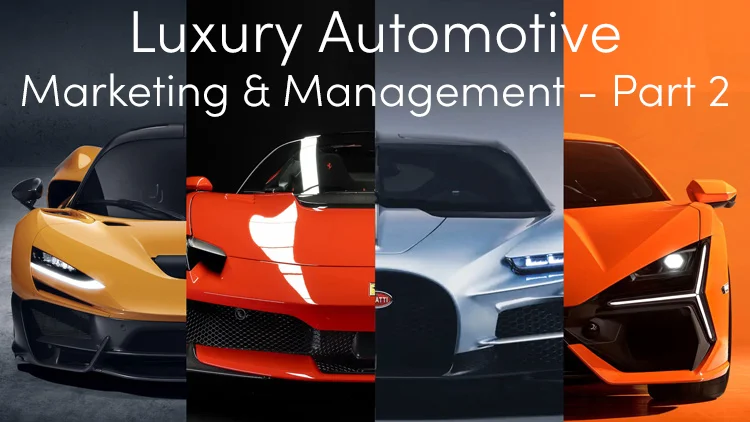
Following up on the first half of the Luxury Automotive Strategy and Marketing online course published a while back, the second half is now available on Udemy at the link HERE.
As for the previous one, this course too is thought for enthusiasts and university students who want to learn more about the workings of the industry. While it is not necessary to have completed the first half to be able to understand and learn this second one, the two are closely linked and form a complete picture.

So, after learning about the key players in the industry and how their branding and strategies compare to each other, this new section looks at market dynamics highlighting the main trends, some academic analysis of them, and an overall view of the global luxury market numbers. Last but not least, a couple of interesting case studies conclude the course comparing diversification strategies and innovation in luxury automotive.

I hope you'll enjoy it. Don't forget to leave feedback and get in touch to know more.

Cover homepage alt copy 3

Bugatti Rimac starts officially: Stephan Winkelmann’s legacy

  • Brand: Bugatti, Rimac
  • Topic: Strategy & Marketing

On the 2nd of November, it was officially announced the operations’ commencement for the newly established joint venture Bugatti Rimac d.o.o. born from the partnership of Rimac Automobili with the German Group and especially with Porsche that now owns a 45% stake in the new company, and a 22% in Rimac Group.

The latter too is a new entity led by Mate Rimac under which the Joint Venture, and Rimac Automobili, as an independent company, will stay along with Rimac Technology, the division which will continue the production of battery systems, drivetrains, and other EV components that were key to Rimac’s success. To go more in-depth into the details and implications of this new entity you can check the previous article ‘Rimac signs historic Strategic Joint Venture with Porsche to form Bugatti-Rimac’.

mate rimac bugatti*Mate Rimac during the joint venture announcement. Source:Rimac Media

This new company structure, however, meant also an important change at the top level of Bugatti’s management. And just a few days before President and CEO Stephan Winkelmann announced he was leaving the company after almost four years. From now on he will maintain his role as Chairman and CEO at Automobili Lamborghini, where for a while he held both. With him, other prominent figures followed like Head of Communications Tim Bravo.

So how has Bugatti evolved in the last 20 years after VW’s acquisition, and what role did Stephan Winkelmann take in this development despite his relatively short time in the company?

23 YEARS OF BUGATTI

It was in 1998 that the VW Group acquired Bugatti along with other luxury brands, after its ‘Italian period’ under the management of Romano Artioli.

The modern company as we know it today was born with the reveal of its first modern hypercar after the Italian EB110 almost ten years earlier, the Veyron EV 16.4.

The car entered production a few years later, in 2005, and in around 10 years of production 450 Veyrons were made. Despite the company making substantial losses, at the time it was claimed that the car was more of a testing vehicle to push the boundaries of what they could achieve. Regardless of the actual losses (different outlets claimed numbers varying from €2 to 6 million at the time), the car almost instantly became the quintessential symbol of extreme performance in automotive. Much like the McLaren F1 had done in the 90s.

The Veyron, taking from Italdesign's late 90s concepts, defined Bugatti’s modern design language as well as its brand image.

Fast forward to 2016, and after three iterations of the Veyron, the successor and new flagship Chiron that is now nearing the end of production was unveiled. Since then, for a total of 500 units, the model has seen seven special limited editions, Sport, Sport 110 Ans, Sport Les Légendes du Ciel, Super Sport 300+, Super Sport, Pur Sport, and Noire.

There is not much financial information available about Bugatti, but now former CEO Winkelmann claimed that 2019 was a record year in terms of production, turnover, deliveries, and financials results overall. 2020 too was the third record-breaking year in a row for the brand in terms of operating results, and 2021 after a record Q1 seem on track for a similar result. Looking at its sales it seems evident how its model has got more consistent. The first phase, clearly identifiable as the Veyron lifecycle, was likely affected by the 2008 financial crises, imbalance in regional markets, and possibly production efficiency.

BUGATTI CAR DELIVERIES BY YEAR (2005-2021)

bugatti sales*2021 deliveries are up to Q3

It must be noted that with such low production numbers, variations in deliveries are not as significant as they are for automakers with higher volumes. However, with the introduction of Chiron, and other models, since 2017 sales have been relatively stable, even in 2020. 2021 has been in line too so far, so sales can be expected to match a similar level by the end of the year.

Since 2018 though, the face of Bugatti, and its approach changed quite significantly compared to the previous 18 years. It seems to be following the general direction of the industry that might very well become an established trend in the future. As true luxury in every industry moves from the expensive good itself to being about the uniqueness and personalisation of a product as well as the entire ownership experience, luxury automakers are increasingly undertaking one-off or few-off projects as discussed in ‘One-Off Supercars: What’s the next step for luxury automotive?’. And Bugatti followed a similar path.

MR. STEPHAN WINKELMANN LEGACY

It is under Mr. Winkelmann's stewardship that Bugatti made an additional step.

With the intention of delivering two models per year, under his leadership and brief, in 2018 the concept for the Divo was introduced. Instead of pursuing extreme speed, this car, produced in only 40 units, was developed for handling and driving on the track. To the Divo followed two more extremely rare vehicles celebrating the story of the company. The Centodieci, a tribute to the EB110 and the Italian period of the brand in only 10 units. And the La Voiture Noire, a one-off celebrating the story of the black Atlantic owned by Jean Bugatti and disappeared during World War II.

Last but not least, the Bolide is a track-only hypercar whose concept was introduced in 2020 under the brief “What if”, which meant bringing to the extreme the capabilities of the W16 engine. Again only 40 of these will be produced, and much like it happened with the Veyron, the Bolide too aims at delivering the quintessential Bugatti experience, unmatched by anyone else.

bolide winkelmann*Mr Winkelmann and Bugatti Bolide. Source:Bugatti Media

As claimed by Head of exterior design Frank Heyl and former Head of Communications Tim Bravo, the concepts for both Centodieci and La Voiture Noire were developed in a much shorter time than what it would usually take. This was mainly thanks to improvements in the use of digital tools and virtual reality, which highlighted also the technological advancement of the company.

In these four years, along with a more solid financial situation, Bugatti improved its brand image through product portfolio diversification, extreme exclusivity, sustainable and consistent growth.

As a matter of fact, under Mr. Winkelmann’s direction, another company already delivered similar results with an analogous strategy. It is Lamborghini, where he returned in 2020 as Chairman and CEO after Stefano Domenicali left to head Formula 1, the company he guided from 2005 to 2016 that earned him the name of “Mr. Lamborghini”.

In those eleven years, sales increased by over 130% exceeding the 3,000 units per year, turnover increased by 221% to €872 million between 2010 and 2015, the portfolio became the largest ever with the introduction of Aventador and later Huracán with their respective improved version in following years. He showcased the first concept for the Urus and paved the way for its eventual release in 2018. The SUV completely changed the game by consistently doubling the sales of Lamborghini every year since its release up until now.

Additionally, a number of striking, limited editions, that increased the brand’s prestige through extreme design, innovation, and performance were added too:

  • Reventón (36 units)

  • Sesto Elemento (20 units)

  • Veneno (14 units)

  • Centenario (40 units)

  • Aventador J (1 unit)

sesto elemento*Lamborghini Sesto Elemento. Source:Lamborghini Media

And finally, also a few concepts that pushed even further potential new products and technologies such as Egoista, Estoque, and Asterion.

Overall, Mr. Winkelmann (along with each company’s team) managed to drastically improve the financial conditions and business model of both Lamborghini and Bugatti, bringing record results for many consecutive years. With product range expansion and increased exclusivity changed also the perception and reputation of these brands, definitively established as major players in the industry.

This will be a tough act to follow for Rimac. The Croatian company is certainly a trend-setter like Bugatti in many ways, and it has now the opportunity to bring about an even deeper change to the French brand. As long as it will be implemented while respecting the values of exclusivity, elegance, and extreme performance built so far by Bugatti, it will have all the instruments for continued success.

Rimac signs historic Strategic Joint Venture with Porsche to form Bugatti-Rimac

  • Brand: Bugatti, Porsche, Rimac
  • Topic: Electric Vehicle Market, Strategy & Marketing

On Monday, July 5th, 2021, Rimac Automobili held a live event during which were announced a series of changes at the corporate level that represent historic milestones for the young Croatian company.

Mate Rimac, on the stage, revealed the birth of Bugatti-Rimac, a strategic Joint Venture between his company, now the leader in the super sports electric vehicles, and the long-standing high-end French automotive brand part of the VW Group.

The discussion began around 18 months back, and after a while rumours started to spread on the internet about VW selling Bugatti to Rimac, and Porsche simultaneously acquiring a higher stake in the EV automaker.

There are not many details about what went on behind closed doors, but on Monday the result of this discussion was finally revealed. So, let’s have a look at what are the deal’s implications and why it is important in this moment of the luxury automotive market.

RIMAC’S NEW STRUCTURE

rimac share holder structure*SourceRimac Media

This is Rimac's updated corporate and shareholding structure as announced during the event.

From the top line, we can observe all of Rimac’s major shareholders, and there is no real surprise there. Mate maintains a 35% stake in his company, so does Porsche at 22% and Hyundai at 11%. The remaining 32% sees other automakers such as Kia, Chinese battery manufacturer Camel Group and more.

In the next row of the chart, things start to get more interesting. We see, in fact, the entity called Rimac Group now, where Rimac Automobili stood. The group then splits into two separate units that despite remaining distinct from one another, will maintain their synergies where necessary.

The first one is Rimac Technology. This division will remain completely under the Rimac Group, and independent. This is, in the words of its founder, the initial and biggest competitive advantage the company had and perfectly complementary to the automotive business.

He spoke frequently about how the technological know-how has been the real game-changer that allowed the company to flourish and establish itself as a major player in this market, before the car itself. Rimac’s current model Nevera, whose production is set to start in the coming weeks, is in fact, entirely produced in-house. This expertise in EV battery and drivetrain manufacturing, as well as software development its components’ management is what brought in the partnerships with Pininfarina, Aston Martin, Koenigsegg, and many more. Expertise that without the opportunity for economies of scale with these deals, would be extremely difficult to maintain with Rimac’s low production number.

Most importantly in this case though, this is also what initially captured the interest of Porsche and ultimately led to the present partnership.

On the other side of the graph appears the real news. Bugatti-Rimac. The Joint Venture between the two automakers should bring together the best of Bugatti’s century-old history and automotive heritage with Rimac’s unprecedented boost of innovation.

Bugatti Rimac Porsche cars*SourceRimac Media


The majority stake in Bugatti-Rimac will also stay under Rimac Group with 55%, the remaining 45% will be held by Porsche. Both the divisions then will be run by Mate Rimac himself, who stays as the CEO of Rimac Group. Porsche will have a role in the company support as an advisor.

The mission is clear. To bring Bugatti into its new century and secure its future, but it doesn’t end there. While both Rimac and Bugatti will keep producing their own hypercars, at their own headquarters near Zagreb, Croatia and Molsheim, France respectively (except for EV-related components for both brands that will be entirely developed and produced in Croatia), the strategic JV will combine the companies’ R&D efforts and other areas of development.

Being under Porsche, naturally, the German automaker will benefit as well from a consistent know-how and technology transfer that will help the development of future high-performance electric models.

WHY THIS JOINT VENTURE IS IMPORTANT

The shift toward electric mobility is happening faster than many predicted. The reasons are many, not just restrictive Governments’ environmental regulations. On the customers’ side, the novelty, performance, and features enabled by digitalisation, connectivity, and OTA updates have created a stronger appetite for electric vehicles and they are changing the customers’ preferences. According to a survey by McKinsey 45% of current car owners will consider buying an EV as their next vehicle.

mate rimac*Monday’s presentation participants. In order from the left, Oliver Blume, CEO of Porsche AG, Mate Rimac, Founder and CEO of Rimac, Lutz Meschke, Deputy Chairman and Member of the Executive Board Finance and IT at Porsche AG

An EY market research reported by Bloomberg, claims that by 2033 the EV market will be the dominant one. EV sales should outpace ICE car ones, by 2028 in Europe, 2033 in China, and 2036 in the US. Also, by 2045, their analysts predict that non-EV sales will account for less than 1% of the entire market.

This, even if in a different way, is happening in the luxury performance market as well.

A few days ago in Modena, Italy, home of some of the most iconic luxury automotive brands in the world, it was held theMotor Valley Fest. During the opening speech, McKinsey Senior Partner Gianluca Camplone reported some noteworthy forecasts.

When it comes to the luxury segment, the continued growth is ensured by a constantly increasing number of high-net-worth individuals, especially in the APAC region. Also, as discussed when addressing the transformation of Luxury and Super Sports cars into consumer electronics, with the difference in performance between brands and models flattening and the loss of that ‘emotional factor’ with the electric drivetrain, the differentiating factors and value proposition for each brand will have to change or at least expand, becoming more experiential.

Bugatti’s 100-plus-year long expertise and knowledge of its customer base will play an important role in this development and can definitely benefit Rimac too.

Most importantly though, the market analysis reported the growth forecast of the hypercar market and its shares by powertrains.

mckinsey chart*SourceMcKinsey

The graph highlights two important facts.

First is the overall growth of this segment, which signals a trend in the market where super-wealthy clients look increasingly for rarer products, as seen with the trend in one-off supercars which almost always exceed the pricing of the average hypercar.

Secondly, the fact that by 2025, over 60% of the entire segment will be represented by electrified models, divided in half between hybrids and full-electrics. This is the most important piece of information. In this context because it gives an image of a changing sector, even in the niche where up until a few years ago it seemed impossible to have a car without a gearbox and with a motor that does not make any sound.

In turn, it is easy to understand the benefits and the importance of the new Bugatti-Rimac JV, where the French automaker does not have synergies with other brands of the group like Lamborghini and Bentley have with Audi and Porsche, but still needs a change of pace when it comes to electrification. This partnership gives Bugatti access to world-leading high-performance electric technology. Additionally, both the brands pricing-wise are similarly positioned, differently from the other companies in the VW Group.

For now, it seems like the change will not be sudden for Bugatti anyway. The French automaker will also pass the hybrid intermediate step. But the backing of Rimac puts it in the best shape possible to go through this transition. As for Rimac, apart from the joint R&D efforts, the access to Bugatti’s experience in the sector, services, and CRM, will surely enjoy increased brand awareness and most of all reputation that will solidify even more its position as a world’s leader.

Implications of VW selling Bugatti to Rimac

  • Brand: Bentley, Bugatti, Lamborghini, Rimac
  • Topic: Electric Vehicle Market, Strategy & Marketing

A couple of weeks back, the news spread about Volkswagen’s intention to sell its top luxury low-volume automaker, Bugatti. What is more surprising is that Croatian EV automaker and tech supplier Rimac has been quoted among the interested parties in the purchase. As many by now suggested though, considering Porsche’s interest in Rimac, the move seems definitely less unexpected.

bugatti rimac vw cover

So, is VW just getting rid of the automaker or accelerating its transition into electrification, or they have other reasons (financial difficulties after the crisis)? Is the same going to happen to Lamborghini and Bentley, the other luxury manufacturers under the VW umbrella?  

SOME BACKGROUND ON BUGATTI

With regard to Volkswagen Group’s expansion in the luxury segment, its most important year is 1998. It is in 98 in fact, that with Ferdinand Piëch and his aggressive expansion strategy VW completed the acquisition of Bugatti, Rolls-Royce Bentley, and Lamborghini. You can check the article How VW turned Lamborghini into the success it is today? to know more about the latter.

Later, after a few concepts commissioned to Giugiaro at Italdesign, in 2005 the company finally began the delivery of its first production model, the Veyron 16.4. After that, the Chiron followed in 2016, and various limited editions, such as Grand Sport, Super Sport, and Pur Sport.

BUGATTI SALES FIGURES (2005-2019)

graph

In 2019, the company closed with an estimated €253.57 million revenue (Dun&Bradstreet) and a record sales of 82 vehicles. The sales graph shows mainly the lifecycle (so far) of their two main models, Veyron, and the successor Chiron. In the last two years also, the company attracted, even more, the attention of professionals and enthusiasts’ community with the release of the £4.5 million Divo, the £9 million Centodieci, and the £12 million one-off La Voiture Noire, respectively planned for 40, 10 and 1 units.

WHAT ABOUT VW’S DECISION?

Bugatti’s parent company and owner of numerous other major automotive brands, Volkswagen Group has recently gone under a radical management restructuring. Herbert Diess current group CEO, recently replaced as VW brand CEO by Ralf Brandstaetter, has been at the forefront of the efforts to cut costs, especially in these difficult times, to free resources and allow a fast transition to large-scale electrification. In the first half of 2020, VW Group with a 23% drop in sales, has so far reported a pre-tax loss of €1.4 billion.

According to some reports then, selling the luxury marque would be part of this cost-cutting strategy by the German automaker. But because Bugatti’s acquisition was strongly wanted by Ferdinand Piëch, it would not be possible for VW to just sell the marque.

ferdinand piechFerdinand Piëch *Source: Wikipedia 

Especially considering that over 50% of the group is controlled by the Holding Porsche SE, whose 50% is owned by the Porsche-Piëch family at 50%, who however retains 100% of the voting rights.

herbert diessHerbert Diess *Source:Volkswagen Media©

At the same time, Rimac, the Croatian firm leading the luxury performance electric vehicle niche, has become a major player, thanks to its know-how, collecting numerous partnerships and investments. You can read more about it here Nico Rosberg enters the Rimac Family: Rimac Business Model.

So, in the described plan, Porsche that acquired a 15.5% stake in Rimac in two years, would increase it up to 49% while the EV manufacturer would buy the Bugatti brand which would effectively remain, at least partially under the VW Group. Naturally, this process would need the approval of other important stakeholders such as the Chinese Camel Group that owns a 14% stake.

SOME OBSERVATION

To answer the first question at the beginning of the article, this exchange would not only allow VW to save costs and focus its resources on mass-produced electric cars but would also grant Bugatti a faster transition toward electrification thanks to Rimac.

chiron
divo
lavoiturenoire
chiron
divo
lavoiturenoire

At the same time, the Croatian manufacturer, who despite the blazing success has so far produced a very low volume of cars, could benefit from Bugatti’s expertise. Considering the differences in values and characteristics between the two brands they would also not risk cannibalising their extremely limited sales.

As for the other companies, Lamborghini, Bentley, Ducati, even the design company Italdesign would all be under scrutiny. However, regarding luxury automotive brands Lamborghini and Bentley, there are three reasons that put these two brands in a stronger and more integrated position compared to Bugatti.

First, both Bentley and Lamborghini share important components of their SUVs, luxury, and sports cars with other VW Group brands. Bentayga and Urus share VW’s MLB Evo modular platform (Modularer Längsbaukasten, German for Modular Longitudinal Matrix) with Audi’s Q and A product lines, VW Touareg and Porsche Cayenne. As for the engines, Urus, Bentayga, Continental GT, and Flying Spur share the 4.0 Litres V8 engine with Porsche and Audi. Additionally, Lamborghini also shares with Audi the 5.2L V10that was mounted in a late version of the Gallardo and on the Huracàn. All these factors not only translate into a significant cost reduction but are even more significant when considering the highest profit margin on each of these cars and the current market trend. The two companies’ SUVs are in fact by far their best-selling models. In both cases, they account for around 50% of the total sales or more.

huracan-evo
flying-spur
continental-gt
2021-bentayga
urus
huracan-evo
flying-spur
continental-gt
2021-bentayga
urus

*Source:Bentley Media© &Lamborghini Media©

Secondly, both Lamborghini and Bentley look ahead of Bugatti in terms of electric technology integration and development. Both have shown concepts of full-electric cars, Terzo Millennio and EXP 100 GT respectively. They also all have already developed hybrid platforms, Lamborghini with the Siàn and Bentley with the Bentayga. Additionally, Bentley can boast already a well laid-out development plan to reduce emissions and develop a greener product lineup with the Beyond100 Strategy. Check Bentley H1 Results and Beyond100 Business Strategy to know more.

Third, both have been performing significantly well in the past few years in terms of sales numbers becoming leaders in their segments, with only Ferrari coming close. This holds true even in 2020. Especially compared with the rest of the industry. In the first half of 2020, Bentley even registered a 2.8% increase in deliveries, while Lamborghini’s -22.1% is still way smaller than that of its direct competitors.

All in all, if this transaction happens, even if many enthusiasts might feel sad at the idea of Bugatti turning electric (which will have to happen anyway eventually), who better than Rimac can bring it into this new automotive era? As for the other two luxury automotive brands, as of now, it seems highly unlikely to see VW deciding to sell them.
Privacy Policy - Cookie Policy