New Online Course Available Now

  • Brand: Aston Martin, Bentley, Bugatti, Ferrari, Lamborghini, Maserati, McLaren, Pagani, Porsche, Rolls-Royce, Mercedes, BMW
  • Topic: Electric Vehicle Market, Finance, Strategy & Marketing, Supercars Future

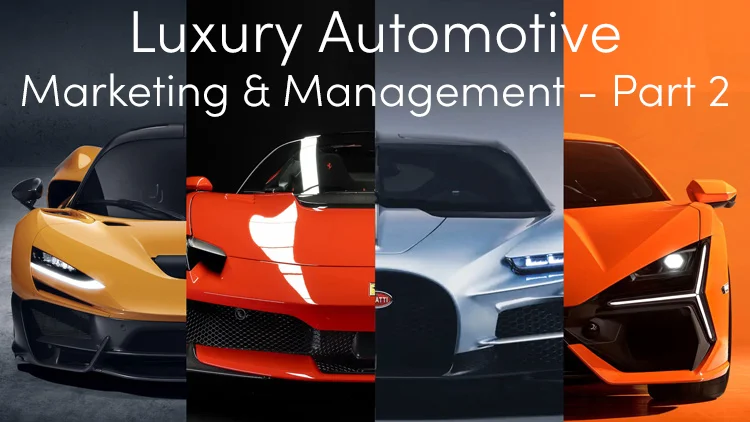
Following up on the first half of the Luxury Automotive Strategy and Marketing online course published a while back, the second half is now available on Udemy at the link HERE.
As for the previous one, this course too is thought for enthusiasts and university students who want to learn more about the workings of the industry. While it is not necessary to have completed the first half to be able to understand and learn this second one, the two are closely linked and form a complete picture.

So, after learning about the key players in the industry and how their branding and strategies compare to each other, this new section looks at market dynamics highlighting the main trends, some academic analysis of them, and an overall view of the global luxury market numbers. Last but not least, a couple of interesting case studies conclude the course comparing diversification strategies and innovation in luxury automotive.

I hope you'll enjoy it. Don't forget to leave feedback and get in touch to know more.

Cover homepage alt copy 3

New Luxury Automotive: Going Beyond Performance?

  • Brand: Aston Martin, Ferrari, Pagani, Rimac
  • Topic: Electric Vehicle Market, Strategy & Marketing

The current luxury automotive landscape is shaped by a specific trend that has influenced various players and could increasingly define new products in the near future. In a way, it might even seem like the industry is going backwards. But the truth is that recently something has fundamentally changed in how the value proposition of luxury cars is conceived. And electric cars might be a big part of this.

In the early days of the automotive industry, cars were rare objects for the rich and the daring who wanted to experiment first-hand with this new technology. Cars were not thought for the mass market and were entirely built by hand and highly personalised, at least until the advent of the Ford Model T in the early days of the past century. In Europe in particular the trend of hand-crafted cars and coachbuilders who would specify a body according to the client’s specifications continued for a while. Along with the aesthetics, one of the defining characteristics of cars at the time was performance, and racing was a powerful marketing tool for it.

This is true today as well, but there is more going on. I have already touched previously on how customization is gaining more importance today, and how it has become a significant share of companies earnings (to know more check Tailor-made: What luxury car customers can't go without and One-off Supercars: What’s the next step for luxury automotive? ). In its Q2 2024 report, Ferrari quotes a +16.2% in revenues, and as it happened several times already, among the contributing factors is consistently mentioned increased popularity of personalisation programs, which also allows for the significant margins made on every single vehicle sold. But in the modern industry of supercars and hypercars it is becoming more and more common to see taglines about “the fun of driving” or “driving involvement" rather than the continued comparison of 0-100 km/h (or 0-62 mph) times and top speeds that has been the benchmark of most new performance cars’ headlines for many years.

The trend has been developing for a few years now. Ferrari is a prime and most successful example of this and it is visible in the comparison between revenues and sales figures over the last few years. Right after the pandemic and the quick 2021 recovery, revenue growth remained consistent at almost 20% while sales growth has been gradually limited toward the 15,000 units mark dropping significantly to around 3% in 2023 highlighting the increasing margins made on each model thanks to increasing personalisation demand. 

Ferrari's Sales and Revenues Growth Percentage by Year (2020-2023)

ferrari growth

Enjoyment over performance

With the advent of electric performance cars, obliterating normal combustion engine cars in acceleration performance, some initially thought this new technology benchmark would be the driver for the future of the industry. But, at least for now, things are going in a different way.

Despite environmental regulations limiting emissions and engines’ size, which have been the main factors in the growing adoption of turbochargers and superchargers for automakers to keep boosting performance, we are seeing more “going back” to naturally aspirated large high-revving engines. This is naturally, in part, allowed by the fact that environmental restrictions are different for low-volume manufacturers, but hybridisation is one key enabler for this. Supporting electric power allows OEMs to maintain engines that become the centrepiece of a vehicle by offering more involving and immediate response when driving, along with the soundtrack that all collectors love.

The same goes for manual gearboxes. While dual-clutch transmissions and other more daring alternatives (from the likes of Koenigsegg) have reached high levels of refinement with smooth and lightning-quick gear changes, once again OEMs are finding a key selling point in the involvement and driving enjoyment that a manual stick shift offers. While more classics-inspired low-volume automakers like GMA had that single formula right from the start, others are going back to it. Aston Martin recently produced a few limited editions with manual gearboxes. The same goes for Pagani, which not only reintroduced it in its latest Utopia but also made it available for unique iterations of the Huayra. The Italian automaker also claimed that so far over 70% of the very limited Utopia production run has been ordered with a manual gearbox.

manual gearbox*Aston Martin Valour and Pagani Utopia reintroducing manual gearbox

All these trends suggest that as technology has improved and made a leap forward, unlike in the old days, some OEMs have understood that performance numbers can only go so far, and what counted the most at the end of the day for a car owner was the enjoyment and driving involvement, rather than 0.1 seconds less to reach 100 km/h.

Luxury OEMs changing plans

One of the most controversial pieces of news around the topic came a few months ago from an interview with Mate Rimac. The founder and CEO of Rimac Automobili has, in just over 10 years, become the one symbol worldwide for performance automotive electrification as discussed in previous articles on Rimac’s growth and marketing. Its Nevera has become the fastest-accelerating road-legal car in the world to the point where most other top-of-the-line high-performance supercars would seem slow in comparison and has also broken many records. After all this, however, a few months ago, Rimac has been quoted as saying that the future of electric hypercars is uncertain because clients simply do not want them. The reasons for this would apparently, be a refusal to accept a product that is seen as “imposed by politics” with environmental regulations pushing greener vehicles, and a lack of emotional connection with such cars. As mentioned earlier, clients today want more and more something that is unique. Electric vehicles are becoming mainstream, and at the same time instead loud cars with big engines that were already rare are becoming even more so. These would be the key reasons driving clients away from EV supercars and toward a more familiar experience of performance and sound involvement, even if this means inferior performance.

In this context, two companies are taking different but equally interesting action on the matter. On one side, Aston Martin recently announced that they delayed their upcoming EV by at least 1 year (from 2025 to 2026) due to low demand. They instead stuck with big V12 engines and a limited application of hybrid powertrains on the likes of Valkyrie and the upcoming Valhalla.

On the other, Ferrari is trying to “make the EV emotional”, by doing it differently from anyone else. A patent filed by Ferrari a while back shows a unique project for the potential development of an upcoming electric prancing horse.

 Ferrari's EV patent

ferrari new patents

The plans show how the new EV would feature an e-drive axle and a sound-transmission devise that uses air pressure and vibrations to send sound to the cabin via an acoustic conduit. No electronics or speakers were used to produce sound, making it not just an imitation like some proposed at times, but a proper sound, just likely different. Ferrari would also add resonators on the axles that should amplify the sound coming from the e-motors. Specific valves enabled by an ECU would allow the sound profile and volume to change and adjust in the same way as an active exhaust system opens and closes valves to increase the volume. According to Ferrari, the solution is not devised exclusively for added drama, but also to give drivers a better awareness of what the car is doing at any given time.

Conclusions

The industry seems to have come full-circle since its early days. On the marketing side, personalisation is an increasingly important requirement for clients and OEMs are getting an equally growing share of revenues from customisation programs along with unique limited runs of special editions, or unique models. And like in the early days of the industry, these cars have to be unique to represent the owner's status and identity.

On the other hand, though the technical driving force has changed. Technology for the sake of evolution and performance is being “refused”, with demand steering manufacturers toward larger combustion engines, manual gearboxes, and tactile analogue controls that one might have thought would start disappearing in favour of electric motors, automatic gearboxes (or none at all), and 100% of control integrated into digital infotainment systems. Performance is not as defining as it used to be, while experience both in the car and outside is so more than ever.
The Best Car Configurator: Pagani and MHP with Unreal Engine

  • Brand: Pagani
  • Topic: Strategy & Marketing

Last week the Unreal Build: Automotive 2021, an event that was first hosted in 2017, was held online. During the Conference, companies collaborating with automotive giants presented some bleeding-edge technology applications that promise to revolutionise the user experience, marketing, processes, data, and KPI collection in the industry. At the base of all this is the Unreal Engine.

Definitely well-known by millennials and GenZ, probably less by others, the Unreal Engine is, in fact, born fromEpic Games as a videogame engine at the end of the 90s. Since then, it has been used to develop countless titles, and crucially, 3D Graphic content in a range of different fields.

One of the great projects presented is a collaboration between Pagani Automobili and MHP and introduced as the best car configurator in the industry.

MHP is a German consultancy owned at 81.8% by Porsche that focuses on Automotive IT services and innovation.

huatra bc configurator*Configurator Screenshot Pagani Huayra BC

THE CURRENT MARKET

Mostly in the last decade, luxury automotive has seen the rising trend of personalisation. It has become crucially important and extensive tailor-made programs turned into a necessity for luxury automakers to complement their products and define the customer experience it is expected from such them today.

While modern automotive ateliers are refined places, where clients can review a huge variety of fabrics, material samples, and hues for the cars’ bodywork paint, there is an obvious issue with this process. Dealerships will not have the actual product the client wants to showcase. At best, the same model with a different specification. This is even more relevant for OEMs that produce an extremely limited volume of cars such as Pagani, Koenigsegg, and Bugatti.

Pretty much all the modern luxury automakers nowadays have a car configurator to bypass this obstacle. This can come in different versions. A basic one, built in the companies’ websites which is useful for new models, or first-time buyers to get an idea of what to expect but also available to anyone. And a more in-depth one, which is used by employees in dealerships, ateliers, or other specialised departments where the personalisation can really get to the smallest detail.

So, what are the limitations of this model? How can it be improved and what’s the next step?

THE PROJECT

Here’s when MHP and Unreal Engine come in. As said by the Senior Consultant at MHP:

“Because every single vehicle is built exclusively for a customer, the retailers don’t have the physical cars available in the stores. We had to develop a solution that is visually appealing, photorealistic, and provides this immersive feel, all inside of an Unreal Engine-based application.”

This experience was enabled by the evolution of the Unreal Engine and especially by the addition of ray tracing. This graphic rendering technique simulates the behaviour of light in an environment and when recursive it even replicates the effects caused by light refraction, reflection, absorption, and fluorescence hitting different materials. This last step effectively achieved photorealism.

The video below is a quick demonstration of the Pagani configurator capabilities only in its lighter version that you can try out at the link at the end of the page:

The importance of this new application is that along with being aesthetically superior, it will not just be limited to the configurator. MHP transformed a “Point-of-sales application into a flexible rendering backend”.

This means that along with the retail configurator, and differently from other similar applications, the new platform can be used as a streaming configurator, or to generate high-quality images, videos, and other digital content and giveaways on demand. In turn, this availability will make for a more immersive customer experience, a closer connection with the brand, and limit the costs as everything can be managed by the same application.

Another noteworthy achievement is the creation of configurable videos. Posing the client’s personalised car into a digital environment allows seeing a realistic rendering of it in different settings (those who have been to the Pagani museum in San Cesario sul Panaro will recognise the extremely accurate setting reproduced in the configurator and visible in the video above), times, and weathers. Also, along with a specialised crew, MHP shot a film around the Imola racetrack in Italy. Here, the subject, a Pagani car, can be swapped or modified according to the clients’ requirements to see the actual vehicle's appearance in real surroundings making the experience much deeper and overall better.

IMPLICATIONS AND TECHNOLOGY POTENTIAL EVOLUTIONS

According to Pascal Bayer, Application Architect at MHP, this system based on Unreal Engine is structured as a modular service that can cater to different needs all from this single source. This connects the different application interfaces used for each service and importantly, also allowed for the integration of analytics and CRM tools.

unreal scheme*Source:Unreal Build: Automotive 2021

Integration, with the possibility of gathering additional data at a marketing level, opens up opportunities to improve and personalise even more strategies and customer experience.

Certainly, an important development, as mentioned before, is the potential for a real-time content distribution system, set up on the cloud. An on-demand rendering system accessible from a cloud service to directly export footage and images can be a powerful marketing tool as well.

The evolutions and applications of this technology in the coming years could be countless. One above all that has been growing fast in different industries is the use of VR. While not present at the moment for this platform, developers claim it will certainly be with future versions.

Other noteworthy use cases, some of them already present or in development, are:

  • User experience with infotainment systems

  • Ads and live-action CGI Integrations and other marketing content

  • Integrations with Pixel Streaming Services by Google

  • Design review

  • Integrations for AR, VR, XR

  • Factory planning

  • Engineering

To give further insights on the applications and processes that can integrate the Unreal Engine technology, here are some great infographics provided during the conference.

graph2

graph3*Source:Unreal Build: Automotive 2021

The possible applications of this technology are countless, and as far as luxury automotive marketing goes, Pagani and MHP realised an important tool that can greatly improve the customer experience as well as being the cornerstone for future developments and services. These integrations will become more and more regular as Epic Games’ vision of giving creators the most streamlined and user-friendly platform possible, takes shape. With the foreseen advent of aMetaverse, the digital experience then could really replace the face-to-face one even for market segments such as luxury automotive where the personal and tailored approach is a prerequisite today.

For new generations, this digital integration will also be expected as part of an increasingly personalised customer service.


Check the link below if you’d like to try the Pagani-MHP configurator (in its lighter version):

https://pagani-mhp-gtc-static.mhp-immersive.com/


An Interview with Luca Venturi, Issimi Co-Founder and CMO, and Former Pagani Brand and Marketing Manager

  • Brand: Pagani
  • Topic: Interview

This week, I have something a bit different that I hope to replicate soon in the future. The focus is, in fact, a video. I have had the pleasure of interviewing Luca Venturi.
Luca is an experienced professional within the luxury automotive industry. He has worked for many years atPagani Automobili as a Head of Communication, Brand, and Marketing Manager. After that, along with a couple of colleagues, he decided to startIssimi, where he now holds the role of Chief Marketing Officer.

In this long interview, we touched on many topics through Mr. Venturi’s experiences and unique anecdotes. The role of Marketing Manager in a highly reputable top-end luxury automotive manufacturer such as Pagani, the relationship with co-workers and with an icon of the industry such as Horacio Pagani, the birth of an idea and its growth into a thriving company, luxury car auction houses, and the market of pre-owned luxury and classic cars. Finally, we got to new technologies both in marketing and automotive. Virtual and Augmented reality, Electric and Hybrid powertrains, and how they can or will change this industry.

I’m sure this chat will be extremely insightful for any professional or person that wishes to learn more about this industry or work within it. Without further ado, let’s proceed with the video. Enjoy!

*Video Chapters are in the description on YouTube

I would like to personally thank Luca again for accepting to talk with me and for sharing his amazing experiences, suggestions, and points of view on the sector.

If you’d like to keep following future developments, now you can subscribe to the newly created RccDB Cars YouTube Channel.

You can find both me and Luca on Instagram at: @rccdb_cars and @luca_f_venturi

Also, to check out Issimi, their work, amazing list of special cars, and other projects head over to Issimi.com, @issimiofficial

For direct contacts write me at riccardo.delbello@rccdbcars.com

Luxury Automotive Startups: What’s the recipe for success

  • Brand: Pagani, Rimac
  • Topic: Strategy & Marketing, Supercars Future

The luxury automotive segment is an extremely competitive niche, with just a few strong players and very high entry barriers. Over the last 30 years, many tried and very few succeeded. While electrification is partially lowering such barriers on the engine side, other aspects and services required from a modern vehicle are much more complex than before.

An electric motor, in fact, with fewer moving parts (around 20, against the combustion engine’s 2000, according to MES Insights and Drive electric) will be cheaper in terms of R&D. Superior costs for automakers so far might have included the battery packs, but with the increasing competition that too has decreased a lot.

EV BATTERY PACKS COST REDUCTION ($ PER KWH)

ev battery graph*Source:Statista

On the other hand, though, modern cars need a lot more attention on electronic components. Much of the competition has moved toward IoT, self-driving, and AI systems. Additionally, for a modern luxury car, there are two important considerations to make.

The first is that the fully electric car is not yet accepted by some buyers. The majority is uncertain or against this technology, so a new company might consider developing a powertrain based on internal combustion engine or at least hybrid technology, thus losing that ‘electric motor ease of development’ advantage. For this reason, some companies source their engines (as well as other components) from established manufacturers instead of producing them in-house.

LUXURY CAR OWNES OPINIONS ON EVS BEING THE
FUTURE OF THE AUTOMOTIVE MASS MARKET BY AGE GROUP (%)

graph1

LUXURY CAR OWNERS OPINIONS ON EVS BEING THE FUTURE OF THE LUXURY AUTOMOTIVE MARKET BY AGE GROUP (%)

graph2

The second is that a luxury car ownership experience is expected to come with a truly special andcustomer experience.

So, despite this new era for the automotive industry, it does not seem easier for start-ups to enter this market. But who are the new players and what do they need to succeed?

NEW ENTRANTS

Let’s have a look at some of the most interesting new companies trying to make it into this competitive niche between 2020 and 2021.

1. Automobili Estrema

The new company, founded in 2020 in the Italian motor valley, has just introduced its flagship full-electric high-performance car, Fulminea. In the land of V8 and V12 ICEs, Estrema brings innovation with a 2040 horsepower hypercar powered by 4 electric motors and a hybrid battery pack. It will in fact feature supercapacitors paired with solid-state cells. Fulminea will be produced in just 61 units.  

This company is the vision of entrepreneur Gianfranco Pizzuto, already an early investor in Fisker Automotive in 2007, a precursor of the hybrid electric technology in automotive with the Karma and many years in the sector. With him, other experienced executives worked for important companies such as Mercedes Benz, BMW, and Nio.

estrema fulminea*Source:Estrema Automobili

2. Naran Automotive

The company founded in 2017, revealed its first car, Naran Hyper Coupe in late 2020. CEO and founder Ameerh Naran from Zimbabwe, grown with a strong passion for high-performance automotive aims at creating the most powerful and most beautiful cars in the world.

Naran's first attempt, the Hyper Coupe, a GT3 inspired vehicle powered by a 5L Twin-Turbo V8 producing 1048 hp, 1036 Nm of torque, and 1377 Kg of downforce. It will also feature hydraulic steering, four-way adjustable dampers, forged carbon-ceramic brakes, double-wishbone suspension, hybrid carbon wheels.

naran hyper coupe*Source:Naran Automotive

3. Vision Automobiles

This French start-up, founded in 2019, takes a different approach from the previous two. In their own words, the upcoming car is a ‘revolution’, and for good reason, it has been called…you guessed it, 1789. It takes in fact a different approach. It is built around a powertrain that will run on bio-methane. Much like those investing in E-fuels, Vision not only thinks the days of ICEs are not numbered but that they can become completely sustainable too.

This allows them to maintain all the advantages that this powertrain has over the electric one, such as weight and sound. 1789 is a track car inspired by the 24 Hours of Le Mans prototypes, and it is said that road-legal cars will only come later from the acquired expertise. Yet, on the company’s website, there is no mention of figures or performance. Instead, the focus is on the luxurious and bespoke nature of the vehicle and the driving experience it will offer.

Only from posts on social media, it is known that the 1789 will be powered by a Twin-turbo V8 that should produce over 1000 hp.

vision 1789*Source:Vision Automobiles

These are just three of the latest examples reported over others because they represent three vastly different approaches to the industry. However, there are many more compelling projects out there like the One by Elektron and the AP-0 by Apex both EV concepts scheduled for the next few years.

WHAT IT TAKES TO SUCCEED

The stories of success can be counted on one hand. Like the start-ups mentioned, three are the brightest examples that come to mind: Koenigsegg, Pagani, and Rimac.

Again, like the three mentioned above, these automakers too brought different approaches to the industry. So, have they satisfied specific needs in the sector? Did luck play a role or there is more?

ONE COMMON TRAIT

If there is one characteristic that they share is the presence of a strong and charismatic individual at the top. Each one of them with his own strong personality has become the de facto face of the company. Ever present in the brand’s marketing and communication as well as in the influence over the projects developed. Horacio Pagani with his concept borrowed from Leonardo Da Vinci of art and science going hand in hand, Christian Von Koenigsegg with daring technological innovation, and Mate Rimac with the forward-looking vision of the future of high-performance automotive.

horacio christian mate*From left to right: Horacio Pagani, Christian Von Koenigsegg, Mate Rimac

UNIQUENESS

Going in order of seniority, Pagani was a big hit right from the get-go with its firstborn Zonda. Through the ‘80s, Horacio Pagani worked in Lamborghini and was a pioneer in the use of carbon fibre and composites materials. This was an important factor that distinguished him later, as the use of carbon fibre started to become common in sports cars in the mid-80s.

The Zonda was a success thanks to its beauty, distinctive design features that still maintains today like the four round headlights and the quad exhaust tips in the centre, and performance reached thanks to Horacio’s technical expertise and the deal with Mercedes-Benz which still today provides the special V12 engines for all their models. Finally, the obsessive attention to detail both inside and out gave it the almost-jewellery-piece status it has today.

Most importantly, after 20 plus years, Pagani has not only maintained each one of those unique features but greatly improved on every single one of them, making the Zonda a proper icon and its successor the Huayra a true piece of art, unrivalled as far as craftsmanship goes.

zonda cinque front*Zonda Cinque Roadster

Koenigsegg instead established itself thanks to the focus on pure performance and technological innovation. With every new model, the Swedish company is right at the top, overshadowing its competitors with some incredible performance achievements.

Additionally, Koenigsegg takes pride in being one of the few, if not the only company to produce almost every single component in-house. One quote from founder Christian Von Koenigsegg on this topic epitomises the values around which the company is built. When asked if this decision brings advantages over its competitors he replies:

“For example, with the Regera, I don’t see any of the other established brands, daring to remove shifting of gears. It’s such a fundamental thing to take away from a sports car, that I think it’s only Koenigsegg that could make that decision. And I’m very confident about the decision […] We take more freedoms like that”.

Koenigsegg too like Pagani remains true to its values by improving every single time on its achievements, and bringing some new outrageous concepts to the table both in terms of technology and now also for sustainability, like with the Gemera in 2020.

koenigsegg Gemera*Koenigsegg Gemera

Finally, Mate Rimac as a sign of the changing times was a pioneer in the development of full-electric hypercars. Inspired by both the previous examples he decided to follow them, but in his own way. Its business model, in fact, is extremely different. The young Croatian company is already a success, but not in terms of car sales per se. Despite the global praise, the company, so far, produced an extremely limited number of vehicles.

What distinguished it is its technological advancement that no one else had which brought them an incredible number of high-profile partners and clients. In its founder’s words:

In order to survive, we basically became, at the very beginning, a technology company […] that’s the only reason why we still exist today […] a little bit like the history of Ferrari, Enzo Ferrari had to build road cars to finance his race cars, I wanted to build road cars, but had the technology business to pay for that” because “looking at my big heroes, Pagani and Koenigsegg, they started at a time when it was much simpler to be competitive in the car industry […] for example at that time there was no infotainment, now just the infotainment is as complex as a whole car 60, 70 years ago”.

rimac ctwo*Rimac C_Two

CONCLUDING THOUGHTS

The modern market is extremely competitive, but it is also highly diversified. It is difficult to excel even in a single segment as it will be likely already covered by another strong player. And, keeping in mind Rimac’s words, it could not be enough anyway, as they had to adopt a ‘hybrid’ business model to survive until now, while the two predecessors did not.

For a start-up to succeed there must be a perfect mix of personality, performance, design, technology, brand experience, and something more. Each of the successful companies quoted here pioneered an approach to the sector, a way of thinking about luxury supercars. That unprecedented and original vision, distinguishing an automaker from all the others is probably the ultimate factor necessary to make it in the luxury automotive industry.   

Privacy Policy - Cookie Policy