New Online Course Available Now

  • Brand: Aston Martin, Bentley, Bugatti, Ferrari, Lamborghini, Maserati, McLaren, Pagani, Porsche, Rolls-Royce, Mercedes, BMW
  • Topic: Electric Vehicle Market, Finance, Strategy & Marketing, Supercars Future

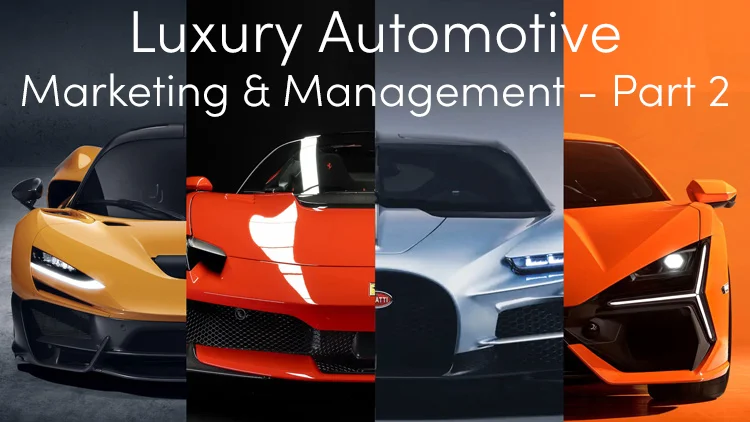
Following up on the first half of the Luxury Automotive Strategy and Marketing online course published a while back, the second half is now available on Udemy at the link HERE.
As for the previous one, this course too is thought for enthusiasts and university students who want to learn more about the workings of the industry. While it is not necessary to have completed the first half to be able to understand and learn this second one, the two are closely linked and form a complete picture.

So, after learning about the key players in the industry and how their branding and strategies compare to each other, this new section looks at market dynamics highlighting the main trends, some academic analysis of them, and an overall view of the global luxury market numbers. Last but not least, a couple of interesting case studies conclude the course comparing diversification strategies and innovation in luxury automotive.

I hope you'll enjoy it. Don't forget to leave feedback and get in touch to know more.

Cover homepage alt copy 3

Are Luxury Performance EVs Dead in 2025?

  • Brand: Porsche, Rimac, Rolls-Royce, Mercedes
  • Topic: Electric Vehicle Market, Supercars Future

2024 was a complex year for the automotive industry, with legacy automakers losing significant ground either in EV market shares, financial results, or both. This is due to several factors affecting the industry. Geopolitical, technological, and trends among consumers. While there is no doubt that the future of automotive is electric (at least in large part if not completely), the same might not be completely true for the luxury performance niche for the foreseeable future.

EVs are “young”. While cars have been around for well over a century, the true development of consumer-ready electric cars is barely around 15 years, and there are still countless areas of significant improvements that can completely change the product and user experience in years to come. Going from batteries to software, and more.

After early adopters jumped on the bandwagon and the excitement “died down”, it left space to critics and doubters. This, particularly in 2024, is reflected in a significant drop in EV sales in the West. China is the great exception, with EVs not only growing but reaching around 65-70% of the global share.

Luxury Automotive OEMs review their electrification strategies

It is throughout this difficult period for the industry with many OEMs committing significant investments in EV-related technology, like Ford's $14 billion for the EV expansion in the US, that some started going back on their development strategies.

The latest of which is none other than Porsche. The German automaker has been a strong and early promoter of the new powertrain technology, with its Taycan, initially named Mission E, and many more in between from concepts like the Mission R, or Mission X, to actual all-electric production version of its “traditional” lineup like the latest Macan.

It has to be said that Porsche never fully went in only one direction. A while back they made the headlines with their big investment in E-fuel development for their legacy models and classic cars (Link E-fuel article here), but an estimate of their investment in EV technology just in the last 3 years is around $25 billion.

Only a few months ago Porsche announced it was reviewing its EV strategy stating they are reducing their EV development targets. Key reasons for this have been sluggish sales of its EV models due to low demand, the significant investment required to continually develop software and technology for its new models, and, not to be underestimated in the luxury sector, the drastic depreciation hitting EVs in general, trend for which the Taycan has unfortunately become a symbol.

Porsche Taycan Depreciation over 1 and 4 years

depreciation

A quick look at the Taycan (Coupé) current rate of depreciation shows a quite worrying situation, that any buyer in this segment would seriously consider before the purchase. Compared to 2024’s prices for the different trim levels as new starting at £86,000, and topping at £161,000 (excluding the Turbo GT version that was not available in the previous generation Taycan), models purchased earlier in the same year depreciate by an average of 31% on starting prices that do not include options yet, and over 51% in 4 years. If options were included in original sales prices these percentages would increase even more.

A first announcement by the German automaker stated that the previous target of 80% of BEV sales by 2030 might not be achieved due to factors previously stated. Chairman Lutz Meschke said: “We will refresh our combustion engine cars, including the Panamera and the Cayenne, and of course, we will continue to rely on plug-in hybrids”. He continued “When it comes to research and development, you’ll see more flexibility in the upcoming years. We will develop new combustion-engined derivatives in order to give the right answer to customer demand”. This could, for example, be reflected in the decision of releasing an ICE version of the upcoming 718 that was notoriously set to become a BEV only, announced by the Mission R concept a few years ago, to try and renew the product line and revive its sales that has been somewhat slow over quite a few years.

mercedes cla elettrica*Mercedes-Benz BEV CLA Concept

Right before the German automaker, compatriots at Mercedes-Benz went through a similar process. Initially the development of the MB.EA-Large EV platform planned for 2028 was halted, then came the delay of the target of 50% sales of electrified models (BEVs and PHEVs) from 2025 to 2030, and it’s a few days ago the announcement that the production of the CLA concept unveiled a while back has also been delayed due to development issues.

In Great Britain too, automotive OEMs follow the trend. Aston Martin, amid a slowly and very gradually recovering financial situation, delayed the announcement of its first EV to 2026 which was initially set to come this year. Geely-owned Lotus has reportedly abandoned the plans to go 100% electric and Bentley too, which was set to reach the same target by 2030 confirmed that hybrids will likely remain on sale even after that date.

Is there more to this trend?

As mentioned previously, China is going strong and its EV market is in constant evolution with serious competitors coming to the global stage and making the headlines with important achievements. These days in the Western media the peak of this wave has surely been Xiaomi’s SU7 which in its “Ultra Prototype” iteration (which is not road legal) managed to attract everyone’s attention with a lap time of 6:46.874 at the Nürburgring Nordschleife becoming the fastest EV on the track. It comfortably outpaced the £1.8 million Rimac Nevera (7:05.29) and the new £186,000 Porsche Taycan Turbo GT with Weissach Package (7:07.55) with a prototype that is said to cost just around £94,000.

While this is working well for the mass market though in China, luxury automakers have a different and much smaller customer base, and on top of that for several of these brands the largest markets are still in the West (usually the USA) and currently made on average in larger part of people around 50+year-old or older. This demographic, grown up with specific expectations about the performance and sensations that a performance luxury car can and should offer seems fairly opposed to electrification and its added value proposition compared to combustion-engined cars. So, this is the obvious and most likely factor due to which the market niche is highly likely to remain mostly ICE-driven in the short to medium term, with hybrids decisively taking their place.

There are potential alternatives with the likes of Ferrari attempting a new approach to BEVs as discussed previously, or a new developing trend of Extended-range Electric Vehicles (EREV) which is mostly aimed at solving range-anxiety and thus not likely to make luxury car buyers fall in love with performance EVs.

xiaomi record*Xiaomi sets lap time at the Nordschleife

The most emblematic example of this change happening over the last year or so is the statement released by Rimac’s CEO Mate Rimac confirming that luxury car buyers simply do not want performance EVs. According to some, this could be hinting that upcoming models by the Croatian brand will get some sort of internal combustion powertrain component. In terms of sales the only exception in the year just passed has been the Rolls-Royce Spectre, which is naturally not focused on performance and thus (as founder Charles Rolls said over 100 years ago) takes advantage of the silent and smooth powertrain enhancing all the characteristics that brand’s clients look for.

What could be next?

As the market composition, especially for traditional luxury automakers seems unlikely to drastically change in the short term, a significant change could be once more driven by forward-looking markets like China.

With the offering of sporty BEVs increasing in China, customers more used to, or growing up in a market dominated by EVs may first start trends that define new value propositions more suited to the electric powertrain that go beyond straight-line acceleration (already proven not sufficient to convince sceptics) and would probably fall in technology applications and EV-specific driving-related use-cases.

Last but not least, a determinant factor that could change traditional performance car buyers’ mind is a revolution in EV battery technology. If new chemistries bring a significant improvement not much in power density, but in volume and weight reduction like some such as solid-state promise, they could help OEMs bringing down the overall cars' weight to the 1,500 kg average of current performance cars and thus significantly benefit dynamics and driving capabilities.

Mercedes Vision EQXX and the EV Battery Challenge

  • Brand: Mercedes
  • Topic: Electric Vehicle Market, Strategy & Marketing

A few hours ago, Mercedes-Benz CEO Ola Kaellenius went back to the much-discussed Vision EQXX. The focus is again on the impressive range the concept would be capable of.

The Vision EQXX was presented first at the beginning of the year and developed in just 18 months. Most importantly, it showcased in numbers all the aspects that Mercedes truly believes are key for the EV sector of tomorrow, and which the OEM has already been pursuing with all the other models of the EQ range (its EV product line). The first two metrics mentioned by Kaellenius himself are in fact drag coefficient and battery range.

rear eqxx*Source: Mercedes Media

How is the market shaping the EV purchasing decisions? Which are the factors affecting the choice and how different OEMs in the segment are approaching it?

Challenges in the EV market

From the customer point of view, demand is surely increasing, and mass adoption is expected rather soon. According to a report by McKinsey, the most important factors affecting customers’ decision are always related to battery, range performance, and charging capabilities.

Also, there is a difference in general preferences with regards to features, where EV buyers are on average more accustomed to the use of digital channels, more personalised and seamless options that rely on new technologies. Naturally, considering the overall direction of our everyday life, and our evolving relationship with technology, it is easy to see how connectivity and other digital integrations will likely become increasingly important for a purchase decision. Especially in the volume market, they will presumably become proper deal-breakers.

Naturally, along with these come different variables separated from the specific characteristics of a vehicle but that still influence the overall EV adoption rate.

Regulations and Subsidies

The main ones are regulations and incentives. China which, as mentioned by Reuters, is reducing its subsidies by 30% in 2022 and intends to completely phase them out from 2023 on, is a good example. In the first month of the year, the BEV sales dropped by 18.6% following the incentives cut, and this is something that happened already before and on which Beijing went back and forth a few times already.

interior*Source: Mercedes Media

Infrastructure

Infrastructure development is another defining factor, directly connected with “range anxiety”, especially in countries where this is felt the most.
In my overview EV Market growth 3 years later: China and the rest of the world I highlighted how best-selling models’ characteristics in different continents change significantly. In particular, in China except for the booming Model 3, small and cheap EVs with pretty short-range are by far the best selling ones, which indicates how price sensitivity is more relevant than range anxiety there.

On the other hand though, in Europe and the US, this is definitely important. Tesla got and still has a significant advantage over the competition thanks to its “apple-like” model. The OEM created a vertically integrated ecosystem that gives it complete control over its charging network resulting in the most prominent competitive advantage over any other manufacturer today.

To secure a stronger position in the EV segment, McKinsey again proposes a series of 7 steps that could help OEMs' go-to-market strategy, or even strengthen that of brands that have already moved into the electrification space.

mckinsey graph

This is particularly interesting because some points reflect strategic moves that have already been adopted by some OEMs.

  • Branding is definitely one of them. From subtle changes like a logo restyling (VW, BMW, Nissan, Peugeot, to name a few), to wider communication strategy updates.

logos evolution

  • When it comes to creating the charging ecosystem, as mentioned, right now this is probably Tesla’s most relevant and least replicable competitive advantage. Other automakers are trying to catch up by developing plans for private charging solutions as well.

  • Generating income from the vehicles' life cycle instead is something that is happening through digitalisation. Increment in OTA updates and software development translate into new occasions for OEMs to vary the offering

  • An omnichannel approach is being adopted not just for the brands’ communication strategies, but also for new sales models. Like it was discussed in the case of AMG’s Pop up store and changing dealerships function, several automakers are moving toward an online sales strategy.

Mercedes Vision EQXX, and the rest of the industry

Mercedes claims some proper class-leading numbers with this concept, which if achieved in relatively short times could be real game-changers.

The Vision EQXX claims a drag coefficient of just 0.17, the lowest in the industry. A record that right now is held at 0.2 by both the American Lucid Air, and again Mercedes’s flagship EQS. The German automaker has been aggressively pursuing this target, which is very evident from their decisive change in design with the entire EQ model range.

Secondly, the range is set at 1000 km thanks to higher battery energy density, with the current record-holder still being the Lucid Air which is claimed to reach a range of 830 km thanks to around 105 kWh of battery capacity.

table cars

Overall, within the same segment of 4-door luxury saloon cars, there is a certain alignment in terms of charging and range performance, with two main differences. The first is that the BMW i4 (which is soon to be followed by the i7) is much cheaper than the competition, around half the price of most other models. So, a relatively lower performance can be expected. The second is that VW Group seems to have taken a different approach to this trend. Both Taycan and E-Tron GT, in fact, have a significantly lower range than their competitors but charge from 10 to 80% significantly quicker.

Different strategies could be more successful in certain countries and vice versa. While it seems that the majority of the luxury players are focusing on the increased range, the path taken by Porsche and Audi that here share the same platform too for Taycan and E-Tron GT could be the best as range anxiety fades.

Mercedes Vision EQXX anyway, sets important targets, and not just for range, but for weight as well. Because the OEM claims a battery pack weight reduction of 30% which is a massive deal, considering that batteries weight has been one of the major factors affecting car performance and driveability, especially for sporty models. Time will tell in which way the market will move forward, and major brands taking quite different approaches make everything even more unpredictable.

AMG’s First Pop-up Store: Car Dealerships Changing for Good

  • Brand: Mercedes
  • Topic: Electric Vehicle Market, Strategy & Marketing

Following the example of the parent company, AMG recently opened its first pop-up store called UNXPCTD in Munich. Pop-up stores are not a new thing. Mercedes-Benz itself is surely one of the most active brands in this sense. Since 2016 the brand started quite a few similar initiatives in Europe, Asia, and the US. Before these, it had already extended the concept of car dealerships with the “me Stores”. In proper luxury automaker style Mercedes me Stores included “information, consultancy, restaurant, and events all rolled into one”, and as CEO Ola Källenius said:

“All Mercedes me Stores, with their welcoming bistro and event concepts, are designed to appeal to both young and new customers”

The German company is not the only one of course. Other players such as Jaguar Land Rover, Ford, Audi, Porsche, Lamborghini and, Tesla also adopted this model.

amg pop up store lounge

However, this time is different. In 2020 and 2021 there has been a return to this model with several new initiatives for two main reasons that distinguish this “wave” from the previous ones.

A New Motivation

The first reason is, of course, the virus outbreak. The continuous change of conditions and the uncertainty in several countries forced OEMs to be more cautious and adopt a more flexible model that required a minor commitment. Hence, the pop-up setup.

The second reason is well-expressed by Porsche’s latest initiative announced at the end of the year. The automaker is set to open almost 40 new locations. Naturally, these will not be the regular car dealerships that we are used to seeing. They will be split into two different types of locations called Porsche Studios and Porsche NOW. While similar in concept, the first will be permanent while the second will be a pop-up shop, so only temporary. For both these new stores though, the most important aspect is enabling a direct connection with the target and new audiences.

porsche studio*Source: Porsche

Data has become the most important currency in any industry to understand customer preferences and behaviour. In-car software provides a lot of it, so automakers need to close the gap. The aim here is to reduce the distance between OEM and customers, and the traditional car sales process is increasingly detached and outdated. Alternative sales models offer a more direct point of contact with the customers allowing manufacturers to gather crucial information.

Advantages of pop-up store models

Pop-up shops fit into this changing scenario in several different ways.

As mentioned, they offer more flexibility as they are not permanent by definition. Thanks to this, brands can also attach special events, or limited-edition merchandise releases that further increase the “hype” from enthusiasts and grow the word-of-mouth effect.

Since they are only temporary and most of the time small, they are placed in very strategic positions. The location plays a crucial role. For instance, it is possible to find them in large malls or shopping centres. Regardless of the interest of a single individual, such locations grant a continuous stream of people, giving much more exposure to the brand than normal dealerships that are usually located in more peripheric areas, and clustered with other similar activities.

Also, with these, the automaker brings the product and the brand to the audience and not vice versa. Porsche’s Sales Retail Director Marco Kana said:

“With the urban sales' formats, we have sought and found new ways to reach customers. Whether it is a Porsche Studio or one of our Porsche NOW sales pop-ups, these innovative formats offer easy access to the brand and are ideally suited to developing contact opportunities with new target groups”

A pop-up store, in fact, can be more focused on the simple marketing activity. Along with selling cars, these spaces are focused on delivering the brand experience and identity through digital integrations (i.e. Mercedes placing an F1 Simulator in its Liverpool pop-up store a while back), test drives, and just the overall environment. And this in turn creates a true and direct connection with the public that can become brand loyalty, which is extremely difficult to achieve through other forms of advertising.

Most of all, in fact, they offer a smart way to promote a brand. Today advertising has often a negative connotation. Ads are often considered just interruptions in social media content consumption or annoying pop-ups, and new generations end up paying to get rid of them. Pop-up stores offer the opportunity to engage with potential customers delivering an engaging experience to those who want to. And they provide instant gratification.

The Next Step

Going back to AMG’s initiative, along with pop-up store, came also a survey aimed at improving the understanding of people’s preference when purchasing a performance car entirely online.

The importance of these new sales models, in fact, is also in the fact that they represent a departure from the traditional process, and a step toward online sales. The chip shortage meant that in many markets dealerships faced (and are facing) a severe lack of availability, which is causing a bubble in pricing for both new and used cars.

While dealers might somewhat benefit from it in the short term, the overall direction of the market is as much toward EVs as it is toward online sales.

Estimated rate of new car sales purchased online in the United States, Europe, and China(2020-2025)

online sales*Source: Statista

Back in 2019 Tesla announced that it was adopting a 100%-online-sales policy, maintaining fewer locations with the main function of delivering services to the customer, while maintaining just a small stock for customers who decided to come in and buy a car right away. The same year 78% of its Model 3 sales were completed online, and up to 82% of the buyers did not need a test drive. In a similar way, Volvo confirmed that by 2030 it will only sell electric vehicles and shift to online sales. Its showrooms will become centres for servicing, models’ display, pick-up of new vehicles delivery, and other services to the client.

VW too, upon announcing its sales model restructuring through online platforms, teased five new sales formats including city showrooms and pop-up stores. It then visualised also the “dealer of tomorrow”.

vw dealership tomorrow*Source: VW

Online sales will mean a much shorter value chain and more transparency and consistency for customers. Ironically, this translates into an even closer relationship between OEMs and clients, thanks to the access to a bigger volume of data on purchasing behaviour and preferences. So, with electric mobility developing rapidly, every major automaker is also investing to develop its sales model in a new direction that increasingly involves digital touchpoints and transactions.

Digital Sales Matrix

car sales matrix

Some Conclusions

Technology and digitalisation are changing the automotive industry in every aspect. Not just that of the final product. Car manufacturers are experimenting with different solutions, and gradually moving away from the traditional sales process.

New experiences like pop-up stores have become a popular way for automakers to promote their products and connect in a new and positive way with existing and new audiences. As a consequence of the pandemic, they also offer a more flexible and less risky way for OEMs to approach direct promotion. Covid-19 also brought a sharp increase in online purchases, and every major automaker is developing digital platforms. Automotive E-commerce developer GForces claimed a 1228% rise in online transactions in 2020.

Car dealerships as we know them today are changing for good. The viable path for them will be to transform into integrated touchpoints within the automaker ecosystem, providing a range of services, from car servicing to financial advice, and more. An ecosystem that will be complemented by online platforms and alternative models, like the ones described above. Thanks to data shared at different levels, and technology these will integrate digital and live services to offer a new and more transparent experience.
6 Factors to Relaunch the brand: Aston Martin and Mercedes Agreement

  • Brand: Aston Martin, Mercedes
  • Topic: Strategy & Marketing

In the latest press release published by Aston Martin, the automaker announces its report for Q3 of 2020 along with the renewed partnership with Mercedes-Benz AG through a new strategic technology agreement and new financing.

aston martin mercedes cover

The new agreement stands on the one established first in 2013. Since Lawrence Stroll became one of the major investors in the company and Executive Chairman, there has been a significant restructuring within the company. The main step has been the appointment of a new CEO substituting Andrew Palmer, previous Mercedes-AMG CEO Tobias Moers. If you would like to know more about him, what he has done so far, and the changes in Aston Martin you can check my previous article New Aston Martin’s CEO: Who is Tobias Moers.

According to the press release, the main targets stemming from this new arrangement are the production of 9000-10000 vehicles by 2025, revenue of £2 billion, and Adjusted EBITDA of £500 million.

But how is Aston Martin planning to achieve all this?

1. UPDATED FINANCIAL PLAN

Aston Martin will issue £125 million of new ordinary shares, plus £286 million of Consideration Shares to Mercedes-Benz, so-called in the document as part of the agreement for the technology the German automaker will provide. Such shares will be issued in tranches along with the delivery of the promised technology upgrades, with the first coming by the end of 2020 already, the second by early 2022, and the remaining within early 2023.

With Mercedes increasing its stake in Aston Martin, it will have the right to nominate a non-executive director of the Board initially. Later, with the shareholding reaches 15% and above they will have the right to nominate a second one as well.

Along with these measures, debt financing will be raised too through a first lien note issue for £840 million with 2025 maturity, a second lien one for £259 million maturing in 2026, and an £87 million revolving credit facility with 2025 maturity.

Both equity and debt issues should strengthen business resilience and support its growth strategy.

2. NEW MERCEDES-BENZ TECHNOLOGY

With the new Strategic Cooperation Agreement, Aston Martin for its new generation planned up to 2027 will have access to the latest conventional, hybrid, and full-electric powertrains, “State-of-the-art”electric/electronic (E/E) architecture, hardware, and software.

aston martin interior*Current Interior of a DBS Superleggera Volante equipped with Mercedes previous generation infotainment


This could be a big deal, since, under the current agreement from 2013, Aston only had access to the older generation of Mercedes’ electronic components, which is something that some customer seemed not enthusiastic about. The fact that now Mercedes has a much more relevant economic interest in the company and the transferred E/E technology is defined as state-of-the-art, could indicate that the latest component will be used by the British automaker too.

A second hint about this, and its importance stressed multiple times within the press release, is that this technology transfer will drastically reduce Aston Martin’s risk. Avoiding in-house E/E components production, all its resources will be focused instead just on new vehicles’ development and other areas of the business that contribute to making the car unique to the brand.

valhalla interior*Source: Aston Martin Valhalla Interior, Source: Aston Martin Media©

3. DEALER NETWORK DE-STOCK AND Q3 IMPROVEMENTS

As mentioned in previous articles, part of the updated strategy and renewed business model was the dealerships’ de-stocking in order to balance demand and supply and reposition the product line as that of a true luxury marque. 

ASTON MARTIN RESULTS FOR THE 9 MONTHS TO 30 SEPTEMBER 2020 (£ MILLION)

table 1

Despite the negative financial results, especially if compared to 2019 which was already a tough year for the company there are some factors to highlight. Naturally, the major cause of disruption in 2020 is Covid-19, and as the numbers of infected increase in many countries, it could still seriously worsen the market condition in the last quarter. Nonetheless, there are positive signs. First of all, the significantly lower wholesale volume, compared to 2019 both in the YTD and Q3 columns, are due to an effective de-stocking that reached over 1400 vehicles. So, a ‘necessary evil’ in this case.

Then, some national market improved more than others. Compared to Q2, China in Q3 experienced a +29%, which even starting from a low basis is still a noteworthy result. Third, even with the overall negative result, Q3 was an improvement over Q2. Of the total de-stock, 567 have been delivered just in Q3, which represented an acceleration, and operating loss was also lower than in the previous quarter. Finally, there was considerable debt reduction.

4. DBX

It has been said many times now that the SUV DBX is extremely important for Aston Martin. As of now the St. Athan plant, which has been created exclusively for the production of this vehicle (as further proof of its importance), has reached the full rate of production again. Also, in the press release CEO Tobias Moers mentions a quality-led ramp-up as appropriate for our luxury product positioning”. 

ASTON MARTIN SALES BY MODEL CATEGORY IN 2020

aston martin sales by model

The YTD column shows GT is the most successful category in Aston Martin line-up both in 2019 and 2020. But in Q3 DBX was by far the best-selling model with 345 units alone. This figure confirms the ‘solid order book’mentioned previously by Mr. Stroll and represents a positive outlook for the coming months.

5. NEW DELIVERY PLAN

After de-stocking, Aston Martin will implement a “disciplined production to order to generate a margin more aligned to the luxury automotive segment”.

The production target set for 2025, will include front-engine, SUV, and mid-engine vehicles. The newly introduced mid-engine line already counts Valkyrie which will be delivered from half of 2021, and Valhalla set to arrive in the near future as well. A third production model that should not be limited will be the Vanquish Vision presented at the Geneva Auto Show 2019.

The SUV line could be expanded as wellwith other models complementing the new DBX. Hybrid powertrains will account for 20-30% of Aston Martin production by 2024 and the first full-electric should arrive no earlier than 2025.

6. ASTON MARTIN FORMULA 1 TEAM

Lawrence Stroll’s F1 team Racing Point (already powered by Mercedes engines as well) will go under the Aston Martin brand from the 2021 season. This move will bring significant benefits to the automotive business with a rare model that just Ferrari and McLaren have enjoyed so far.

A successful Formula 1 team represents a powerful marketing tool, and the support by Mercedes, which has dominated the turbo-hybrid era of the sport, surely gives a relevant advantage. Additionally, from next year, 4-time World Champion Sebastian Vettel will join the teamtoo bringing with him his strong popularity as 

Sebastian Vettel

one of the most successful and respected drivers in the sport’s history.

The second, but potentially even more important, benefit of a Formula 1 team activity is the technology transfer that will be available for the automotive business’ mid-engine vehicles directly from the racing cars. This is something that has happened for quite a long time now, and with the new FIA regulation coming in 2022 new innovations could stem from it.
 
aston martin f1 liveryAston Martin F1 Livery Concept, Source:Sean Bull Design©
 

OUTLOOK

The comprehensive plan and the closer ties with Mercedes, which has been extremely successful in the last few years in many automotive segments, look like the best recipe to reposition the brand, shield its products from depreciation and ensure sustainable growth and innovation aligned with the current market changes.

However, after a partial recovery, there is still much uncertainty around the Covid-19 progression, with various countries re-establishing restrictions and lockdowns. A second drop in sales and financial markets confidence is plausible, and while on one hand, the consequences could be even more severe than the ones experienced before, on the other some effects are now already known, and serious infrastructures and measures are already in place. Overall the outlook should be cautiously optimistic.

Privacy Policy - Cookie Policy