New Online Course Available Now

  • Brand: Aston Martin, Bentley, Bugatti, Ferrari, Lamborghini, Maserati, McLaren, Pagani, Porsche, Rolls-Royce, Mercedes, BMW
  • Topic: Electric Vehicle Market, Finance, Strategy & Marketing, Supercars Future

Following up on the first half of the Luxury Automotive Strategy and Marketing online course published a while back, the second half is now available on Udemy at the link HERE.
As for the previous one, this course too is thought for enthusiasts and university students who want to learn more about the workings of the industry. While it is not necessary to have completed the first half to be able to understand and learn this second one, the two are closely linked and form a complete picture.

So, after learning about the key players in the industry and how their branding and strategies compare to each other, this new section looks at market dynamics highlighting the main trends, some academic analysis of them, and an overall view of the global luxury market numbers. Last but not least, a couple of interesting case studies conclude the course comparing diversification strategies and innovation in luxury automotive.

I hope you'll enjoy it. Don't forget to leave feedback and get in touch to know more.

Cover homepage alt copy 3

Maserati: What went wrong?

  • Brand: Maserati
  • Topic: Strategy & Marketing

2024 has been a difficult year for Stellantis’ top-tier luxury brand despite undergoing a deep image renewal with a new product line to match.

A while back I wrote about Maserati’s renovated marketing communication on the eve of the release of the MC20 and the start of its electrification journey. The MC20 was an extremely important vehicle for the brand as it not only recalled one of its most iconic modern models the MC12, but it also marked its return to the research of that somewhat lost exclusivity.

As for electrification, the first step into this new world was the introduction of a mild-hybrid version of the Ghibli that by that time was already 8 years old, even with minor upgrades throughout the years.

Maserati in Numbers

The previous look at Maserati showed how sales kept decreasing sharply after the 2017 peak driven by the introduction of the successful SUV Levante. The period for the brand was unfortunately marked by mismanagement with a strategy too focused on volumes rather than exclusivity, quality issues, and an ageing lineup with technology that could not keep up with the direct competition of German brands.

A decisive change of direction was necessary then, and it came in 2020. To the initial steps just mentioned and detailed in the article here ‘Maserati strategy: back to the origins to look at the future’ followed the release of convincing and competitive all-new models. The Grecale SUV, the GranTurismo and GranCabrio GT (Coupé and Convertible), with each model coming in two trim levels, Modena and the sporty Trofeo, but all three have also been followed by the first full-electric versions called Folgore. Finally, the convertible MC20 Cielo was also added to the new lineup.

These models brought, as expected, elegant Italian styling with attention to detail, and most of all, updated technology with the new Maserati Intelligent Assistant (MIA) based on Android Automotive as is Stellantis’ Uconnect.

Expectations were high for the new update lineup that should have brought Maserati back in competition against the German brands leading the premium and luxury segments. However, after a recovery (+42%) from the slump of 2019, worsened in 2020 by the pandemic, sales have remained mostly stable with a promising +14% in 2023, but things got worse in the past year.

Maserati Yearly Sales (2015-2024)
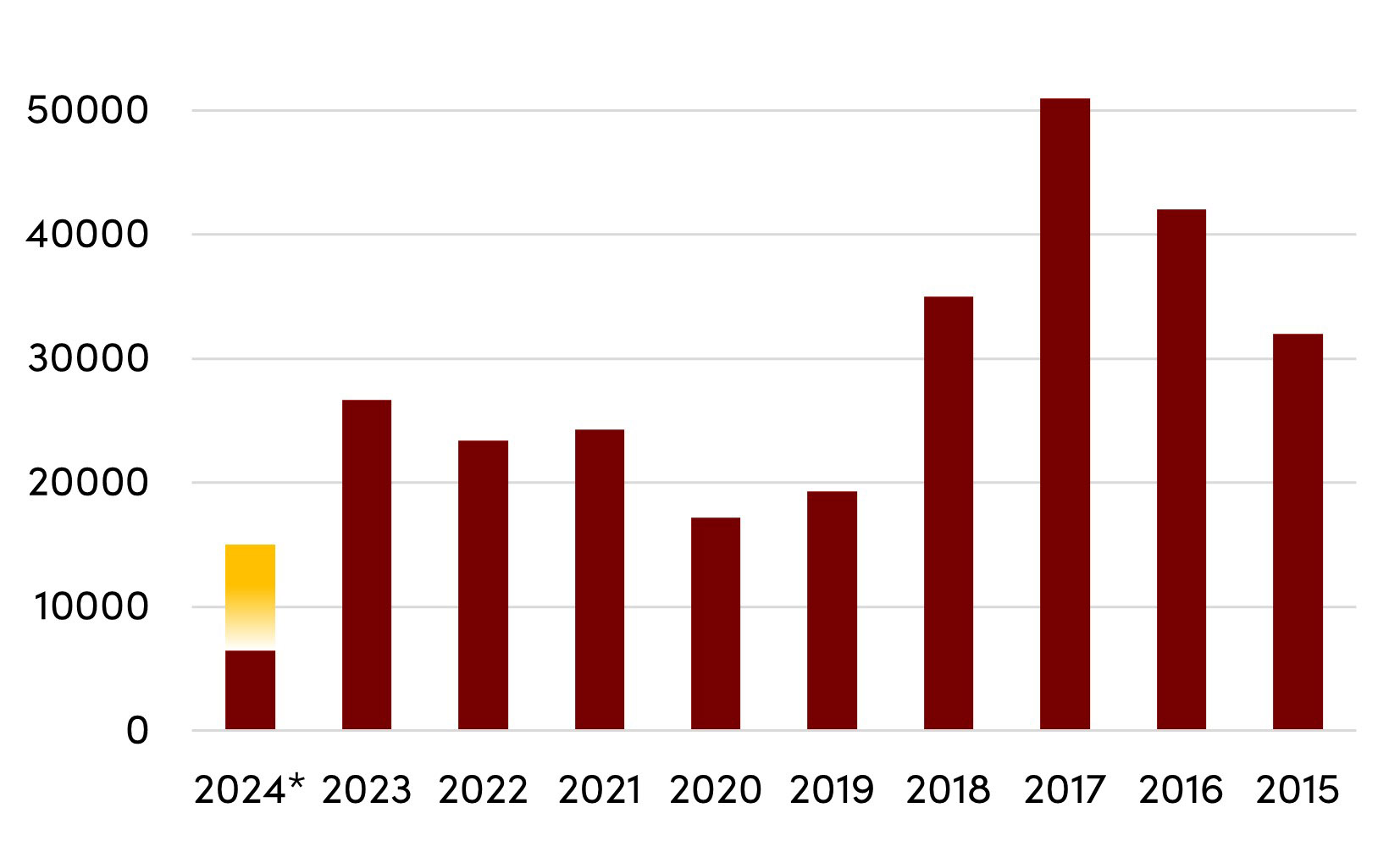
sales graph*2024 data is a projections for H2 based on H1 sales report

Deliveries in the first half of 2024 reached just 6,500 units equalling a -57% compared to the same period in 2023, and the trend is expected to have continued through the year bringing the overall sales to a total of around 15,000 units for the full year.

Maserati Communications and Media

The report from Stellantis quotes as key reasons for this slowdown the discontinuation of three V8-based models whose production was stopped in rapid succession between 2023 and 2024. The Levante, Ghibli, and Quattroporte. The first two were followed by end-of-production limited editions called Ultima, programmed for 103 units each and featuring reviewed components and performance, with a significantly higher price to match (around £160,000 for both in the UK or $190,000 in the US).

What is even more worrying though, is that the second reason quoted in the report is the low sales of the new SUV Grecale. Considering a global automotive market where the different sources quote the percentage of SUVs sold in developed areas between 49 and 54% of the total, and a world in which Porsche’s best-seller over the past 20+ years has always been an SUV by far, the new mid-size Grecale should have been Maserati’s heavy seller and make up for the loss of the other models if not more.

grecale trofeo

Following the news of this drastic slowdown in the first 6 months of the year, the now-former CEO Carlos Tavares in an interview stated:

“With Maserati, we have the right cars and we have the right technologies. We can offer thermal or 100% electric luxury sports cars. If sales are sluggish right now, it is a matter of marketing. We have also improved a lot on the quality front, but now we need to work on marketing. We lack prospects and leads, we need to reach potential customers and deliver the right message for the right positioning.”

This explanation however left many industry observers confused, to say the least.

What went wrong?

First of all, the difficulties for Maserati have been exacerbated by continuous production stops and reductions in the different production plants that began in early 2024 and peaked at a -75% production rate in Turin-based Mirafiori factory later the same year. The low demand that is impacting the brand production plans, especially for the full-electric models (and not just the ones under the Maserati brand for Stellantis) is the same that a while before forced the closure of the Grugliasco factory.

Along with the Mirafiori situation, the other two plants in Modena and Cassino, producing MC20 and Grecale respectively would have seen a production decrease of 79 and 58% (Italpassion.fr). The overall reduction would be around 64% with production that has dropped below 10,000 units from the almost 30,000 of the previous year.

At launch, most of the media and experts expressed positive opinions of the new Maserati models, MC20, Grecale, GranTurismo, and GranCabrio.

The quality improvements in construction and materials as mentioned by former CEO Tavares have definitely been noticed and appreciated, as are the new updated technology, and above all the performance and dynamics able to rival with Maserati’s most fierce competitors if not surpass them.

So where does the real problem lie? Well, two factors that likely held back sales are pricing first, and secondly, but probably even more important in this segment, depreciation coming as a consequence.

The problem with high prices has been quoted by most media outlets or expert testers when comparing new Maserati models with their direct competitors.

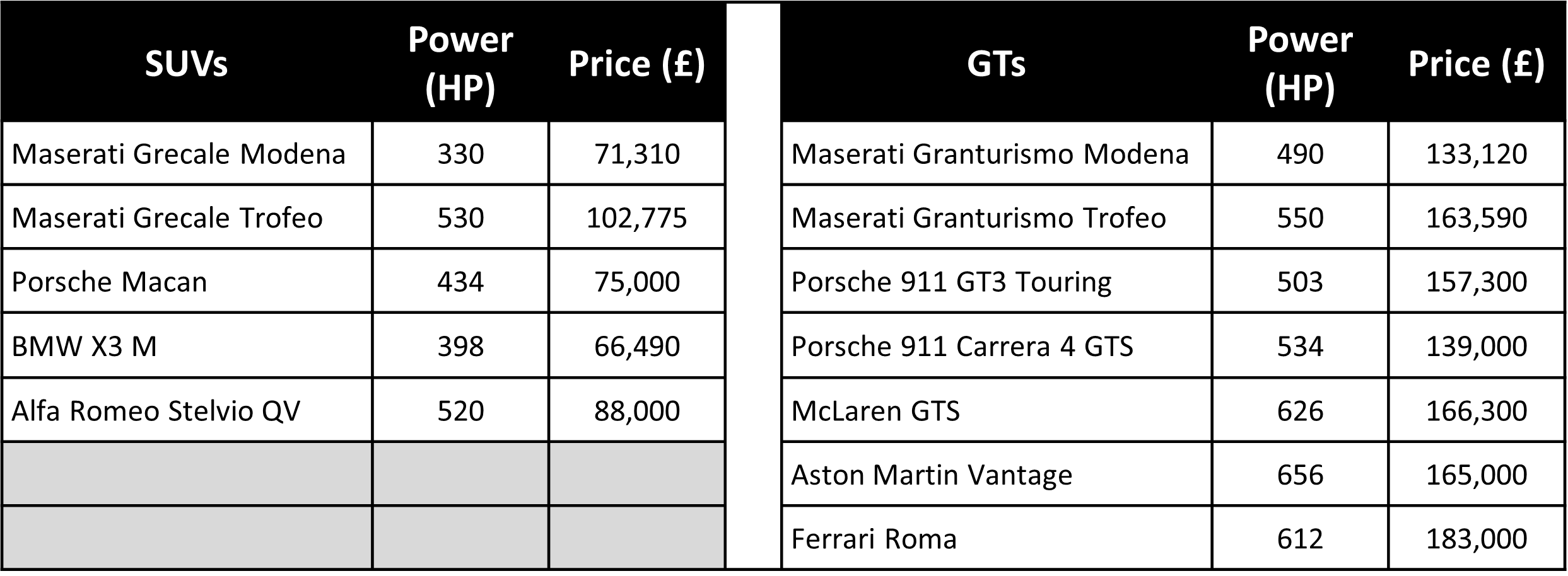
Below are some examples of the Grecale and Granturismo Modena and Trofeo trim levels against competitors in the market right now with prices (for the UK) and power figures. While not exhaustive as a comparison, as there are many more factors involved in a luxury vehicle’s valuation, the table along with the following considerations can be helpful to draw a picture of Maserati’s current positioning.

Maserati Grecale SUV and Granturismo (Modena and Trofe trims) competition by Price (£) and Power (HP)
table

On the SUV side, the top-trim Trofeo leads in terms of power but at a significantly higher cost than its competitors. It must be also considered that in line with the rest of the automotive luxury industry, Maserati too offers a long list of options and additional packages that can easily drive the price of these cars up by £30,000-50,000 bringing the Grecale Trofeo potentially to over £150,000.

Similarly, on the GT side, the Granturismo Trofeo ties in price the absolute top of the luxury performance market with Porsche’s offering being even lower, McLaren and Aston Martin on the same level but offering significantly more power, and even entry-level Ferrari is not that far ahead.

What must be taken into account here is the also the brand value. As proven multiple times, and even reported in various previous articles, the brand is the most important characteristic considered by buyers when approaching a luxury automaker. And as of now, considered the history, and status all these luxury competitors bring significantly higher brand equity, which in turn translates into lower depreciation and leads straight onto the next and most important point.

As reviewed with various examples in Luxury Automotive Resale Value and Depreciation: How and Why, depreciation is one of the most important factors in the luxury automotive segment and one that when achieved can constitute a significant driver for increased sales. While none of the listed brands is immune to it, especially in these times of uncertainty, unfortunately for Maserati, an evident example of severe depreciation that might drive customers away is its top-of-the-line MC20.

mc20

Starting at around £220,000, which once options are added can easily go close to £300,000, the mid-engine supercar from Maserati goes straight into competition with the best of the previously mentioned McLaren, Aston Martin, Ferrari or even Lamborghini brands. However, a quick look at the pre-owned market shows that models with extremely low mileage from 2-3 years ago sell between £140,000 and £149,000, which assuming a (conservative) £250,000 price at sale after options, would mean a 40-44% depreciation in such a short amount of time.

Similar depreciation rates are observable for the Grecale SUV as well, and slightly better for the Granturismo (between 25% and 35%) even though it must be remembered that the latter is newer so currently pre-owned samples on sale are all from 2024.

The solution to this situation is anything but easy. On the one hand, readjusting the models' positioning could devalue the brand or the perceived luxury that Maserati is trying to restore and has partially regained with this new generation. On the other hand, adopting a similar strategy to that used in the 2010s, with discount deals on leases and other solutions of the same sort has already proven unsuccessful and in the worst cases even damaging to the brand reputation. One potential, yet risky solution, taking into account the already severe production delays, and factories' closures, could be to gradually adopt the ‘luxury business model’ and artificially limit sales like Ferrari has always successfully done and others are trying to which could, in time, positively affect the depreciation factor.
Maserati enters Formula E: the future is electric

  • Brand: Maserati
  • Topic: Motorsport, Strategy & Marketing

On Monday, Maserati announced its entry in the Formula E Championship starting from the 2022-23 season. This is not just a first for the Trident house, but a first for Formula E itself which sees the first Italian manufacturer entering the Championship, and a first for Stellantis that through Maserati gains access to the top of electric vehicles’ racing, and to an important testing platform for future developments. As said by Senior VP of Motorsport, Jean-Marc Finot:

“Beyond this piece of history, Maserati Formula E will be our technological laboratory to accelerate the development of high-efficiency electrified powertrains and intelligent software for our road sports cars”

About Formula E

Formula E will be on its 9th season next year. But the most important news, on which Maserati is most likely betting, is the introduction of the 3rd Generation (or Gen3) of the car. It promises to be lighter, more powerful, and overall more evolved than its predecessor. It should be a significant step forward compared to the current Gen2 Evo even in terms of looks, to try and make the sport more appealing.

Gen2 cars weighing at a minimum of 900 kg, have raced with a power between 200 and 250 kW (335 hp) in race and qualifying mode respectively, and a maximum speed limited at 280 km/h. The new one will weigh 780 kg, and produce 300 to 350 kW (470 hp) in race and qualifying mode, with a top speed that could go up to 322 km/h.

Keeping in line with its message, there will also be an improved focus on sustainability. Along with the best energy efficiency possible, the cars will be developed around a full Life Cycle Assessment, to retain its status as the first fully net-zero carbon footprint global sport. So far, the organisation has offset its carbon emissions thanks to initiatives certified by Verified Carbon Standard (VCS), Clean Development Mechanism (CDM), and Gold Standard (GS), all drawn around the Kyoto Protocol.

Gen3 cars will make more extensive use of sustainable materials. Consumables such as tyres, batteries, and even broken carbon fibre parts will be investigated to improve their lifespan, as well as their end-of-life/recycling processes.

Gen3 sustainability

Over the first 7 seasons, the sport's popularity increased quite significantly, peaking during the 2018-2019 season, with 411 million unique viewers. The next year was heavily impacted by the pandemic, and even though the 2020-2021 season displayed a good recovery, it did not quite reach the level of 2019. One positive data highlighted by ABB Formula E however is that the live audience was the highest ever.

Formula E unique viewers by season(in million)

graph fe viewers

Despite the increasing audience, revenues fell by 11.5% to €142.8 million due to races cancellation and sales prices decreasing. The key objective is still to reach profitability, but the upcoming financial regulations and car changes could have a positive impact.

Starting from seasons 9 and 10, in fact, the sport will impose new financial caps for teams and manufacturers. They will have a maximum expenditure of €13 million and €25 million per season each. The limit for the teams will be increased to €15 million from the 11th season. These have been devised by the FIA management along with the teams to help the long-term sustainability of the championship.

In the meantime, along with Maserati, Formula E continues to receive the support of several high-profile manufacturers such as Audi, BMW, DS Automobiles, Jaguar, Mahindra, Mercedes, Nio, Nissan, and Porsche.

Formula E within Maserati’s Strategy

The entrance into the electric racing championship is only the last step of a long restructuring process for the Italian automaker. It started back in 2019 with important changes at the top of the organisation’s management after two bad years, and an extremely negative 2019 when the majority of the competitors took advantage of a healthy and growing market instead.

Since then, Maserati has successfully presented to the world its new super sports car MC20, which in the company’s representatives words would have marked the OEM’s return to racing.

fangio*Fangio competing in F1 with the Maserati 250F

A racing history started in the early 1900s, with the Tipo26 whose name 26 indicated the year in which it first competed. It then followed in the 30s with several victories at the Targa Florio, and several successful participation in the World Sportscar Championship (now WEC) throughout the 50s. During these years it also took part in the Formula 1 Championship reaching victories and famously, the title in 1957 with Juan Manuel Fangio driving the 250F.

Followed more competitions in rally and touring series, up to the FIA GT Championship in 2004 in which Maserati participated with its MC12 derived from the Enzo Ferrari’s chassis. Its campaign successfully continued up to 2010 with 6 Teams’ Championships, 2 Manufacturers’ Championships, and 6 Drivers’ Championships.

mc12 racing*Maserati MC12 racing

Now Maserati is keeping its promise, but probably not quite like some expected. So, instead of going racing with the MC20, the OEM enters Formula E.

This, of course, is still extremely important (probably even more so) for the company’s medium to long-term strategy, as electrification gains importance, and Maserati brings forward its “Folgore” line-up (thunderbolt in Italian).

So far, the automaker has introduced two mild-hybrid versions of its existing models Ghibli and Levante both featuring a 48V motor paired with the 4 cylinders 2 litres engine. Electrification was supposed to arrive already in 2021 with the all-new GranTurismo and GranCabrio, only teased in camouflaged shots so far. The models have been delayed as it has the upcoming crossover Grecale, the smaller sister of the SUV Levante.

In terms of sales, 2020 was an even worse year for Maserati. This time though it was not alone, as almost every automaker, except those in the top-end of the luxury market, have been hit hard by the pandemic. The first half of 2021 had instead shown strong recovery signals with over 100% increase y-o-y, but that was mainly due to an overall market recovery. Sales of around 11,000 units in the first six months indicate that the automaker could even exceed its 2019 figure of 19,000. This year, however, minor problems have still been caused by the pandemic, along with the mentioned delay of the new models sparked by the chip shortage discussed in a previous article.

new granturismo*New Maserati GranTurismo

Overall, even with setbacks caused by major industry factors, Maserati has shown important recovery signals and some interesting choices aimed at properly relaunching the brand. In this context, the Formula E entry represents an important opportunity both in terms of technological development and marketing.

For the automaker’s marketing, the Formula E championship is more of a bet on its future. But still a pretty safe one. In the best-case scenario, if the popularity of the sport keeps growing it could contribute to putting back Maserati as a prominent name in motorsport, as well as a name synonym with innovation and performance in the luxury electric mobility space.

If Formula E does not get the popularity many are hoping for, Maserati will still have the opportunity to reap the rewards of technological development and a boost in visibility and brand image with a niche of fans and enthusiasts.

Finally, it is important to note the opposite dynamic as well. In important markets like the US, where the Italian brand is very popular, the Maserati name could attract new fans to the sport increasing its following.

A honourable mention

In September 2020, as is required of any proper luxury manufacturer, Maserati launched its personalisation program: Fuoriserie.

This division adds prestige to the brand, especially on the occasion of high-profile partnerships like the latest with David Beckham for a one-of-a-kind MC20. The new motorsport initiative too can offer important synergy opportunities, like others are doing. One good example of this is Aston Martin that has used its recent entry in the Formula 1 championship on different occasions for special editions or unique specifications of its road cars.

Maserati can use its renewed motorsport activity to create a unique heritage thanks to the all-important personalisation in the modern luxury automotive market.

Phase 2: Q1 and Italian Luxury Car Manufacturers’ reaction

  • Brand: Ferrari, Lamborghini, Maserati
  • Topic: Strategy & Marketing

Phase 2 approaches and automakers are starting to finally look ahead. Factories are gradually reopening even under strict controls for health and safety. In Europe, since the second half of April, several countries began the process.

In Italy, and especially in the motor valley, the major luxury automakers have put in place measures and plans to succeed in this risky task. If the Italian ‘experiment’ goes well, it would send a positive signal to other countries, and within May other important production hubs could reopen as well.

OUTBREAK DEVELOPMENT

contagion chart*SourceThe Guardian from Johns Hopkins

So far, all the companies in the luxury low-volume automotive space have, to some extent, brought examples of cooperation and sensibility to the current condition of our society. Technical knowledge and highly skilled labour allowed each firm to contribute to their respective countries’ efforts. 

BUT FIRST, WHAT IS HAPPENING IN THE GLOBAL MARKET?

With regards to automakers’ core businesses, as mentioned in a previous article, low-volume manufacturers so far have suffered less from the impact of the pandemic. Ferrari and Bentley have even reported positive sales results. Nonetheless, even companies that maintained a good sales momentum were hit heavily by the crisis with significant losses on cash flows from all the operating activities.

By observing the data in the 2020 Q1 reports of various automotive companies and groups, a certain degree of correlationbetween the volume of cars delivered in 2019 and the decrease in sales since January can be identified. This correlation stems from the target customer segment of each company, showing how the luxury market has been affected in a minor way.

CORRELATION BETWEEN VEHICLES SOLD IN 2019 AND YOY SALES DECREASE IN Q1 OF 2020

regression chart and graph*Ford figures are relative to US, EU, and Mainland China markets only
*Toyota figures are relative to US, EU, Mainland China, and Japan markets only
*Luxury companies relevant for this graph have not been added as they haven’t released official figures for Q1 yet but will be added as they do.

Naturally, there are a number of other factors at play. Apart from the resilience of the wealthier consumers, a major one is the geographic penetration and market balance. This is quite evident by comparing VW and Toyota’s data. The German group has a massive presence in Asia, and China being the first country affected by the virus outbreak has also suffered the most in Q1, with a -31% car deliveries, well above the global average of 23%.

Toyota, on the other hand, relies mainly on the US and Japan which have been impacted much later and where the manufacturer sells around twice the vehicles delivered in Europe or China. Similarly, low-volume manufacturers’ largest market is generally the US. This explains how some have even posted positive results in Q1 but could also indicate an increased risk for Q2now that the American continent is the most exposed to the pandemic.

The other major exception to this trend among the marques included, this time in the luxury segment is Rolls-Royce. The company like its competitors sells mainly in North America, which accounts for a 30% share of the total. But the business in China which had grown fast in 2019 reaching over 20% of the company’s total sales had endured a hard blow. Rolls-Royce CEO Torsten Müller-Ötvös said that sales in the Asian country fell “pretty close to zero”, which would explain, if not all, at least the majority of this decline.

So, how have Italian automotive manufacturers reacted so far? And what measures are they preparing for the gradual reopening of the workplaces in Phase 2?

FERRARI

Ferrari manages to grow and report good sales results even in this difficult start of 2020. Its statement is aligned with the one of 2019 which was already very positive considering the fast growth of the brand in these last few years.

To face the crisis, Ferrari’s 2019 market rebalancing, which saw the fastest growth of the Mainland China, Hong Kong, and Taiwan region with 20.3%, also works in the company’s favour. In 2020, the sharp drop in shipments to the same region (-88.7%) is mainly a consequence of deliveries anticipated in 2019. This means that Ferrari’s in Asia could have offset any significant hit during this period, but is likely to see consequences later on, even if China is already starting its recovery.

FERRARI SHIPMENTS BY REGION (%) OVER A 4.9% INCREASE FROM 2610 TO 2738 UNITS

pie charts

In this difficult context, Ferrari is also arguably the company that has distinguished itself the most making the headlines for its help to the community in Maranello and not only, as well as its initiative and planning for the ‘Back on Track’ strategy.

The entire plan revolves around four main objectives. The first is preserving the wellbeing and welfare of the employees. ‘Back on track’ is a complex program to preserve the health and safety of the company’s employees. Put in place by a dedicated team, it consists of behavioural guidelines, medical screening and tracking with an app, and help and support to the families and suppliers within the factory premises. Along with this 3d printed respirator valves have been delivered to hospitals.

Second is the supply chain management, with the increase of inventories to avoid shortages in case of further disruption. The third factor considered is the dealership network support from financial burden, reduced pre-owned market operations, and special geographical allocations based on dealers reopening date. Finally, along with the stop of new hirings, expenditure limitations, and increased digital marketing activities, projects and investments will be reprioritised.  

LAMBORGHINI

Lamborghini has also emerged quite positively from Q1 in 2020 as predicted by CEO Stefano Domenicali during an interview, with only a slight decline in sales.

In Sant’Agata Bolognese also the activities have been repurposed to focus on the production of medical supply. The automaker has produced every day 1,400 surgical masks and 300 protective shields. 3D printers instead have been used to build 30 new lung simulators.

Mr. Domenicali quoted in a Lamborghini’s press release regarding Phase 2 on May 4th also said:

”We are ready to restart with great energy, but also with strict protocols for safeguarding what is most precious to us: the safety of our people…” “We will constantly monitor the contagion’s evolution and be ready to adjust our protocols in accordance with the guidelines provided by the Italian government and the Emilia-Romagna Region…”

Then continues “We continue to nurture the dreams of our fans and customers, andon 7 May, through a virtual launch, we will present a new car in order to complete our model range. We closed the first quarter of 2020 despite the situation with very positive results…”

lamborghini instagram*Lamborghini Phase 2 announcement on Instagram

So, while working closely with Trade Unions to define a strict plan of behavioural conduct to ensure the safety of its employees, the company actively promotes its business. After almost two months of lockdown, the announced absence at what should have been the Geneva Motor Show looks more like a well-thought-out decision to have an exclusive event instead of just a lack of new models to introduce.

CONCLUSIONS

Other Italian companies in a similar market segment, such as Maserati and Pagani have released communication of factories, dealerships, and museum closure. They have not published detailed plan updates regarding Phase 2 though. FCA group is applying health and safety measures in its plants with sanitisation and behavioural guidelines regarding social distancing.

Italian luxury low-volume car manufacturers, coming out of a good 2019, have closed Q1 of 2020 positively in terms of sales, considering the difficulties. The luxury automotive segment, in general, has suffered less from the consequences of the pandemic, and its major players have laid out structured plans to restart production in Phase 2.

A heavier impact though is to be expected in Q2. Not only it started with all the firms in full lockdown but also with Western markets more heavily affected than China’s which instead is already showing signs of recovery. The improving Chinese economy could not be enough anyway to offset the potential loss of companies that rely heavily on the United States market, where the pandemic is still in full swing.

Maserati strategy: back to the origins to look at the future

  • Brand: Maserati
  • Topic: Strategy & Marketing

Numerous announcements popped up on Maserati’s marketing channels lately, and especially since the beginning of the year. The company is going through a major restructuring process. The developments involve a wide range of business aspects: marketing and customer relationship, top management, production, and of course, product line.

maserati granturismo marketing strategy

So, what is the best first step for an Italian luxury car manufacturer to signal the beginning of a new era? Producing a highly exclusive, high-performance luxury supercar. This is Maserati’s formula for the entrance in a new decade and in a new phase of its history.

Let’s back up a little first, to review the company’s recent history and most importantly why Maserati needs such a bold announcement.

THE LAST DECADE

Maserati is laying the foundation for its recovery after two years of decline that have reached the lowest point in 2019. Financially, the last few weeks are heavily affected by the Covid-19 outbreak as shown by the graphs.

The brand has changed quite a lot in the span of just 20 years. First acquired by Ferrari in 1999, it was handled as a luxury marque, selling low volumes of vehicles every year throughout the 2000s. In 2005 the brand’s ownership was passed to Fiat.

After a sharp decline of almost 50% due to the 2008 financial crisis, the brand restarted climbing up the ladder. Its strategy in the new decade was shaped to drastically increase the sales number to compete directly with big brands in the same segment such as BMW and Mercedes. Huge results, in fact, arrived in 2013 and 2014 thanks to the updated lineup with the new Ghibli and Quattroporte that brought the deliveries from the 5,675 units of 2010 to 36,000 in 2014. Then delays with updates and production of the SUV Levante caused a contraction in 2015, the year for which the new vehicle delivery start was intended. As predicted though, the Levante significantly improved the numbers in the two following years as it happened for every luxury manufacturer. Coming into 2018 and 2019 a late product-cycle, with dated technology and luxury features that did not keep with the competition in terms of value for money, along with big investments for the new generation caused another sharp decline.

MASERATI YEARLY CAR DELIVERY FIGURES

graph sales

BACK TO THE ORIGINS

Since the second half of 2019, a brand’s refocusing, and a clear vision of its future started to take shape in Maserati’s communication strategy. A large mix of measures has been taken to ensure the survival of the marque in the ‘new luxury automotive industry’. So far, they seem to strike a perfect balance between future vision and celebration of the Trident heritage and prestige, an asset of crucial importance that not many modern manufacturers can boast.

It all started with some relevant marketing initiatives, first of which is the reveal, as mentioned at the beginning, of its new luxury supercar named MC20. The new mid-engine car is the spiritual successor to the successful MC12, supercar based on the Ferrari Enzo, produced only in 50 units that marked Maserati’s return to racing. The name itself MC stands for Maserati Corse (Italian for Maserati Racing), while the 20 recalls the year of production as did the first Maserati racing car Tipo 26.

This is already a return to the roots, but it is even more apparent in the big launch event scheduled initially for May and now delayed to September due to the Covid-19 outbreak. It is called ‘MMXX: The Way Forward’. The intention to reiterate heritage and ‘Italianness’  is clear from the decision to use roman numbers, to the choice of Modena as setting for it, to strengthening the brand’s identity with messages such as ‘Maserati has 100% Italian DNA and is in continuous movement’. The last part of this statement though is also really relevant, so let’s look at the ‘continuous movement’.

WHAT ABOUT THE FUTURE IN THE MARKETING MIX AND STRATEGY?

The restructuring goes indeed even deeper. First came the announcement at the end of 2019 of the appointment of a new leadership team with new CCO and CMO Bernard Loire and Paolo Tubito. Then, the press releases regarding the restructuring and updating of the Italian industrial plants in Modena and Turin, with the last one, in particular, receiving an €800 million investment from FCA for a new EV production hub. These, of course, regard mainly plans for the development of hybrid powertrain that will be applied to the upcoming Ghibli and the full electric one to the GranCabrio and GranTurismo further down the road. Part of another €5 billion R&D investment by FCA for Italy is also directed at the development of autonomous driving from level 2 to 3.

The marketing activities continued also through Maserati’s sponsored Multi 70 Trimaran which in one if its last regattas displayed the MC20 logo on the sails. Trimaran regattas might seem an unusual choice for marketing promotion but digging a little deeper is sufficient to see that it is not. Being a very niche sport and, especially for those who practice it, mostly linked to the world of luxury, speed, aerodynamics, and technological evolution, it is closer to the automotive sector than one could expect. Brands in the same market segment such as Aston Martin, Mercedes, Volvo, and Land Rover have all some degree of involvement in the nautical niche, whether it is through luxury yachts or regattas.

Finally, on the customer care and engagement side, there are also interesting updates. First is the new personalisation program which is a really important requirement in today’s luxury industry, and it is being applied more and more even by premium manufacturers, not just those in the top luxury segment. A new workshop in Modena will be built for it. Secondly, the Modena factory will also have a modern paint shop that will carry out a double function: the implementation of eco-friendly technologies and a special structure that will allow clients to follow their cars being painted.

TO CONCLUDE…

The overarching strategy put in place by Maserati involves numerous aspects of the business and addresses different issues. Mainly the dated product line and the loss of Italian prestige due to the close link with mass-produced Chrysler cars. This along with the ‘obsolete’ technology and lack of luxury features put Maserati at a disadvantage in comparison with its competitors in the same market segment.

The new plan instead shows a clear vision for the company’s future and employs a smart balance of Italian heritage, racing spirit, and pursuit of innovation. All the actions will be delayed due to the current situation, but the pieces are in place on the chessboard. Whether the strategy will be well-executed remains to be seen but the starting position is certainly good.

Privacy Policy - Cookie Policy