New Online Course Available Now

  • Brand: Aston Martin, Bentley, Bugatti, Ferrari, Lamborghini, Maserati, McLaren, Pagani, Porsche, Rolls-Royce, Mercedes, BMW
  • Topic: Electric Vehicle Market, Finance, Strategy & Marketing, Supercars Future

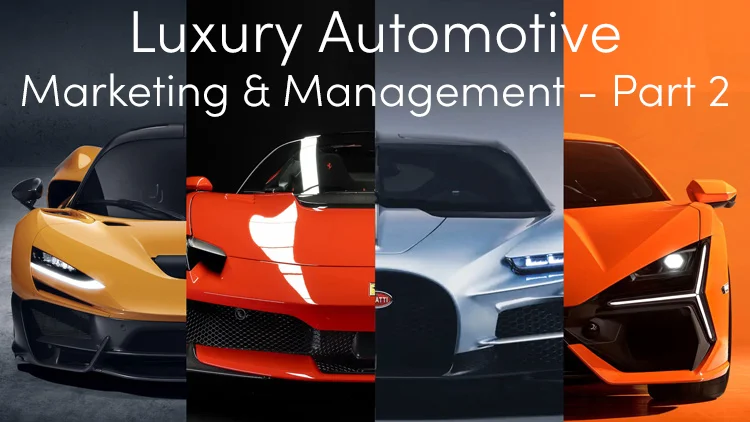
Following up on the first half of the Luxury Automotive Strategy and Marketing online course published a while back, the second half is now available on Udemy at the link HERE.
As for the previous one, this course too is thought for enthusiasts and university students who want to learn more about the workings of the industry. While it is not necessary to have completed the first half to be able to understand and learn this second one, the two are closely linked and form a complete picture.

So, after learning about the key players in the industry and how their branding and strategies compare to each other, this new section looks at market dynamics highlighting the main trends, some academic analysis of them, and an overall view of the global luxury market numbers. Last but not least, a couple of interesting case studies conclude the course comparing diversification strategies and innovation in luxury automotive.

I hope you'll enjoy it. Don't forget to leave feedback and get in touch to know more.

Cover homepage alt copy 3

Can Aston Martin become profitable in 2025?

  • Brand: Aston Martin
  • Topic: Finance, Strategy & Marketing

Aston Martin is another luxury automaker that has gone through significant changes in a short time. After the IPO, and the difficult pandemic period sales and financial performance suffered a slowdown that resulted in layoffs and the start of its restructuring.

Ownership Structure and Partnerships

The initial step of this process has been the acquisition of a 16.7% stake in the company by the consortium Yew Tree Overseas Limited led by Lawrence Stroll. In subsequent investments, the consortium has brought the share of ownership up to over 26%. A little later, but across more or less the same period another important player entered the picture. Chinese Automaker Group Geely started with a 7.6% stake acquisition in late 2022. The company is naturally well known in Europe by now thanks to its extensive interests with the ownership of legacy brands such as Volvo and Lotus and the creation of new ones like Polestar, already existing but revamped as an EV manufacturer and completely separated by the former parent company Volvo, Lynk & Co, experimenting with new vehicle ownership alternative models, and Zeekr, another EV-only startup that began operations in 2021 and is set to start its first deliveries in Europe in the second half of 2025.

After the initial investment, Geely extended its ownership of the brand to 17% in 2023 becoming the third largest shareholder.

Another important milestone in 2023 for the British automaker is the partnership formed with American EV-maker Lucid. The contract for over $450 million included the supply of electric powertrain components, such as its proprietary high-performance twin motor, and batteries for upcoming electrified vehicles. Following this agreement, however, once again things have not been easy for Aston Martin which, while issuing two separate profit warnings in 2024 due to delays and sales slowdown in China, has also delayed plans for the introduction of its first EV, initially to 2027 and later to 2030.

A sign of relative instability, and probably one that is not encouraging for potential investors, has been the continued change of leadership in a short time. After almost 6 years at the helm of the company, Andy Palmer, right after the arrival of Mr Stroll, was replaced by former AMG CEO Tobias Moers. The new leadership came less than two years later with former Ferrari CEO Amedeo Felisa, who himself remained for just two more years before being substituted by former Bentley CEO Adrian Hallmark.

While some time to properly recover from the pandemic impact was expected, with renewing infrastructure and product portfolio, 2024 was initially quoted as the year the company would have finally become profitable after several years. This has not happened, due to several factors. But what went wrong? And can Aston Martin turn this trend around?

A new direction for the brand

As it has been discussed a few times already in this blog, under the new leadership Aston Martin has refocused its image, communication, and brand strategy on pure performance rather than a more classic ‘British elegance’ and grand touring vehicles.

This vision is ultimately realised in the new vehicle lineup that has been completely renovated over the past five years.

Aston Martin product

With the 2023 launch of the new DB12 dubbed as “the world’s first super tourer” instead of “just” being a grand tourer, the 12% increase in horsepower and the revised vehicle dynamics Aston Martin brought this vision to life. All the following releases, which over a 2-year period replaced the old lineup, followed suit. The new Vantage’s power has been increased by over 30% over its predecessor, and finally, the new Vanquish which brought back the old formula with the front-engine V12 rather than the mid-engine concept teased in 2019, also delivers important figures with maximum power at 823 hp.

Last but not least, 2025 should finally see the first deliveries of the second mid-engine ever made by the automaker. Born from the collaboration of a few years ago with Red Bull racing, styled by Adrian Newey and Valkyrie’s little sister, the Valhalla.

A second important change that has come with the new lineup is the interior tech update. A common complaint made by modern Aston Martin clients was the outdated tech brought in from 2018 Mercedes models with a previous agreement. Now, all the new vehicles (including the DBX707 which gets the interior update from 2025 on) feature new interiors with greatly improved quality and tech that is up to modern standards but interestingly do not forget the importance of luxury tactile experience. For this reason, Aston Martin did not implement entirely digital control like many competitors have been doing but instead decided to “future-proof” its cars with high-quality physical dials and buttons.

aston interior*Aston Martin DB12 interior

The new image for the brand aims to reflect the renewed endeavours in motorsport, with an F1 Team that enters its 5th season under the new name (previously Racing Point), and the Valkyre making its debut this year in the LMH Endurance division. On the motorsport side, the investments go even further, with a completely new HQ for the racing division and a new wind tunnel for aerodynamics testing which has just become operational.

Aston Martin and the Luxury Automotive Industry in 2024-25

While the new approach taken by the management and the steps made so far have been generally praised by enthusiasts communities and media, the results are, unfortunately, far from positive.

Aston Martin Sales (left) and Revenues & Operating Loss (right) (2020-2024)

charts

In 2024, sales have decreased by 9% compared to the previous year and financial losses have remained mostly similar to 2023. Aston Martin reports difficulties with the supply chain in China as a major factor in this slowdown, and the main reason why it had revised its sales target for the year earlier in 2024 lowering it compared to previous estimates. However, it also highlights an 8% increase in volumes in the last quarter of 2024.

So, are there any positives to draw from these uncertain results?

On closer inspection, one positive, reflecting the continuously increased average selling price that reached £245,000 (€291,000) in 2024, is that despite the 3% drop in revenues, while sales volume went to lower levels than 2021 revenues compared to that same year are 45% higher. This at least signals a healthier sales strategy for a luxury brand.

Also, for the first time in quite a few years, the brand seems finally fully positioned on all fronts to deliver good results with marketing, product line, and infrastructure all aligned with the competition and delivering a unique brand character.

Last but not least, it must be remembered that the global market uncertainty has surely negatively affected Aston Martin’s results as several other brands.

In 2024, for the first time in several years, the global luxury market had a contraction, albeit a small one (1-3%). Automotive remains by far the largest industry in the segment with an overall value of €579 billion despite a 5% volume decline. The impact of negative sales is partially offset by the ongoing trend of increased focus on personalisation and exclusivity which Aston Martin has partially captured with improvements in its customer service and range of options of its Q Division (but that is still led by Ferrari with a total 2024 sales of 13,752 units, just +0.7% over 2023 still resulting in a +11.8% in revenues over the same period).

Where to go from here?

The current markets are harder than ever to ‘read’ or try to assess, with multiple geopolitical factors affecting international relations and various dynamics developing in unpredictable ways. So, assuming potential stability of the current situation, Aston Martin seems in the best position in many years (maybe ever) to deliver some good results in 2025. The competition, however, embodied especially by Ferrari, and partially by Lamborghini, is stronger than ever as well. While other British brands like Bentley and McLaren are also not going through an easy time.

aston martin atelier

Key to the long-term success of this project will be to limit depreciation that has already hit hard older DBX models (with older models losing around 50% of the value already over 5 years probably also due to the following release of the more powerful version), and is affecting the resale value of more recent DBX707 and even DB12 models. Naturally, this is not an issue hitting Aston Martin alone. But managing to do that would make new models more desirable. Similarly, the success of the Valhalla which has so far received a very positive reception will also ensure a good overall boost to financial results, as other special runs have done over the past two years, partially offsetting the other difficulties the automaker has gone through.

Last but not least, a continued improvement of customer service, personalization offering, and dealership network should remain a priority as it is one of the main factors affecting luxury buyers’ purchase decisions. As the restructuring has taken place and reshaped the company, 2025 could be the year financial results catch up.
Luxury Automotive Resale Value and Depreciation: How and Why

  • Topic: Finance, Strategy & Marketing

Resale value is an extremely important factor in the luxury automotive sector as it affects different stakeholders and impacts the company long-term. Scarcity and exclusivity are arguably the most important elements of any strategy in this niche and are applied to different extents by every company. This allows maintaining a healthy balance between supply and demand, at least for this industry. And I specify this because as Enzo Ferrari himself said, perfectly exemplifying this concept:

“Ferrari farà sempre un'auto in meno di quante ce ne chieda il mercato”

“Ferrari will always deliver one car less than the market demand”

The production here is not about satisfying the demand. But creating more than what the market can supply. While overproduction is detrimental in any sector, that is even more relevant in luxury automotive. Oversupply can impact resale value negatively, scaring away potential clients and collectors who also buy these cars as investments, and ultimately diluting the brand value.

It is somewhat counterintuitive how right now the majority of luxury automakers are seemingly overlooking the ‘brand dilution’ factor with SUVs’ production numbers. One example is Lamborghini that has been steadily drastically increasing its production and sales in the last three years just thanks to the SUV Urus, while the other models have been decreasing the majority of times (with 2020 of course impacted by the pandemic). However, this trend should at least in the short-term help preserving the value of sold Huracán and Aventador. 

LAMBORGHINI PRODUCTION NUMBERS PER MODEL (2017-2020)

table

A similar trend is observable in Rolls-Royce’s delivery numbers with Cullinan and other models, while Bentley despite the Bentayga outselling the rest of its range, registered extreme variations with the other models too, Flying Spur and Continental GT.

However, the production number in relation to demand is not the only factor affecting car depreciation. Others being mileage, production year, and, even if they are more difficult to define under precise variables, perceived brand value, and market segment.

Let’s have a look at some segments and how the models’ market value behaves.

ENTRY LEVEL

Every luxury automaker has an ‘entry level’ car that gives clients access to the brand, as it is significantly cheaper than flagship models. These cars are, of course, still much more expensive than mass-produced ones, but they usually still end up selling well over 10,000 units over their entire lifecycle. It must be noted however that very often, new clients actually access a brand through the pre-owned market rather than with a new car. For this reason, many companies run official pre-owned programs.

The models reviewed here are Aston Martin Vantage Coupé, Ferrari Portofino, McLaren 540C, and Lamborghini Huracán Coupé (LP 610-4 and LP 580-2) for sale in the UK market registered between 2017 and 2020.

CARS DEPRECIATION
BY MILEAGE

entry level resale value

DEPRECIATION BY REGISTRATION YEAR (2017-2020)

entry level year

Some interesting observations come from these first two graphs. The two models that seem to depreciate the most after one year are Vantage and Portofino, while the other two do not vary much. All of them, however, depreciate significantly due to mileage, where a range between 5 and 10,000 miles can cause up to £10,000 decrease in value.

LUXURY SEGMENT

The second interesting segment is the luxury one, usually featuring Grand Tourers more than pure sports cars. For this segment, the models reviewed are Aston Martin DB11, Bentley Continental GT Coupé, Ferrari GTC4 Lusso (V12), Rolls-Royce Wraith. The cars are comparable as even though both Aston Martin and Ferrari have a strong ‘Sport’ component, in each automaker’s product line these are the most luxurious options. As for Bentley and Rolls-Royce which are more luxury-oriented, Continental GT and Wraith represent the sportier 2-door option, instead of the full-fledged luxury flagship. The years covered are the same as before.

CARS DEPRECIATION
BY MILEAGE

lux mileage

DEPRECIATION BY REGISTRATION
YEAR (2017-2020)lux year

In this segment, cars suffer a higher depreciation rate compared to the other two. The causes can be different. First of all, being cars engineered for everyday use, they usually have higher mileage than sports cars. Another reason could be a lower demand for pre-owned luxury cars that are often driven by a chauffeur and are highly personalised such as a Rolls-Royce, which is not developed to offer the thrill of fast driving. The two models that experience the most absolute depreciation from mileage are Wraith and GTC4 Lusso. On the other hand, the Ferrari is the one that seems to maintain its value through different years.

FLAGSHIP SUPERCARS

The four models included in the graphs below from the 2017-2020 period are Aston Martin DBS Superleggera, Ferrari 488 GTB, McLaren 720s, and Lamborghini Aventador S.

CARS DEPRECIATION
BY MILEAGE

flag mileage

DEPRECIATION BY REGISTRATION YEAR (2017-2020)

flag year

From these two graphs, it can be observed how DBS Superleggera and 720S suffer the most depreciation due to mileage increase. As for the registration year, the differences are more visible for the 720s again, and the Aventador S. Both Aston Martin and Ferrari here do not lose too much value from one year to the other. 

SOLUTIONS ADOPTED BY COMPANIES TO AVOID OR LIMIT DEPRECIATION

Of all the models observed, Ferraris are the ones that maintain most of their value. Lamborghini Aventador too seems to not depreciate drastically. As for the others, they all show a significant depreciation over 3 to 4 years that goes from around 30% up to 50% in the worst cases.

This is most likely due to the production model. As mentioned in previous articles, while Ferrari adopts the production-to-order approach, others do not. This might result in oversupply and value loss due to low demand. The two companies that are affected by the highest depreciation of the ones reviewed are Aston Martin and McLaren.

Aston Martin comes out of two very difficult years, and during 2020 put a lot of effort into destocking to translate to a Ferrari-like business model as highlighted previously. As for McLaren, it had with having similar issues, as well as having been hit severely by the pandemic. Also, the strategy of releasing an extremely high number of special limited edition series, and derivatives of the Sports Series 570S in just 10 years, probably took some exclusivity away from each model and had a detrimental effect overall. This is likely a major factor behind the significant loss of value of an exclusive model such as the Senna on the used market.

mclaren senna*McLaren Senna, Source:McLaren Media

A measure that is quite common to increase car desirability, is the one applied by the likes of Ferrari and Pagani of allocating slots for the limited series only to top clients who already collect the brand’s cars.Ferrari uses this strategy for some production models too. They will not sell certain cars to clients who are more likely to sell them very quickly or have proven to not being loyal to the brand.

Finally, these two companies, along with others, also have a specialised pre-owned program in which they buy back cars from dealers, and once (if needed) these are serviced and restored to perfection they are put on sale again. This is a great solution not only to sell used cars at a premium compared to other platforms, thanks to the OEM’s certification but also to control the supply. Deliberately limiting the presence of used vehicles on the market is a ‘manipulation’ that can help drive up their value.

Automotive Industry’s Health in 2020 so far

  • Topic: Electric Vehicle Market, Finance

International Organisation of Motor Vehicle Manufacturers President Mr. Fu Bingfeng, elected at the end of 2019 to substitute Mr. Christian Peugeot, has commented on the current condition of the global automotive industry. The press release can be summarised into two main statements:

"While the situation is improving or even seems well controlled in many countries, much remains to be done. [...] At this critical moment, we must all work to turn the crisis into a new opportunity. We can seize this opportunity to work together and to foster a better ‘new normal’ going forward."

A couple of months later, some figures put the claims in a clearer perspective. 

SALES/REGISTRATIONS OF NEW VEHICLES IN COUNTRIES REPRESENTED IN OICA BY MONTH (2019-2020)

garph lines*Source: International Organisation of Motor Vehicle Manufacturers

Some trends in sales are observable in the first 5 months of the year, even with the strong influence of COVID-19. The increase in sales in March 2020 is likely due to China gradual reopening as the Western World went into lockdown.

Also, it is evident the general faster recovery from April through June. With the nadir reached in March when the industry registered a -39% compared with 2019, following with the -38% of April up to just -3% of July. The data could indicate various encouraging factors that created this figure, especially when considering that in most countries the production capacity has not yet reached the Pre-Pandemic levels. For instance, people’s finances could have been affected less seriously than expected, so the virus outbreak just delayed their purchase decision, or due to the lockdown, some might have saved more money which allowed the investment in a new vehicle. However, by the end of 2020, the Global demand is expected to decrease by 21% compared to the previous year.

On the commercial side, the reopening has likely meant the renovation of commercial or public fleets. August though, has seen again a slight drop to -5%, which could be caused by what globally looks like the second wave of virus contagion.

Michael Manley, FCA CEO and European Automobile Manufacturers’ Association President (ACEA) in a recent press release highlighted the production loss of 3.6 million vehicles in Europe in the first half of 2020, which translates into a 20% of the total production.

This discrepancy has increased in the third quarter to slightly over 4 million vehicles, accounting for 22.3% of 2019 European production. And projections are not optimistic as the total loss is expected to reach 25% by the end of the year.

The global decrease in sales reflects the European average. Sales between January and August 2020 have slowed by 20.5% compared to 2019.

SALES/REGISTRATION OF NEW VEHICLES FROM JANUARY TO AUGUST 2019-2020 BY COUNTRY, AND YOY PERCENTAGE VARIATION

2019 2020 by country

usa china 2019 2020*China and US data separated from other Countries’ for clarity purposes
**Source: OICA

Almost all the countries members of OICA registered negative results so far in 2020 except for Kazakhstan, Korea, and Turkey.

The last month of Q3 though seems to have brought some relief to some major markets. While not all the national associations have already released official numbers for September, many that have, published positive reports. Germany registered a +8% in new cars registration, Italy +9.5%, Korea improved on its trend with +23.2%, US +6.4% to name a few. Others presented negative data but with a less serious outlook, for instance, France with a -3%, or the UK with a -4.4%, coming mainly from the Business segment which is the smallest, while the private and fleet segments registered only -1.1% and -5.8% respectively.  

STRINGENT ENVIRONMENTAL REGULATION

mike manley*FCA CEO and ACEA President Michael Manley

At the same time, a major factor affecting the industry is also the transition toward green technology. Automotive manufacturers are under pressure by stricter emission regulations.

According to Manley, a large share of the annual industry R&D investment amounting to €60.9 billion has been spent in innovation toward electrification and carbon emissions reduction. The proper recovery of the sector, along with the achievement of the target decarbonisation thus require the cooperation of governments. Also, the fast development of charging infrastructures is required since the adoption rate is still uncertain and the technology premium over the traditional ICE powertrain is still consistent. Even Bill Gates in a recent interview mentioned how the exceptional industry’s effort to move toward a greener future is unmatched when compared to numerous other industries.

OUTLOOK FOR THE END OF 2020

Despite some recovery observed in September, analysts from various national and international entities expect further slowdown in the last quarter of the year.

It appears like the way to reach the level where the industry was when everything stopped at the beginning of 2020 is still long, but the path is the right one. Even now, with fast-rising numbers of people infected by COVID-19, the world has somehow adjusted and put numerous measures in place, so, it seems unlikely to imagine another crisis as serious as the one the industry went through. With this in mind, as the production picks up and gradually reaches the previous levels companies that are not too damaged already should be able to continue their activity.

For some, the future looks uncertain. Especially in the luxury segment, there have been several major restructuring and layoffs. Many companies are striving to improve cost-efficiency in every aspect possible, not just to cope with the virus aftermath but to prepare for the environmental challenge.

Governments, in fact, will also play an important and interesting role in the stimulation of the electric vehicles market. Incentives could be a double-edged sword if not planned and handled properly as it happened in China (for reference check the articles China Automotive Market: Real Openness or Concealed Protectionism? or the research section regarding the Chinese Automotive Market). But as the virus caused a sales €122 billion loss in Europe so far and is still considered the biggest threat to the industry, ACEA calls for National COVID support to be employed to stimulate demand for NEV, which will help EU automotive companies’ recovery and in turn the Continent economic restoration too.

Ferrari shares reflect the company’s positive momentum

  • Brand: Ferrari
  • Topic: Finance

A few weeks back it was reported online how Ferrari had surpassed both General Motors and Ford in market capitalisation. With its shares jumping up by 7% after the positive report of Q1 2020 which I discussed in last week’s article, its market cap reached almost $30 billion. Since then, the situation adjusted slightly with GM going back over $30 billion and Ferrari stabilising at 29.

coverferrarishare

Nonetheless, it is interesting to look at the Italian manufacturer’s shares performance and compare it to the rest of the industry to have a better indication of how well the company has worked so far.

SOME PERFORMANCE COMPARISON

Ferrari stock (RACE) appreciation reflects the company’s noteworthy results and the continued trust of its shareholders. As of May 12th, none of the other big automotive companies and groups has recorded such resilience to the pandemic threat and a consequent good recovery. Since the lockdown order from the Italian government the company’s shares have lost 29% over their 52-week high ($180.95), and already recovered to just -12% of the same value. Right after (or during) a crisis, a share value that close to an all-time high is an important signal of positive momentum for the company. Also, by looking at the average stock price over Q1, calculated from the daily prices over the 3 months, Ferrari is the only company that already climbed back to that value (Tesla’s exception is mentioned below). 

SHARE PRICES OF MAJOR PUBLIC AUTOMOTIVE MANUFACTURERS, 52-WEEK HIGH & LOW, Q1 2020 AVERAGE, AND RESPECTIVE CURRENT DEPRECIATION OVER THE 52-W HIGH AND Q1 2020 AVERAGE

ferrarisharesperformance*Shares prices in USD reported from shares on an US stock exchange, while others are expressed in their own country’s currency

No other company-matched these results, with the sole exception of Toyota, which despite losing slightly less (27%), has not recovered in the same way. In this instance, the Japanese company has been probably helped by its higher reliance on the US market that was less impacted by the virus outbreak than China as highlighted in the 2020 Q1 analysis. It is important to keep in mind that this factor could also be true for the company from Maranello.

Another exception worth mentioning is Tesla. Since the company as of May 12th has already exceeded its Q1 price average. Its results though are difficult to compare to those of the rest of the industry due to the massive volatility showed in the past few months. This is evident from the difference between 52-week high and low, and the relatively high Beta (1.15) which shows high volatility. Anyway, the stock is still farther from its all-time high than Ferrari’s.

TRANSLATION INTO FERRARI’S BUSINESS

This strong results and resilience to the crisis are a reflection of a healthy business. Ferrari outperforms its competitors in terms of operating and profit margins, with 24%  and 19% respectively in 2019. Which has only slightly decreased to 23.6% and 18% in Q1 of 2020. For 2019, the average for high-volume automakers were both around 5%. The data is predictable due to the difference in business model, even if within the same industry. When comparing these results with those of more direct competitors, low-volume manufacturers with similar business models, Ferrari still comes out as stronger.

ferrarinyse

Similarly, the Italian automaker has also a low and stable debt to EBITDA ratio, decreasing from 2017 to 2019 from 1.17 to 0.94. In a capital-intensive industry such as Automotive, is common to see higher ratios.

CONCLUSIONS

These financial results and trust by shareholders reflect the importance of great management and the effective reaction to the pandemic outbreak.

There are currently several positive signals. RACE shares have gradually and constantly appreciated by 92.4% in the last three years. Ferrari showed great resilience in the face of the pandemic. As highlighted in previous articles, the company laid out a detailed plan that made sure to pass through social media passing a clear message of confidence and leading role in this difficult situation. This along with the strong performance of 2019 and Q1 of 2020 is reflected in numerous key factors or KPIs (some highlighted here, more can be analysed too) especially when compared to the rest of the industry and its direct competitors.

Despite the positive outlook, in Q2 and coming months, major risks could arise from weaknesses in the North American market as well as unexpected worsening of the virus contagion numbers.

How Covid-19 will affect the luxury automotive industry

  • Topic: Finance, Supercars Future

The automotive industry has been one of the most affected by the Covid-19 outbreak so far, starting from China back in January. Sales have already suffered a sharp decrease in the mass market, and everyone is trying to assess what the situation is going to look like in a few months. What will be the impact on the luxury performance automotive market? Will there be a substantial difference between the two? And if so to what extent?

covid19 luxury automotive cover*Photo by©McLaren Automotive

LET’S BACK UP A LITTLE

The start of the crisis in China has been already a hard blow for the industry. Not only as the country is, and has been for quite a while now, the largest market in the world, but because numerous OEMs’ supply chain relies, at least partially, on Chinese manufacturers. Even more, a sizable share of these is located in Hubei province, which was the most affected by the Coronavirus outbreak.

In 2020 the global automotive industry also comes out of the second year in a row of a global slowdown. Started in 2018 mostly due to Chinese domestic market stagnation, the trend worsened in 2019. The overall global sales of passenger and commercial vehiclesdecreased by almost 4% last year, once again, due in large part by decline in China.

2020, due to the impact of Covid-19 saw an even sharper decline in the first 3 months. According to CAAM (Chinese Association of Automobile Manufacturers), in January and February only, a total of 1.831 million passenger cars were sold, a year-on-year decrease of 43.6% of which 1.6 million were sold in January.

GLOBAL AUTOMOTIVE INDUSTRY SALES OF PASSENGER AND COMMERCIAL VEHICLES

global automotive sector

The silver lining in this difficult condition, for manufacturers who are heavily reliant on the Asian market such as VW, is that the economy is gradually showing recovery signs.

WHAT ABOUT THE LUXURY PERFORMANCE AUTOMOTIVE SEGMENT?

Two differences can be drawn already between the mass market and the luxury segment of low-volume manufacturers. The first is that the overall low-volume market segment, differently from the rest of the industry, has experienced a substantial growth of 33% in the last 5 years. Highly limited production manufacturers such as Pagani, Bugatti, and Koenigsegg have not been included in the graph as their market is partially different. The low numbers, annually below 100 cars sold, would not affect significantly the total of the industry here.

LOW-VOLUME CAR MANUFACTURERS SALES FIGURES BY BRAND

graph*The data for McLaren is an estimate based on the company’s forecast after the investors' relation of Q3 as official results for the entire year are not published yet

The second is that, differently from many high-volume companies, in the luxury segment the majority of players rely on the US as their biggest market, despite China representing an important share. A good market balance should anyway help these companies get through this period, nonetheless.

RISKS WITHIN THE LUXURY PERFORMANCE CAR MARKET

Two are the risk factors for the luxury performance automotive segment that do not affect the rest of the market in quite the same way. One is the more concentrated supply chain, while the second is resale value.

While the actual number of suppliers might be similar for companies in the two different market segments, the same could not be said for complexity and replaceability.

covid 19 supply chain

A global high-volume car manufacturer such as Toyota, VW or BMW has to rely on an extensive and extremely complex supply chain, hundreds, sometimes thousands of linkages. Low-volume manufacturers, while still managing a complex suppliers’ web, tend to be more localised with a higher percentage of components done in-house. This ensures maintaining both their brand’s national identity and a higher control so that each component and service achieves the top quality required. Companies such as Koenigsegg even pride themselves on producing the vast majority of their parts in-house.

In case of a prolonged stop of some of these highly selected suppliers, low-volume OEMs will have a much harder time replacing the production, while mass-produced car companies instead will have more flexibility and alternatives.

Secondly, if the market stagnates, with the worsening economy and a drop in demand caused by people being forced to stay home, the resale value of luxury cars could be affected. This is an important risk factor as many cars in this segment, especially the limited series, are bought as an investment. A low or absent depreciation rate is an important asset for low-volume manufacturers, as it is attached to the value of the brand itself. Luckily, so far, the resale market has not suffered any massive hits.

MEASURES TO CONTAIN THE RISKS

To cope with the lockdown, different companies in the segment are putting infrastructures in place to bypass the problem. Innovative initiatives and digitalisationwill play a major role in this. Apps and online platforms for vehicle evaluation and specification will be even more important now. Some companies could decide to personally deliver the cars to customers for test drives and handovers to maintain social distancing, instead of managing all the activities from the dealership.

Strategic investments should be put in place to address the VUCA (Volatility, Uncertainty, Complexity, and Ambiguity) and the leadership challenges that come with it.


covid 19 automotive vuca

PWC in a recently released survey shows how financial concerns and global recession risks are the major worries for people in the sector. In its list of measures for automakers, the strategic suggestion is to tackle the crisis by assessing the variety of potential outcomes. Then, creating resilience with flexibility and agility by while aiming at core objectives instead of trying to exactly predict uncertain events.  

CONCLUSIONS

Low-volume luxury automakers can incur major risks from supply chain disruption but having a more concentrated structure arguably allows for better control over operations and logistics.

As for the client base, while many people are losing their jobs and the global economic conditions are worrying, the average buyer within this segment is likely to be more resilient and less affected by the Covid-19 aftermath. In general, considering also the previous market condition and the companies’ creative reaction to this situation, the luxury performance automotive market will be less impacted by the virus outbreak. Smaller companies with more limited financial resources, however, might go through major difficulties as the quarantine forces the delay of operations and new launches. According to experts also, in case of a global recession, the world would lack an emerging market such as China, which during the 2008’s crisis contained the consequences for many companies thanks to its extremely fast growth and boosted the luxury goods sales.

This observation though discounts the geography and governments’ decisions that might impose prolonged lockdown on certain countries.

Ultimately, as the daily routine gradually restarts, people might decide to rely more on private transportation to maintain social distancing. This factor could give some relief to the entire automotive sector partially offsetting the drop in sales occurring during the quarantine period.

CATL and Tesla: how China is winning the EV batteries competition

  • Topic: Electric Vehicle Market, Finance

The current EV battery industry, with a few big companies, is very much an oligopoly. And the major ones all come from Asia, Korea, Japan and of course, China.

Chinese CATL (Contemporary Amperex Technology Limited, or in Chinese 宁德时代 – Níngdé shídài) has got the spot as the largest EV battery manufacturer in the worldfor a while now. Already in 2018, CATL signed deals with VW who has a major presence in China which is also its major market, but also BMW and Nissan. It raised RMB 5.46 billion (£623 million) becoming the leader over Panasonic, which is famously in partnership with Tesla for the EV batteries production. At the end of the year, it posted a 48 per cent year-on-year revenue growth, reaching RMB 29.61 billion (£3,2 billion).

HOW IT STARTED

catllogo

This huge success has been initially driven by subsidies of the Chinese government directed at creating the optimal conditions. At the beginning of 2017, Beijing released a list of EV battery manufacturers eligible for incentives and all the foreign manufacturers were excluded from it. This decision created a strong conflict with the two major companies already present in the Chinese market, LG Chem and Samsung SDI. The restriction has later been eased but under its duration has probably given the edge to CATL over its competitors in the domestic market.

CATL, which according to Reuters is still the largest EV battery manufacturer, has in the meantime added to its customers Daimler, Volvo, Toyota, and Honda. The Chinese company after its big expansion in China is also building its first plant in Germany and looking at the US as well. For CATL this could be an opportunity to leverage its position in the largest automotive market in the world to extend its partnerships with European manufacturers even outside the domestic market. Panasonic still follows, then come Chinese BYD and the South Koreans LG Chem and Samsung.

Having secured deals with big groups like VW, BMW and Daimler could give CATL access to luxury performance brands under large group umbrellas too (Bentley, Bugatti, Lamborghini, Rolls-Royce).

CATL IN THE SHENZHEN STOCK EXCHANGE

The current expansion in the Chinese domestic market and the numerous partnerships make CATL prospects really strong for the future and its shares appreciation shows the trust of its investors. Since its IPO in mid-2018 on the Shenzhen stock exchange, its shares have more than tripled their value from RMB 53 each to over 169.  There has naturally been a slight decrease in the last two weeks caused by the current coronavirus outbreak emergency.

CATLgraph*CATL share price 1 year graph

Despite this last slump, from which the company will arguably recover once the situation is stabilised, CATL has experienced a continued and stable growth. Its appreciation started accelerating in November 2019 when talks with Tesla began. But over a week at the beginning of February, the stock experienced a big jump upwards as it is clearly visible in the graph. Once again, as it often happens these days in the electric segment of the automotive industry, this sudden appreciation has its roots in a big announcement that involved Tesla.

A NEW DEAL FOR THE BIGGEST AUTOMOTIVE MARKET IN THE WORLD

catlfactory

Rumours about a deal between the battery maker and the American car manufacturer, which have been later confirmed, started to spread at the beginning of last month and the market was quick to react. Tesla will use CATL batteries for its China-produced EVs in the new Gigafactory built near Shanghai. The deal is expected to produce important results as Tesla looks to strengthen its unique presence in China, without forgetting that it is already the first automotive company to access the Chinese domestic market without the obligation of establishing a 50-50 Joint Venture with a Chinese partner.

And China to become a global leader in the sector through another partnership with the firm producing the best-selling electric car in the world, the Tesla Model 3.

More importantly, according to a CATL announcement, the company is going to provide Tesla with Lithium Iron Phosphate batteries (LFP). Despite having an inferior energy density compared to those using lithium cobalt oxide, LFP batteries should have a higher specific capacity, lower cost, and toxicity and be more sustainable. It avoids, in fact, the use of cobalt, a rare mineral whose mining, mainly happening in Africa, has caused numerous discussions around ethical and environmental issues, which I have also analysed in a previous article.

THE STRATEGIC SIGNIFICANCE OF THIS PARTNERSHIP

On Tesla’s side, the move makes sense not only to have access to a potentially crucial technology but also as a point of contact with the Chinese market. If it is true that not being forced to form a JV in China grants Tesla a stricter control over its technology and know-how, having a partner in such an important foreign market has been also key to the success of many other companies before. This will also mean avoiding import tariffs and other costs connected with imports. Arguably, apart for its most obvious reasons, the deal is also beneficial from a strategic point of view for both parties. Tesla has a reliable partner with insidership network advantages, CATL gains a huge exposure and more investments along with an important partner.

evbatteries

To strengthen even more the Chinese company’s position, there seem to be troubles on the horizon for its main competitor and Tesla’s first partner, Panasonic. Tensions between the two began in 2019 when Elon Musk blamed the Japanese batteries manufacturer for constraints in the production of the Model 3. News started to spread regarding Tesla vertically integrating the batteries production to reduce its dependence on Panasonic. As for 2020 though, the JV between the two turned profits for the first time, following the strongest financial year yet for Tesla, which I also discussed here. On the automotive side then, things seem to be improving, but last month it was also announced that Panasonic and Tesla would end their collaboration on solar cells. Once again, due to tensions over production issues and differing objectives. Tesla turned once again to China for the solar cell supplies. If such an important partnership was interrupted this would bring further advantage to CATL, especially as it moves in Europe and potentially in the US.

TO CONCLUDE

Along with the results of this partnership in the Chinese domestic market, a key role to lead the industry will be played by expansion and exclusive deals in Europe and the US, as well as technological advancements toward better environmental and production sustainability.   

As of now CATL seems a strong investment option. With profits doubled year-on-year in H1 to RMB 2.1 billion (£232 million), a portfolio of deals with the most important car manufacturers in the automotive industry, and a partnership with great potential and ongoing expansion plans in the other two major continents.

Tesla is the world’s second most valuable car company. Is it worth investing in?

  • Topic: Electric Vehicle Market, Finance

As I am writing this article, Tesla shares trade on the NASDAQ for around $750 each. Its market capitalisation is currently well over $100 billion and has overtaken Volkswagen as the second most valuable automotive company in the world. It is now second only to Toyota. This astonishing growth is the result of a really positive year for the EV company.

teslamodel3


The price of Tesla shares fluctuated heavily over the past two years on average between the $250 and $350, with sudden movements happening at every minor news or report. The Model 3 ‘gamble’ worked out exactly as Elon Musk has predicted.

The new affordable and futuristic EV has been a big hit, but production issues hindered its success until mid-2018. Later, as the situation improved, and production numbers increased the model got the recognition Tesla hoped for. It was the best-selling premium-vehicle in the US in 2018.

Q1 of 2019 still saw slow sales and delayed deliveries to the following quarter. Production and deliveries have gradually improved throughout Q2 and Q3 with Model 3 substantially pulling up the entire company with 60,000 to 79,000 vehicles per quarter. Models S and X together did not reach the 20,000 units. Some issues and uncertain financial results drove Tesla shares valuation as low as $176. Along with this, the official presentation of the new Model Y has been delayed to 2020. This new crossover according to Musk should outsell all the other models combined, which is arguably likely considered the current market trend with SUVs and crossovers sales.

WHAT HAS HAPPENED EXACTLY THEN TO MAKE TESLA SHARES SKYROCKET THIS WAY?

First of all two of the biggest commitment of early 2019 were maintained. The first was to sell between 360,000 and 400,000 vehicles in one year, 500,000 even, if deliveries in the new Gigafactory in China had started early enough. Tesla closed the year reaching sales of 367,500 units. Secondly, the Shanghai Gigafactory did not start its deliveries in 2019 but was indeed established very quickly, setting Tesla in a really favourable position for the future. Because now, not only it is within the largest automotive market in the world, but it is also an industry regulated by a Government that is investing massively in developing an EV infrastructure and market as quickly as possible. Moreover, avoiding import tariffs will likely play an important role in Tesla’s endeavour in China. Its shareholders and new investors showed their trust and satisfaction at this news right away. Its shares in just two days, from October 23rd to the 25th jumped from $250 to almost $330, as can be seen in the graph below.

Moreover, Tesla is the first foreign automotive company in history, to be allowed to set up a wholly-owned subsidiary in China without being imposed a 50-50 Joint Venture with a Chinese partner, as it happened to every other competitor before. This naturally grants the American company to preserve its technology and know-how while avoiding potential risks with tariffs and delivery costs.

In the meantime, Volkswagen Group has been gradually recovering the shareholders’ trust after the emission scandal of 2015 through a major rebranding and massive sales. Its figures this year reached almost 11 million units and has been steadily the highest or second highest-selling brand in the world for the past few years.

How a company that sold just over 350,000 cars in one year is valued more?

The new Gigafactory in Shanghai, as mentioned before, has definitely played an important role in this growth. Secondly, the marketing machine has worked well and consistently all the time. Whether it is the company with new achievements, innovative features, and unforeseen unveilings (i.e. roadster and cybertruck) or its peculiar owner grabbing the media attention with new entrepreneurial initiative, bold claims and even collaborations with social media stars, the spotlight on Tesla never turns off. It works like a proper clickbait machine. This factor made the share ‘hot’ (especially for speculators) but should alert investors.

There are different tools that can be used to select an investment-worthy stock. Rules defined and observed by some of the most successful investors in history, starting from the approach: ‘The only thing you can be confident of while forecasting future stock returns is that you will probably turn out to be wrong’.

A starting point for growth-stocks whose excellent prospects are already well recognised is to look at the price-earnings ratio. Over an almost 10-year period Tesla, being a young company in a capital-intensive sector, rarely registered a profit, meaning its cyclically adjusted P/E ratio (CAPE) would be strongly negative and lose its significance. Despite the profit and positive EPS registered in Q3 and Q4 of 2019, the P/E ratio overall would still be negative.

table*Tesla Net profit/Loss ($ million), EPS, and Outstanding shares volume (2010-2019)

A similar conclusion can be drawn for Tesla’s book value per share. The trend is observable for especially attractive companies, like tech or highly innovative ones. As they improve their prospects, the respective shares are likely to increase in price reflecting less and less their intrinsic value. For this reason, some companies, as great as they might be, risk becoming highly speculative exposing an investor to excessive fluctuation in their stock price which becomes largely unrelated to their actual book value. Finally, Tesla has never paid dividends to its shareholders.

This is just to mention a couple of observable metrics that (along with others) help reflecting a company’s position regardless of the future returns expectations of investors, especially after the entry in the Chinese market. Nevertheless, the trust of its shareholders shows confidence in this renewed industry growth potential but discounts some relevant external factors. Above all, the potential political risk for the Chinese domestic market.

The same metrics for the just overtaken VW, with shares trading at €165.6 and market cap at almost €82 billion, are instead much different. For instance, its CAPE (calculated in euro) is 7.02, with the emission scandal in 2015 that seriously affected the company’s financial outlook. For 2018 alone (2019 annual report is not available yet) is 6.97. VW has also a steady dividend payment record.

Finally, it is mainly due to the 2015 scandal then, that the company, despite the rebranding efforts and the aggressive electrification strategy has not regained yet its previous market value. So, on one hand, there is an attractive company that despite the production and financial difficulties is incredibly attractive and shows good prospects, on the other one that has probably still some time to go to completely recover from its wrongdoing despite the market success.

As of right now then, using value investing criteria, Tesla shares seem risky and significantly overpriced, even for the growth opportunity of the market. Along with the high volatility due in part to its great popularity, there are still numerous factors that could significantly hinder its growth both political and economic. Moreover, the competition in the EV segment is getting fiercer by the day, with new and improving alternatives, many of which just coming from China. The company’s track record is also unstable, even though relatively short and in a very capital-intensive industry. For this reason, while the company looks on a good path to become strong and consistently profitable, it is probably worth waiting for it to stabilise and see if some of these prospects will be realised even when the spotlight turns off. At that moment, Tesla might become a really solid investment in the industry.

Comment below if you don’t agree with this point of view, or if you agree but wish to add your perspective!

AML jumps 20% up amidst Stroll stake acquisition rumour

  • Brand: Aston Martin
  • Topic: Finance

On Thursday, December 5th, a rumour started to spread through the internet according to which Canadian billionaire Mr. Lawrence Stroll would have been about to complete the acquisition of a major stake in Aston Martin Lagonda.

After a difficult year, following the IPO in October 2018 that has seen Aston Martin shares devaluing from 1900p to less than 500p, the speculation was enough to cause a 20% appreciation.

But who is Mr. Stroll, what would be his alleged interest in the British company, and why this caused such a sudden change?

AstonMartinVanquishVision

Lawrence Stroll, born in 1959 in Montreal, is a businessman who made his fortune by investing in the fashion industry. Partnering with Hong Kong businessman and investor Silas Chou (曹其峰) he imported numerous high-end brands into Canada. Later, in 2011, they conducted the IPO for Michael Kors Holdings Ltd, renamed Capri Holdings Ltd at the beginning of 2019 after the takeover of Gianni Versace S.r.l.

He is also a well-known luxury performance car collector and soon, motorsport became another major component of his ventures. In 2018, he lead a group investment to buy Formula 1 team Racing Point.

If this major stake acquisition happens, the Formula 1 team would allegedly go under the name Aston Martin and change its racing livery. Moreover, the engine supply deal from Mercedes could become even stronger, considered the deal that the company from Gaydon already has with the German manufacturer for engine and internal electronic components.

Naturally, there are many unclear points in the situation, first of which is the standing sponsorship of Aston Martin for another F1 team, Red Bull Racing.

Going back to the company’s shares, the price saw a steady decline for over 6 months and a drastic drop in July 2019, corresponding with the release of the interim financial report for the first six months of the year. Despite the increase in sales granted by growing demand in USA and China, an almost £80 million loss against the previous years’ £20.8 million profits, much higher leverage, and subsequent negative EPS reflected the difficult situation of the company.

AstonMartinVantage

Q3 has not been easy as well for Aston Martin. 16% lower sales and planned expansion costs meant a 58% decrease in Operating profit. It has to be said that this result year-over-year is also due to exceptional performance of 2018 with the new Vantage and DBS Superleggera unveilings that lead a 185% growth in the Americas and 134% in the APAC.

The two regions registered a +2% and -34% compared to the previous year. As it can been seen in the graph at the bottom of the page, this last quarter did not impact AML shares as severely as the period before. The situation, which otherwise would have required some serious external intervention, got slightly more stable.

After observing the performance of the company in this last year, it is clearer how the speculation of a substantial investment by Mr. Stroll could positively affect the company’s outlook. First of all a significant infusion of capital, and secondly, why not, a clear business vision from a person who is successfully leading very diverse ventures in his career. Most of all, his involvement in motorsports and the passion for luxury performance automotive have surely had an impact on the suddenly improved trust in the company.

The potential involvement in the Formula 1 Championship whose popularity, through Liberty Media’s strategy, is gaining more momentum, has likely had its effects as well. With huge platforms such as the Netflix series ‘Drive to Survive’ the brand would have more opportunities to get advantageous deals.

An unrelated (to this matter) but crucially relevant factor that will be the long-term decider of Aston Martin’s future is the concurrent opening of the new factory in Saint Athan for the production of DBX. CEO Andy Palmer, according to an interview by Reuters released on Friday would have downplayed the speculation about new investors without completely dismissing them though. It still remains to be seen if these comments will hurt the company’s appearance in the investors' eyes, or its recent development will have a stronger impact in the long run.

Ultimately, the only thing that can truly change the trend for the British company is the success of its current strategy, and Aston Martin seems to be set on a good path, despite the present financial troubles. It will be a matter of a few months. If by early 2020, DBX orders will pour in as it is hoped for, by the time the special models presented at Geneva in 2019 (Valhalla and Vanquish) come around, given a steadier international trade condition, we will most likely see those shares going up again.

Privacy Policy - Cookie Policy